
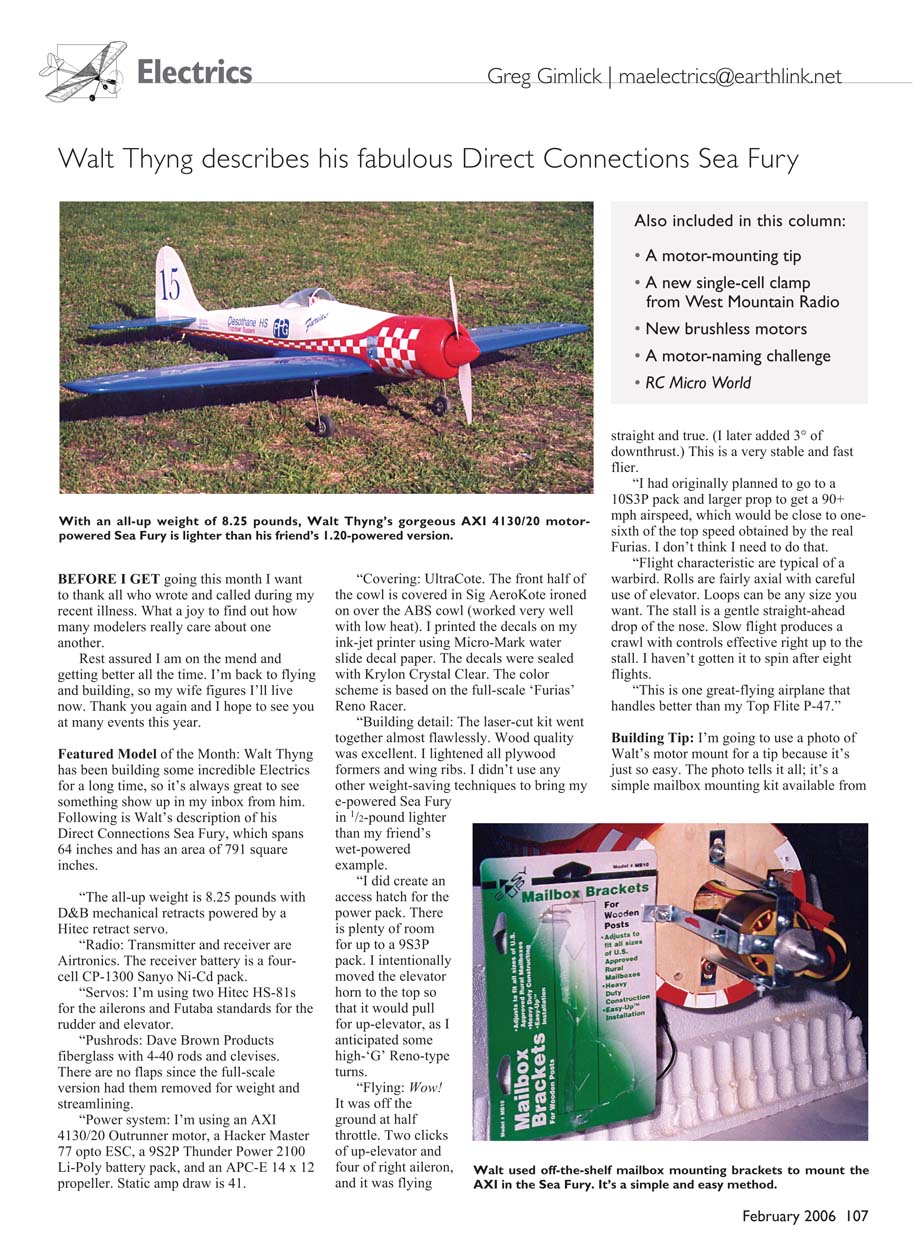
Walt Thyng describes his fabulous Direct Connections Sea Fury
Greg Gimlick | [email protected]
Before I get going this month I want to thank all who wrote and called during my recent illness. What a joy to find out how many modelers really care about one another. Rest assured I am on the mend and getting better all the time. I'm back to flying and building, so my wife figures I'll live now. Thank you again and I hope to see you at many events this year.
Featured Model of the Month: Direct Connections Sea Fury (Walt Thyng)
Walt Thyng has been building some incredible electrics for a long time, so it's always great to see something show up in my inbox from him. Following is Walt's description of his Direct Connections Sea Fury, which spans 64 inches and has an area of 791 square inches.
- All-up weight: 8.25 pounds with D&B mechanical retracts powered by a Hitec retract servo.
- Radio: Transmitter and receiver are Airtronics. The receiver battery is a four-cell CP-1300 Sanyo Ni-Cd pack.
- Servos: Two Hitec HS-81s for the ailerons and Futaba standards for the rudder and elevator.
- Pushrods: Dave Brown Products fiberglass with 4-40 rods and clevises. There are no flaps since the full-scale version had them removed for weight and streamlining.
- Power system: AXI 4130/20 outrunner motor, Hacker Master 77 opto ESC, 9S2P Thunder Power 2100 Li-Poly battery pack, and an APC-E 14x12 propeller. Static amp draw is 41 A.
- Covering: UltraCote. The front half of the cowl is covered in Sig AeroKote ironed on over the ABS cowl (worked very well with low heat). Decals were printed on an ink-jet printer using Micro-Mark water-slide decal paper and sealed with Krylon Crystal Clear. The color scheme is based on the full-scale "Furias" Reno Racer.
Building detail: The laser-cut kit went together almost flawlessly. Wood quality was excellent. I lightened all plywood formers and wing ribs. I didn't use any other weight-saving techniques to bring my e-powered Sea Fury in 1/2-pound lighter than my friend's wet-powered example.
I did create an access hatch for the power pack. There is plenty of room for up to a 9S3P pack. I intentionally moved the elevator horn to the top so that it would pull for up-elevator, as I anticipated some high-G Reno-type turns.
Flying: It was off the ground at half throttle. Two clicks of up-elevator and four of right aileron, and it was flying straight and true. (I later added 3° of downthrust.) This is a very stable and fast flier.
I had originally planned to go to a 10S3P pack and a larger prop to get a 90+ mph airspeed, which would be close to one-sixth of the top speed obtained by the real Furias. I don't think I need to do that.
Flight characteristics are typical of a warbird. Rolls are fairly axial with careful use of elevator. Loops can be any size you want. The stall is a gentle straight-ahead drop of the nose. Slow flight produces a crawl with controls effective right up to the stall. I haven't gotten it to spin after eight flights.
This is one great-flying airplane that handles better than my Top Flite P-47.
Building Tip
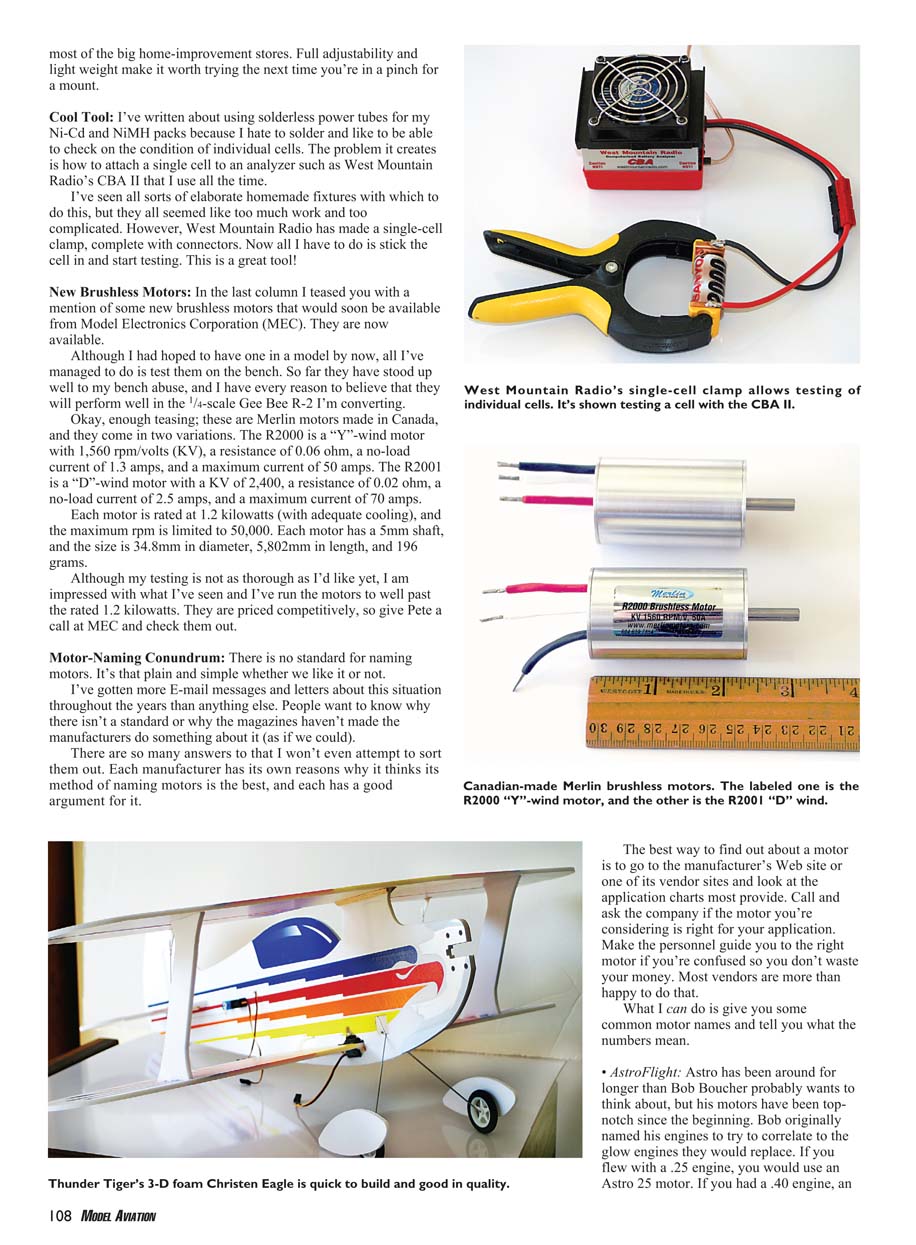
I'm going to use a photo of Walt's motor mount for a tip because it's just so easy. The photo tells it all: it's a simple mailbox mounting kit available from most of the big home-improvement stores. Full adjustability and light weight.
Cool Tool
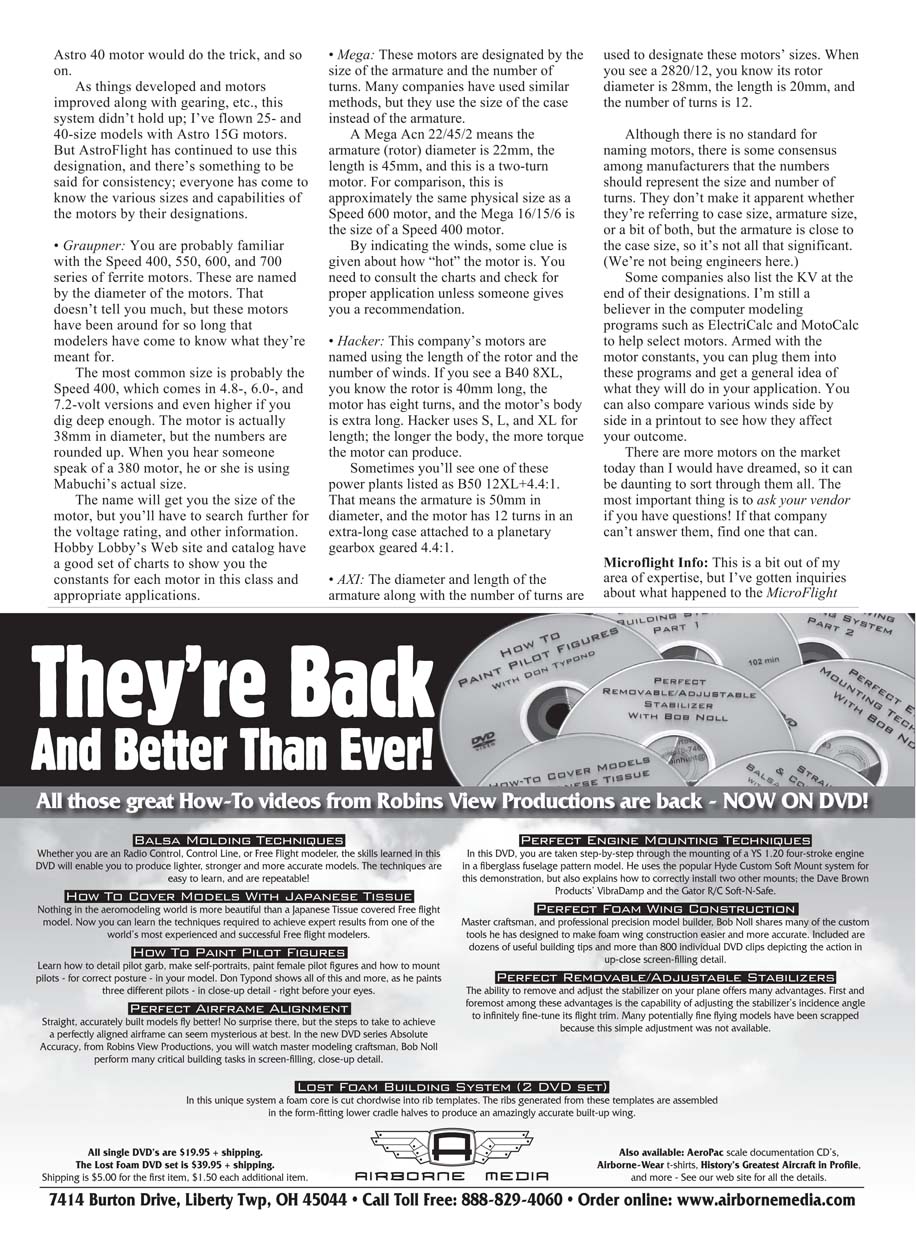
I've written about using solderless power tubes for my Ni-Cd and NiMH packs because I hate to solder and like to be able to check on the condition of individual cells. The problem it creates is how to attach a single cell to an analyzer such as West Mountain Radio's CBA II that I use all the time.
I've seen all sorts of elaborate homemade fixtures to do this, but they all seemed like too much work and too complicated. West Mountain Radio has made a single-cell clamp, complete with connectors. Now all I have to do is stick the cell in and start testing. This is a great tool!
New Brushless Motors
In the last column I teased you with a mention of some new brushless motors that would soon be available from Model Electronics Corporation (MEC). They are now available.
Although I had hoped to have one in a model by now, all I've managed to do is test them on the bench. So far they have stood up well to my bench abuse, and I have every reason to believe they will perform well in the 1/4-scale Gee Bee R-2 I'm converting.
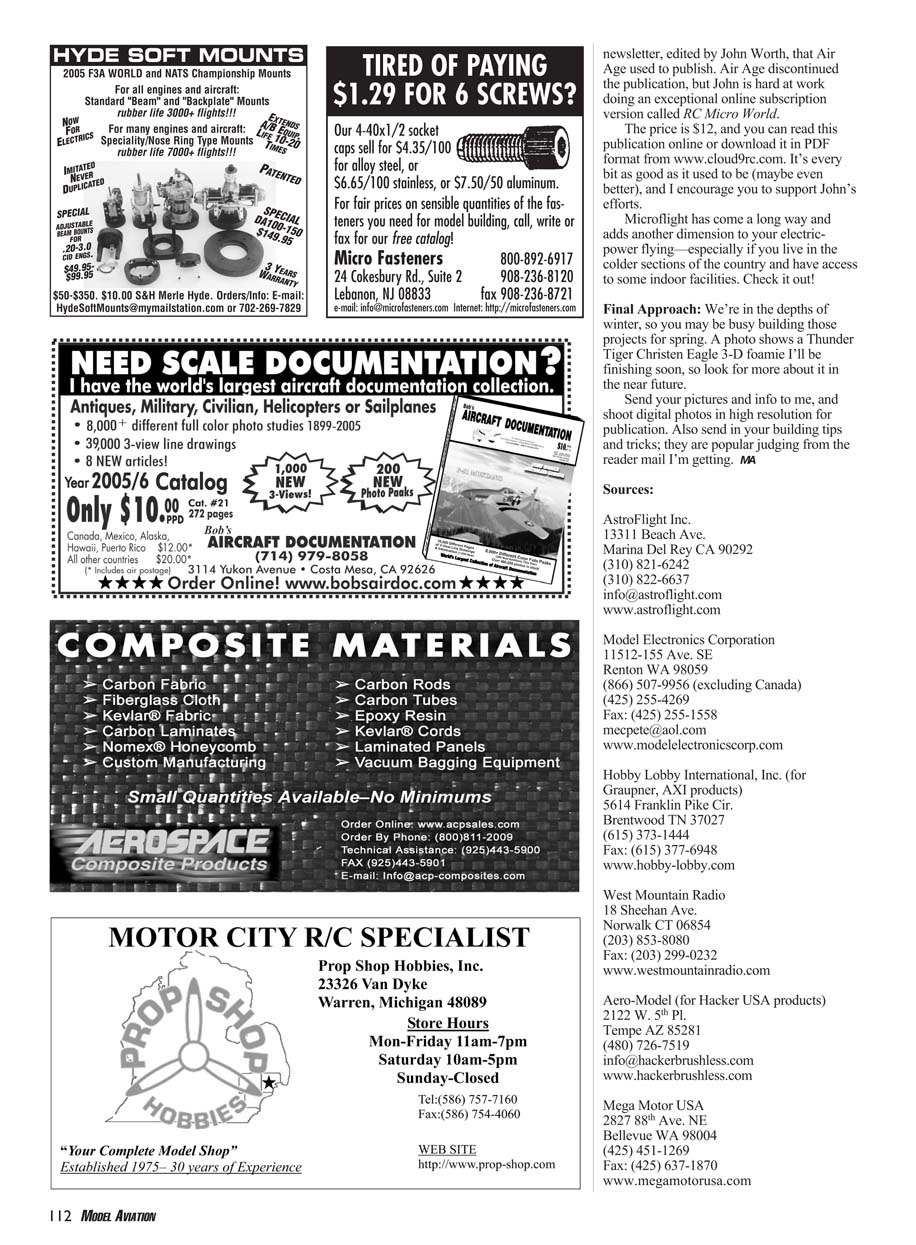
These are Merlin motors made in Canada, and they come in two variations:
- R2000: "Y"-wind motor with 1,560 rpm/volt (KV), resistance 0.06 ohm, no-load current 1.3 A, and maximum current 50 A.
- R2001: "D"-wind motor with KV of 2,400, resistance 0.02 ohm, no-load current 2.5 A, and maximum current 70 A.
Each motor is rated at 1.2 kW (with adequate cooling), and the maximum rpm is limited to 50,000. Each motor has a 5 mm shaft, and the size is 34.8 mm in diameter, 58.02 mm in length, and 196 grams.
Although my testing is not as thorough as I'd like yet, I am impressed with what I've seen and I've run the motors well past the rated 1.2 kW. They are priced competitively, so give Pete a call at MEC and check them out.
Motor-Naming Conundrum
There is no standard for naming motors. It's that plain and simple whether we like it or not.
I've gotten more e-mail messages and letters about this situation throughout the years than anything else. People want to know why there isn't a standard or why the magazines haven't made the manufacturers do something about it (as if we could).
Each manufacturer has its own reasons why it thinks its method of naming motors is the best, and each has a good argument for it. The best way to find out about a motor is to go to the manufacturer's website or one of its vendor sites and look at the application charts most provide. Call and ask the company if the motor you're considering is right for your application. Make the personnel guide you to the right motor if you're confused so you don't waste your money. Most vendors are more than happy to do that.
What I can do is give you some common motor names and tell you what the numbers mean:
- AstroFlight:
- Astro originally named motors to correlate to the glow engines they would replace (e.g., an Astro 25 for a .25 engine, Astro 40 for a .40). As motors improved this system didn't always hold up, but AstroFlight has continued the designation for consistency. Modelers have come to know sizes and capabilities by these designations.
- Graupner:
- Familiar Speed 400, 550, 600, and 700 series ferrite motors are named by diameter. The numbers give you a rough motor size. The most common is the Speed 400, which comes in 4.8-, 6.0-, and 7.2-volt versions (and higher). The motor is actually about 38 mm in diameter; numbers are rounded.
- Mega:
- Designated by armature size and number of turns. For example, a Mega Acn 22/45/2 means armature diameter 22 mm, length 45 mm, and two turns. This helps indicate how "hot" the motor is, but you should consult charts for proper application.
- Hacker:
- Named using rotor length and number of winds. A B40 8XL means the rotor is 40 mm long, eight turns, and the body is extra long. Hacker uses S, L, and XL for body lengths. Example: B50 12XL+4:1 would indicate a 50 mm armature, 12 turns, extra-long case with a planetary gearbox geared 4.4:1.
- AXI:
- Uses rotor diameter, length, and number of turns. For instance, a 2820/12 means rotor diameter 28 mm, length 20 mm, and 12 turns.
Although there is no industry standard, there is some consensus that numbers should represent size and winds. They may refer to case size, armature size, or a bit of both; the armature is close to the case size, so it's usually not critical.
I still recommend using computer modeling programs such as ElectriCalc and MotoCalc to help select motors. Armed with the motor constants, you can plug them into these programs and get a general idea of how they'll perform. You can also compare various winds side by side in a printout to see how they affect the outcome.
There are more motors on the market today than I would have dreamed, so it can be daunting to sort through them all. The most important thing is to ask your vendor if you have questions. If that company can't answer them, find one that can.
Microflight Info
This is a bit out of my area of expertise, but I've gotten inquiries about what happened to the MicroFlight newsletter, edited by John Worth, that Air Age used to publish. Air Age discontinued the publication, but John is hard at work doing an exceptional online subscription version called RC Micro World. The price is $12, and you can read it online or download it in PDF format from www.cloud9rc.com. It's every bit as good as it used to be (maybe even better), and I encourage you to support John's efforts.
Microflight has come a long way and adds another dimension to your electric-power flying — especially if you live in the colder sections of the country and have access to some indoor facilities. Check it out!
Final Approach
We're in the depths of winter, so you may be busy building projects for spring. A photo shows a Thunder Tiger Christen Eagle 3-D foamie I'll be finishing soon, so look for more about it in the near future.
Send your pictures and info to me, and shoot digital photos in high resolution for publication. Also send in your building tips and tricks; they are popular judging from the reader mail I'm getting.
MA
Sources
- AstroFlight Inc.
13311 Beach Ave. Marina del Rey, CA 90292 (310) 821-6242 (310) 822-6637 [email protected] www.astroflight.com
- Model Electronics Corporation
11512-155 Ave. SE Renton, WA 98059 (866) 507-9956 (excluding Canada) (425) 255-4269 Fax: (425) 255-1558 [email protected] www.modelelectronicscorp.com
- Hobby Lobby International, Inc. (for Graupner, AXI products)
5614 Franklin Pike Cir. Brentwood, TN 37027 (615) 373-1444 Fax: (615) 377-6948 www.hobby-lobby.com
- West Mountain Radio
18 Sheehan Ave. Norwalk, CT 06854 (203) 853-8080 Fax: (203) 299-0232 www.westmountainradio.com
- Aero-Model (for Hacker USA products)
2122 W. 5th Pl. Tempe, AZ 85281 (480) 726-7519 [email protected] www.hackerbrushless.com
- Mega Motor USA
2827 88th Ave. NE Bellevue, WA 98004 (425) 451-1269 Fax: (425) 637-1870 www.megamotorusa.com
Transcribed from original scans by AI. Minor OCR errors may remain.

