
Reader comments support column content
Greg Gimlick | [email protected]
I've gotten a lot of mail in the last couple months, and it really helps direct where I go with the column. It was interesting to see the response to do-it-yourself motor kits and data acquisition. Some of you took me to task for not being more technical and some couldn't understand why I did those articles at all.
You also overloaded the vendors with orders, so although there were some problems, they seemed to get worked out. I've also heard that more readers want to see conversions and some basic information about how to wire things up from a beginner's perspective. I'll try to get to all of that, so please keep your suggestions coming. I've got big shoulders, so let me know what you don't like as well as what you do.
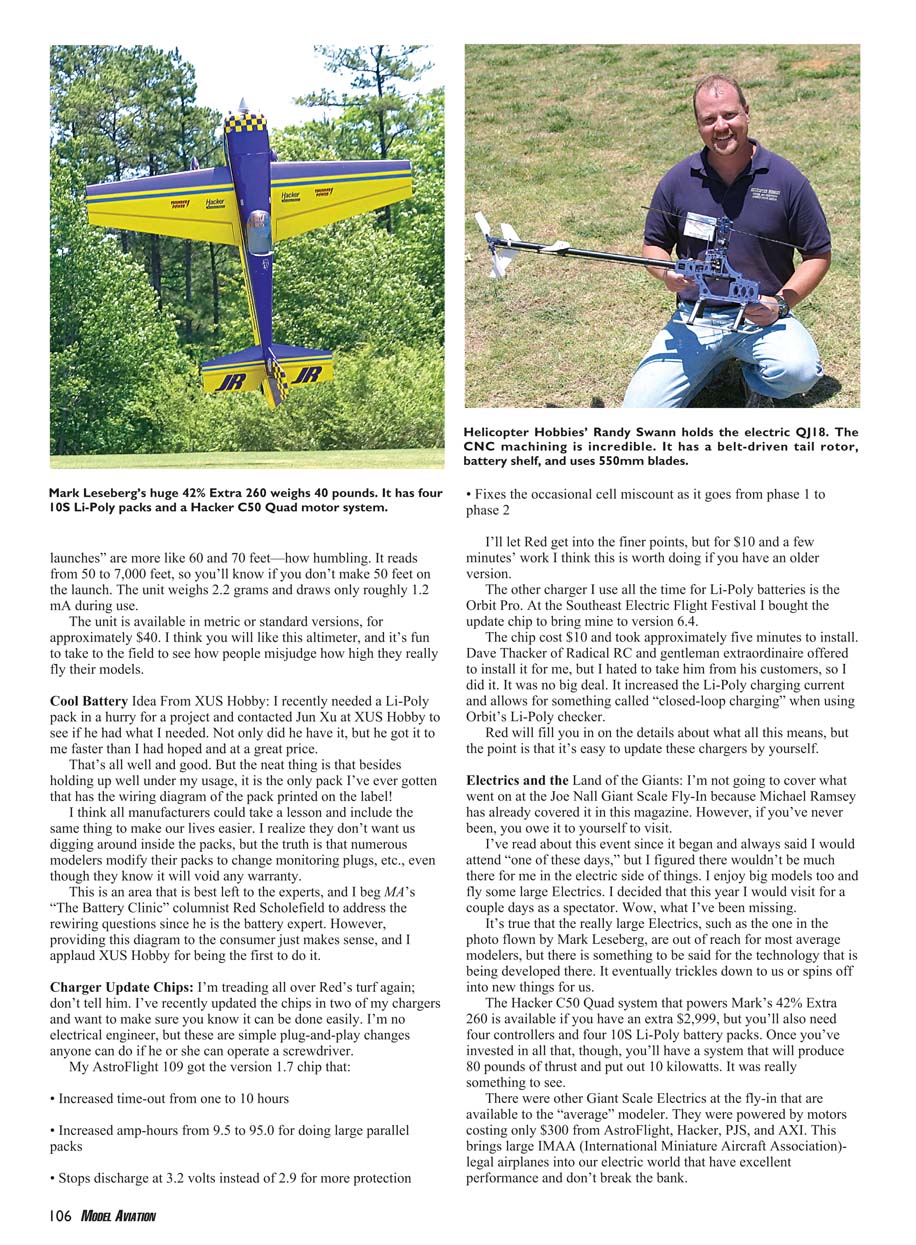
How High Do You Fly? Winged Shadow Systems has brought a nifty little electronic device to our market that finally answers the question "How high?". It is called the How High Model Aircraft Altimeter. This little gem is smaller than a postage stamp and plugs into any outlet on your receiver, or you can use a separate battery. It requires anywhere from 3.2 to 12.0 volts, so your options are wide open. A friend of mine just hooks it to a single small Li-Poly cell and drops it in models as he pleases. I plugged mine into an empty servo connector for testing.
Simplicity is key here, and the How High can be a real eye-opener if you fancy yourself a decent discus-launch glider (DLG) or hand-launch glider (HLG) pilot. You can install the device with the little LED protruding through the fuselage side so you can activate the readout and get the altitude without having to open the fuselage. I chose to just lay the unit inside the hatch of my DLG since I have to open it to arm the radio anyway, and I didn't want to add a hole to my fiberglass fuselage.
Once you land, simply wave your finger over the How High's LED a couple times and wait for it to start blinking. You read the number of flashes, and that tells you the maximum altitude you reached during the flight.
It turns out that my "80- to 90-foot launches" are more like 60 to 70 feet—how humbling. It reads from 50 to 7,000 feet, so you'll know if you don't make 50 feet on the launch. The unit weighs 2.2 grams and draws only roughly 1.2 mA during use. The unit is available in metric or standard versions, for approximately $40. I think you will like this altimeter, and it's fun to take to the field to see how people misjudge how high they really fly their models.
Cool Battery Idea From XUS Hobby I recently needed a Li-Poly pack in a hurry for a project and contacted Jun Xu at XUS Hobby to see if he had what I needed. Not only did he have it, but he got it to me faster than I had hoped and at a great price. That's all well and good. But the neat thing is that besides holding up well under my usage, it is the only pack I've ever gotten that has the wiring diagram printed on the label.
I think all manufacturers could take a lesson and include the same thing to make our lives easier. I realize they don't want us digging around inside the packs, but the truth is that numerous modelers modify their packs to change monitoring plugs, etc., even though they know it will void any warranty.
This is an area that is best left to the experts, and I beg MA's "The Battery Clinic" columnist Red Schleofield to address the rewiring questions since he is the battery expert. However, providing this diagram to the consumer just makes sense, and I applaud XUS Hobby for being the first to do it.
Charger Update Chips
I'm treading all over Red's turf again; don't tell him. I've recently updated the chips in two of my chargers and want to make sure you know it can be done easily. I'm no electrical engineer, but these are simple plug-and-play changes anyone can do if he or she can operate a screwdriver.
My AstroFlight 109 got the version 1.7 chip that:
- Increased time-out from one to 10 hours
- Increased amp-hours from 9.5 to 95.0 for doing large parallel packs
- Stops discharge at 3.2 volts instead of 2.9 for more protection
- Fixes the occasional cell miscount as it goes from phase 1 to phase 2
I'll let Red get into the finer points, but for $10 and a few minutes' work I think this is worth doing if you have an older version.
The other charger I use all the time for Li-Poly batteries is the Orbit Pro. At the Southeast Electric Flight Festival I bought the update chip to bring mine to version 6.4. The chip cost $10 and took approximately five minutes to install. Dave Thacker of Radical RC and another representative offered to install it for me, but I hated to take them from their customers, so I did it myself. It was no big deal. The update increased the Li-Poly charging current and allows for something called "closed-loop charging" when using Orbit's Li-Poly checker.
Red will fill you in on the details about what all this means, but the point is that it's easy to update these chargers by yourself.
Electrics and the Land of the Giants
I'm not going to cover what went on at the Joe Nall Giant Scale Fly-In because Michael Ramsey has already covered it in this magazine. However, if you've never been, you owe it to yourself to visit.
I've read about this event since it began and always said I would attend "one of these days," but I figured there wouldn't be much there for me in the electric side of things. I enjoy big models too and fly some larger electrics. I decided that this year I would visit for a couple days as a spectator. Wow, what I've been missing.
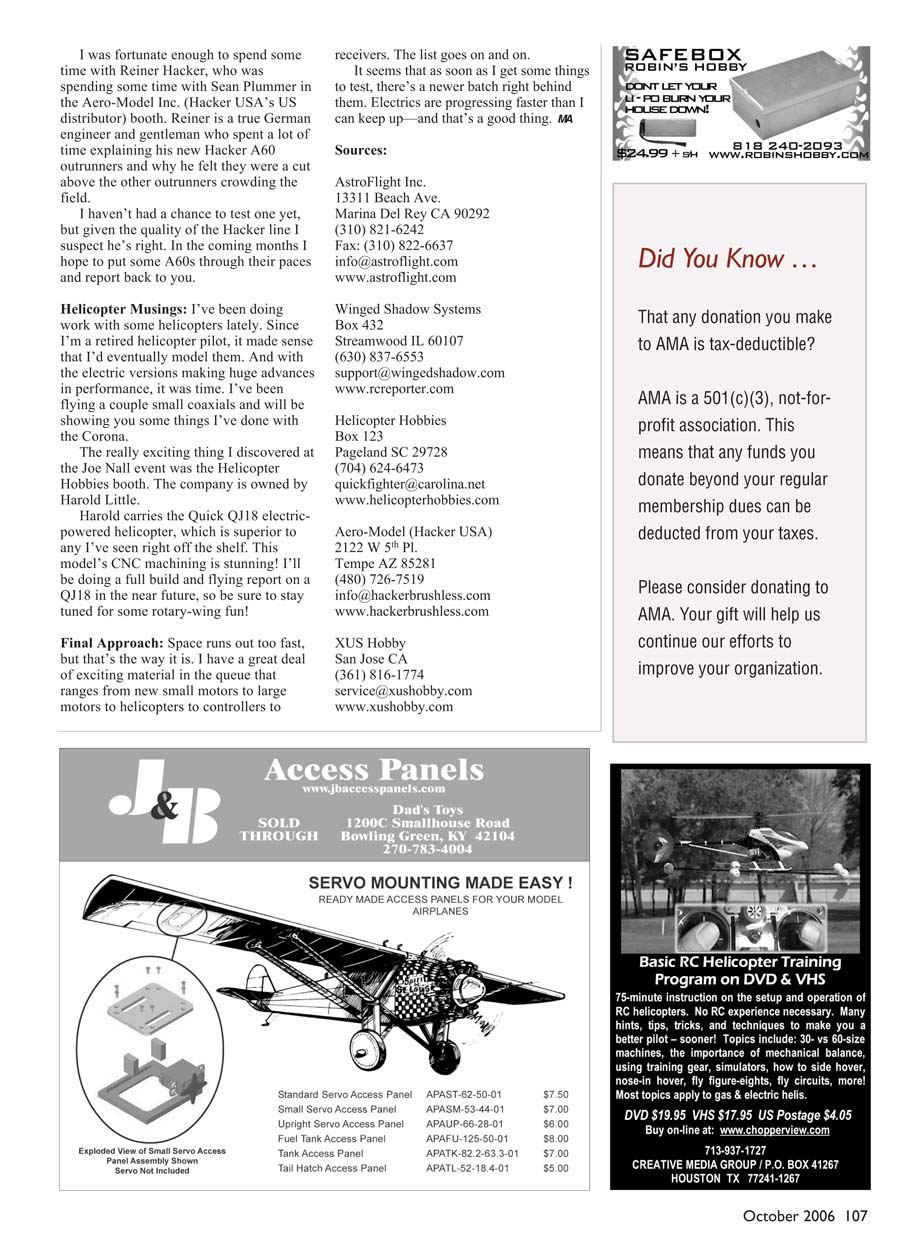
It's true that the really large electrics, such as the one flown by Mark Leseberg, are out of reach for most average modelers, but there is something to be said for the technology that is being developed there. It eventually trickles down to us or spins off into new things for us.
The Hacker C50 Quad system that powers Mark's 42% Extra 260 is available if you have an extra $2,999, but you'll also need four controllers and four 10S Li-Poly battery packs. Once you've invested in all that, though, you'll have a system that will produce 80 pounds of thrust and put out 10 kilowatts. It was really something to see.
There were other Giant Scale electrics at the fly-in that are available to the "average" modeler. They were powered by motors costing only $300 from AstroFlight, Hacker, PJS, and AXI. This brings large IMAC (International Miniature Aircraft Association)-legal airplanes into our electric world that have excellent performance and don't break the bank.
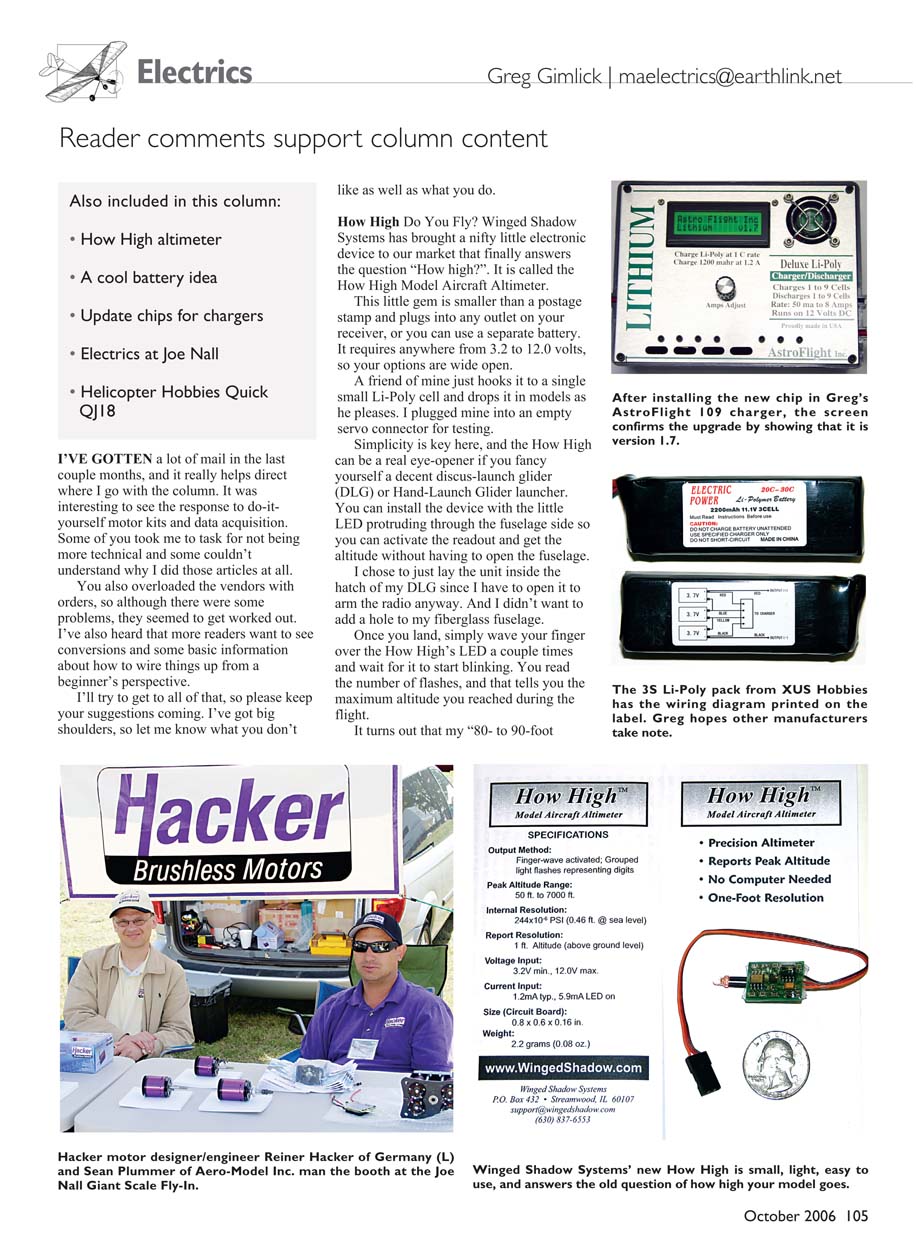
I was fortunate enough to spend some time with Reiner Hacker, who was spending time with Sean Plummer in the Aero-Model Inc. (Hacker USA's U.S. distributor) booth. Reiner is a true German engineer and gentleman who spent a lot of time explaining his new Hacker A60 outrunners and why he felt they were a cut above the other outrunners crowding the field.
I haven't had a chance to test one yet, but given the quality of the Hacker line I suspect he's right. In the coming months I hope to put some A60s through their paces and report back to you.
Helicopter Musings
I've been doing work with some helicopters lately. Since I'm a retired helicopter pilot, it made sense that I'd eventually model them. And with the electric versions making huge advances in performance, it was time. I've been flying a couple small coaxials and will be showing you some things I've done with the Corona.
The really exciting thing I discovered at the Joe Nall event was the Helicopter Hobbies booth. The company is owned by Harold Little.
Harold carries the Quick QJ18 electric-powered helicopter, which is superior to any I've seen right off the shelf. This model's CNC machining is stunning! I'll be doing a full build and flying report on a QJ18 in the near future, so be sure to stay tuned for some rotary-wing fun!
Final Approach
Space runs out too fast, but that's the way it is. I have a great deal of exciting material in the queue that ranges from new small motors to large motors to helicopters to controllers to receivers. The list goes on and on.
It seems that as soon as I get some things to test, there's a newer batch right behind them. Electrics are progressing faster than I can keep up—and that's a good thing.
Sources
- AstroFlight Inc.
13311 Beach Ave., Marina Del Rey, CA 90292 Phone: (310) 821-6242; Fax: (310) 822-6637 Email: [email protected] www.astroflight.com
- Winged Shadow Systems
Box 432, Streamwood, IL 60107 Phone: (630) 837-6553 Email: [email protected] www.rcreporter.com
- Helicopter Hobbies
Box 123, Pageland, SC 29728 Phone: (704) 624-6473 Email: [email protected] www.helicopterhobbies.com
- Aero-Model (Hacker USA)
2122 W 5th Pl., Tempe, AZ 85281 Phone: (480) 726-7519 Email: [email protected] www.hackerbrushless.com
- XUS Hobby
San Jose, CA Phone: (361) 816-1774 Email: [email protected] www.xushobby.com
Transcribed from original scans by AI. Minor OCR errors may remain.

