
Electrics - 2007/08
Greg Gimlick | [email protected]
A field trip to the 2007 Toledo Show
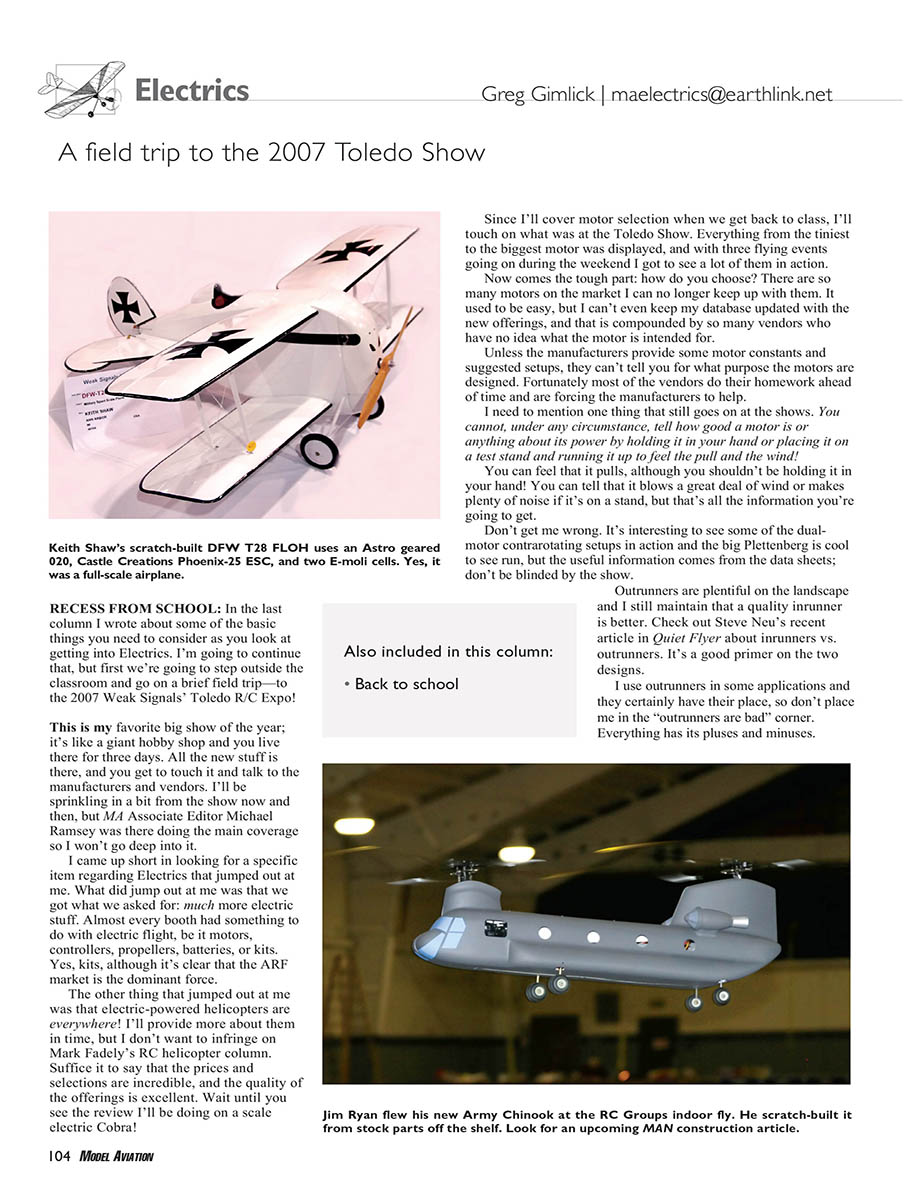
RECESS FROM SCHOOL: In the last column I wrote about some of the basic things you need to consider as you look at getting into electrics. I’m going to continue that, but first we’re going to step outside the classroom and go on a brief field trip—to the 2007 Weak Signals’ Toledo R/C Expo! This is my favorite big show of the year; it’s like a giant hobby shop and you live there for three days. All the new stuff is there, and you get to touch it and talk to the manufacturers and vendors. I’ll be sprinkling in a bit from the show now and then, but MA Associate Editor Michael Ramsey was there doing the main coverage so I won’t go deep into it.
I came up short in looking for a specific item regarding electrics that jumped out at me. What did jump out was that we got what we asked for: much more electric stuff. Almost every booth had something to do with electric flight, be it motors, controllers, propellers, batteries, or kits. Yes, kits, although it’s clear that the ARF market is the dominant force.
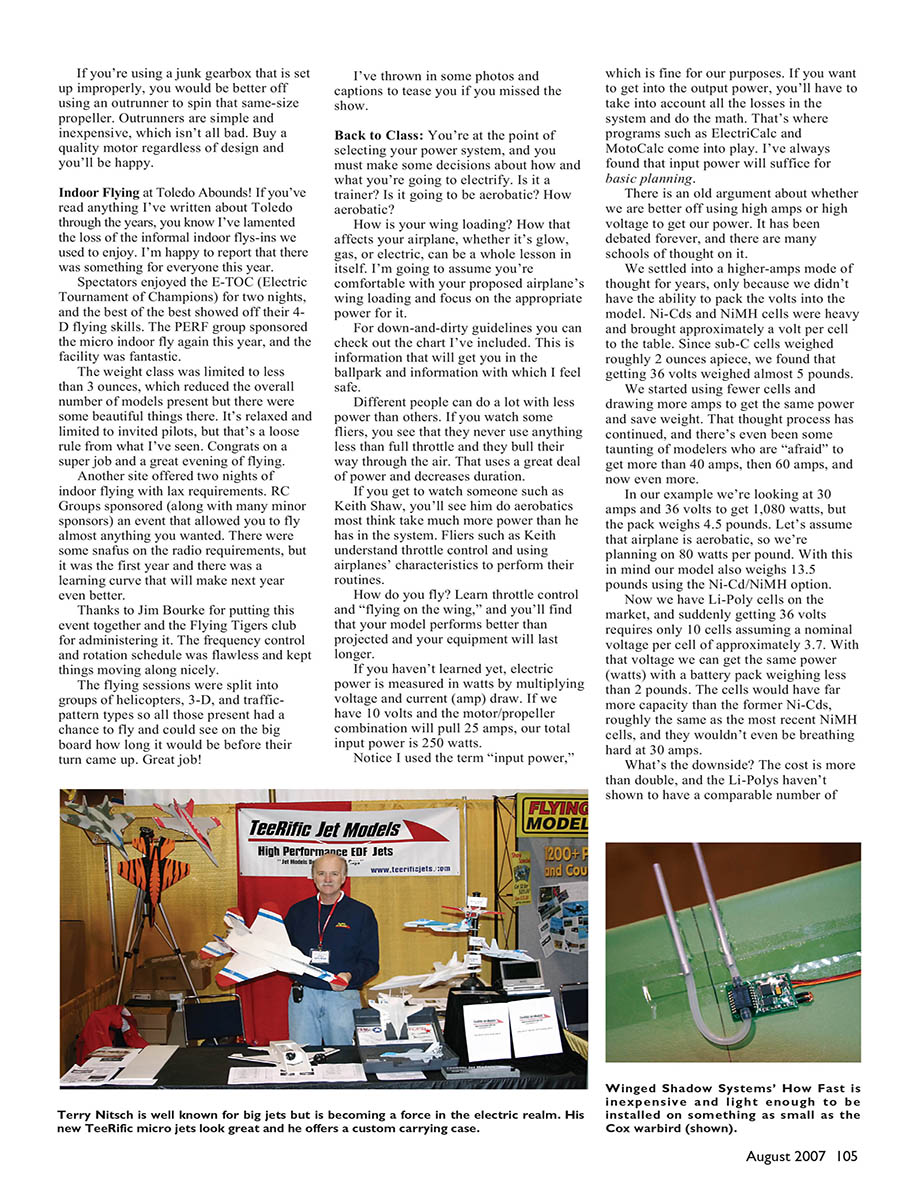
The other thing that jumped out at me was that electric-powered helicopters are everywhere! I’ll provide more about them in time, but I don’t want to infringe on Mark Fadely’s RC helicopter column. Suffice it to say that the prices and selections are incredible, and the quality of the offerings is excellent. Wait until you see the review I’ll be doing on a scale electric Cobra!
Since I’ll cover motor selection when we get back to class, I’ll touch on what was at the Toledo Show. Everything from the tiniest to the biggest motor was displayed, and with three flying events going on during the weekend I got to see a lot of them in action.
Now comes the tough part: how do you choose? There are so many motors on the market I can no longer keep up with them. It used to be easy, but I can’t even keep my database updated with the new offerings, and that is compounded by so many vendors who have no idea what the motor is intended for.
Unless the manufacturers provide some motor constants and suggested setups, they can’t tell you for what purpose the motors are designed. Fortunately most of the vendors do their homework ahead of time and are forcing the manufacturers to help.
I need to mention one thing that still goes on at the shows. You cannot, under any circumstance, tell how good a motor is or anything about its power by holding it in your hand or placing it on a test stand and running it up to feel the pull and the wind! You can feel that it pulls, although you shouldn’t be holding it in your hand. You can tell that it blows a great deal of wind or makes plenty of noise if it’s on a stand, but that’s all the information you’re going to get.
Don’t get me wrong. It’s interesting to see some of the dual-motor contra-rotating setups in action and the big Plettenberg is cool to see run, but the useful information comes from the data sheets; don’t be blinded by the show.
Outrunners are plentiful on the landscape and I still maintain that a quality inrunner is better. Check out Steve Neu’s recent article in Quiet Flyer about inrunners vs. outrunners. It’s a good primer on the two designs.
I use outrunners in some applications and they certainly have their place, so don’t place me in the “outrunners are bad” corner. Everything has its pluses and minuses. If you're using a junk gearbox that is set up improperly, you would be better off using an outrunner to spin that same-size propeller. Outrunners are simple and inexpensive, which isn't all bad. Buy a quality motor regardless of design and you'll be happy.
Indoor flying at Toledo abounds! If you've read anything I've written about Toledo through the years, you know I've lamented the loss of the informal indoor fly-ins we used to enjoy. I'm happy to report that there was something for everyone this year.
Spectators enjoyed the E-TOC (Electric Tournament of Champions) for two nights, and the best of the best showed off their 4-D flying skills. The PERF group sponsored the micro indoor fly again this year, and the facility was fantastic.
The weight class was limited to less than 3 ounces, which reduced the overall number of models present but there were some beautiful things there. It's relaxed and limited to invited pilots, but that's a loose rule from what I've seen. Congratulations on a super job and a great evening of flying.
Another site offered two nights of indoor flying with lax requirements. RC Groups sponsored (along with many minor sponsors) an event that allowed you to fly almost anything you wanted. There were some snafus on the radio requirements, but it was the first year and there was a learning curve that will make next year even better.
Thanks to Jim Bourke for putting this event together and the Flying Tigers club for administering it. The frequency control and rotation schedule was flawless and kept things moving along nicely.
The flying sessions were split into groups of helicopters, 3-D, and traffic-pattern types so all those present had a chance to fly and could see on the big board how long it would be before their turn came up. Great job!
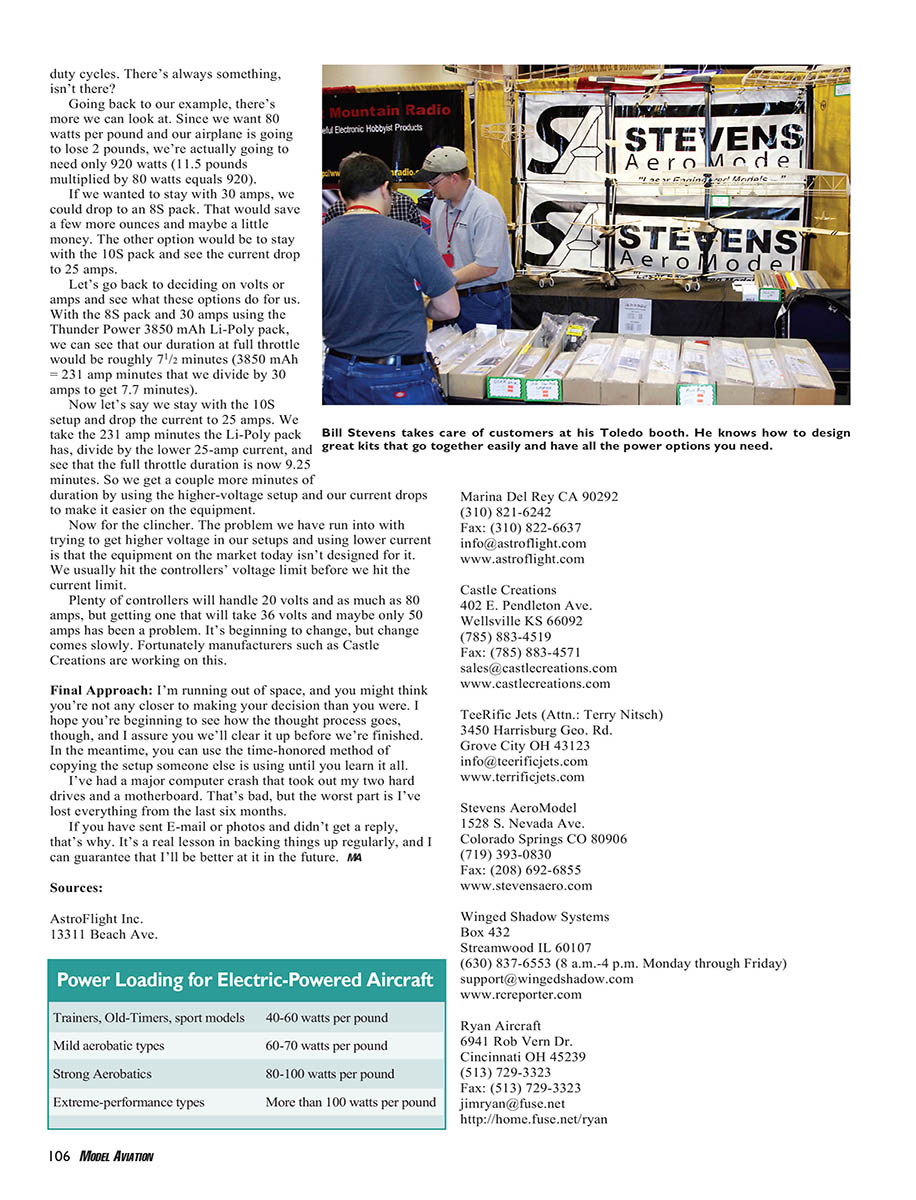
I've thrown in some photos and captions to tease you if you missed the show.
Back to Class
You're at the point of selecting your power system, and you must make some decisions about how and what you're going to electrify. Is it a trainer? Is it going to be aerobatic? How aerobatic?
How is your wing loading? How that affects your airplane, whether it's glow, gas, or electric, can be a whole lesson in itself. I'm going to assume you're comfortable with your proposed airplane's wing loading and focus on the appropriate power for it.
For down-and-dirty guidelines you can check out the chart I'll include. This is information that will get you in the ballpark and information with which I feel safe.
Different people can do a lot with less power than others. If you watch some fliers, you see that they never use anything less than full throttle and they build their way through the air. That uses a great deal of power and decreases duration.
If you get to watch someone such as Keith Shaw, you'll see him do aerobatics and most think he takes much more power than he has in the system. Fliers such as Keith understand throttle control and use an airplane's characteristics to perform their routines.
How do you fly? Learn throttle control and "flying on the wing," and you'll find that your model performs better than projected and your equipment will last longer.
If you haven't learned yet, electric power is measured in watts by multiplying voltage and current (amp draw). If we have 10 volts and the motor/propeller combination will pull 25 amps, our total input power is 250 watts.
Notice I used the term "input power," which is fine for our purposes. If you want to get into the output power, you'll have to take into account all the losses in the system and do the math. That's where programs such as ElectriCalc and MotoCalc come into play. I've always found that input power will suffice for basic planning.
There is an old argument about whether we are better off using high amps or high voltage to get our power. It has been debated forever, and there are many schools of thought on it.
We settled into a higher-amps mode of thought for years, only because we didn't have the ability to pack the volts into the model. Ni-Cd and NiMH were heavy and brought approximately a volt per cell to the table. Since sub-C cells weighed roughly 2 ounces apiece, we found that getting 36 volts weighed almost 5 pounds.
We started using fewer cells and drawing more amps to get the same power and save weight. That thought process has continued, and there's even been some taunting of modelers who are "afraid" to get more than 40 amps, then 60 amps, and now even more.
In our example we're looking at 30 amps and 36 volts to get 1,080 watts, but the pack weighs 4.5 pounds. Let's assume that airplane is aerodynamically efficient and we're planning on 80 watts per pound. With this in mind our model also weighs 13.5 pounds using the Ni-Cd/NiMH option.
Now we have Li-Poly cells on the market, and suddenly getting 36 volts requires only 10 cells assuming a nominal voltage per cell of approximately 3.7. With that voltage we can get the same power (watts) with a battery pack weighing less than 2 pounds. The cells would have far more capacity than the former Ni-Cds, roughly the same as the most recent NiMH cells, and they wouldn't even be breathing hard at 30 amps.
What's the downside? The cost is more than double, and the Li-Polys haven't shown to have a comparable number of duty cycles. There's always something, isn't there?
Going back to our example, there's more we can look at. Since we want 80 watts per pound and our airplane is going to lose 2 pounds, we're actually going to need only 920 watts (11.5 pounds multiplied by 80 watts equals 920).
If we wanted to stay with 30 amps, we could drop to an 8S pack. That would save a few more ounces and maybe a little money. The other option would be to stay with the 10S pack and see the current drop to 25 amps.
Let's go back to deciding on volts or amps and see what these options do for us. With the 8S pack and 30 amps using the Thunder Power 3850 mAh Li-Poly pack, we can see that our duration at full throttle would be roughly 7-1/2 minutes (3850 mAh = 231 amp-minutes that we divide by 30 amps to get 7.7 minutes).
Now let's say we stay with the 10S setup and drop the current to 25 amps. We take the 231 amp-minutes the Li-Poly pack has, divide by the lower 25-amp current, and see that the full-throttle duration is now 9.25 minutes. So we get a couple more minutes of duration by using the higher-voltage setup and our current drops to make it easier on the equipment.
Now for the clincher. The problem we have run into with trying to get higher voltage in our setups and using lower current is that the equipment on the market today isn't designed for it. We usually hit the controllers' voltage limit before we hit the current limit.
Plenty of controllers will handle 20 volts and as much as 80 amps, but getting one that will take 36 volts and maybe only 50 amps has been a problem. It's beginning to change, but change comes slowly. Fortunately manufacturers such as Castle Creations are working on this.
Final Approach
I'm running out of space, and you might think you're not any closer to making your decision than you were. I hope you're beginning to see how the thought process goes, though, and I assure you we'll clear it up before we're finished. In the meantime, you can use the time-honored method of copying the setup someone else is using until you learn it all.
I've had a major computer crash that took out my two hard drives and a motherboard. That's bad, but the worst part is I've lost everything from the last six months.
If you have sent e-mail or photos and didn't get a reply, that's why. It's a real lesson in backing things up regularly, and I can guarantee that I'll be better at it in the future.
MA
Sources
- AstroFlight Inc.
13311 Beach Ave. Marina Del Rey, CA 90292 (310) 821-6242 Fax: (310) 822-6637 [email protected] www.astroflight.com
- Castle Creations
402 E. Pendleton Ave. Wellsville, KS 66092 (785) 883-4519 Fax: (785) 883-4571 [email protected] www.castlecreations.com
- TeeRific Jets (Attn.: Terry Nitsch)
3450 Harrisburg Geo. Rd. Grove City, OH 43123 [email protected] www.teerificjets.com
- Stevens AeroModel
1528 S. Nevada Ave. Colorado Springs, CO 80906 (719) 393-0830 Fax: (208) 692-6855 www.stevensaero.com
- Winged Shadow Systems
Box 432 Streamwood, IL 60107 (630) 837-6553 (8 a.m.-4 p.m. Monday through Friday) [email protected] www.rcreporter.com
- Ryan Aircraft
6941 Rob Vern Dr. Cincinnati, OH 45239 (513) 729-3323 Fax: (513) 729-3323 [email protected] http://home.fuse.net/ryan
Power Loading for Electric-Powered Aircraft
- Trainers, old-timers, sport models: 40–60 watts per pound
- Mild aerobatic types: 60–70 watts per pound
- Strong aerobatics: 80–100 watts per pound
- Extreme-performance types: More than 100 watts per pound
Transcribed from original scans by AI. Minor OCR errors may remain.

