
A special gift from Iraq
Greg Gimlick | [email protected]
I'm going to stray off topic a bit to cover some things from a recent trip to the Joe Nall Giant Scale Fly-In and touch on a few interesting items: jets, big models, and cool chargers. I can already tell there's not enough space!
A Gift to Me From Iraq
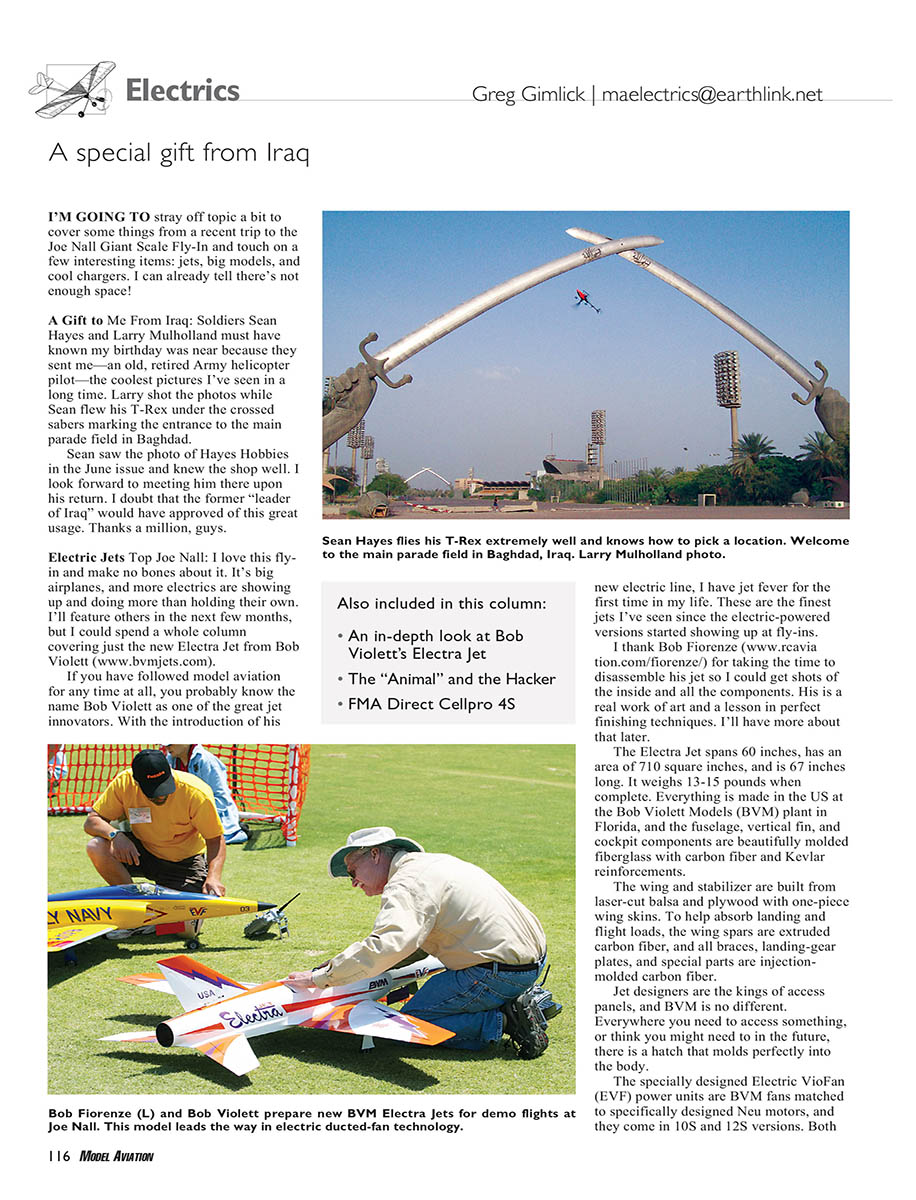
Soldiers Sean Hayes and Larry Mulholland must have known my birthday was near because they sent me—an old, retired Army helicopter pilot—the coolest pictures I've seen in a long time. Larry shot the photos while Sean flew his T‑Rex under the crossed sabers marking the entrance to the main parade field in Baghdad.
Sean saw the photo of Hayes Hobbies in the June issue and knew the shop well. I look forward to meeting him there upon his return. I doubt that the former "leader of Iraq" would have approved of this great usage. Thanks a million, guys.
Electric Jets Top Joe Nall
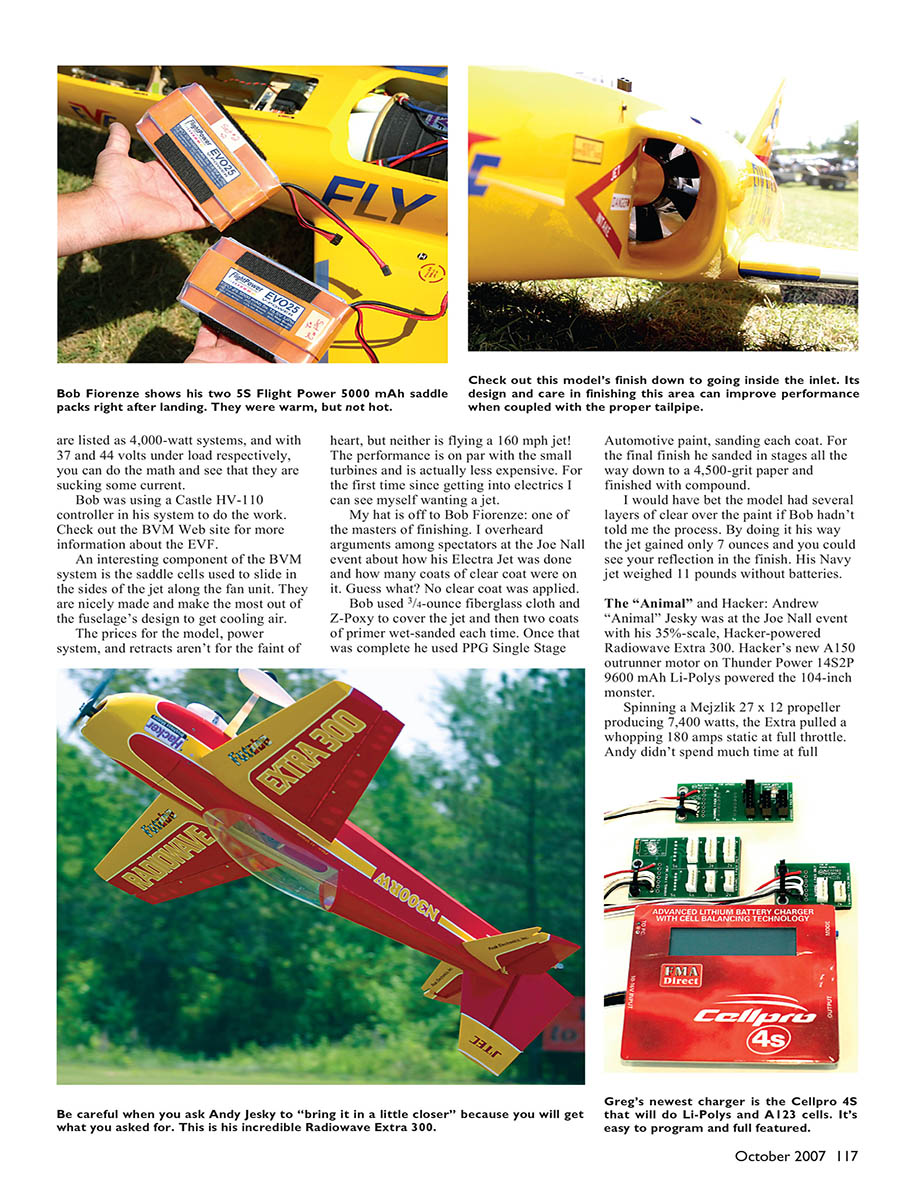
I love this fly‑in and make no bones about it: it's big airplanes, and more electrics are showing up and doing more than holding their own. I'll feature others in the next few months, but I could spend a whole column covering just the new Electra Jet from Bob Violett (www.bvmjets.com).
If you have followed model aviation for any time at all, you probably know the name Bob Violett as one of the great jet innovators. With the introduction of his new electric line, I have jet fever for the first time in my life. These are the finest jets I've seen since the electric-powered versions started showing up at fly‑ins.
I thank Bob Fiorenze (www.rcaviation.com/fiorenze/) for taking the time to disassemble his jet so I could get shots of the inside and all the components. His is a real work of art and a lesson in perfect finishing techniques. I'll have more about that later.
The Electra Jet spans 60 inches, has an area of 710 square inches, and is 67 inches long. It weighs 13–15 pounds when complete. Everything is made in the US at the Bob Violett Models (BVM) plant in Florida. The fuselage, vertical fin, and cockpit components are beautifully molded fiberglass with carbon fiber and Kevlar reinforcements.
The wing and stabilizer are built from laser-cut balsa and plywood with one-piece wing skins. To help absorb landing and flight loads, the wing spars are extruded carbon fiber, and all braces, landing-gear plates, and special parts are injection-molded carbon fiber.
Jet designers are the kings of access panels, and BVM is no different. Everywhere you need to access something, or think you might need to in the future, there is a hatch that molds perfectly into the body.
The specially designed Electric VioFan (EVF) power units are BVM fans matched to specifically designed Neu motors, and they come in 10S and 12S versions. Both are listed as 4,000-watt systems, and with 37 and 44 volts under load respectively, you can do the math and see that they are drawing significant current. Bob was using a Castle HV-110 controller in his system to do the work. Check the BVM website for more information about the EVF.
An interesting component of the BVM system is the saddle cells used to slide in alongside the fan unit. They are nicely made and make the most out of the fuselage's design to get cooling air.
The prices for the model, power system, and retracts aren't for the faint of heart, but neither is flying a 160 mph jet! The performance is on par with the small turbines and is actually less expensive. For the first time since getting into electrics I can see myself wanting a jet.
My hat is off to Bob Fiorenze: one of the masters of finishing. I overheard arguments among spectators at the Joe Nall event about how his Electra Jet was done and how many coats of clear coat were on it. Guess what? No clear coat was applied.
Bob used 3/4-ounce fiberglass cloth and Z-Poxy to cover the jet and then two coats of primer, wet-sanding each time. Once that was complete he used PPG Single Stage automotive paint, sanding each coat. For the final finish he sanded in stages all the way down to 4,500-grit paper and finished with compound.
I would have bet the model had several layers of clear over the paint if Bob hadn't told me the process. By doing it his way the jet gained only 7 ounces and you could see your reflection in the finish. His Navy jet weighed 11 pounds without batteries.
The "Animal" and Hacker
Andrew "Animal" Jesky was at the Joe Nall event with his 35%-scale, Hacker-powered Radiowave Extra 300. Hacker's new A150 outrunner motor on Thunder Power 14S2P 9600 mAh Li-Polys powered the 104-inch monster.
Spinning a Mejzlik 27 x 12 propeller and producing 7,400 watts, the Extra pulled a whopping 180 amps static at full throttle. Andy didn't spend much time at full throttle. The model weighed 31 pounds, and Andy really knew how to show it off.
The real surprise came at the end of his flight when we were talking in the pits. The Extra had been on the ground for approximately five minutes, and Andy said, "Stick your hand in the cowl and feel that motor." I figured he was trying to get me to burn my hand as a joke, but then he stuck his hand in.
When I felt the motor it was barely above ambient temperature! I couldn't believe it was that cool after that aerobatic flight.
I am extremely impressed with the new Hacker A150. At 4.5 pounds and a kilovolt (kV) rating of 166, it's meant for big airplanes and big propellers, and it certainly didn't disappoint the crowd.
FMA Direct Cellpro 4S Charger
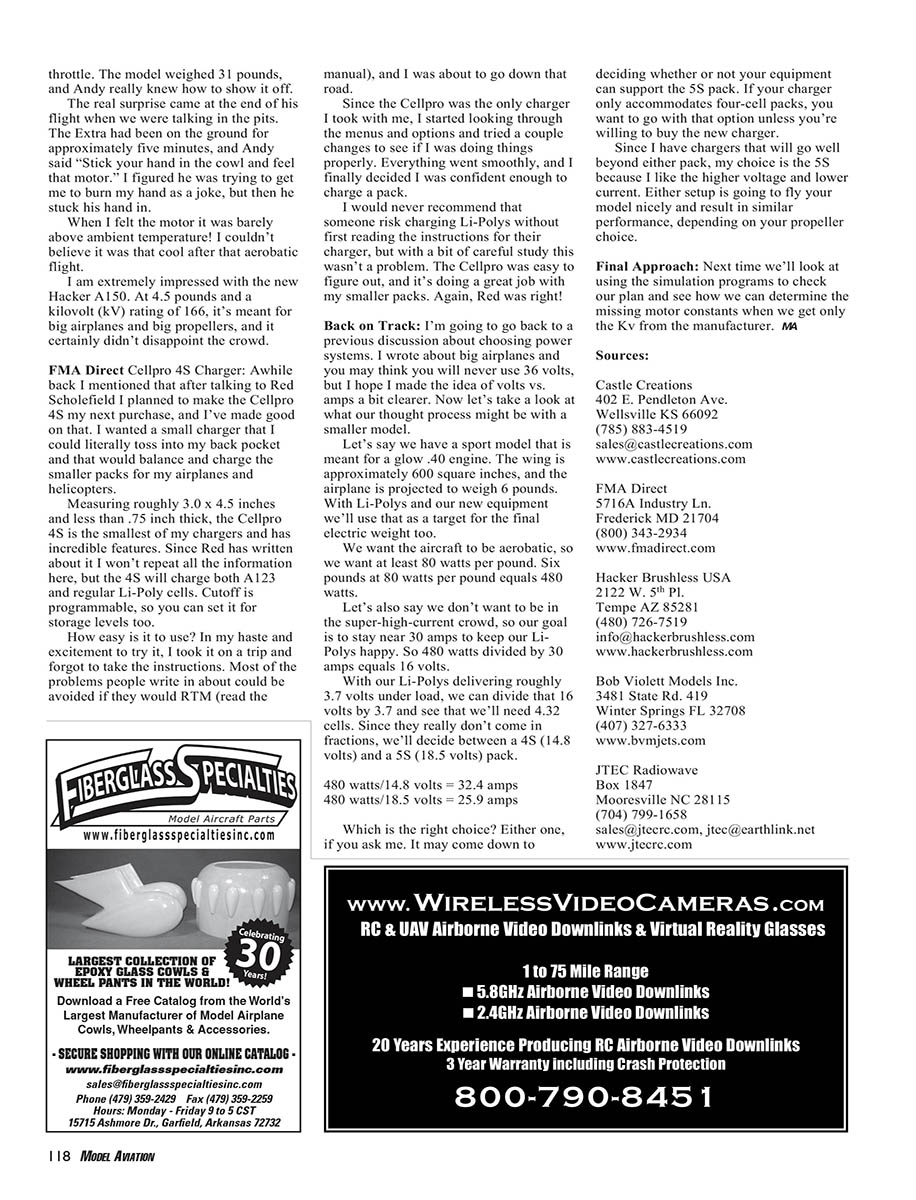
A while back I mentioned that after talking to Red Schofield I planned to make the Cellpro 4S my next purchase, and I've made good on that. I wanted a small charger that I could literally toss into my back pocket and that would balance and charge the smaller packs for my airplanes and helicopters.
Measuring roughly 3.0 x 4.5 inches and less than 0.75 inch thick, the Cellpro 4S is the smallest of my chargers and has incredible features. Since Red has written about it I won't repeat all the information here, but the 4S will charge both A123 and regular Li-Poly cells. Cutoff is programmable, so you can set it for storage levels too.
How easy is it to use? In my haste and excitement to try it, I took it on a trip and forgot to take the instructions. Most of the problems people write in about could be avoided if they would RTM (read the manual), and I was about to go down that road.
Since the Cellpro was the only charger I took with me, I started looking through the menus and options and tried a couple changes to see if I was doing things properly. Everything went smoothly, and I finally decided I was confident enough to charge a pack.
I would never recommend that someone risk charging Li-Polys without first reading the instructions for their charger, but with a bit of careful study this wasn't a problem. The Cellpro was easy to figure out, and it's doing a great job with my smaller packs. Again, Red was right!
Back on Track
I'm going to go back to a previous discussion about choosing power systems. I wrote about big airplanes and you may think you will never use 36 volts, but I hope I made the idea of volts vs. amps a bit clearer. Now let's take a look at what our thought process might be with a smaller model.
Let's say we have a sport model that is meant for a glow .40 engine. The wing is approximately 600 square inches, and the airplane is projected to weigh 6 pounds. With Li-Polys and our new equipment we'll use that as a target for the final electric weight too.
We want the aircraft to be aerobatic, so we want at least 80 watts per pound. Six pounds at 80 watts per pound equals 480 watts.
Let's also say we don't want to be in the super-high-current crowd, so our goal is to stay near 30 amps to keep our Li-Polys happy. So 480 watts divided by 30 amps equals 16 volts.
With our Li-Polys delivering roughly 3.7 volts under load, we can divide that 16 volts by 3.7 and see that we'll need 4.32 cells. Since they really don't come in fractions, we'll decide between a 4S (14.8 volts) and a 5S (18.5 volts) pack.
480 watts / 14.8 volts = 32.4 amps 480 watts / 18.5 volts = 25.9 amps
Which is the right choice? Either one, if you ask me. It may come down to deciding whether or not your equipment can support the 5S pack. If your charger only accommodates four-cell packs, you want to go with that option unless you're willing to buy the new charger.
Since I have chargers that will go well beyond either pack, my choice is the 5S because I like the higher voltage and lower current. Either setup is going to fly your model nicely and result in similar performance, depending on your propeller choice.
Final Approach
Next time we'll look at using the simulation programs to check our plan and see how we can determine the missing motor constants when we get only the Kv from the manufacturer.
MA
Sources
- Castle Creations
402 E. Pendleton Ave. Wellsville, KS 66092 (785) 883-4519 [email protected] www.castlecreations.com
- FMA Direct
5716A Industry Ln. Frederick, MD 21704 (800) 343-2934 www.fmadirect.com
- Hacker Brushless USA
2122 W. 5th Pl. Tempe, AZ 85281 (480) 726-7519 [email protected] www.hackerbrushless.com
- Bob Violett Models Inc.
3481 State Rd. 419 Winter Springs, FL 32708 (407) 327-6333 www.bvmjets.com
- JTEC Radiowave
Box 1847 Mooresville, NC 28115 (704) 799-1658 [email protected] [email protected] www.jteccrc.com
Transcribed from original scans by AI. Minor OCR errors may remain.

