
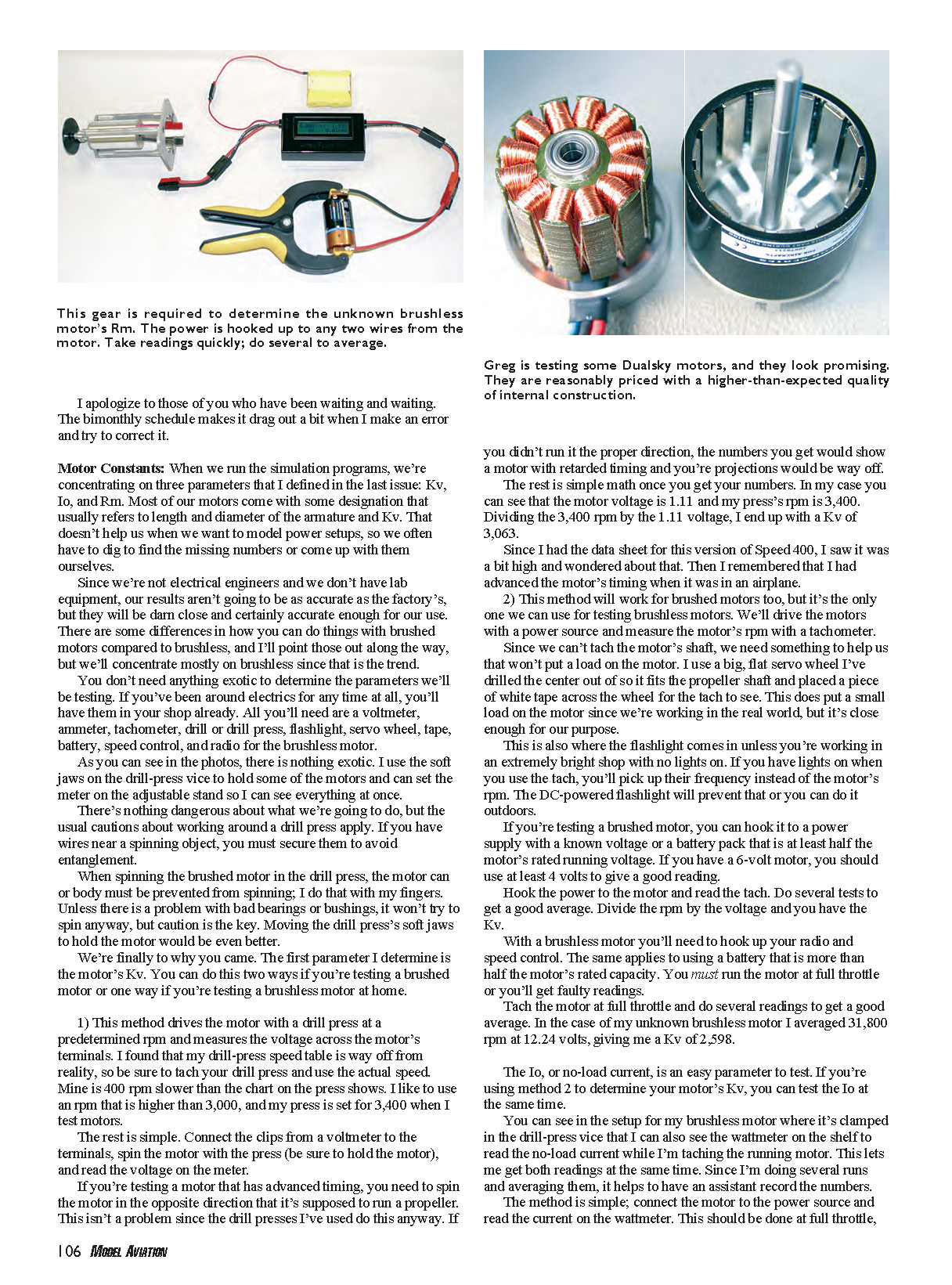


I apologize to those of you who have been waiting. The bimonthly schedule makes it drag out a bit when I make an error and try to correct it.
Motor Constants
When we run the simulation programs, we're concentrating on three parameters I defined in the last issue: Kv, Io, and Rm. Most motors come with designations that refer to armature dimensions and Kv, but that often leaves other numbers missing. Since we're not electrical engineers and don't have lab equipment, our results won't match factory lab precision, but they'll be close enough for practical modeling.
There are some differences between testing brushed and brushless motors; I'll point those out, but we'll concentrate mostly on brushless since that is the trend.
Equipment
You don't need anything exotic. Typical shop tools suffice:
- Voltmeter
- Ammeter or wattmeter
- Tachometer
- Drill or drill press
- Flashlight (DC-powered preferred)
- Servo wheel (flat) with center drilled to fit shaft
- Tape (white for tach mark)
- Battery or power supply
- Speed control and radio (for brushless motors)
- Mounting aids (vice, soft jaws, stands)
I use soft jaws on the drill-press vice to hold motors and an adjustable meter stand so I can see readings at once.
Safety and practical cautions
- Secure all wires so they cannot become entangled with spinning parts.
- Keep hands and loose objects away from spinning parts.
- When spinning a brushed motor on a drill press, prevent the motor can or body from spinning (soft jaws or holding it with fingers). Moving the vice jaws to clamp the motor is better.
- Take electrical measurements quickly when applying power to avoid heating windings.
- Repeat tests several times and average readings for reliability.
Measuring Kv (rpm per volt)
You can determine Kv two ways for brushed motors and one way for brushless motors.
Method 1 — Drill press back-EMF (works for brushed motors)
- Spin the motor at a known rpm using a drill press.
- Measure the open-circuit voltage across the motor terminals with a voltmeter while it spins.
- Kv = rpm / measured voltage.
Notes:
- Tach your drill press; the speed table is often inaccurate. I like to use an rpm higher than 3,000 (I set my press to 3,400 rpm for tests).
- If the motor has advanced timing, spin it in the opposite direction to how it normally drives a propeller. If run the wrong direction, your numbers will reflect retarded timing and be incorrect.
- Example: motor voltage = 1.11 V at 3,400 rpm → Kv = 3,400 / 1.11 ≈ 3,063.
Method 2 — Powered tachometer (works for brushed and brushless)
- Mount a light, low-load reflective target on the motor shaft (I use a flat servo wheel with a strip of white tape).
- Apply a known voltage from a power supply or battery (for brushless, use battery + speed control + radio at full throttle).
- Measure the motor rpm with a tachometer (use a DC flashlight to illuminate the reflective mark if needed to avoid picking up AC light frequency).
- Kv = rpm / applied voltage. Do several readings and average.
Notes:
- Use a battery or supply that is at least about half the motor's rated running voltage (e.g., for a 6 V motor, use at least 4 V).
- For brushless motors, run at full throttle (otherwise you will get faulty readings).
- Example: averaged 31,800 rpm at 12.24 V → Kv = 31,800 / 12.24 ≈ 2,598.
Measuring Io (no-load current)
Io is simple to measure and can be done simultaneously with Method 2.
- Connect the motor to the power source (for brushless, use speed control and radio).
- Run the motor at full throttle and read the current on an ammeter or wattmeter.
- Repeat several runs and average the readings. That average is Io.
Measuring Rm (winding resistance)
- Brushed motors: measure the resistance across the brushes with an ohmmeter.
- Brushless motors: measure quick V and I across any two motor leads while applying power briefly (to avoid heating), then calculate Rm = V / I. Repeat quick readings and average. The measured value is the phase-to-phase resistance for most brushless motors.
Final notes
- Secure wires and keep clear of spinning parts.
- Take readings quickly to avoid heating windings.
- Repeat tests several times and average values for reliable results.
These three parameters — Kv, Io, and Rm — are all you need to model most electric setups with reasonable accuracy.
Transcribed from original scans by AI. Minor OCR errors may remain.

