
FMA Direct's FunJet ARF and Co-Pilot II
I'm taking a detour this month and not discussing wiring, ESCs, etc. I'm writing this the day before Christmas and feeling like a kid with a new toy, a couple days early.
I've known about FMA Direct's products and used them for many years—mostly ESCs, batteries, receivers, and chargers. The company recently introduced a line of airplanes that comes ready to fly (RTF) or almost ready for your receiver (ARF), and the models have the newest version of the Co-Pilot system installed.
The old version was impressive, but the Co-Pilot II absolutely blew me away. There, the cat's out of the bag.
I'll start with a disclaimer. I do not work for FMA Direct. I am not sponsored by the company or anyone else. I told MA editor Michael Ramsey that it was going to be tough writing about this product without sounding as if I worked for the manufacturer.
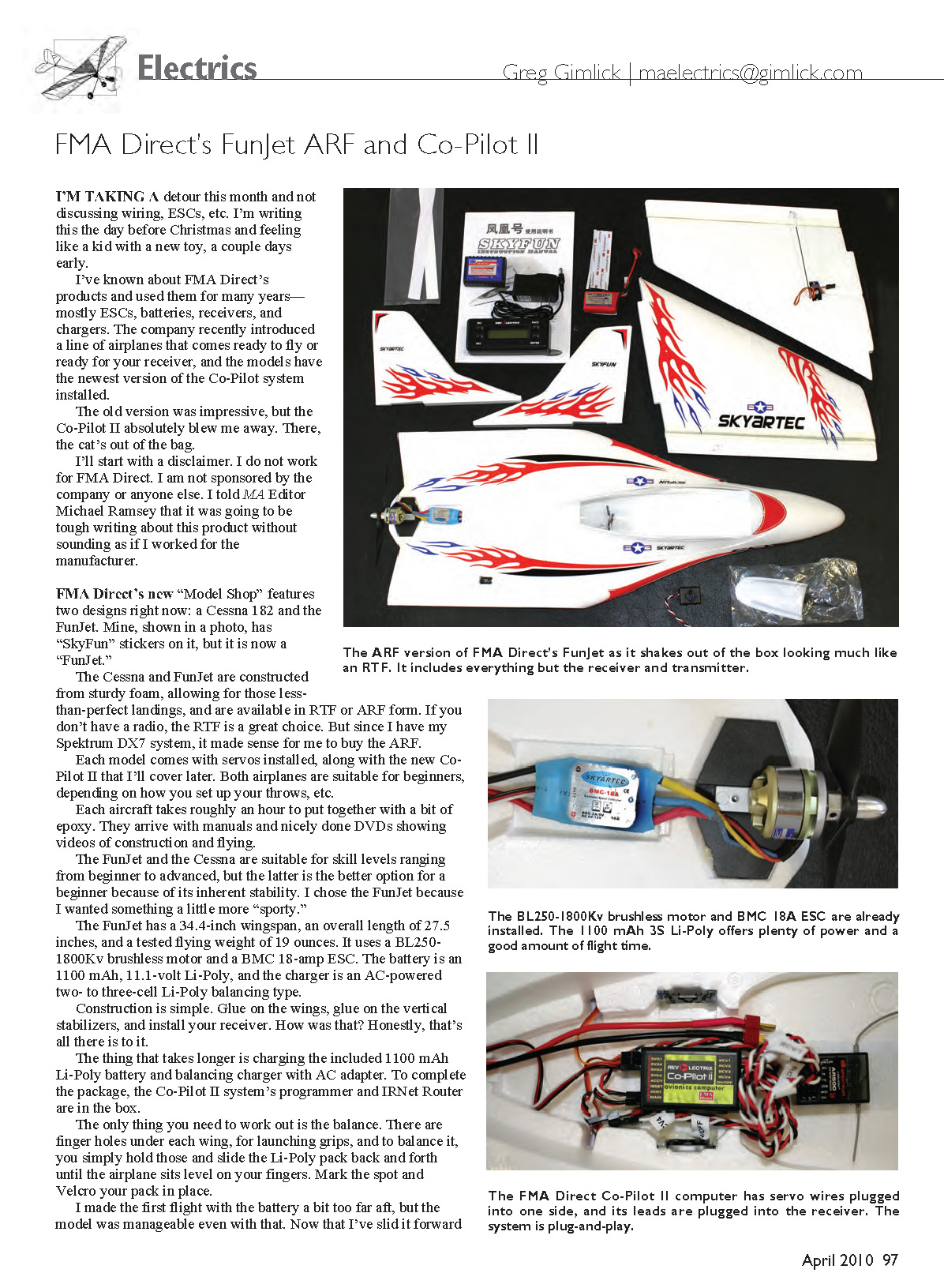
FMA Direct's new "Model Shop" features two designs right now: a Cessna 182 and the FunJet. Mine, shown in a photo, has "SkyFun" stickers on it, but it is now a FunJet.
The Cessna and FunJet are constructed from sturdy foam, allowing for those less-than-perfect landings, and are available in RTF or ARF form. If you don't have a radio, the RTF is a great choice. But since I have my Spektrum DX7 system, it made sense for me to buy the ARF.
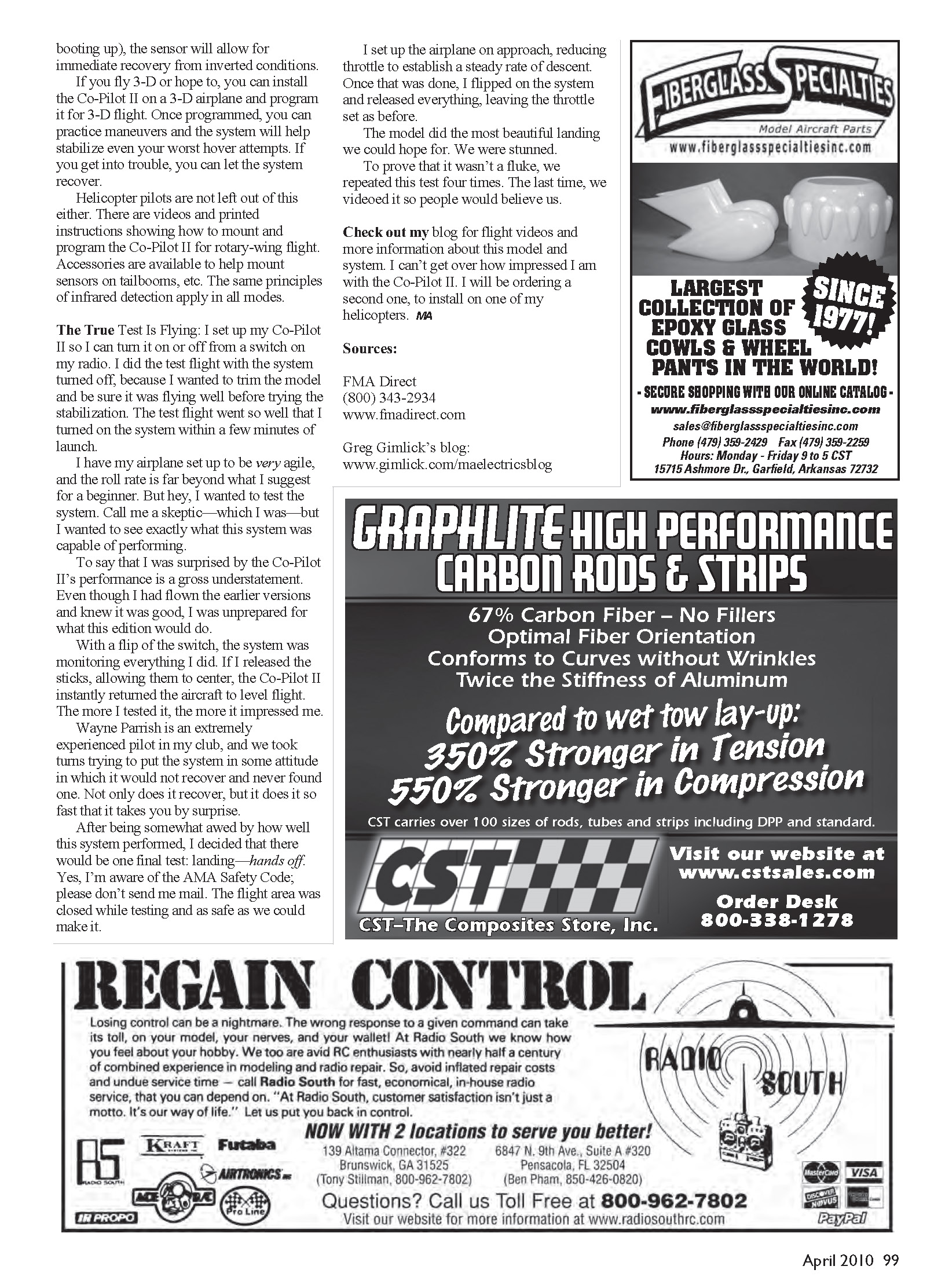
Each model comes with servos installed, along with the new Co-Pilot II that I'll cover later. Both airplanes are suitable for beginners, depending on how you set up your throws, etc.
Each aircraft takes roughly an hour to put together with a bit of epoxy. They arrive with manuals and nicely done DVDs showing videos of construction and flying.
The FunJet and the Cessna are suitable for skill levels ranging from beginner to advanced, but the Cessna is the better option for a beginner because of its inherent stability. I chose the FunJet because I wanted something a little more sporty.
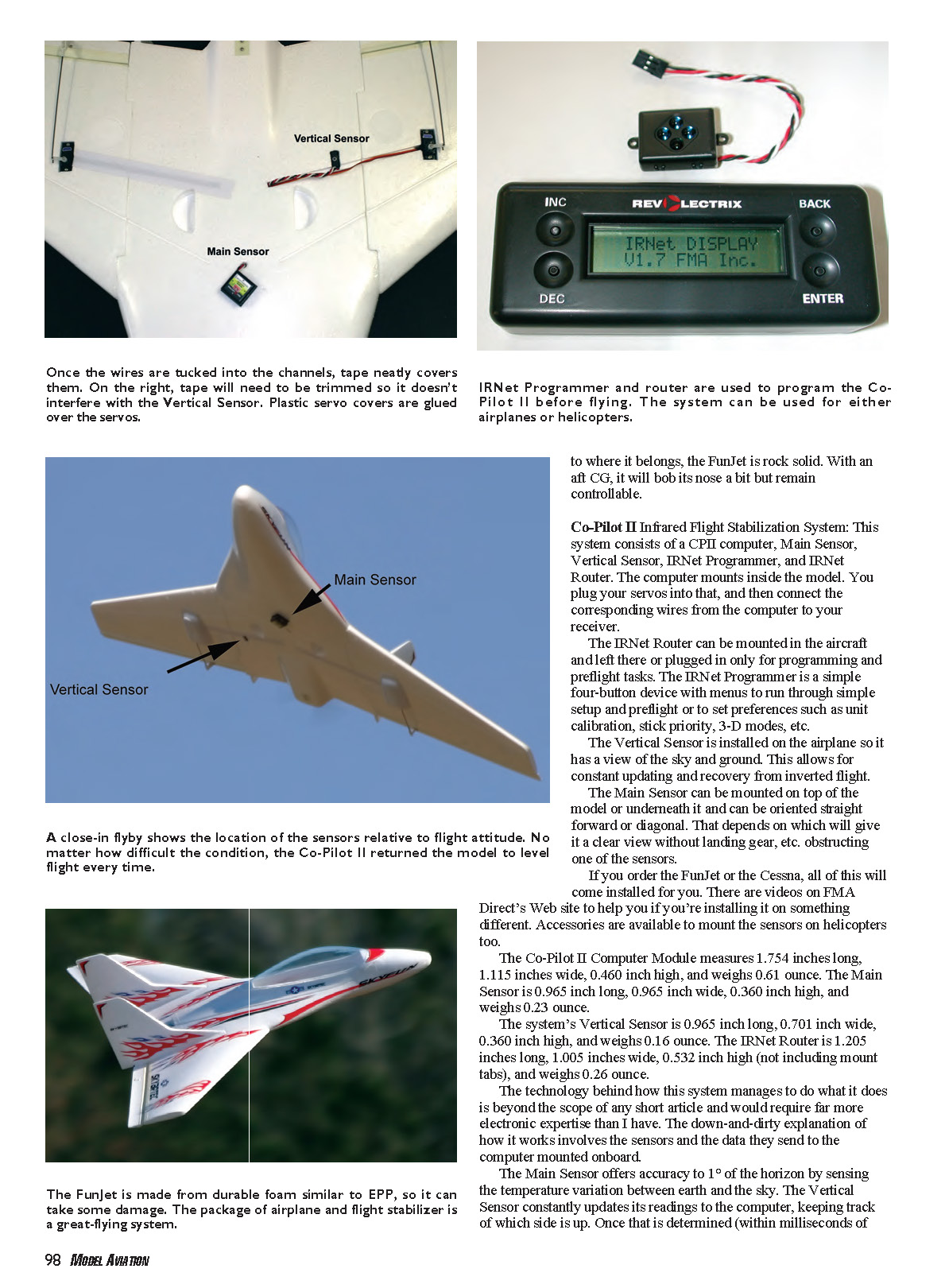
The FunJet has a 34.4-inch wingspan, an overall length of 27.5 inches, and a tested flying weight of 19 ounces. It uses a BL250-1800Kv brushless motor and a BMC 18-amp ESC. The battery is an 1100 mAh, 11.1-volt Li-Poly, and the charger is an AC-powered two- to three-cell Li-Poly balancing type.
Construction is simple:
- Glue on the wings.
- Glue on the vertical stabilizers.
- Install your receiver.
The thing that takes longer is charging the included 1100 mAh Li-Poly battery and using the balancing charger with the AC adapter. To complete the package, the Co-Pilot II system's programmer and IRNet Router are in the box.
The only thing you need to work out is the balance. There are finger holes under each wing for launching grips, and to balance it you simply hold those and slide the Li-Poly pack back and forth until the airplane sits level on your fingers. Mark the spot and Velcro your pack in place.
I made the first flight with the battery a bit too far aft, but the model was manageable even with that. Now that I've slid it forward to where it belongs, the FunJet is rock solid. With an aft CG it will bob its nose a bit but remain controllable.
Co-Pilot II Infrared Flight Stabilization System
This system consists of a Co-Pilot II computer, Main Sensor, Vertical Sensor, IRNet Programmer, and IRNet Router. The computer mounts inside the model. You plug your servos into it, and then connect the corresponding wires from the computer to your receiver. The IRNet Router can be mounted in the aircraft and left there or plugged in only for programming and preflight tasks. The IRNet Programmer is a simple four-button device with menus to run through simple setup and preflight tasks or to set preferences such as unit calibration, stick priority, 3-D modes, etc.
The Vertical Sensor is installed on the airplane so it has a view of the sky and ground. This allows for constant updating and recovery from inverted flight.
The Main Sensor can be mounted on top of the model or underneath it and can be oriented straight forward or diagonal. That depends on which will give it a clear view without landing gear or other items obstructing the sensors.
If you order the FunJet or the Cessna, all of this will come installed for you. There are videos on FMA Direct’s website to help you if you’re installing it on something different. Accessories are available to mount the sensors on helicopters too.
Co-Pilot II components, dimensions, and weights:
- Co-Pilot II computer module: 1.754 in long × 1.115 in wide × 0.460 in high; weighs 0.61 oz.
- Main Sensor: 0.965 in × 0.965 in × 0.360 in; weighs 0.23 oz.
- Vertical Sensor: 0.965 in × 0.701 in × 0.360 in; weighs 0.16 oz.
- IRNet Router: 1.205 in × 1.005 in × 0.532 in (not including mounting tabs); weighs 0.26 oz.
The technology behind how this system manages to do what it does is beyond the scope of any short article and would require far more electronic expertise than I have. The down-and-dirty explanation involves the sensors and the data they send to the computer mounted onboard.
The Main Sensor offers accuracy to 1° of the horizon by sensing the temperature variation between earth and sky. The Vertical Sensor constantly updates its readings to the computer, keeping track of which side is up. Once that is determined (within milliseconds of booting up), the sensor allows for immediate recovery from inverted conditions.
If you fly 3-D or hope to, you can install the Co-Pilot II on a 3-D airplane and program it for 3-D flight. Once programmed, you can practice maneuvers and the system will help stabilize even your worst hover attempts. If you get into trouble, you can let the system recover.
Helicopter pilots are not left out. There are videos and printed instructions showing how to mount and program the Co-Pilot II for rotary-wing flight. Accessories are available to help mount sensors on tailbooms, etc. The same principles of infrared detection apply in all modes.
The True Test Is Flying
I set up my Co-Pilot II so I can turn it on or off from a switch on my radio. I did the test flight with the system turned off because I wanted to trim the model and be sure it was flying well before trying the stabilization. The test flight went so well that I turned on the system within a few minutes of launch.
I have my airplane set up to be very agile, and the roll rate is far beyond what I suggest for a beginner. But I wanted to test the system. Call me a skeptic—which I was—but I wanted to see exactly what this system was capable of.
To say that I was surprised by the Co-Pilot II’s performance is a gross understatement. Even though I had flown the earlier versions and knew it was good, I was unprepared for what this edition would do.
With a flip of the switch, the system was monitoring everything I did. If I released the sticks, allowing them to center, the Co-Pilot II instantly returned the aircraft to level flight. The more I tested it, the more it impressed me.
Wayne Parrish, an extremely experienced pilot in my club, and I took turns trying to put the system in an attitude in which it would not recover—and never found one. Not only does it recover, but it does so fast enough to take you by surprise.
After being somewhat awed by how well this system performed, I decided there would be one final test: landing—hands off. Yes, I’m aware of the AMA safety code; please don’t send me mail. The flight area was closed while testing and as safe as we could make it.
I set up the airplane on approach, reducing throttle to establish a steady rate of descent. Once that was done, I flipped on the system and released everything, leaving the throttle set as before.
The model did the most beautiful landing we could hope for. We were stunned.
To prove that it wasn’t a fluke, we repeated this test four times. The last time, we videoed it so people would believe us.
Check out my blog for flight videos and more information about this model and system. I can’t get over how impressed I am with the Co-Pilot II. I will be ordering a second one to install on one of my helicopters.
MA
Sources:
- FMA Direct — (800) 343-2934 — www.fmadirect.com
- Greg Gimlick’s blog — www.gimlick.com/maelectricsblog
Transcribed from original scans by AI. Minor OCR errors may remain.

