
Xtreme Power Systems' Nano Technology
Greg Gimlick | [email protected]
Also included in this column:
- Taking the CX2 and CX3 up a notch
- Bend it with Du-Bro
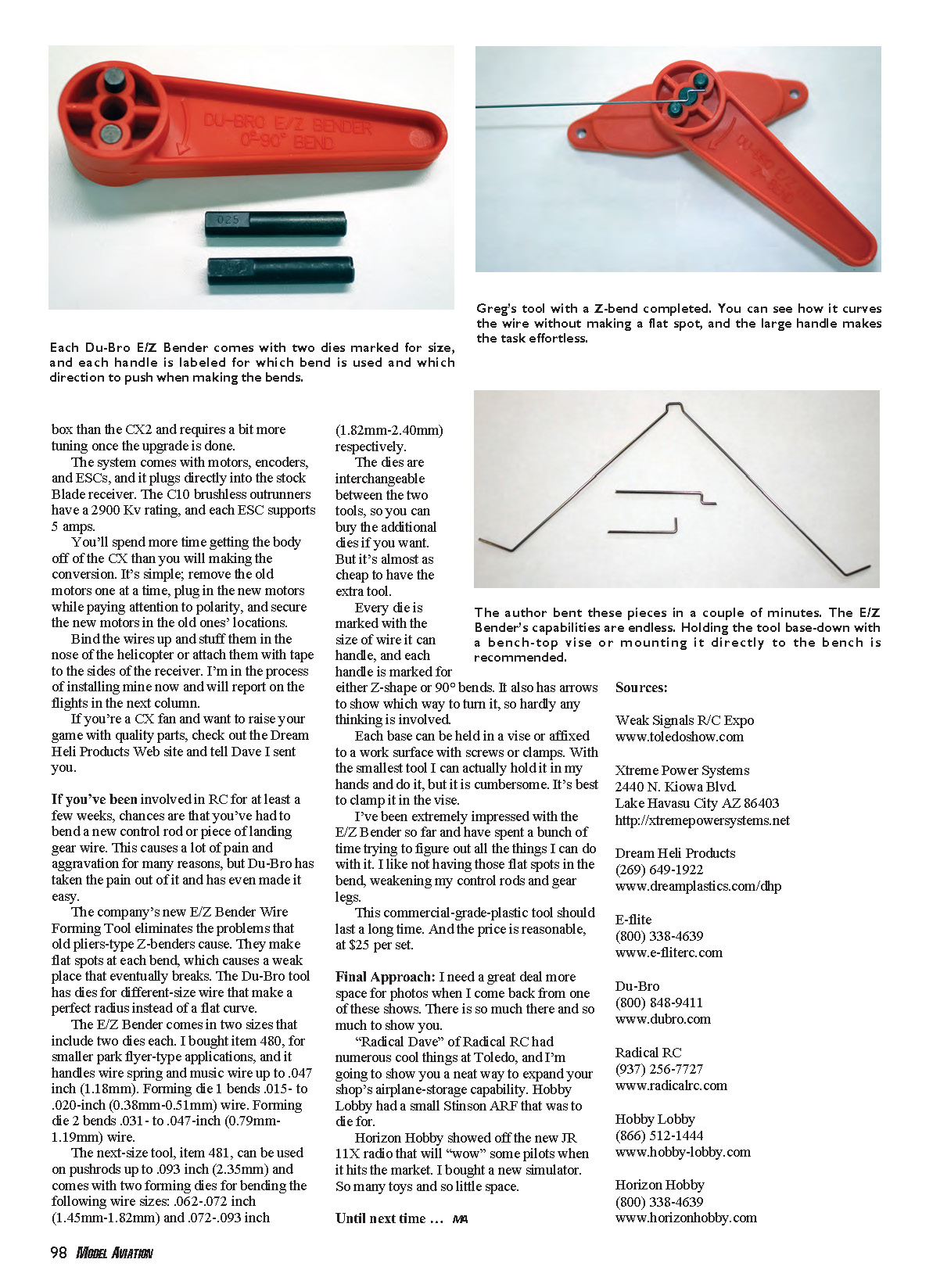
The Toledo Weak Signals R/C Expo was great as usual this year. There is a lot to write about, and you might have seen a bunch of stuff from the show throughout this issue. I'll go over a few things I picked up that I'm using here in the shop.
XtremeLink Nano receiver
One of the 2.4 GHz systems I've been flying is from Xtreme Power Systems (XPS); it's the Graupner iFS MX-16. I've stuffed the XPS six-channel receiver into a couple of park flyers and wished there was one a bit smaller. XPS delivered on that in a big way—or is it a small way?
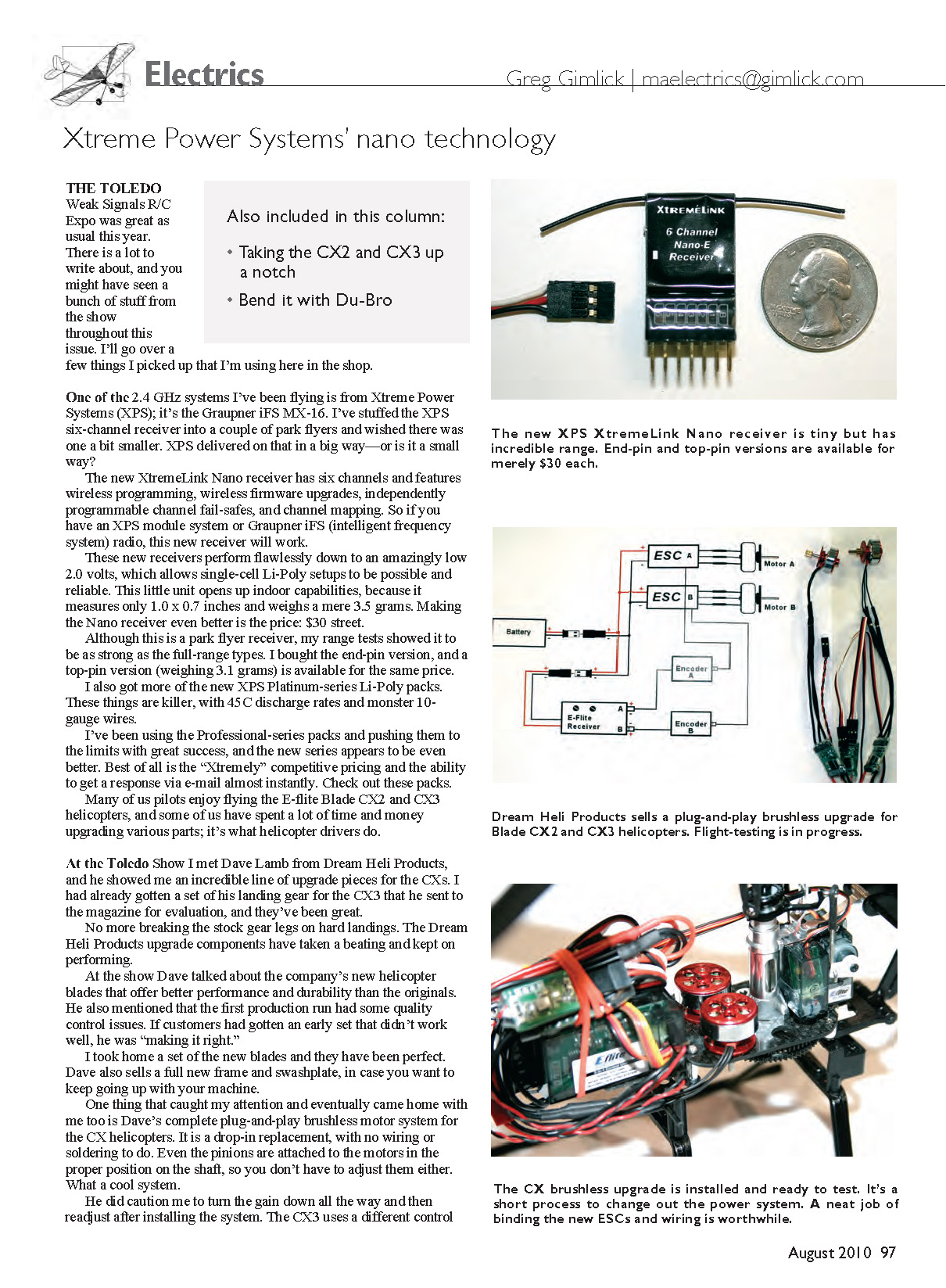
The new XtremeLink Nano receiver has six channels and features wireless programming, wireless firmware upgrades, independently programmable channel fail-safes, and channel mapping. So if you have an XPS module system or a Graupner iFS (intelligent frequency system) radio, this new receiver will work.
These new receivers perform flawlessly down to an amazingly low 2.0 volts, which allows single-cell Li-Po setups to be possible and reliable. This little unit opens up indoor capabilities because it measures only 1.0 x 0.7 inches and weighs a mere 3.5 grams. Making the Nano receiver even better is the price: $30 street.
Although this is a park-flyer receiver, my range tests showed it to be as strong as the full-range types. I bought the end-pin version; a top-pin version (weighing 3.1 grams) is available for the same price.
XPS Platinum-series Li-Poly packs
I also got more of the new XPS Platinum-series Li-Poly packs. These things are killer, with 45C discharge rates and monster 10-gauge wires.
I've been using the Professional-series packs and pushing them to the limits with great success, and the new series appears to be even better. Best of all is the "Xtremely" competitive pricing and the ability to get a response via e-mail almost instantly. Check out these packs.
Dream Heli Products — CX2 and CX3 upgrades
Many of us pilots enjoy flying the E-flite Blade CX2 and CX3 helicopters, and some of us have spent a lot of time and money upgrading various parts; it's what helicopter drivers do.
At the Toledo show I met Dave Lamb from Dream Heli Products, and he showed me an incredible line of upgrade pieces for the CXs. I had already gotten a set of his landing gear for the CX3 that he sent to the magazine for evaluation, and they've been great.
No more breaking the stock gear legs on hard landings. The Dream Heli Products upgrade components have taken a beating and kept on performing.
At the show Dave talked about the company's new helicopter blades that offer better performance and durability than the originals. He also mentioned that the first production run had some quality-control issues. If customers had gotten an early set that didn't work well, he was "making it right."
I took home a set of the new blades and they have been perfect. Dave also sells a full new frame and swashplate, in case you want to keep going up with your machine.
One thing that caught my attention and eventually came home with me too is Dave's complete plug-and-play brushless motor system for the CX helicopters. It is a drop-in replacement, with no wiring or soldering to do. Even the pinions are attached to the motors in the proper position on the shaft, so you don't have to adjust them either. What a cool system.
He did caution me to turn the gain down all the way and then readjust after installing the system. The CX3 uses a different control box than the CX2 and requires a bit more tuning once the upgrade is done.
The system comes with motors, encoders, and ESCs, and it plugs directly into the stock Blade receiver. The C10 brushless outrunners have a 2900 Kv rating, and each ESC supports 5 amps.
You'll spend more time getting the body off of the CX than you will making the conversion. It's simple: remove the old motors one at a time, plug in the new motors while paying attention to polarity, and secure the new motors in the old ones' locations.
Bind the wires up and stuff them in the nose of the helicopter or attach them with tape to the sides of the receiver. I'm in the process of installing mine now and will report on the flights in the next column.
If you're a CX fan and want to raise your game with quality parts, check out the Dream Heli Products website and tell Dave I sent you.
Du-Bro E/Z Bender Wire Forming Tool
If you've been involved in RC for at least a few weeks, chances are that you've had to bend a new control rod or piece of landing-gear wire. This causes a lot of pain and aggravation for many reasons, but Du-Bro has taken the pain out of it and has even made it easy.
The company's new E/Z Bender Wire Forming Tool eliminates the problems that old pliers-type Z-benders cause. They make flat spots at each bend, which creates weak places that eventually break. The Du-Bro tool has dies for different-size wire that make a perfect radius instead of a flat curve.
The E/Z Bender comes in two sizes that include two dies each. I bought item 480, for smaller park-flyer-type applications, and it handles spring music wire up to .047 inch (1.18 mm). Forming die 1 bends .015 to .020 inch (.38 mm–.51 mm) wire. Forming die 2 bends .031 to .047 inch (.79 mm–1.19 mm) wire.
The next-size tool, item 481, can be used on pushrods up to .093 inch (2.35 mm) and comes with two forming dies for bending the following wire sizes: .062–.072 inch (1.45 mm–1.82 mm) and .072–.093 inch (1.82 mm–2.40 mm), respectively.
The dies are interchangeable between the two tools, so you can buy the additional dies if you want. But it's almost as cheap to have the extra tool.
Every die is marked with the size of wire it can handle, and each handle is marked for either Z-shape or 90° bends. It also has arrows to show which way to turn it, so hardly any thinking is involved.
Each base can be held in a vise or affixed to a work surface with screws or clamps. With the smallest tool I can actually hold it in my hands and do it, but it is cumbersome. It's best to clamp it in the vise.
I've been extremely impressed with the E/Z Bender so far and have spent a bunch of time trying to figure out all the things I can do with it. I like not having those flat spots in the bend, weakening my control rods and gear legs.
This commercial-grade-plastic tool should last a long time. And the price is reasonable, at $25 per set.
Final Approach
I need a great deal more space for photos when I come back from one of these shows. There is so much there and so much to show you.
"Radical Dave" of Radical RC had numerous cool things at Toledo, and I'm going to show you a neat way to expand your shop's airplane-storage capability. Hobby Lobby had a small Stinson ARF that was to die for.
Horizon Hobby showed off the new JR 11X radio that will "wow" some pilots when it hits the market. I bought a new simulator. So many toys and so little space.
Until next time ... GG
Sources:
- Weak Signals R/C Expo — www.toledoshow.com
- Xtreme Power Systems — 2440 N. Kiowa Blvd., Lake Havasu City AZ 86403 — http://xtremepowersystems.net
- Dream Heli Products — (269) 649-1922 — www.dreamplastics.com/dhp
- E-flite — (800) 338-4639 — www.e-flite.com
- Du-Bro — (800) 848-9411 — www.dubro.com
- Radical RC — (937) 256-7727 — www.radicalrc.com
- Hobby Lobby — (866) 512-1444 — www.hobby-lobby.com
- Horizon Hobby — (800) 338-4639 — www.horizonhobby.com
Transcribed from original scans by AI. Minor OCR errors may remain.

