
XPS radio news—and it's big!
Greg Gimlick | [email protected]
Taking off
It’s that time again: trade shows and spring fly-ins. Spring is hard to beat for RC activity. Some things never change, though—like the multitude of connectors on the market, none of them the same.
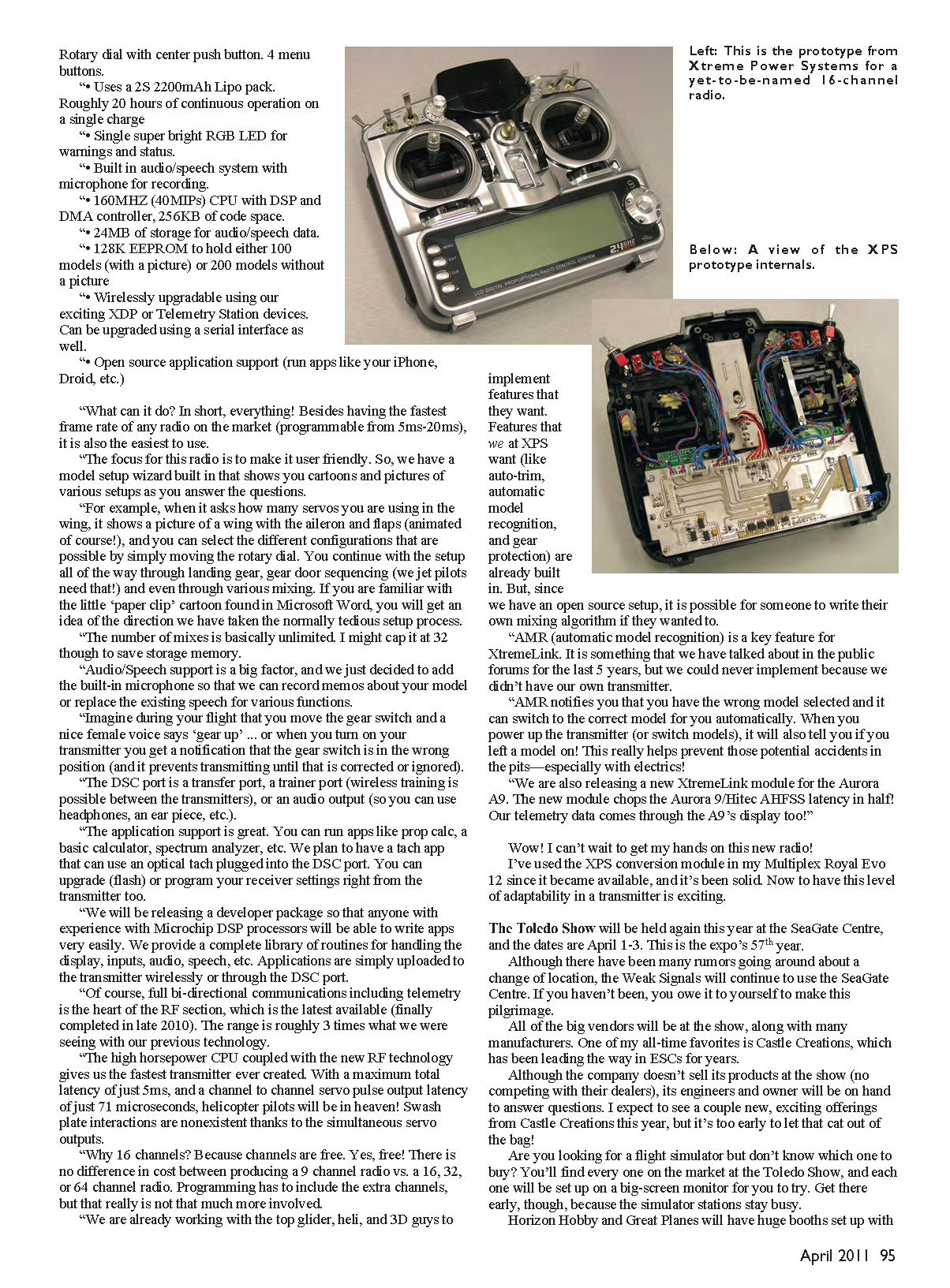
Representatives from Xtreme Power Systems (XPS) will be at the Weak Signals’ Toledo R/C Expo (the Toledo Show) this year, as usual, but XPS has much bigger news than in past years. XPS has been working on producing its own branded transmitter to complement its conversion modules and other products.
It is hoped the first production versions will be ready at Toledo or shortly after. This is an exciting development because the radio will have 16 channels and is open-source based—big news for techies who want to code and modify functions.
I talked to Jim Drew of XPS, and he provided the following details about the new system. I’m already on the list to buy one.
Transmitter (unnamed) — features
- 16 channels
- 4 stick pots, 2 slider pots, 2 knob pots
- 6 two-position switches, 2 three-position switches, and 4 trims (photos are of a prototype and subject to change)
- 240 x 64 backlit (white) LCD display
- Rotary dial with center push button; 4 menu buttons
- Uses a 2S 2200 mAh LiPo pack — roughly 20 hours of continuous operation on a single charge
- Single super-bright RGB LED for warnings and status
- Built-in audio/speech system with microphone for recording
- 160 MHz (40 MIPS) CPU with DSP and DMA controller; 256 KB of code space
- 24 MB of storage for audio/speech data
- 128 KB EEPROM to hold either 100 models (with a picture) or 200 models without a picture
- Wirelessly upgradable using XDP or Telemetry Station devices; can also be upgraded using a serial interface
- Open-source application support (run apps like prop calc, calculator, spectrum analyzer, etc.)
What can it do? In short, everything. Besides having the fastest frame rate of any radio on the market (programmable from 5 ms–20 ms), it is designed to be the easiest to use.
The focus for this radio is user friendliness. A model setup wizard shows cartoons and pictures of various setups as you answer questions. For example, when it asks how many servos you are using in the wing, it shows a picture of a wing with aileron and flaps (animated), and you can select different configurations by simply moving the rotary dial. The setup continues through landing gear, gear door sequencing, and various mixing. If you're familiar with the little “paper clip” cartoon found in Microsoft Word, you’ll get an idea of the direction taken to simplify the normally tedious setup process.
The number of mixes is basically unlimited (I might cap it at 32 to save storage memory).
Audio/speech support is a major feature; the built-in microphone lets you record memos about your model or replace existing speech for functions. Imagine during flight you move the gear switch and a voice says “gear up,” or when you turn on your transmitter you get a notification that the gear switch is in the wrong position (and it prevents transmitting until corrected or ignored).
The DSC port serves as a transfer port, a trainer port (wireless training is possible between transmitters), or an audio output (so you can use headphones or an earpiece).
Application support is strong. You can run apps like prop calc, a basic calculator, or a spectrum analyzer. They plan a tach app that can use an optical tach plugged into the DSC port. You can upgrade (flash) or program your receiver settings directly from the transmitter.
A developer package will be released so anyone experienced with Microchip DSP processors can write apps easily. XPS will provide a complete library of routines for handling display, inputs, audio, speech, etc. Applications can be uploaded wirelessly or through the DSC port.
Full bi-directional communications including telemetry is at the heart of the RF section, which was completed in late 2010. The range is roughly three times what they saw with previous technology.
The high-performance CPU coupled with new RF tech gives the fastest transmitter XPS has created. With a maximum total latency of just 5 ms and a channel-to-channel servo pulse output latency of just 71 microseconds, helicopter pilots will be delighted—swash plate interactions are nonexistent thanks to simultaneous servo outputs.
Why 16 channels? Because channels are essentially free. There is no difference in cost between producing a 9-channel versus a 16-, 32-, or 64-channel radio. Programming must include the extra channels, but that isn’t significantly more involved.
XPS is already working with top glider, heli, and 3D pilots to implement desired features. XPS features like auto-trim, automatic model recognition (AMR), and gear protection are already built in. With open-source setup, someone could write their own mixing algorithm if desired.
AMR is a key feature for XtremeLink. It notifies you if you have the wrong model selected and can switch to the correct model automatically. When you power up the transmitter (or switch models), it will also tell you if you left a model powered on—helping prevent potential accidents in the pits, especially with electrics.
XPS is also releasing a new XtremeLink module for the Aurora A9. The new module halves the Aurora 9/HiTec AFHSS latency, and XPS telemetry data comes through the A9’s display too.
I can’t wait to get my hands on this new radio. I’ve used the XPS conversion module in my Multiplex Royal Evo 12 since it became available, and it’s been solid. Now to have this level of adaptability in a transmitter is exciting.
The Toledo Show will be at the SeaGate Centre, April 1–3. This is the expo’s 57th year. Despite rumors of a location change, Weak Signals will continue to use the SeaGate Centre. If you haven’t been, you owe it to yourself to make the pilgrimage.
All the big vendors will be at the show, along with many manufacturers. One favorite is Castle Creations, a leader in ESCs for years. Although the company doesn’t sell products at the show (so as not to compete with dealers), engineers and reps will be available to answer questions. I expect to see a couple of exciting new products from Castle Creations this year, but it’s too early to share details.
If you’re looking for a flight simulator but don’t know which to buy, you’ll find every one on the market at the Toledo Show, each set up on a big-screen monitor for you to try. Get there early—the simulator stations stay busy.
Electrics - 2011/04
Many manufacturers will have products on display, and numerous engineers and factory demonstration pilots will be present to answer questions. Those companies don’t sell at the show, but products will be available from vendors.
You won't want to miss the Nick Ziroli Plans booth, where you'll find Nick and a host of well-known figures. Rich Uravitch and his products are represented at the Ziroli booth; he and Nick are a blast to hang out with. Their products are top-notch, and some will be for sale at the show.
I’ve shown my TME (Tejera Microsystems Engineering) Xtrema charger many times in this column and called it a must-have. Albert Tejera is the mind behind the inventions, and he will be in his booth demonstrating them. He also makes one of the finest smoke systems I’ve seen.
Aero-Model Inc./Hacker Brushless USA is another booth you won’t want to miss. Sean and Dana Plummer have been providing electric-power modelers with some of the finest motors in the world for years, and they continue to expand their line. Sean is a wealth of information, and his website features combo deals. Not all purple motors are the same—go to Toledo to see the original that others are copying.
Stevens AeroModel will appeal to builders and those who want to get into building. Bill Stevens has a main-floor booth stocked with fine laser-cut kits for indoor and park flying. He is always in the booth, which is fully stocked for selling. You can visit the indoor fly-in to see Bill’s products in flight, then return to buy them the next day. He also carries motors, controllers, and tools to optimize your models. Check out his electric CL designs too.
We used to struggle to find decent spinners for electric models, but Tru-Turn Precision Model Products has changed that. They developed a line of specialized electric spinners and propeller nuts. If you bring a motor to the show, the Tru-Turn staff will match it with the right setup for your needs.
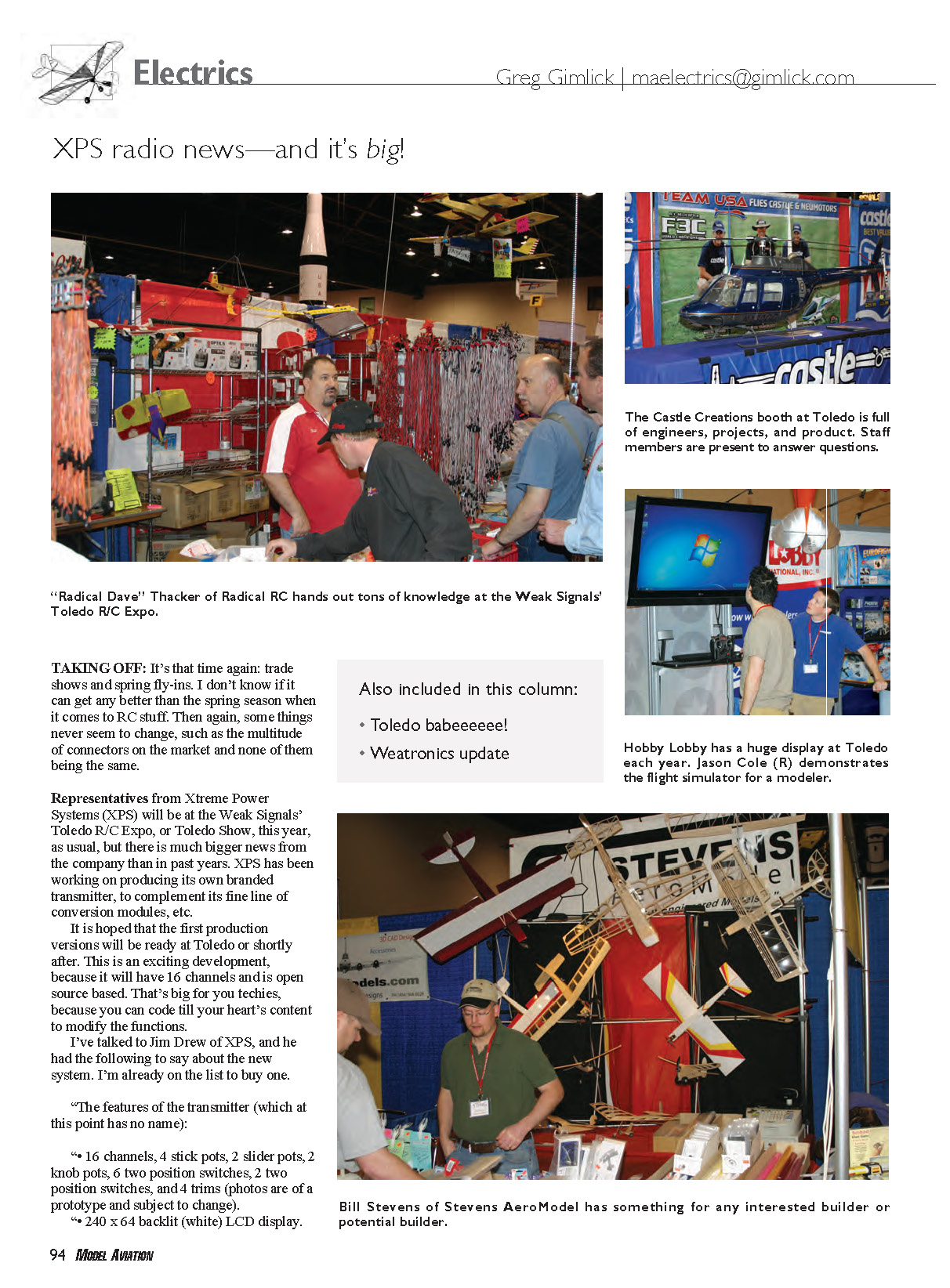
No big show would be complete without Dave Thacker and Radical RC. He spends more time offering advice and help to modelers than most. “Radical Dave” knows electrics, sells a ton of products he uses himself, and is a must-stop-at booth.
The Toledo Show wouldn’t be the Toledo Show without Hobby Lobby in all its glory. Its booth has grown every year, and the products are incredible. I think I’ve reviewed almost every one of the company’s thrust-vectoring jets in the last year—you can find them at the expo, along with flight simulators, hard-to-find accessories, and great advice.
Hitec/Multiplex won’t sell at the show but will have numerous reps to describe products and answer questions. The company has a full line of great-flying foam airplanes and exceptional radios. The telemetry in the Hitec Aurora system is getting rave reviews.
If you’ve wanted to try helicopters but have no one to help, consider the Multiplex Funcopter. It is a highly updated version of the old Lite Machines Corona fixed-pitch aircraft, encased in impact-resistant foam. I flew a Funcopter at the NEAT Fair; it’s an impressive, crashworthy trainer for helicopters.
Weatronic update
After I covered the Weatronic radio system in the December column, I heard from readers who had trouble contacting the company. Gerhard Paasche, U.S. distributor, clarified issues Weatronic faced after the recent death of the company’s founder:
- Weatronic Germany moved and restructured within Germany. They also changed servers and service providers, which caused problems.
- The service during this time was regrettably below standard, and Paasche offered no excuses—just the facts.
- The good news: Weatronic has developed new receivers and accessories. Paasche is receiving the first ones this month and will update his website accordingly (for an outlook on what’s coming, see www.weatronic.com for offerings in Europe).
- He will be filling existing orders this month and taking orders for current products now—and new products as soon as they appear on the website.
I hope Weatronic has resolved its issues by now. I continue to be impressed with the radio system and have had great service from it in my giant-scale WACO.
Final Approach
That's it—trade show season and big fly-ins are here, so I’ll be on the road for a while. I hope to see you at the field.
MA
Sources
- Xtreme Power Systems
2440 N. Kiowa Blvd. Lake Havasu City, AZ 86403 www.xtremepowersystems.net
- Toledo Show
Transcribed from original scans by AI. Minor OCR errors may remain.

