
More about World War I Aeroplanes, Inc.
Also included in this column:
- The mother of all charge adapters
- Zeus "max-charge" Li-Polys
- Get the correct connectors
- Antenna saver
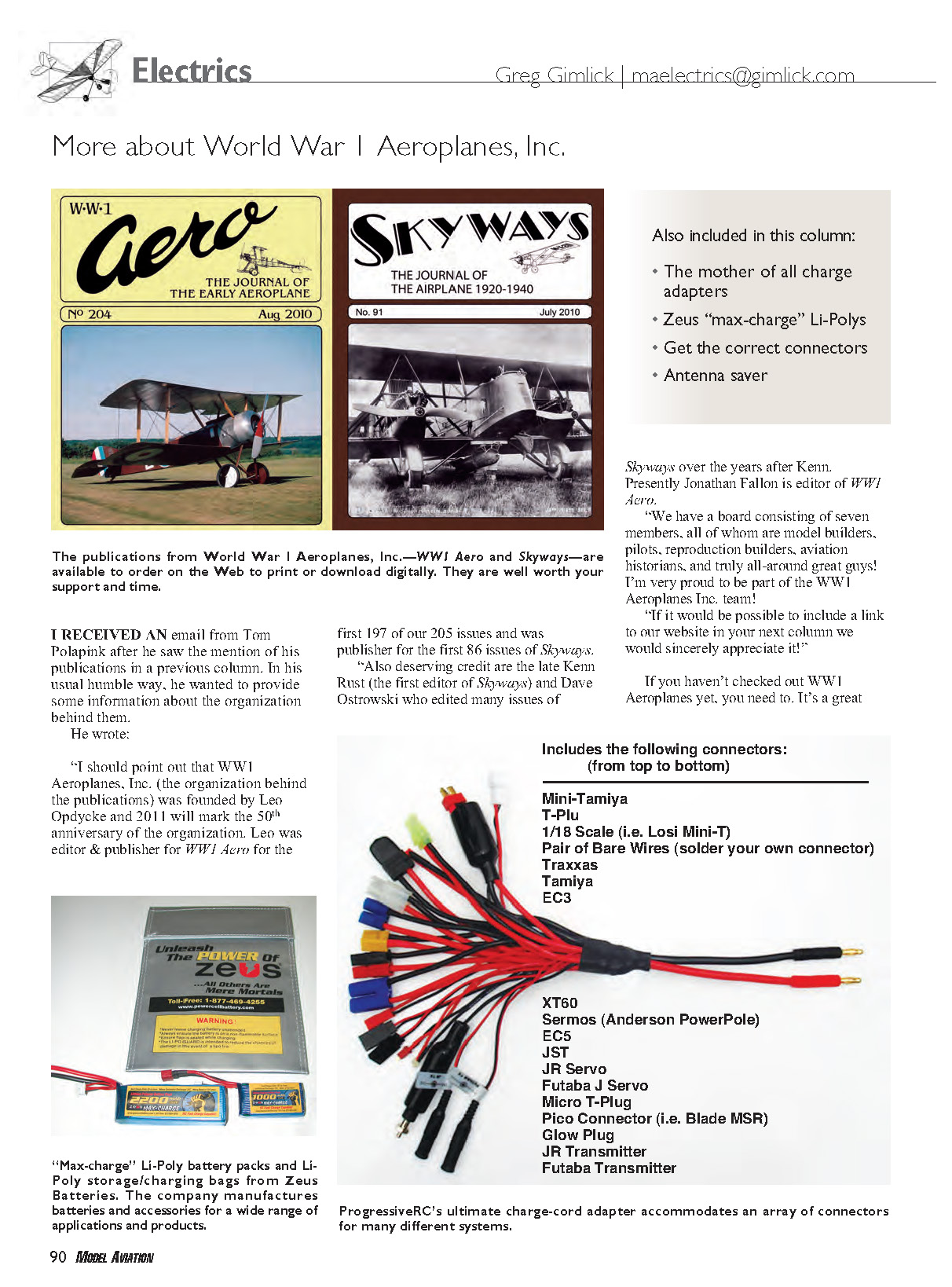
The publications from World War I Aeroplanes, Inc.—WW1 Aero and Skyways—are available to order on the web to print or download digitally. They are well worth your support and time.
I received an email from Tom Polapink after he saw the mention of his publications in a previous column. In his usual humble way, he wanted to provide some information about the organization behind them. He wrote:
"I should point out that WW1 Aeroplanes, Inc. (the organization behind the publications) was founded by Leo Opdycke and 2011 will mark the 50th anniversary of the organization. Leo was editor & publisher for WW1 Aero for the first 197 of our 205 issues and was publisher for the first 86 issues of Skyways.
"Also deserving credit are the late Kenn Rust (the first editor of Skyways) and Dave Ostrowski who edited many issues of Skyways over the years after Kenn. Presently Jonathan Fallon is editor of WW1 Aero.
"We have a board consisting of seven members, all of whom are model builders, pilots, reproduction builders, aviation historians, and truly all-around great guys! I'm very proud to be part of the WW1 Aeroplanes Inc. team!
"If it would be possible to include a link to our website in your next column we would sincerely appreciate it!"
If you haven't checked out WW1 Aeroplanes yet, you need to. It's a great organization that is worthy of our support. Contact information is in the "Sources" listing at the end of this column.
The Old Rhinebeck Aerodrome is a "must see" if you have even the slightest interest in WW I-era aircraft. Its annual RC event happens in September the week before the NEAT (Northeast Electric Aircraft Technology) Fair.
The mother of all charge adapters
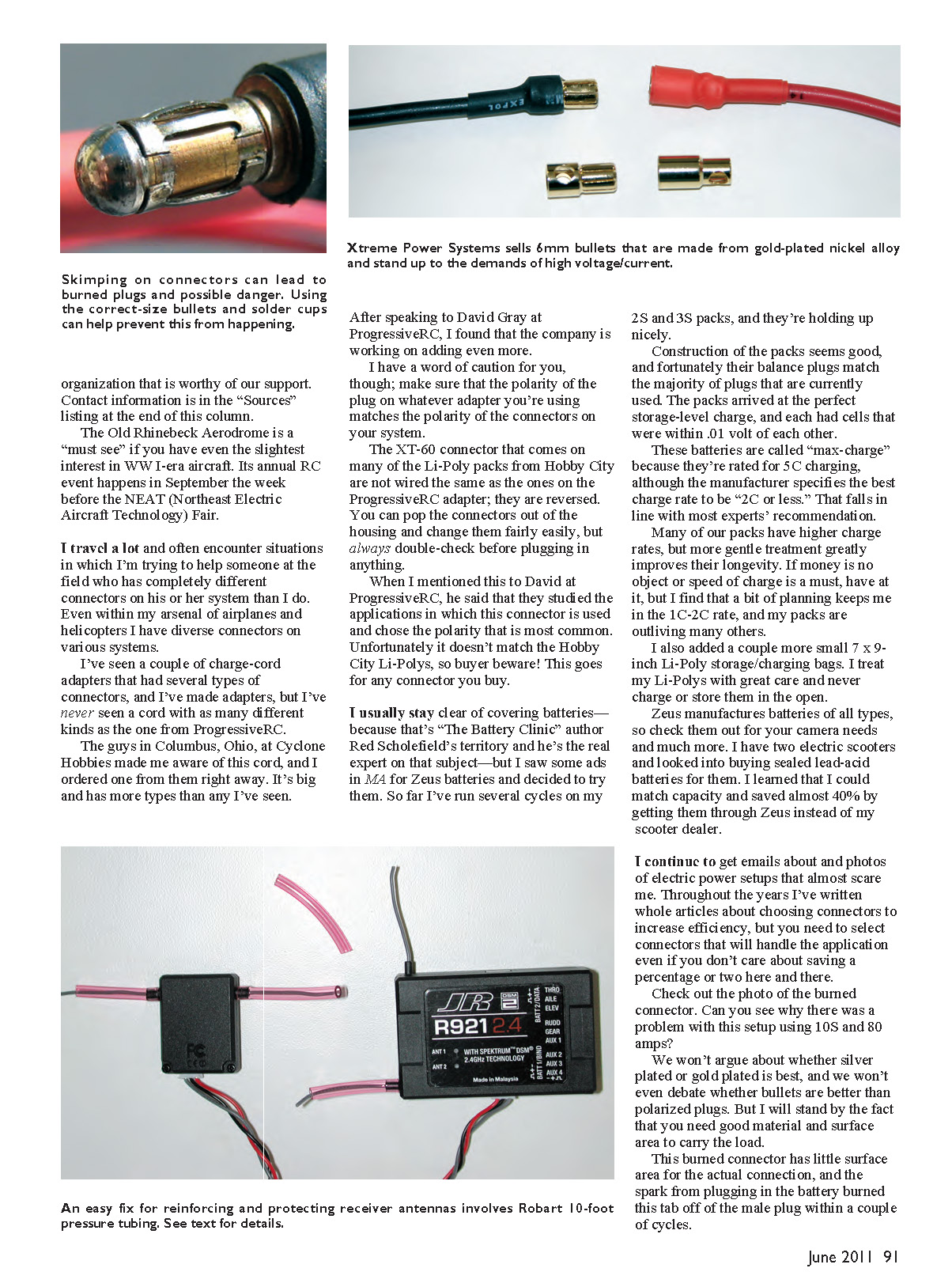
I travel a lot and often encounter situations at the field where someone's system uses completely different connectors than mine. Even within my own fleet I have diverse connector types. I've seen a couple of charge-cord adapters that had several connector types, and I've made adapters myself, but I've never seen a cord with as many different kinds as the one from ProgressiveRC. The guys in Columbus, Ohio, at Cyclone Hobbies made me aware of this cord, and I ordered one right away. It's large and contains more connector types than any I've seen. After speaking to David Gray at ProgressiveRC, I found that the company is working on adding even more.
A word of caution: make sure the polarity of the plug on whatever adapter you're using matches the polarity of the connectors on your system. The XT-60 connector that comes on many of the Li-Poly packs from HobbyCity is wired opposite to the ones on the ProgressiveRC adapter; they are reversed. You can pop the contacts out of the housing and change them fairly easily, but always double-check before plugging anything in. When I mentioned this to David at ProgressiveRC, he said they studied the applications in which this connector is used and chose the polarity that is most common. Unfortunately it doesn't match the HobbyCity Li-Polys, so buyer beware! This applies to any connector you buy.
Zeus "max-charge" Li-Polys
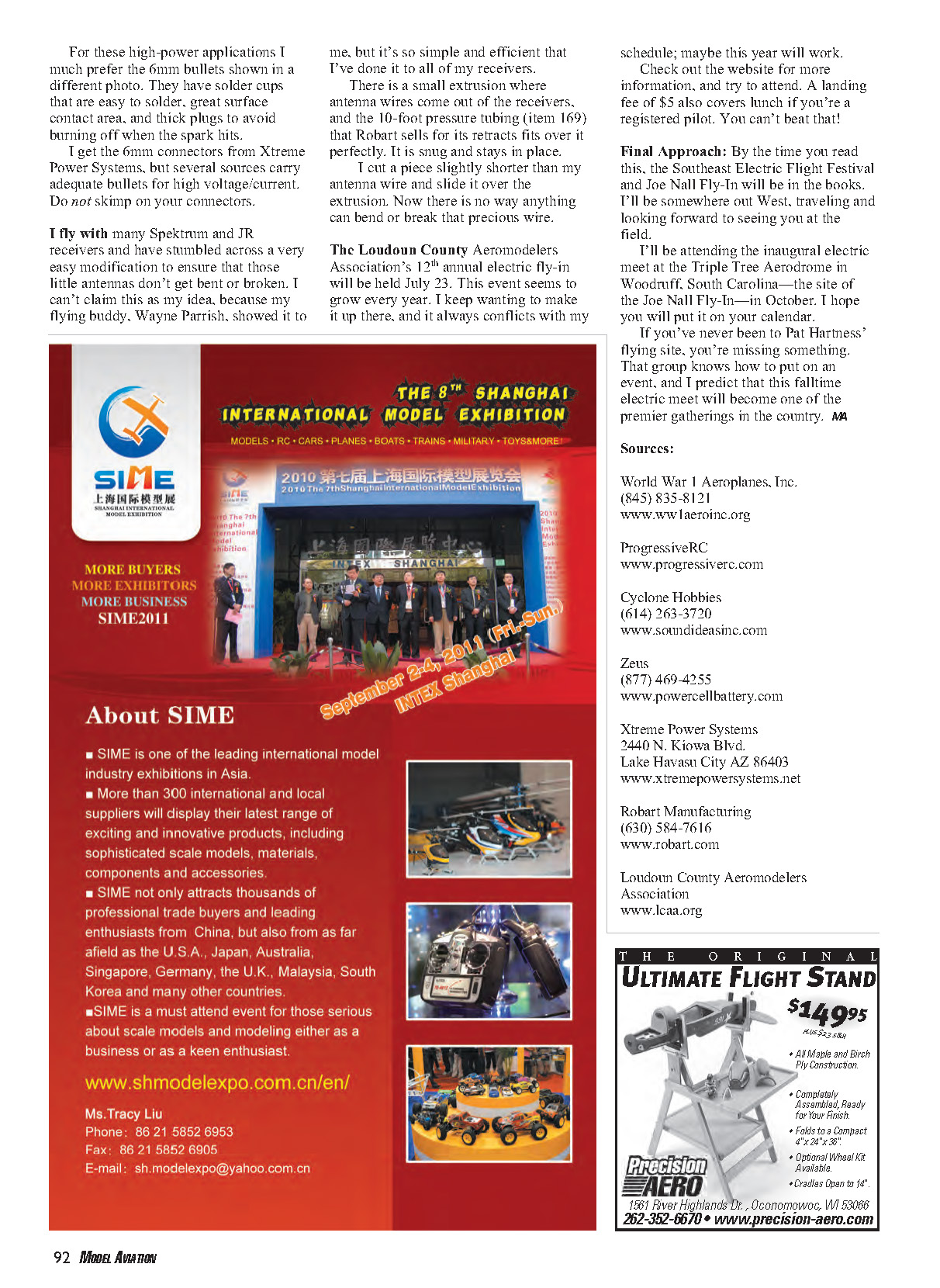
I usually stay clear of covering batteries—because that's "The Battery Clinic" author Red Scholefield's territory and he's the real expert—but I saw some ads in MA for Zeus batteries and decided to try them. So far I've run several cycles on my 2S and 3S packs and they're holding up nicely.
Construction of the packs seems good, and fortunately their balance plugs match the majority of plugs that are currently used. The packs arrived at the perfect storage-level charge, and each had cells that were within .01 volt of each other.
These batteries are called "max-charge" because they're rated for 5C charging, although the manufacturer specifies the best charge rate to be "2C or less." That falls in line with most experts' recommendations. Many of our packs are charged at higher rates, but gentler treatment greatly improves longevity. If money is no object or speed of charge is a must, go for higher C rates, but I find that planning to keep me in the 1C–2C range helps my packs outlive many others.
I also added a couple more small 7 x 9-inch Li-Poly storage/charging bags. I treat my Li-Polys with great care and never charge or store them in the open.
Zeus manufactures batteries of all types, so check them out for camera needs and much more. I have two electric scooters and looked into buying sealed lead-acid batteries for them. I learned that I could match capacity and saved almost 40% by getting them through Zeus instead of my scooter dealer.
Get the correct connectors
I continue to get emails and photos of electric power setups that almost scare me. Over the years I've written whole articles about choosing connectors to increase efficiency, but you need to select connectors that will handle the application even if you don't care about saving a percentage or two.
Check out the photo of the burned connector. Can you see why there was a problem with this setup using a 10S pack and 80 amps? We won't argue about whether silver plated or gold plated is best, and we won't even debate whether bullets are better than polarized plugs. But I will stand by the fact that you need good material and sufficient surface area to carry the load.
This burned connector has very little surface area for the actual electrical contact, and the spark from plugging in the battery burned the tab off the male plug within a couple of cycles.
If you are saving a few pennies and skimping on connectors, this is what's going to happen. The fix is easy: use the correct-size bullets and solder cups, and don't attempt to solder the wires directly to some small plug that isn't intended to carry 80 amps.
Antenna saver
I fly with many Spektrum and JR receivers and discovered a very easy modification to ensure those little antennas don't get bent or broken. I can't claim this as my idea—my flying buddy Wayne Parrish showed it to me—but it's so simple and effective that I've done it to all my receivers.
There is a small extrusion where antenna wires come out of the receivers, and the 10-foot pressure tubing (item 169) that Robart sells for its retracts fits over it perfectly. It is snug and stays in place. I cut a piece slightly shorter than my antenna wire and slide it over the extrusion. Now there's no way anything can bend or break that precious wire.
Events and trips
The Loudoun County Aeromodelers Association's 12th annual electric fly-in will be held July 23. This event seems to grow every year. I keep wanting to make it up there, and it always conflicts with my schedule; maybe this year will work. Check the website for more information, and try to attend. A landing fee of $5 also covers lunch if you're a registered pilot. You can't beat that!
Final Approach: By the time you read this, the Southeast Electric Flight Festival and Joe Nall Fly-In will be in the books. I'll be somewhere out West, traveling and looking forward to seeing you at the field.
I'll be attending the inaugural electric meet at the Triple Tree Aerodrome in Woodruff, South Carolina—the site of the Joe Nall Fly-In—in October. I hope you will put it on your calendar.
If you've never been to Pat Hartness' flying site, you're missing something. That group knows how to put on an event, and I predict that this falltime electric meet will become one of the premier gatherings in the country. MA
Sources:
- World War I Aeroplanes, Inc.
(845) 835-8121 www.ww1aeroinc.org
- ProgressiveRC
- Cyclone Hobbies
(614) 263-3720 www.soundideasinc.com
- Zeus
(877) 469-4255 www.powercellbattery.com
- Xtreme Power Systems
2440 N. Kiowa Blvd Lake Havasu City, AZ 86403 www.xtremepowersystems.net
- Robart Manufacturing
(630) 584-7616 www.robart.com
- Loudoun County Aeromodelers Association
Transcribed from original scans by AI. Minor OCR errors may remain.

