
People do read this column!
Greg Gimlick
I'm not alone! Sometimes I wonder if anybody really reads these columns, and then I write something that brings out responses and shows me that people do. Such was the case with my October 2012 column concerning high-powered electrics.
Space is short, so I'm going to get right to the emails.
A Better Solution
I cautioned about keeping connectors labeled and checking twice before connecting them for a series connection. I failed to discuss the obvious solution and Scott Bland contacted me about it with the following:
"I have been flying four different airplanes with a 12-cell setup for the last four years and have come up with a method that is 'pilot proof' (really me proof) for making the series connection safe and foolproof.
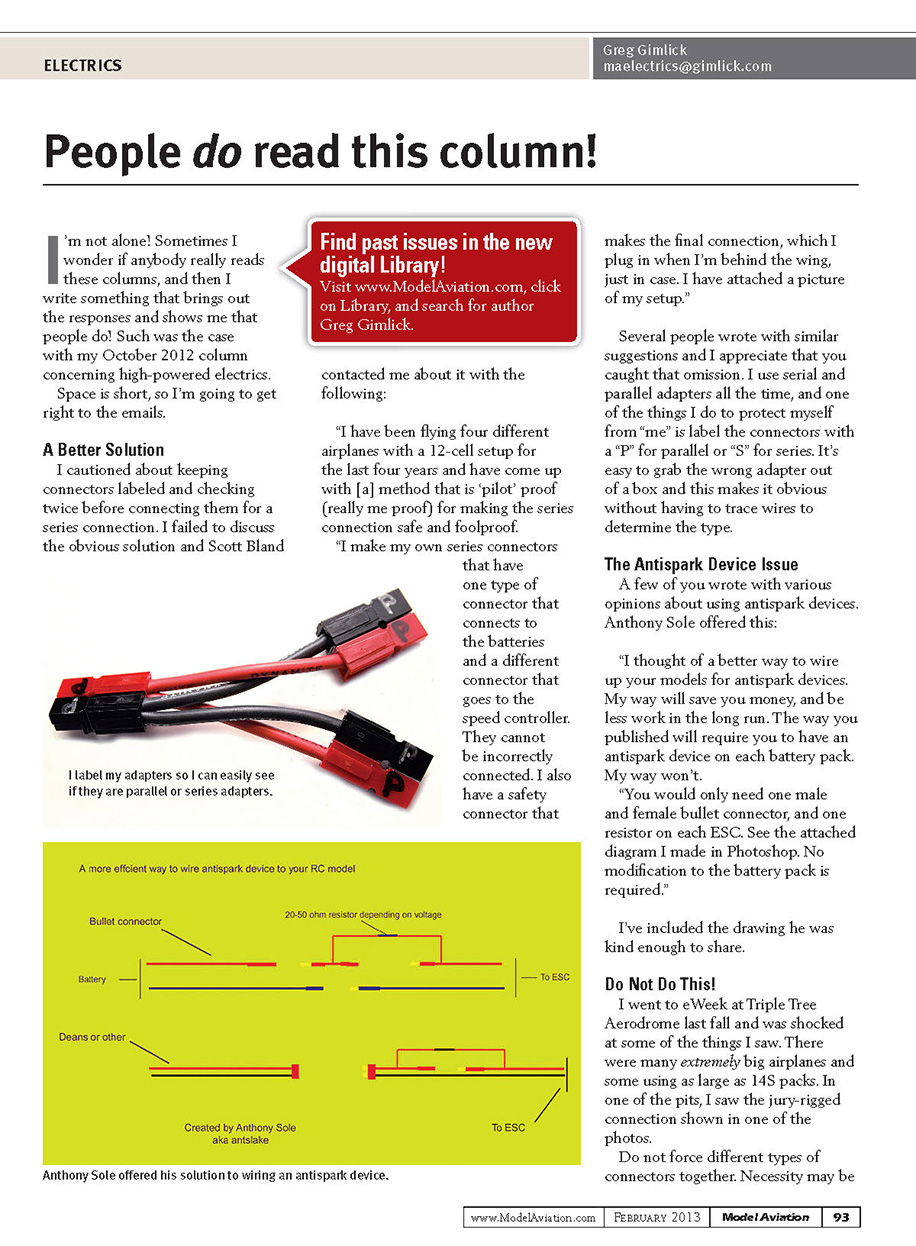
"I make my own series connectors that have one type of connector that connects to the batteries and a different connector that goes to the speed controller. They cannot be incorrectly connected. I also have a safety connector that makes the final connection, which I plug in when I'm behind the wing, just in case. I have attached a picture of my setup."
Several people wrote with similar suggestions and I appreciate that you caught that omission. I use serial and parallel adapters all the time, and one of the things I do to protect myself from "me" is label the connectors with a "P" for parallel or "S" for series. It's easy to grab the wrong adapter out of a box and this makes it obvious without having to trace wires to determine the type.
The Antispark Device Issue
A few of you wrote with various opinions about using antispark devices. Anthony Sole offered this:
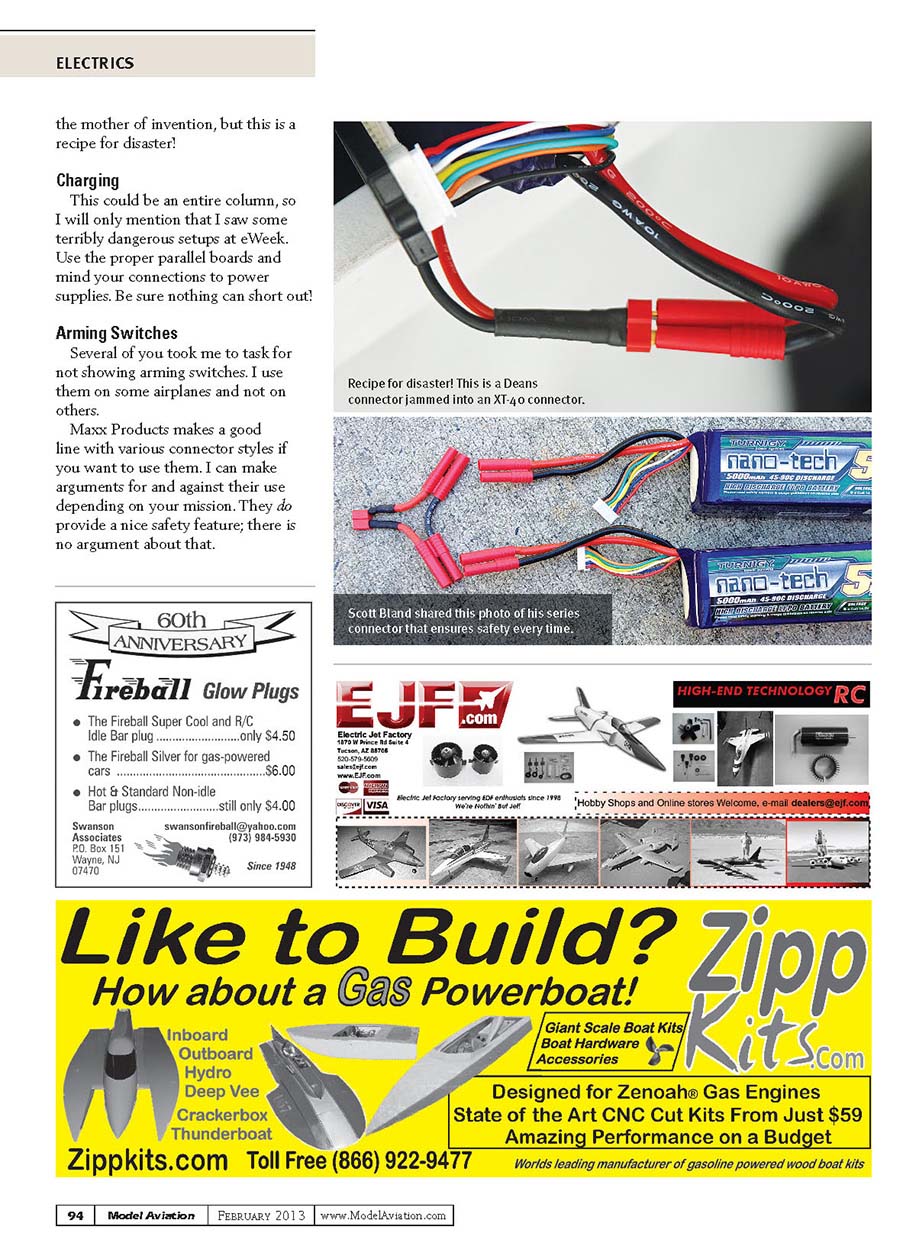
"I thought of a better way to wire up your models for antispark devices. My way will save you money, and be less work in the long run. The way you published will require you to have an antispark device on each battery pack. My way won't.
"You would only need one male and one female bullet connector, and one resistor on each ESC. See the attached diagram I made in Photoshop. No modification to the battery pack is required."
I've included the drawing he was kind enough to share.
Do Not Do This!
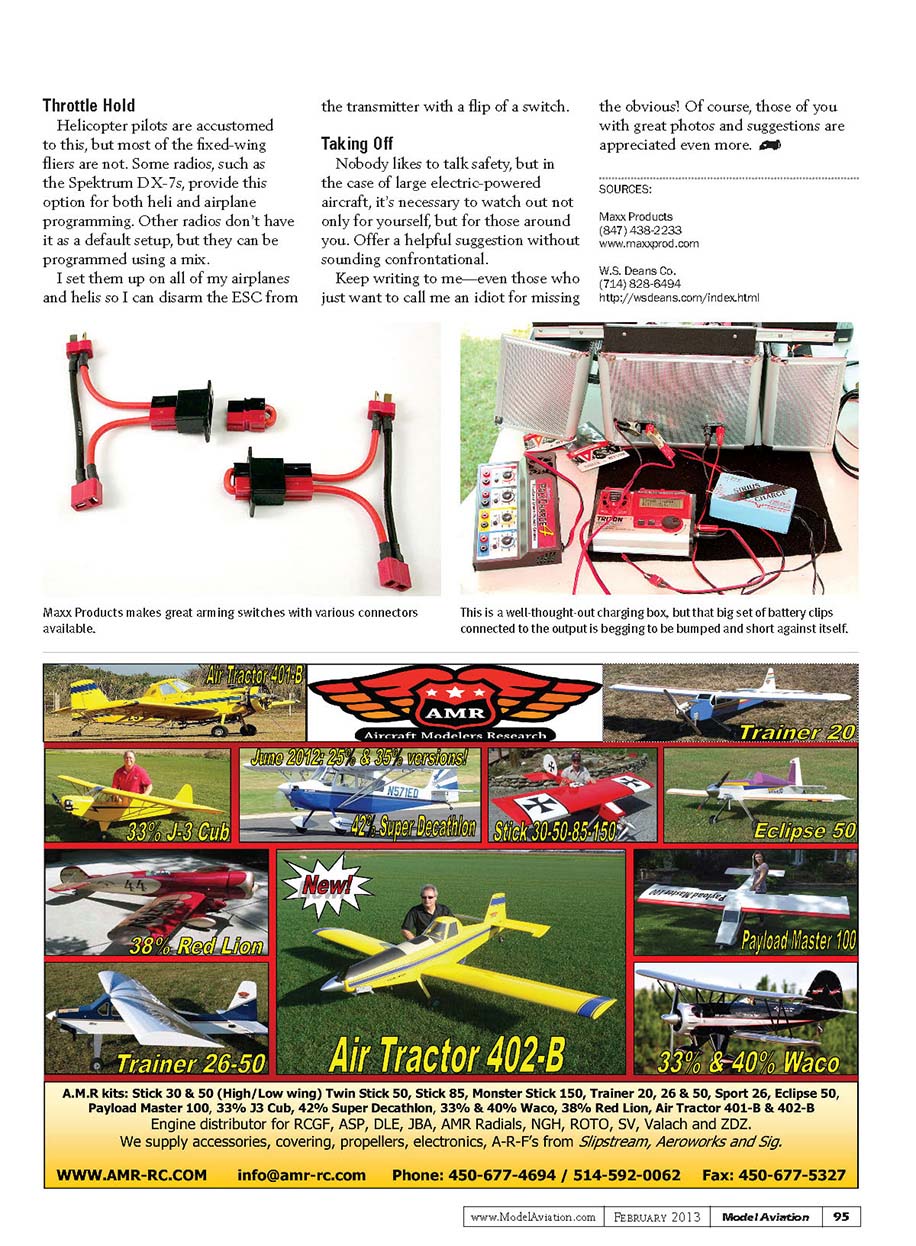
I went to eWeek at Triple Tree Aerodrome last fall and was shocked at some of the things I saw. There were many extremely big airplanes and some using as large as 14S packs. In one of the pits I saw a jury-rigged connection that was downright dangerous. Do not force different types of connectors together. Necessity may be the mother of invention, but this is a recipe for disaster!
Charging could be an entire column, so I'll only mention that I saw some terribly dangerous setups at eWeek. Use the proper parallel boards and mind your connections to power supplies. Be sure nothing can short out.
Arming Switches
Several of you took me to task for not showing arming switches. I use them on some airplanes and not on others. Maxx Products makes a good line with various connector styles if you want to use them. I can make arguments for and against their use depending on your mission, but they do provide a clear safety benefit.
Throttle Hold
Helicopter pilots are accustomed to this, but most fixed‑wing fliers are not. Some radios, such as the Spektrum DX‑7S, provide this option for both heli and airplane programming. Other radios don't have it as a default setup, but they can be programmed using a mix.
I set throttle hold up on all of my airplanes and helis so I can disarm the ESC from the transmitter with the flip of a switch.
Taking Off
Nobody likes to talk safety, but in the case of large electric-powered aircraft it's necessary to watch out not only for yourself but for those around you. Offer a helpful suggestion without sounding confrontational.
Keep writing to me—even those who just want to call me an idiot for missing the obvious! Of course, those of you with great photos and suggestions are appreciated even more.
SOURCES:
- Maxx Products
(847) 438-2233 www.maxxprod.com
- W.S. Deans Co.
(714) 828-6494 http://wsdeans.com/index.html
Transcribed from original scans by AI. Minor OCR errors may remain.

