
Electrics
Greg Gimlick
Keith Shaw writes about his "one-off" Czech-Mate
REMAINING FLEXIBLE: I was hoping to regale you in this column with tales of daring do from my trip to the NEAT (Northeast Electric Aircraft Technology) Fair in upstate New York, but as fate would have it I didn't get there.
The Army taught me to be "rigidly flexible," and as absurd as that seems, it works. I ended up with some health problems and was hospitalized instead of having electric fun with my friends, but things are on the upswing and I'm hoping to have some photos and info from them to include in the near future.
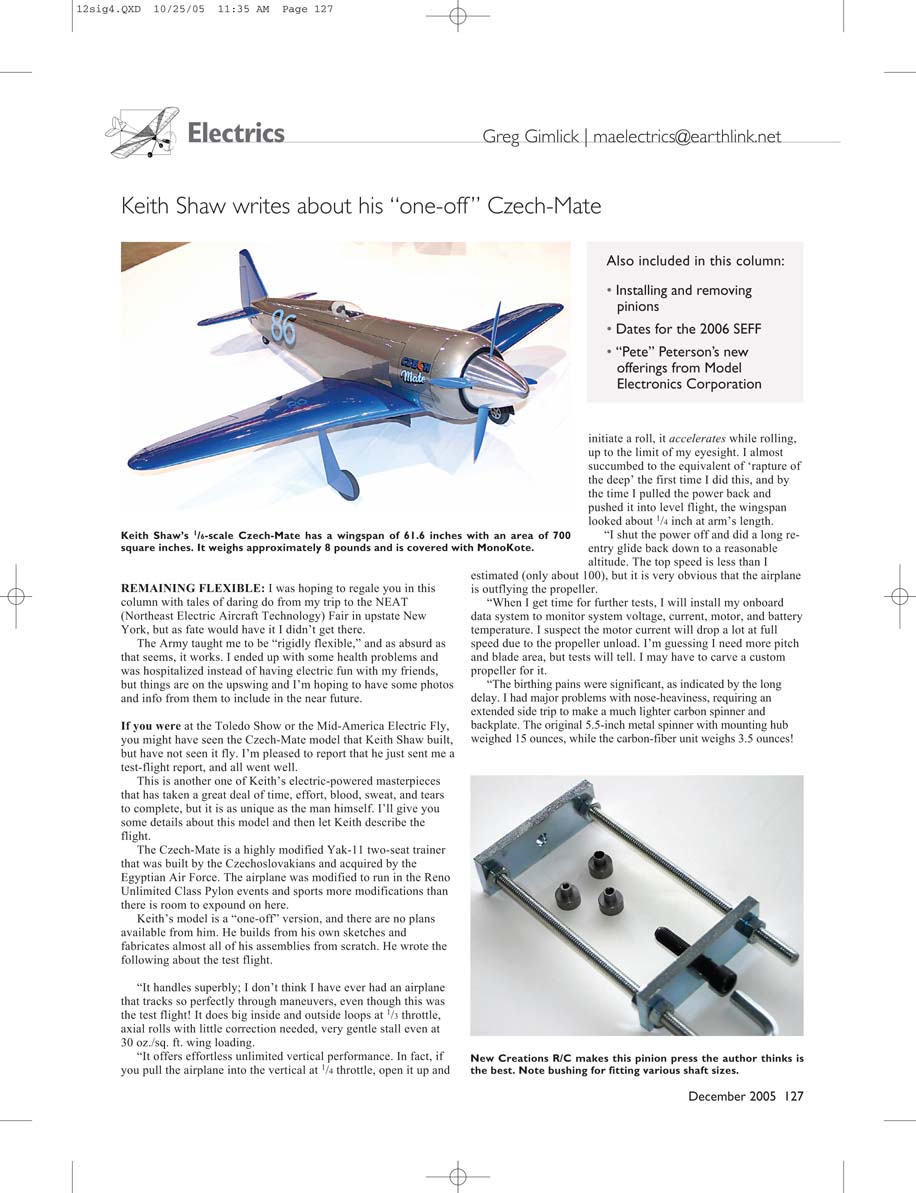
If you were at the Toledo Show or the Mid-America Electric Fly, you might have seen the Czech-Mate model that Keith Shaw built, but have not seen it fly. I'm pleased to report that he just sent me a test-flight report, and all went well.
This is another one of Keith's electric-powered masterpieces that has taken a great deal of time, effort, blood, sweat, and tears to complete, but it is as unique as the man himself. I'll give you some details about this model and then let Keith describe the flight.
The Czech-Mate is a highly modified Yak-11 two-seat trainer that was built by the Czechoslovakians and acquired by the Egyptian Air Force. The airplane was modified to run in the Reno Unlimited Class Pylon events and sports more modifications than there is room to expound on here.
Keith's model is a "one-off" version, and there are no plans available from him. He builds from his own sketches and fabricates almost all of his assemblies from scratch. He wrote the following about the test flight.
"It handles superbly; I don't think I have ever had an airplane that tracks so perfectly through maneuvers, even though this was the test flight! It does big inside and outside loops at 1/3 throttle, axial rolls with little correction needed, very gentle stall even at 30 oz./sq. ft. wing loading.
"It offers effortless unlimited vertical performance. In fact, if you pull the airplane into the vertical at 1/4 throttle, open it up and initiate a roll, it accelerates while rolling, up to the limit of my eyesight. I almost succumbed to the equivalent of 'rapture of the deep' the first time I did this, and by the time I pulled the power back and pushed it into level flight, the wingspan looked about 1/4 inch at arm's length.
"I shut the power off and did a long re-entry glide back down to a reasonable altitude. The top speed is less than I estimated (only about 100), but it is very obvious that the airplane is outlying the propeller.
"When I get time for further tests, I will install my onboard data system to monitor system voltage, current, motor, and battery temperature. I suspect the motor current will drop a lot at full speed due to the propeller unload. I'm guessing I need more pitch and blade area, but tests will tell. I may have to carve a custom propeller.
"The birthing pains were significant, as indicated by the long delay. I had major problems with nose-heaviness, requiring an extended side trip to make a much lighter carbon spinner and backplate. The original 5.5-inch metal spinner with mounting hub weighed 15 ounces, while the carbon-fiber unit weighs 3.5 ounces.
"I have made many carved plug/fiberglass molds, but this was the first attempt at a spinner. It is much harder to do than I imagined, several tricks to get the carbon cloth layup to release needed to be dreamed up. Wax and Polyvinyl Alcohol were not enough. But it was worth it: the spinner is scale shape and runs true.
There were also fits with the radio getting interference at partial throttle, cured by some repositioning of equipment and ferrite toroids on various radio leads. The Castle Creations Phoenix HV-85 controller is opto-isolated, but apparently there are enough generated fields to ride down ESC and servo wiring and scramble the receiver.
After all the bugs were worked out of the airplane, the weather decided to step in with rain, 30 mph and/or dead crosswinds, or 100% bright cloud cover, none conducive to the testing of a high-performance racer. I finally flew it last night after a short, unpredicted rain shower.
After the five-minute test flight, which used 2.6 Ahr of the 3.2 Ahr 9S1P Kokam pack, the motor temp was 100° F, the Castle controller was 90° F, but the Kokams were 130° F. Not all that high, but I think a couple of built-in blower fans would be appropriate as the peak currents are about 70 amps.
It's exciting to hear from someone who is a true craftsman. I know there are more of you out there, so don't be shy about sending in your information. Share it with others and see that you're not alone.
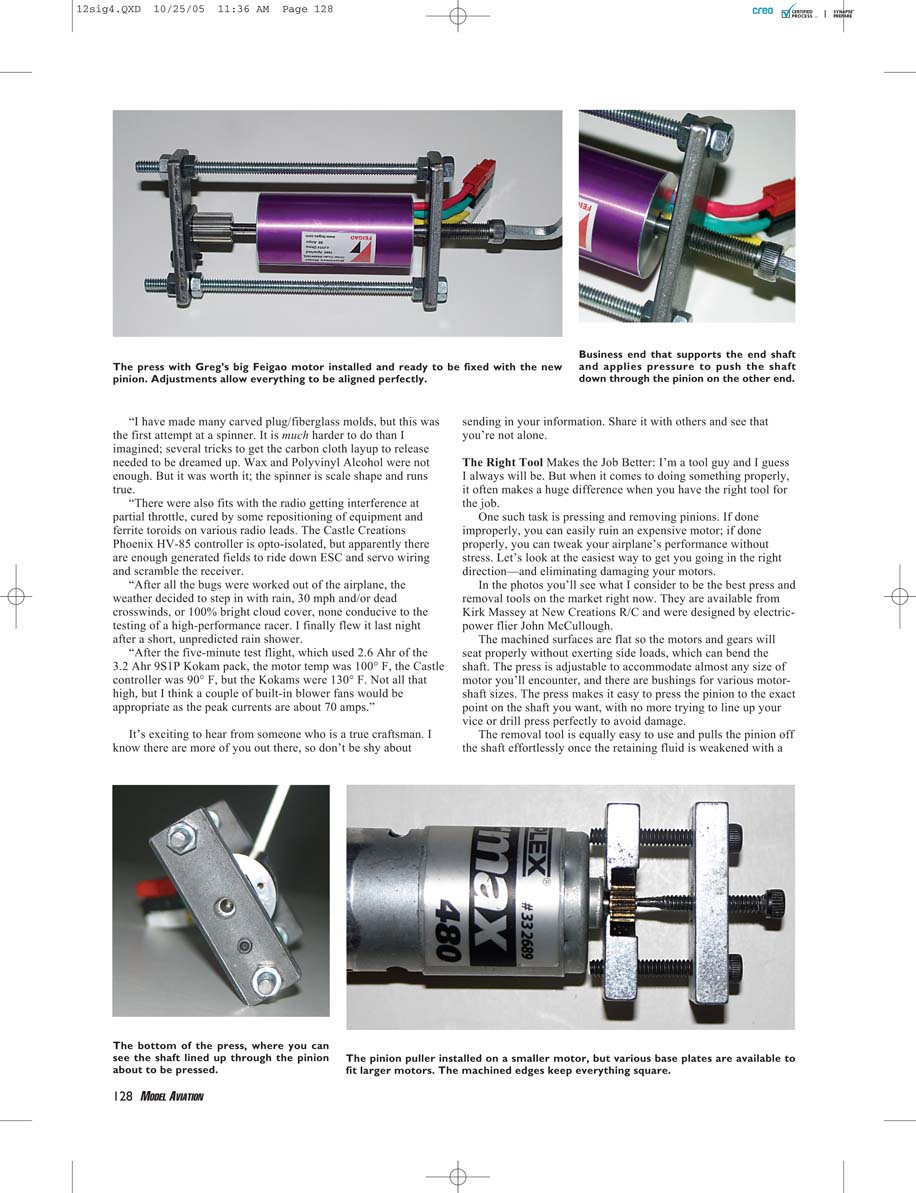
The Right Tool Makes the Job Better: I'm a tool guy and I guess I always will be. But when it comes to doing something properly, it often makes a huge difference when you have the right tool for the job.
One such task is pressing and removing pinions. If done improperly, you can easily ruin an expensive motor; if done properly, you can tweak your airplane's performance without stress. Let's look at the easiest way to get your going in the right direction—and eliminating damaging your motors.
In the photos you'll see what I consider to be the best press and removal tools on the market right now. They are available from Kirk Massey at New Creations R/C and were designed by electric-power flier John McCullough.
The machined surfaces are flat so the motors and gears will seat properly without exerting side loads, which can bend the shaft. The press is adjustable to accommodate almost any size of motor you'll encounter, and there are bushings for various motor-shaft sizes. The press makes it easy to press the pinion to the exact point on the shaft you want, with no more trying to line up your vice or drill press perfectly to avoid damage.
The removal tool is equally easy to use and pulls the pinion off of the shaft effortlessly once the retaining fluid is weakened with a touch. It will be available in a "Y" or "D" (Delta) version and is designed to power glow-engine models in the 40-90 size.*
I've got an order in for one of these motors to power one of my big models, so I will report back to you soon on that.
If there is a vendor you particularly trust and have had great experiences with, share the knowledge. Whether it's covered here or online, it's important to spend money wisely and help others avoid pitfalls. I don't want to get into the business of trashing businesses, but we can sure promote the great ones.
Final Approach: This is the December issue, so I'll take this opportunity to wish you all a Merry Christmas and a happy new year. Keep those letters and photos coming along with your suggestions for topics and projects. In the next column I'll address some of your questions about motor selection and try to clear up some confusion.
From the mail I've received so far, it looks as though you are doing some interesting things with electric power that need to be shared. I think I've caught up on all the E-mail from when I was out. If you haven't received a reply, please send me a reminder and I'll get right on it. MA
Manufacturers:
AstroFlight Inc. 13311 Beach Ave. Marina Del Rey CA 90292 (310) 821-6242 Fax: (310) 822-6637 [email protected] www.astroflight.com
Castle Creations 402 E. Pendleton Ave. Wellsville KS 66092 (785) 883-4519 Fax: (785) 883-4571 [email protected] www.eastcastlecreations.com
FMA Direct 5716A Industry Ln. Frederick MD 21704 (800) 343-2934 Fax: (301) 668-7619 www.fmadirect.com
New Creations R/C Box 496 Willis TX 77378 Tel./Fax: (936) 856-4630 www.newcreations-rc.com
Model Electronics Corporation 11512-155 Ave SE Renton WA 98059 (866) 507-9956 (excluding Canada) or (425) 255-4269 Fax: (425) 255-1558 [email protected] www.modelelectronicscorp.com
*Note: Available in sizes to power glow-engine models in the 40-90 size.
Transcribed from original scans by AI. Minor OCR errors may remain.

