
An electric search during the Joe Nall pilgrimage
Greg Gimlick | [email protected]
TAKING OFF:
Just when you think you have a great plan, things change. I missed SEFF (the Southeast Electric Flight Festival) this year, so I didn't get to see the world record set and I missed getting to see all the people I look forward to seeing every year.
I did get to the Joe Nall Fly-In, though, and I will write about the electric side of that. I also installed the newest version of the RealFlight G4 flight simulator and used the editing function to do some electrics, so I'll write about that. I better get busy; space goes quickly.
Joe Nall Fly-In: Every May, this is like a trip to Mecca for the big-airplane crowd. In spite of rising costs of travel, attendance was up and the number of models flown seemed to increase twofold.
One of the great changes this year was moving all the 3-D flying downwind to the second flying field, which left the primary field open to regular IMAC (International Miniature Aircraft Association) RC Aerobatics-type flying. This corrected the last couple years' space conflicts, and I think there was more flying at both fields because of it. There was plenty of room for everyone. The 72 MHz pins were kept at the home site, and the new area was 2.4 GHz only.
Electrics are becoming more prevalent, and the cost of owning them has come down significantly. Since I'm referring to Giant Scale, it's never going to be cheap, but now it's feasible for almost anyone who is interested to get a large model to fly at the Joe Nall gathering. The atmosphere at this event is the most relaxed of any large get-together I've attended, so even those of us who get jittery in front of a crowd can feel comfortable flying.
On the grand scale of things, Don Helms of Wilmington, North Carolina, flew his incredible KMP 96-inch-span OV-10 Bronco. It has wood-and-fiberglass construction, covered with 1/2-ounce cloth and finished with water-based polyurethane. The paint is base coat without clear coat because of clean electric power.
The 30-pound beast is powered by two E-flite Power 110 motors spinning APC 17 x 10E propellers behind 8S2P 5000 mAh Li-Poly packs and Castle Creations Phoenix HV-85 controllers. The retracts are from Century Jet Models.
Don says it's time to work on a scale cockpit. The OV-10 was spectacular in the air.
You may be asking, "What about a normal sport flier who wants to fly at Joe Nall?" Well, grab your Hobby Lobby catalog and get a Senior Telemaster—the ARF or build-it-yourself version.
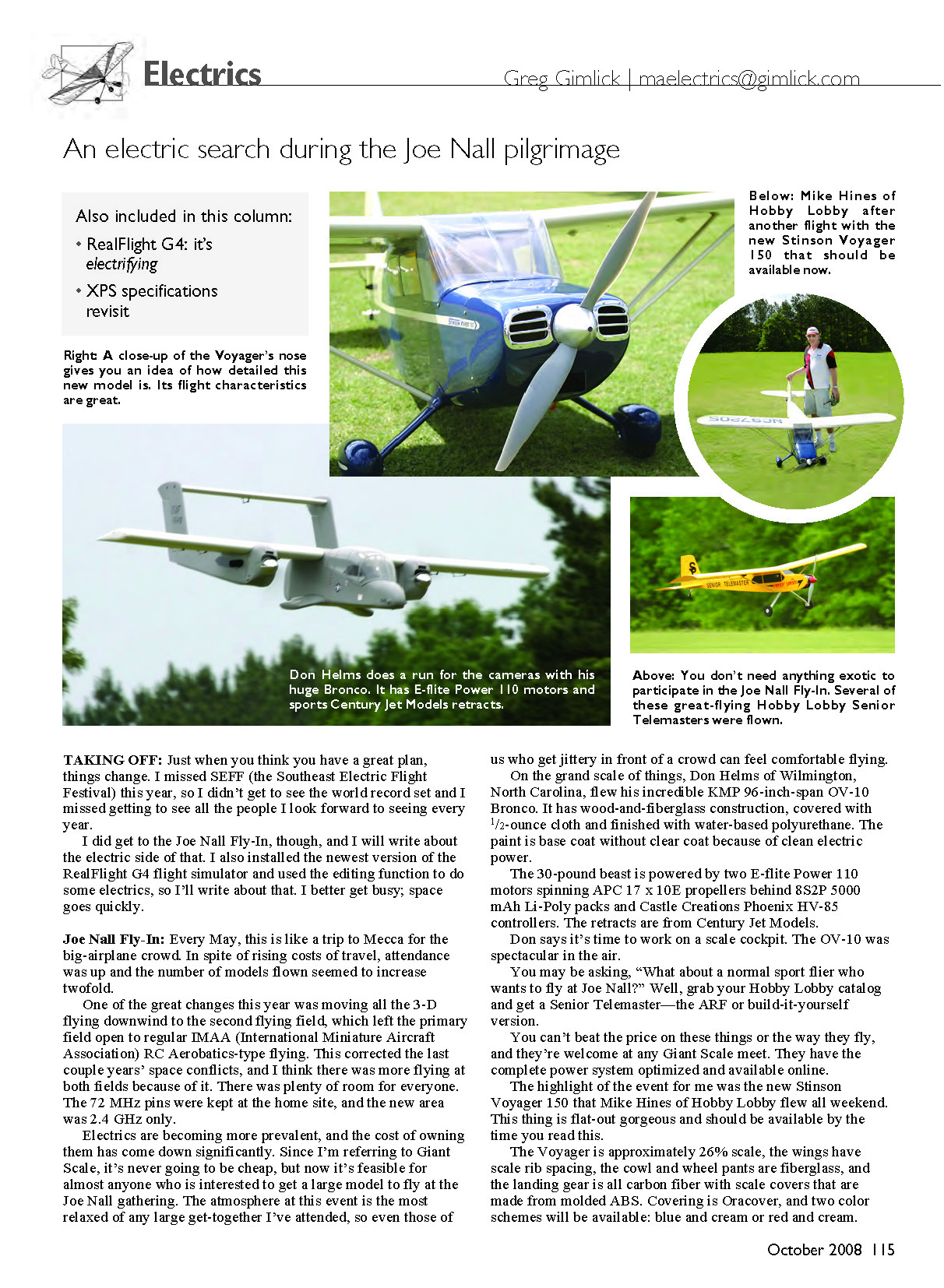
You can't beat the price on these things or the way they fly, and they're welcome at any Giant Scale meet. They have the complete power system optimized and available online. The highlight of the event for me was the new Stinson Voyager 150 that Mike Hines of Hobby Lobby flew all weekend. This thing is flat-out gorgeous and should be available by the time you read this.
The Voyager is approximately 26% scale, the wings have scale rib spacing, the cowl and wheel pants are fiberglass, and the landing gear is all carbon fiber with scale covers that are made from molded ABS. Covering is Oracover, and two color schemes will be available: blue and cream or red and cream.
Power is supplied by an AXI 5345/18 motor, a Jeti SPIN 99 ESC (although it draws only approximately 50–55 amps), an APC 22 x 12 propeller, and two 5000 mAh 5S Li-Poly packs in series. The Voyager's flight times are roughly 10 minutes with a safety margin, and it weighs approximately 18 pounds.
The Joe Nall Fly-In gets better every year. So if you can possibly work it into your schedule, you won't regret it. You can also meet and talk to almost all the AMA officers, so whine in person while having some fun.
RealFlight G4:
I've always been a fan of simulators, even in my full-scale flying career. They make you a better pilot and can save you a lot of money.
RealFlight is the brainchild of Knife Edge Software and is distributed by Great Planes. The real power behind it is Jim Bourke. If that name sounds familiar, it's because he started RCGroup and still owns it.
Jim has been around aviation his whole life and currently owns the only full-scale Yak-54 in the US, known as "Russian Thunder." See the source list for the Russian Thunder Web site.
That's a long way of saying that Jim knows a little something about airplanes, both full scale and models. He is the general manager and brain behind Knife Edge Software and employs a crew of wizards who help him refine and continuously improve the RealFlight simulator.
Rather than go through all the steps of installing the software and describing every aspect of the program, which would be impossible without several pages, I'm going to focus on using it to simulate an electric-powered model I have in my arsenal.
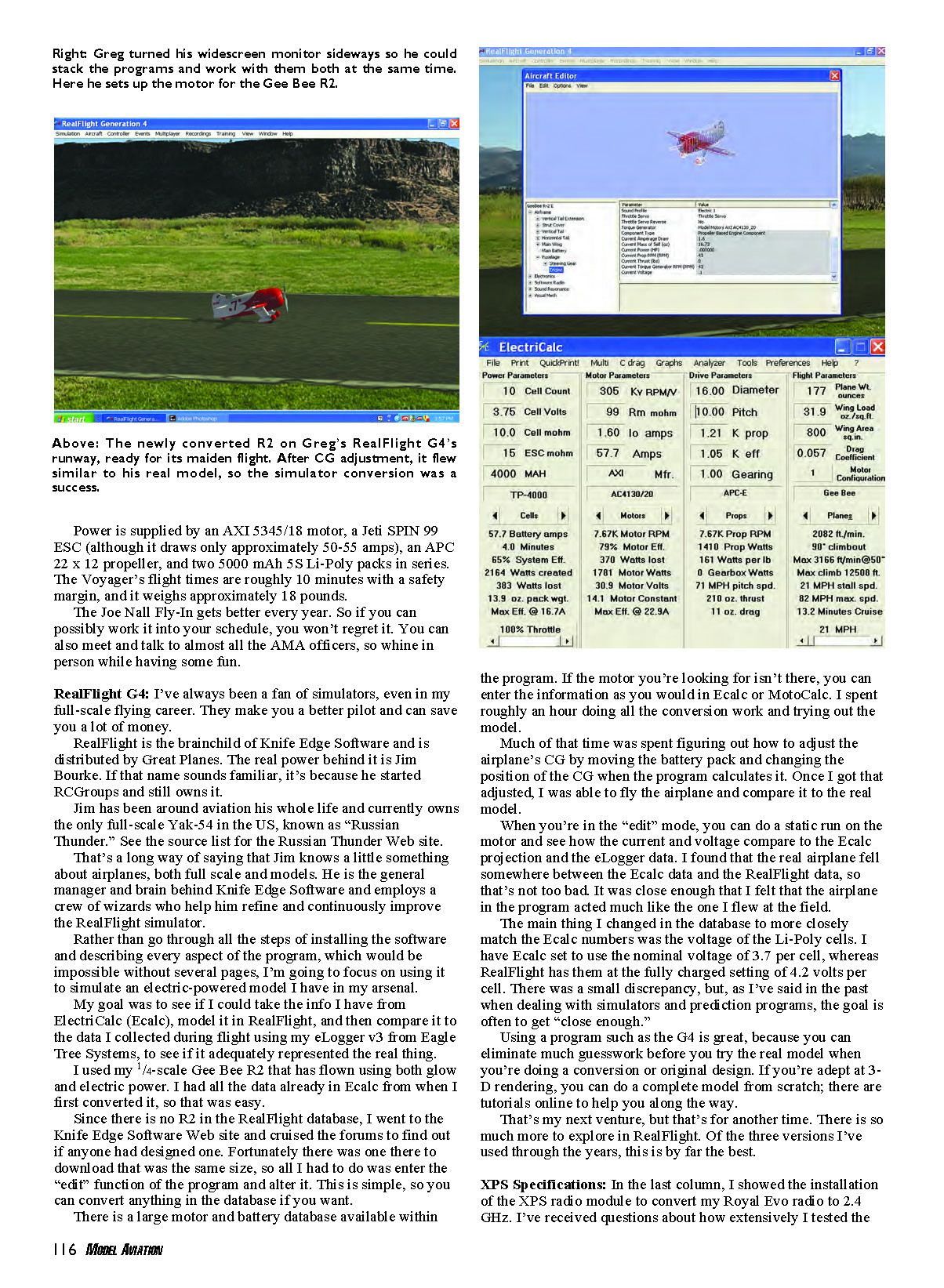
My goal was to see if I could take the info I have from ElectriCalc (Ecalc), model it in RealFlight, and then compare it to the data I collected during flight using my eLogger v3 from Eagle Tree Systems, to see if it adequately represented the real thing.
I used my 1/4-scale Gee Bee R2 that has flown using both glow and electric power. I had all the data already in Ecalc from when I first converted it, so that was easy.
Since there is no R2 in the RealFlight database, I went to the Knife Edge Software Web site and cruised the forums to find out if anyone had designed one. Fortunately there was one there to download that was the same size, so all I had to do was enter the "edit" function of the program and alter it. This is simple, so you can convert anything in the database if you want.
There is a large motor and battery database available within the program. If the motor you're looking for isn't there, you can enter the information as you would in Ecalc or MotoCalc. I spent roughly an hour doing all the conversion work and trying out the model.
Much of that time was spent figuring out how to adjust the airplane's CG by moving the battery pack and changing the position of the CG when the program calculates it. Once I got that adjusted, I was able to fly the airplane and compare it to the real model.
When you're in the "edit" mode, you can do a static run on the motor and see how the current and voltage compare to the Ecalc projection and the eLogger data. I found that the real airplane fell somewhere between the Ecalc data and the RealFlight data, so that's not too bad. It was close enough that I felt that the airplane in the program acted much like the one I flew at the field.
The main thing I changed in the database to more closely match the Ecalc numbers was the voltage of the Li-Poly cells. I have Ecalc set to use the nominal voltage of 3.7 per cell, whereas RealFlight has them at the fully charged setting of 4.2 volts per cell. There was a small discrepancy, but, as I've said in the past when dealing with simulators and prediction programs, the goal is often to get "close enough."
Using a program such as the G4 is great, because you can eliminate much guesswork before you try the real model when you're doing a conversion or original design. If you're adept at 3-D rendering, you can do a complete model from scratch; there are tutorials online to help you along the way.
That's my next venture, but that's for another time. There is so much more to explore in RealFlight. Of the three versions I've used through the years, this is by far the best. unit to determine the specs I listed.
The specs in my column were taken directly from the XPS Web site and its press information. I did not independently verify the information, nor have I verified the specs of the Spektrum radio I use. I am still flying both systems without incident. The purpose of the column was to show the installation process for the module and describe my experience thus far.
Final Approach:
It's in the high 90s in North Carolina as I write this, so building season is here for us. In the next column, I'll share some projects with you and show you the new toy I got from TME for my Xtrema charger that takes it up another notch. This is an extremely versatile charging system. MA
Sources:
- Russian Thunder
- RealFlight RC Simulator
- Knife Edge Software
885A NW Grant Ave. Suite A Corvallis OR 97330 www.knifeedge.com
- Eagle Tree Systems (eLogger v3)
(425) 614-0450 www.eagletreesystems.com/MicroPower/micro.htm
- TME
11705 Boyette Rd. #418 Riverview FL 33569 www.tmenet.com
- Hobby Lobby
(866) WE-FLY-RC (933-5972) www.hobby-lobby.com
Transcribed from original scans by AI. Minor OCR errors may remain.

