
Troubleshooting 101
Greg Gimlick
TROUBLE-SHOOTING 101: Lately, I've received many emails from readers requesting help with setups. As I look over the requests and review others I've received, I start to see a trend and it's time to talk about it.
The trend is to throw everything but the kitchen sink at the problem and not always in an organized manner. If no one teaches you how to check out issues, then you're on your own. Most of the emails I received came from fliers who don't have club members to help them.
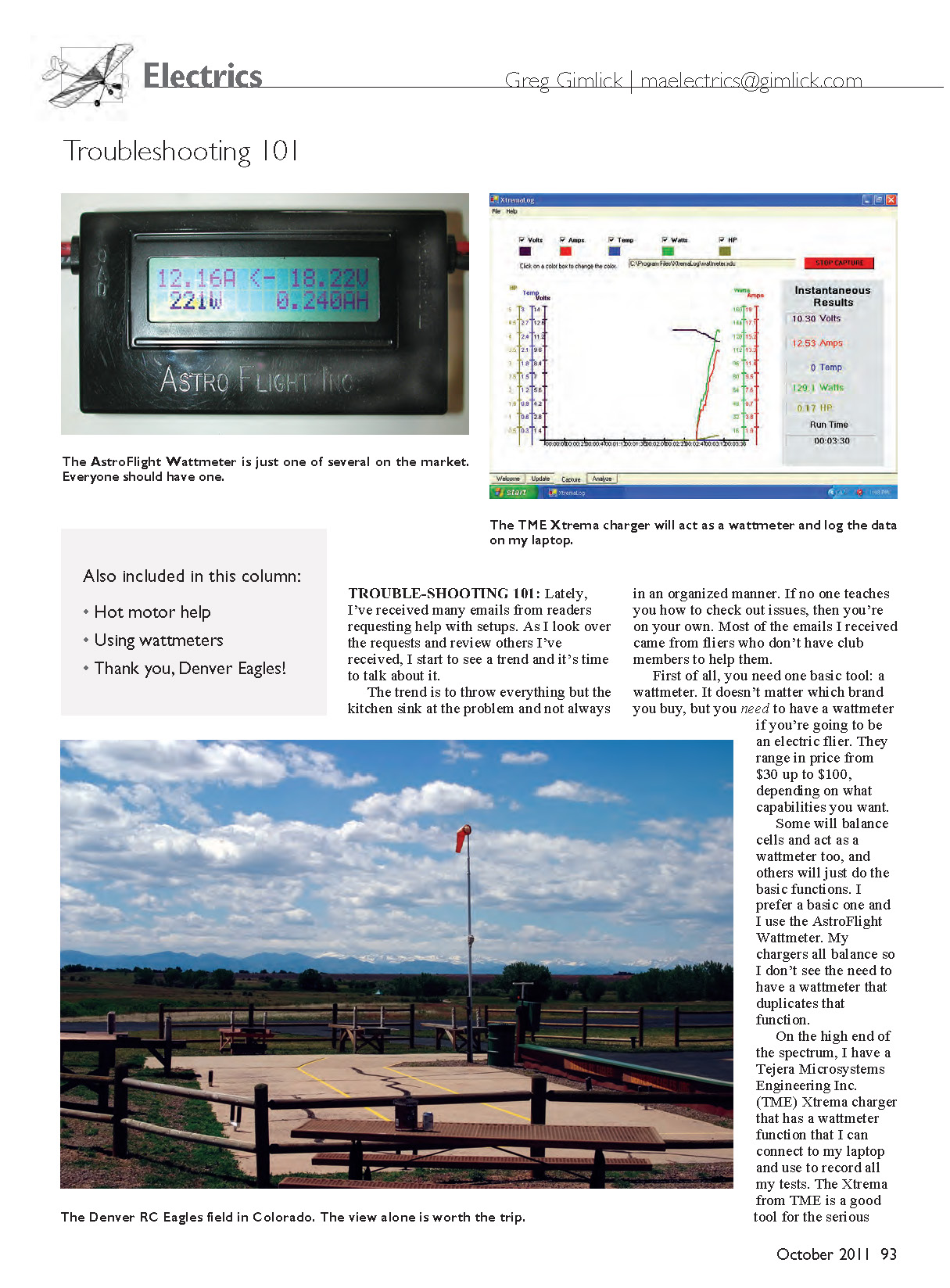
First of all, you need one basic tool: a wattmeter. It doesn't matter which brand you buy, but you need to have a wattmeter if you're going to be an electric flier. They range in price from $30 up to $100, depending on what capabilities you want.
Some will balance cells and act as a wattmeter too, and others will just do the basic functions. I prefer a basic one and I use the AstroFlight Wattmeter. My chargers all balance so I don't see the need to have a wattmeter that duplicates that function.
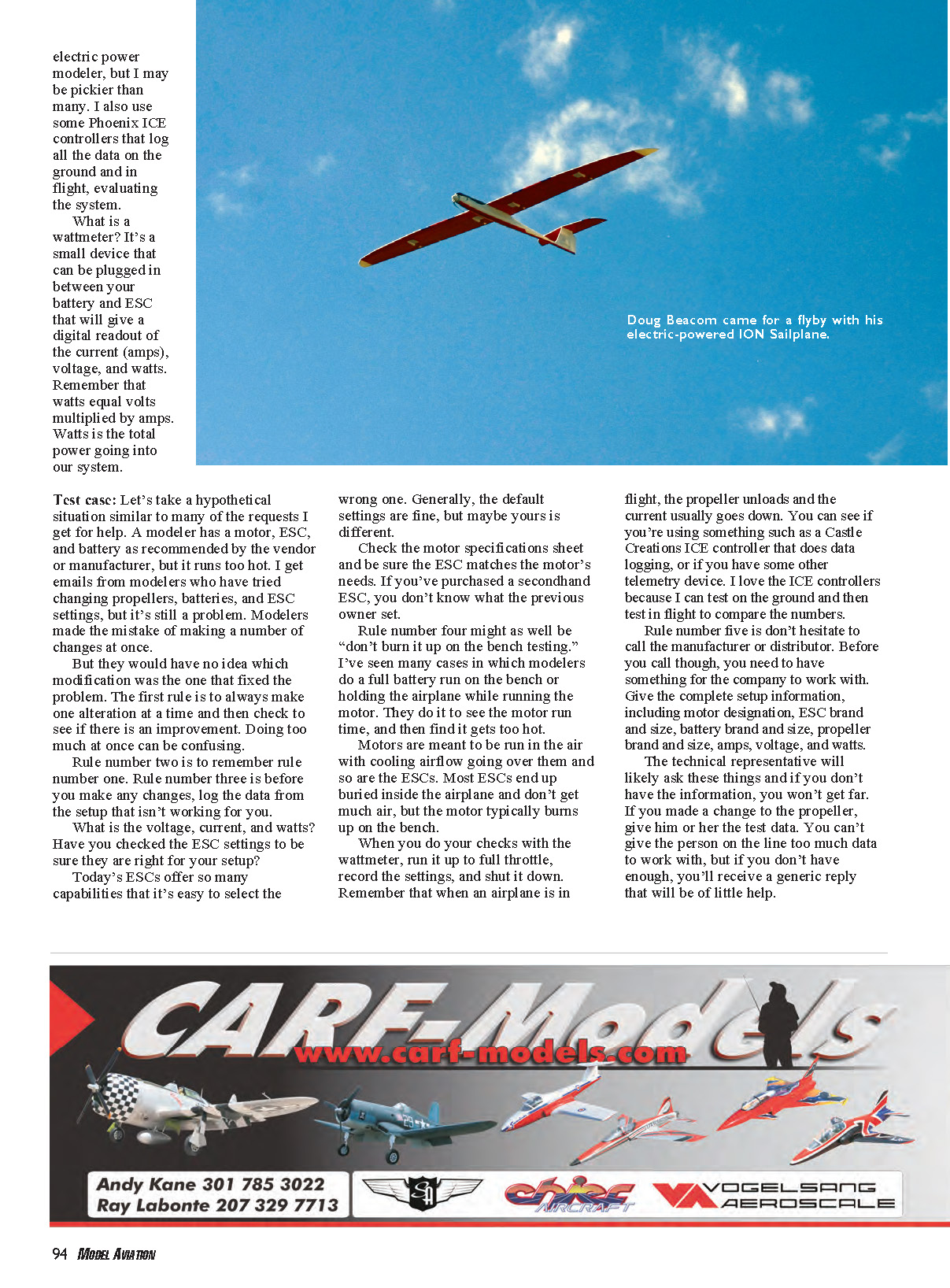
On the high end of the spectrum, I have a Tejera Microsystems Engineering Inc. (TME) Xtrema charger that has a wattmeter function that I can connect to my laptop and use to record all my tests. The Xtrema from TME is a good tool for the serious electric power modeler, but I may be pickier than many. I also use some Phoenix ICE controllers that log all the data on the ground and in flight, evaluating the system.
What is a wattmeter? It's a small device that can be plugged in between your battery and ESC that will give a digital readout of the current (amps), voltage, and watts. Remember that watts equal volts multiplied by amps. Watts is the total power going into our system.
Test case: Let's take a hypothetical situation similar to many of the requests I get for help. A modeler has a motor, ESC, and battery as recommended by the vendor or manufacturer, but it runs too hot. I get emails from modelers who have tried changing propellers, batteries, and ESC settings, but it's still a problem. Modelers made the mistake of making a number of changes at once.
But they would have no idea which modification was the one that fixed the problem. The first rule is to always make one alteration at a time and then check to see if there is an improvement. Doing too much at once can be confusing.
Rule number two is to remember rule number one. Rule number three is before you make any changes, log the data from the setup that isn't working for you.
What is the voltage, current, and watts? Have you checked the ESC settings to be sure they are right for your setup?
Today's ESCs offer so many capabilities that it's easy to select the wrong one. Generally, the default settings are fine, but maybe yours is different.
Check the motor specifications sheet and be sure the ESC matches the motor's needs. If you've purchased a secondhand ESC, you don't know what the previous owner set.
Rule number four might as well be "don't burn it up on the bench testing." I've seen many cases in which modelers do a full battery run on the bench or holding the airplane while running the motor. They do it to see the motor run time, and then find it gets too hot.
Motors are meant to be run in the air with cooling airflow going over them and so are the ESCs. Most ESCs end up buried inside the airplane and don't get much air, but the motor typically burns up on the bench.
When you do your checks with the wattmeter, run it up to full throttle, record the settings, and shut it down. Remember that when an airplane is in flight, the propeller unloads and the current usually goes down. You can see if you're using something such as a Castle Creations ICE controller that does data logging, or if you have some other telemetry device. I love the ICE controllers because I can test on the ground and then test in flight to compare the numbers.
Rule number five is don't hesitate to call the manufacturer or distributor. Before you call though, you need to have something for the company to work with. Give the complete setup information, including motor designation, ESC brand and size, battery brand and size, propeller brand and size, amps, voltage, and watts.
The technical representative will likely ask these things and if you don't have the information, you won't get far. If you made a change to the propeller, give him or her the test data. You can't give the person on the line too much data to work with, but if you don't have enough, you'll receive a generic reply that will be of little help.
Electrics
Greg Gimlick
Some common findings: There is no single answer to all of the heat problems, but I have discovered some common themes. Here is a small list of the findings:
- Wrong ESC setting (outrunner set for an inrunner, switching rate, etc.)
- Wrong propeller size
- Poor choice of connectors
- Incorrect motor choice
- No cooling air to motor or ESC
- Overtesting on the bench damaged the motor
What the wattmeter will do for you:
- Predict flight time by knowing volts, current, and wattage at full charge. This is an estimate only. Do not do a full battery run on the bench to determine flight time.
- Be sure that peak currents are safe for motor, wiring, and connector.
- Check battery health and compare to charger numbers.
- Double-check the ESC's low-voltage cutoff.
- Help you choose the best propeller or gearing, and the most efficient motor.
- Check for wiring and connector power losses.
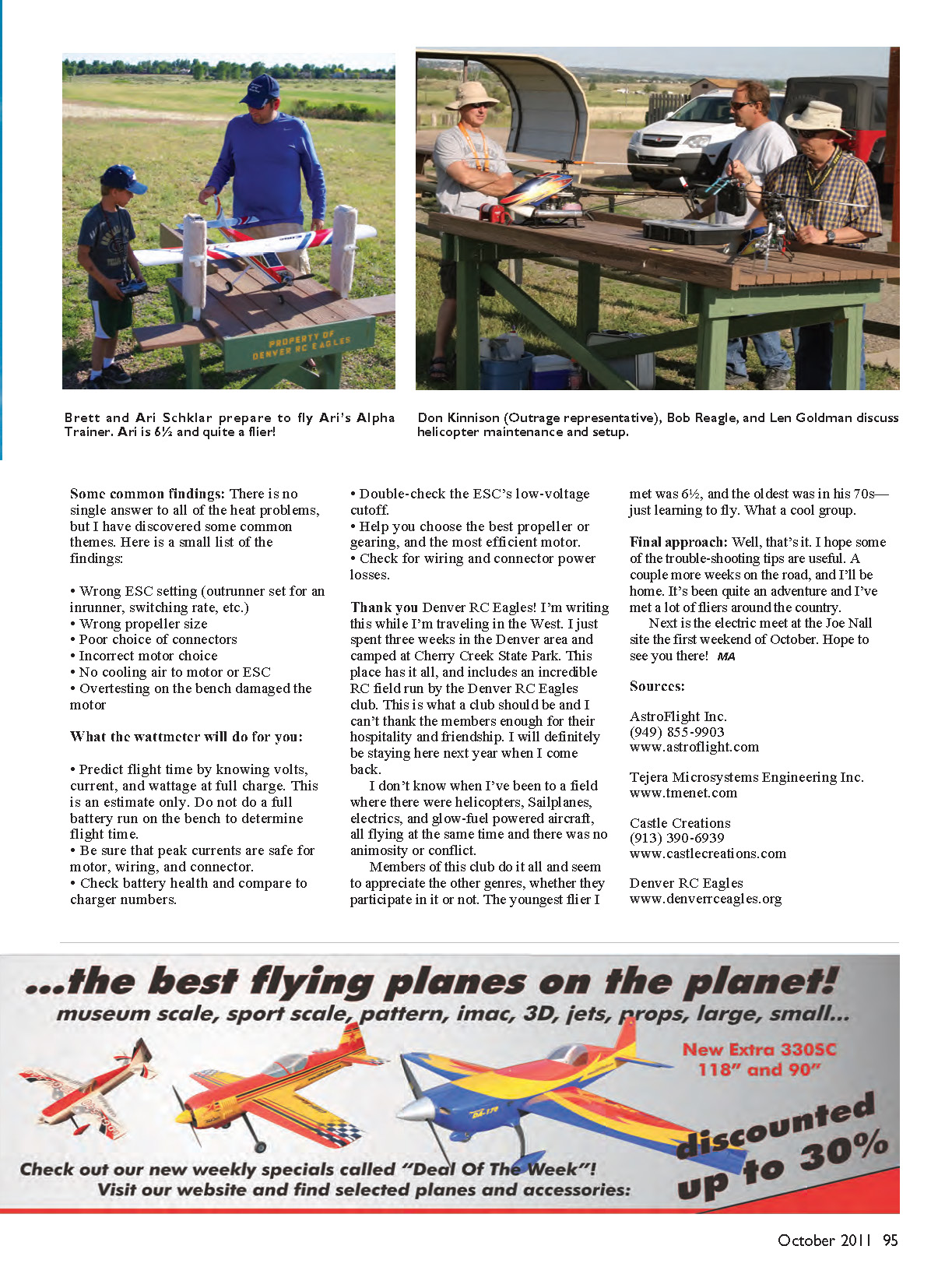
Thank you Denver RC Eagles! I'm writing this while I'm traveling in the West. I just spent three weeks in the Denver area and camped at Cherry Creek State Park. This place has it all, and includes an incredible RC field run by the Denver RC Eagles club. This is what a club should be and I can't thank the members enough for their hospitality and friendship. I will definitely be staying here next year when I come back.
I don't know when I've been to a field where there were helicopters, sailplanes, electrics, and glow-fuel powered aircraft, all flying at the same time and there was no animosity or conflict.
Members of this club do it all and seem to appreciate the other genres, whether they participate in it or not. The youngest flier I met was 6½, and the oldest was in his 70s—just learning to fly. What a cool group.
Final approach: Well, that's it. I hope some of the trouble-shooting tips are useful. A couple more weeks on the road, and I'll be home. It's been quite an adventure and I've met a lot of fliers around the country.
Next is the electric meet at the Joe Nall site the first weekend of October. Hope to see you there!
Sources:
- AstroFlight Inc.
(949) 855-9903 www.astroflight.com
- Tejera Microsystems Engineering Inc.
- Castle Creations
(913) 390-6939 www.castlecreations.com
- Denver RC Eagles
Transcribed from original scans by AI. Minor OCR errors may remain.

