
Electrified Fanatic
by Christopher True
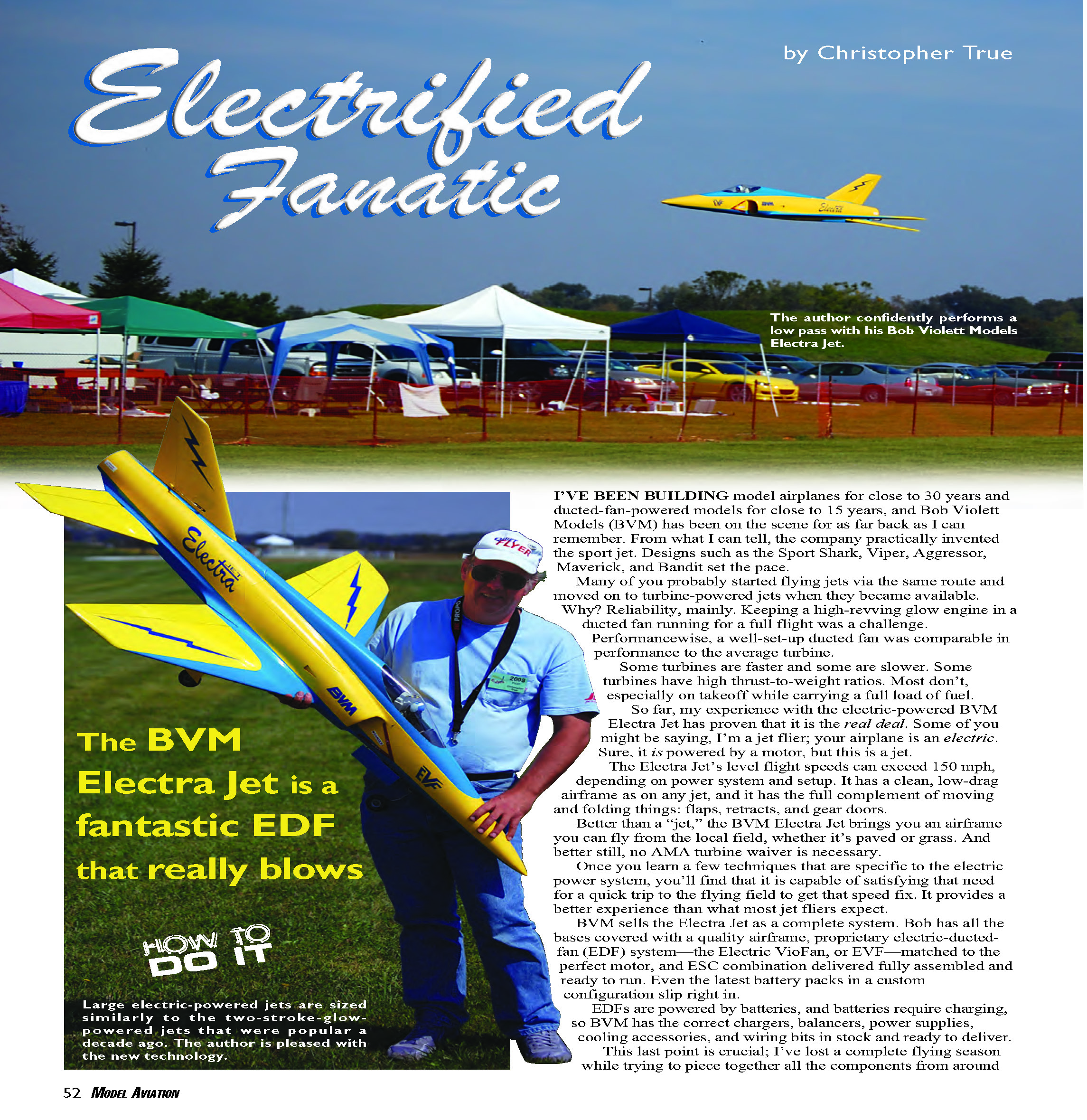
I've been building model airplanes for close to 30 years and ducted-fan-powered models for close to 15 years, and Bob Violett Models (BVM) has been on the scene for as far back as I can remember. From what I can tell, the company practically invented the sport jet. Designs such as the Sport Shark, Viper, Aggressor, Maverick, and Bandit set the pace.
Many of you probably started flying jets via the same route and moved on to turbine-powered jets when they became available. Why? Reliability, mainly. Keeping a high-revving glow engine in a ducted fan running for a full flight was a challenge.
Performance-wise, a well-set-up ducted fan was comparable in performance to the average turbine.
Some turbines are faster and some are slower. Some turbines have high thrust-to-weight ratios. Most don't, especially on takeoff while carrying a full load of fuel.
So far, my experience with the electric-powered BVM Electra Jet has proven that it is the real deal. Some of you might be saying, "I'm a jet flier; your airplane is an electric." Sure, it is powered by a motor, but this is a jet.
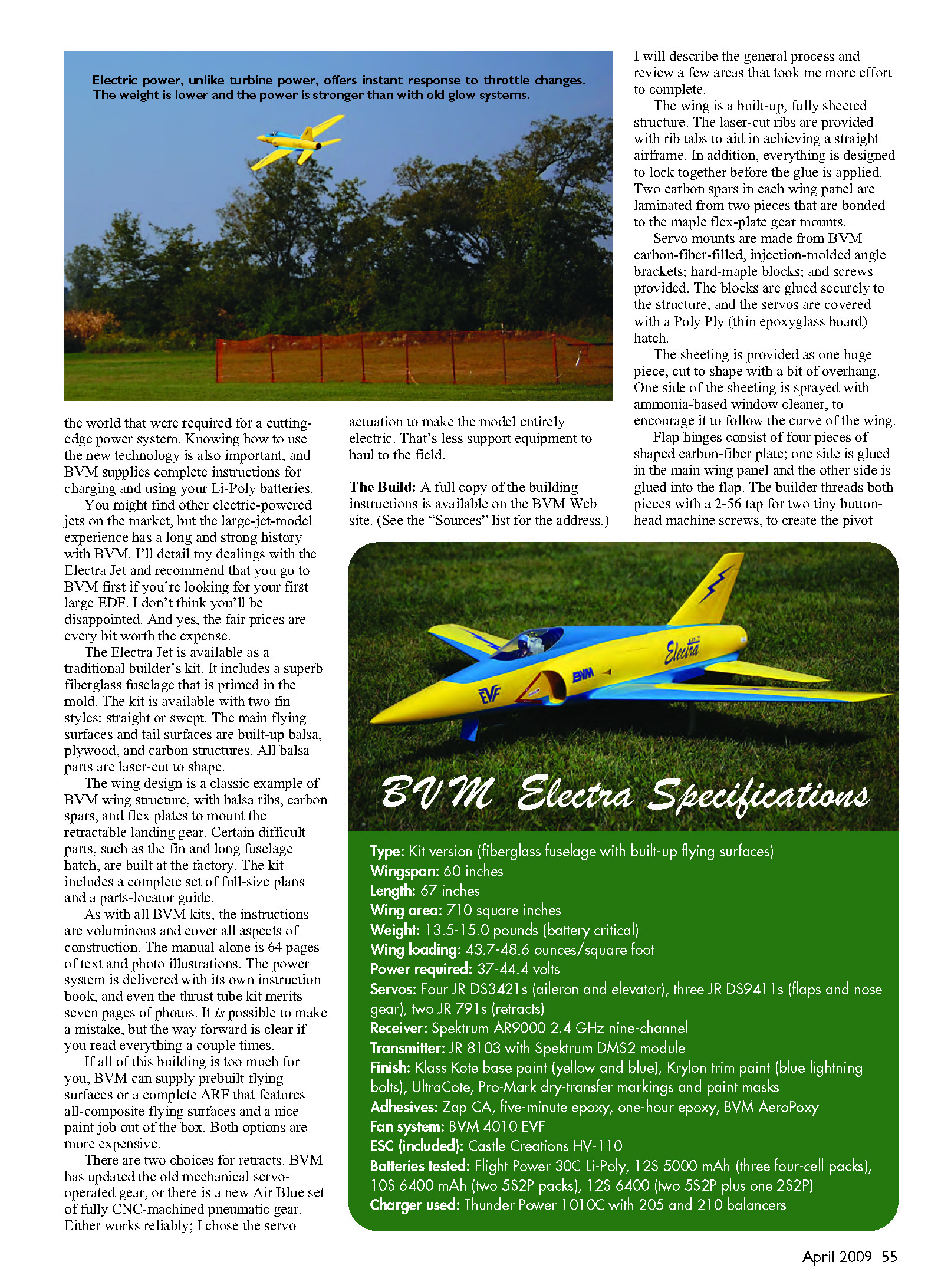
The Electra Jet's level-flight speeds can exceed 150 mph, depending on power system and setup. It has a clean, low-drag airframe as on any jet, and it has the full complement of moving and folding things: flaps, retracts, and gear doors.
Better than a "jet," the BVM Electra Jet brings you an airframe you can fly from the local field, whether it's paved or grass. And better still, no AMA turbine waiver is necessary.
Once you learn a few techniques that are specific to the electric power system, you'll find that it is capable of satisfying that need for a quick trip to the flying field to get that speed fix. It provides a better experience than what most jet fliers expect.
BVM sells the Electra Jet as a complete system. Bob has all the bases covered with a quality airframe, proprietary electric-ducted-fan (EDF) system—the Electric VioFan, or EVF—matched to the perfect motor and ESC combination delivered fully assembled and ready to run. Even the latest battery packs in a custom configuration slip right in.
EDFs are powered by batteries, and batteries require charging, so BVM has the correct chargers, balancers, power supplies, cooling accessories, and wiring bits in stock and ready to deliver. This last point is crucial; I've lost a complete flying season while trying to piece together all the components from around the country that were required for a cutting-edge power system. Large electric-powered jets are sized similarly to the two-stroke, glow-powered jets that were popular a decade ago. Knowing how to use the new technology is also important, and BVM supplies complete instructions for charging and using your Li-Poly batteries.
You might find other electric-powered jets on the market, but the large-jet-model experience has a long and strong history with BVM. I’ll detail my dealings with the Electra Jet and recommend that you go to BVM first if you’re looking for your first large EDF. I don’t think you’ll be disappointed. And yes, the fair prices are every bit worth the expense.
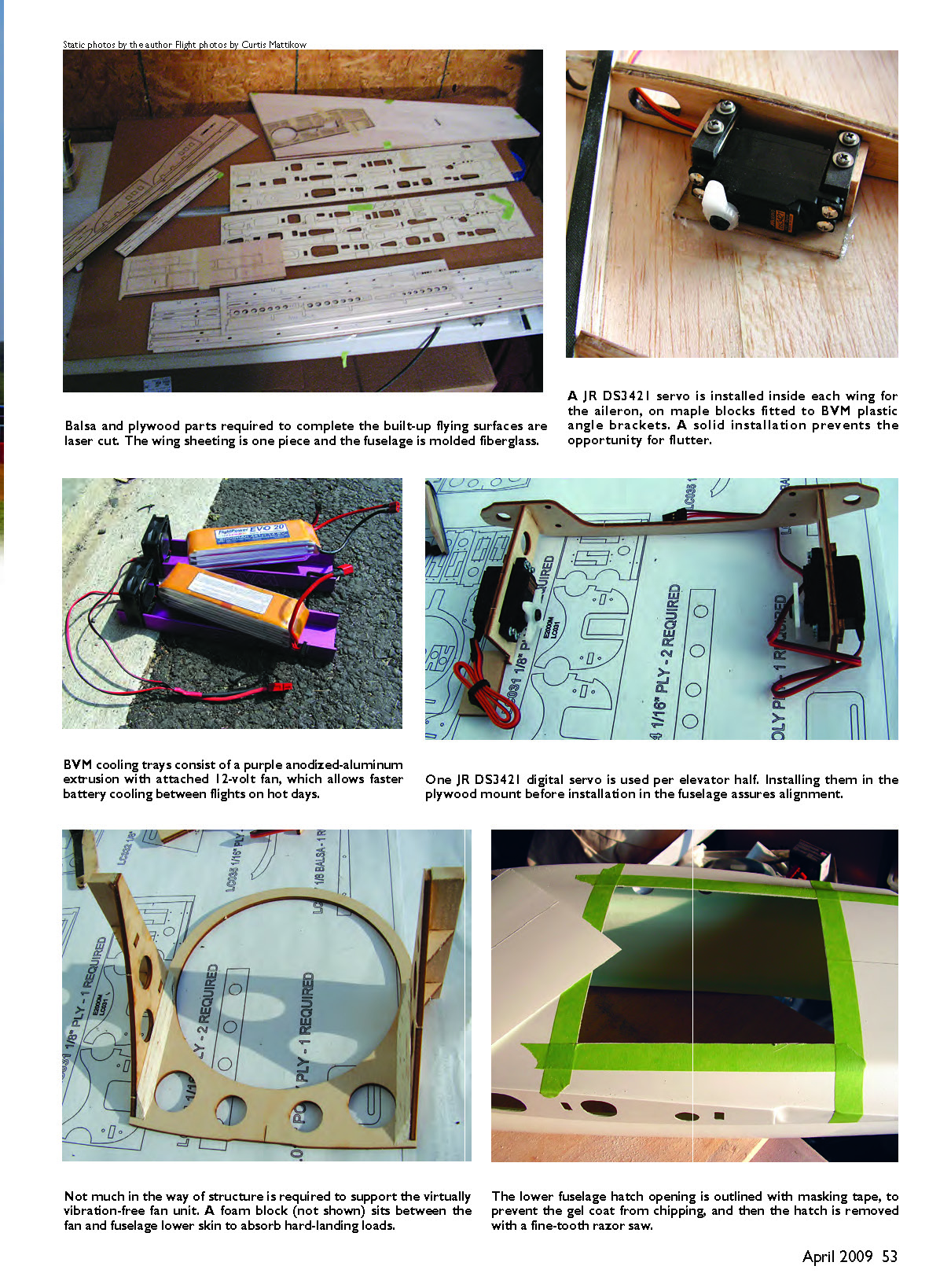
The Electra Jet is available as a traditional builder’s kit. It includes a superb fiberglass fuselage that is primed in the mold. The kit is available with two fin styles: straight or swept. The main flying surfaces and tail surfaces are built-up balsa, plywood, and carbon structures. All balsa parts are laser-cut to shape.
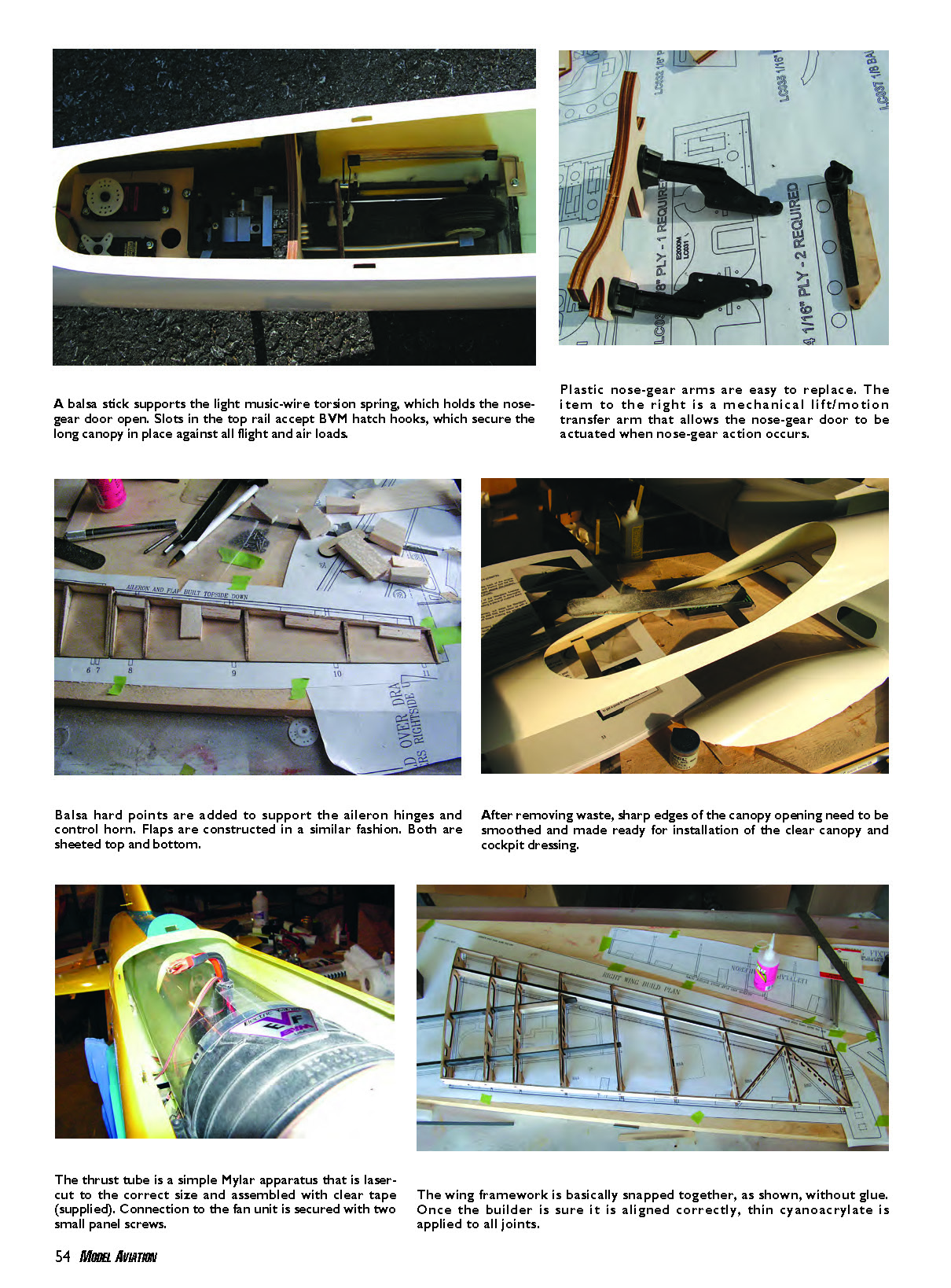
The wing design is a classic example of BVM wing structure, with balsa ribs, carbon spars, and flex plates to mount the retractable landing gear. Certain difficult parts, such as the fin and long fuselage hatch, are built at the factory. The kit includes a complete set of full-size plans and a parts-locator guide.
As with all BVM kits, the instructions are voluminous and cover all aspects of construction. The manual alone is 64 pages of text and photo illustrations. The power system is delivered with its own instruction book, and even the thrust tube kit merits seven pages of photos. It is possible to make a mistake, but the way forward is clear if you read everything a couple times.
If all of this building is too much for you, BVM can supply prebuilt flying surfaces or a complete ARF that features all-composite flying surfaces and a nice paint job out of the box. Both options are more expensive.
There are two choices for retracts. BVM has updated the old mechanical servo-operated gear, or there is a new Air Blue set of fully CNC-machined pneumatic gear. Either works reliably; I chose the servo actuation to make the model entirely electric. That’s less support equipment to haul to the field.
The Build
A full copy of the building instructions is available on the BVM Web site. (See the “Sources” list for the address.)
I will describe the general process and review a few areas that took me more effort to complete.
The wing is a built-up, fully sheeted structure. The laser-cut ribs are provided with rib tabs to aid in achieving a straight airframe. In addition, everything is designed to lock together before the glue is applied. Two carbon spars in each wing panel are laminated from two pieces that are bonded to the maple flex-plate gear mounts.
Servo mounts are made from BVM carbon-fiber-filled, injection-molded angle brackets; hard-maple blocks; and screws provided. The blocks are glued securely to the structure, and the servos are covered with a Poly Ply (thin epoxy-glass board) hatch.
The sheeting is provided as one huge piece, cut to shape with a bit of overhang. One side of the sheeting is sprayed with ammonia-based window cleaner to encourage it to follow the curve of the wing.
Flap hinges consist of four pieces of shaped carbon-fiber plate; one side is glued in the main wing panel and the other side is glued into the flap. The builder threads both pieces with a 2-56 tap for two tiny button-head machine screws to create the pivot point. A small drop of medium cyanoacrylate under the hinge screw will hold it securely.
The wing control-surface horns are also specially shaped carbon plate. Neat little die-cut alignment fixtures are supplied to ensure that the aileron horn is installed exactly right.
Standard fiberglass-fuselage construction advises the builder to thoroughly sand the fuselage’s interior for best glue adhesion. Follow the instructions closely. The inlets fit well with only minor filling required.
Special plastic, carbon-reinforced receptacles and dihedral braces are provided for attaching the wings. They are removable.
The canopy and hatch are supplied with plywood support frames preinstalled. They fit the fuselage well—better than I normally achieve. However, better isn’t good enough, and the instructions go into quite a bit of detail about how to perfect these fits by basically lapping them into place with fine sandpaper. It all worked out great.
The canopy needs four hooks installed, as well as one spring-loaded BVM hatch latch that holds the entire assembly on the model. This retention system is slick. No tape, no screws, no bolts. I love it!
The Electra Jet comes with a nice cockpit kit of vacuum-formed plastic, a separate seat back, materials to make the black-and-yellow ejection-seat pull ring, and a panel sticker. The pilot is available as an optional accessory.
BVM highly recommends the new Spektrum 2.4 GHz radio technology; it is highly resistant to radio interference given off by the high-power EVF setup. The servo complement is a mix of JR DS3421s on the aileron, rudder, and elevator, and DS9411s elsewhere.
BVM’s instructions cover the glass cloth method of wing finishing and the PPG paint systems. I covered my flying surfaces in UltraCote film, since I was working in limited facilities.
The fuselage seams required a bit of attention with a scuff board to bring them down smooth and a brushed spot coat of primer to touch them up. The fuselage-to-tail joints were filleted slightly with polyester auto-body filler, and a minute amount of the same filler fine-tuned the wing-to-fuselage fillet fit.
I applied Klass Kote two-part epoxy paint with a relatively inexpensive Astro Pneumatic HVLP (high volume, low pressure) spray gun. White primer was applied to the areas that I had worked on; most of the fuselage was still the out-of-the-mold pristine white primer that had been scuffed with a 3M Scotch-Brite pad.
I wet-sanded all the paint with a combination of 1,200-, 1,500-, and 2,000-grit paper. Then I rubbed it out with rubbing compound followed by polishing compound. I used 3M Fine Line Tape to mask off areas on the wing that were to be painted blue and then scuffed with 600-grit sandpaper. I was also able to wet-sand and polish the paint on the film areas.
All markings, including the lightning bolts, were paint masks that Pro-Mark supplied. The masks were surprisingly affordable, at roughly $35, and simply sticking them in place and then spray-painting resulted in nice, clean separation lines with no bleeds. I used a can of Krylon spray for the markings.
Fan System and Batteries
BVM has three basic power systems, all of which work well in the Electra Jet. System 4010 runs on 10 cells, 5012 runs on 12 cells, and a new 5212 12-cell system uses a slightly larger and more powerful Neu 1524 motor. All setups work best with the Flight Power 2P 6400 mAh battery packs that provide more than six minutes of flight.
My initial flights were with older 5000 mAh packs, but the current 6400s offer more power and longer duration; they are what I fly routinely now. My fan system is a 4010, which I use on both a 10-cell set of 6400 Flight Power packs and a 12-cell set.
Flying the Electra Jet
So how did it perform? Great, with the exception of one small teething issue.
I set the CG a small amount nose-heavy and made sure to program a good dose of exponential on the aileron and elevator function. Experience with other BVM aircraft tells me that they are never short of control authority at the recommended settings, and 40% exponential is normally the number that makes the model handle the way I like.
After assembling the Electra Jet at the field, I gave one retract linkage an extra turn or two toward the tighter retract direction to ensure that the door was closed firmly. As I would learn, that was a mistake!
I loaded my 12S 5000 mAh cells and clicked the canopy into place. After taxiing into position, I set takeoff flap and applied full throttle. The model came off the ground after slightly more than 100 feet, popped the gear up, made the first turn, and then pulled up the flaps. No trim adjustments were made initially, but during the next circuit or two I added roughly six clicks of up-trim—it was slightly nose-heavy—and then two clicks of aileron. Perfect!
As I always do during a test flight, I spent a couple minutes flying the model around at a moderate speed to get the feel for it. I dropped the flaps and looked for any required trim change; there was none, and the slow speed at full flaps was quite stunning.
I did a couple of fast passes after a couple minutes, and a small gremlin did show its face because I changed the adjustment on the main gear. The Electra Jet came around the corner and I went to WOT (wide-open throttle), passing myself at warp 9, and heard a little pop, crack sound.
I immediately came off the throttle, slowed the aircraft to sub-light speed, and then dropped the flaps and flew the approach. That was the slowest jet landing I've ever performed.
On touchdown, at hardly any airspeed, one of the landing gear collapsed; no damage was done to the airframe. I checked it out afterward, and the crack sound I had heard was a gear door that left the airplane. I had adjusted the linkage too far to the retraction side; it was pulling against the wing skin pretty hard, and it wasn't pushing out enough in the extended direction.
On subsequent flights, I opened the envelope with basic aerobatics; blazing, high-speed passes; and flaps-down, crawling-across-the-sky, slow-speed passes. You can tell that there are years and years of aerodynamic refinements behind this airframe, because there is nothing to criticize.
Rolls are axial as if on a string. Knife edge shows only slight roll coupling (which can be easily dialed out if insisted), and the slow-speed handling is beyond reproach. If you've flown a good RC Aerobatics (Pattern) airplane, you'll know this model; it's just much faster than any modern Pattern aircraft.
The BVM Electra Jet is a superb-flying classic sport jet. Any pilot who can handle a fast-flying model will be delighted with it. The complete package has been totally reliable during the 40 flights I have on it to date.
The assembled Electra Jet just fits at an angle in my small Saturn Vue SUV. For longer trips with more equipment, I take the wings off, which happens quickly; I can break it down in less than five minutes and assemble it in only a couple more.
The motor system is rock solid, with no cooling needed between flights. So if you want to get three quick flights in and have three sets of packs, you can accomplish that in roughly 20 minutes of field time.
I hope to have my Electra for many years to come. If anything happened to it, I think I'd have to get a replacement—quickly.
Christopher True [email protected]
Sources:
- BVM
- (407) 327-6333
- www.bvmjets.com
- Pro-Mark
- (618) 524-2440
- www.pro-mark.com
- FlightPower
- (828) 658-2400
- www.bestrc.com/flightpower
- JR Radio
- (800) 338-4639
- www.horizonhobby.com
Transcribed from original scans by AI. Minor OCR errors may remain.

