
Electronics
Eloy Marez
2626 W. Northwood, Santa Ana CA 92704
THE APRIL (2001) "Letters to the Editor" section of Model Aviation contains a letter from Ronald A. Testa, Bridgeport, Connecticut, that discusses some interesting points.
One point Mr. Testa made is that many so-called "interference"-related problems can be the result of something else: a failure in the Radio Control (RC) equipment. Amen! (And possibly some failure on the part of the pilot.)
Ronald wrote:
"However, there are solutions that would detect or prevent anyone else turning on a transmitter with the same frequency as someone else flying.
- Provide an electronic switch on each transmitter that would detect a signal of the same frequency from some other source and prevent the master switch from activating the transmitter.
- Provide an indicator or sound device on each transmitter that becomes active if a signal is received that does not match the position of the control sticks or switches on your transmitter while you are flying.
These are by no means the only possible solutions to this problem. Yet it illustrates at least two ways that the AMA and the manufacturers of these transmitters could be proactive."
I am the bearer of glad tidings to Mr. Testa and to those with similar concerns. Both of the features he mentioned exist, and have for some time.
Channel-check switch (Number 1)
Number 1, as described, has been an optional feature of German-made Multiplex radios for years. The company refers to it as Channel Check, and it does exactly what Mr. Testa describes: your transmitter will not turn on if there is another transmitter on the same frequency.
Channel Check is designed to be added to certain Multiplex transmitters. All it takes is to plug a circuit board into existing pins on the main board.
Some of you will ask, "How is that done, and can I add it to my Terrific 10?"
It takes a receiver, which must be connected to the whip antenna with something called a TR Switch. TR stands for "Transmit-Receive."
As is most everything now, the TR Switch is a solid-state device that connects the antenna to a receiver until it senses radio-frequency energy from a companion transmitter, at which time it disconnects the antenna from the receiver and switches it to the transmitter.
The output of the receiver, which can be simple unencoded audio, is used to control a DC (direct current) switching circuit—possibly nothing more than a simple silicon-controlled rectifier (SCR).
An SCR is an on-off switching device. Its action is controlled by an applied voltage—in this case, the signal from the receiver described.
There is no wheel-reinventing required—merely applications of known circuitry and techniques. Just don't ask me how to add it to your transmitter; I don't have all the details worked out yet!
What is Multiplex?
The other question you may have is, "What is Multiplex?"
It is an old company that has been manufacturing RC equipment for more than 30 years, and it has been deeply involved in other phases of the hobby with power and sailplane kits.
Multiplex has manufactured RC equipment that has generally been ahead of other radios in features, and is of extremely high quality.
A Multiplex Royal mc (for microcomputer) was the first such radio I ever used, and that was at least 15 years ago. It had all the features of today's competition-type computer systems, but without the display; that technology was not available yet.
The Royal mc had to be set with potentiometers and with the Mark I Eyeball—or as I did, with a digital pulse meter that measured the control pulses at the receiver. The Royal mc was the first transmitter I can remember with a plug-in frequency module.
Multiplex was the first to introduce the now-much-touted "digital" servo, more than 10 years ago. The company claims to have originated the "buddy box" trainer system; however, I learned about it in the 1960s from Orbit Electronics, who used to advertise it as "The end of the crash course!"
Multiplex transmitters have another worthwhile feature. You don't have to get one with a forest of fragile switches across the top—some you will probably never use and, in many cases, are extremely costly to have replaced when they are broken.
These transmitters generally have only the most-used auxiliary controls: retracts and dual rates. You choose anything more—not only the ones you want, but where you place them. Installing it takes only an internal plug and placing the switch or control in a previously plugged opening.
The Channel Check is not a gimmicky gadget by some unknown company; it comes from an established RC-equipment manufacturer.
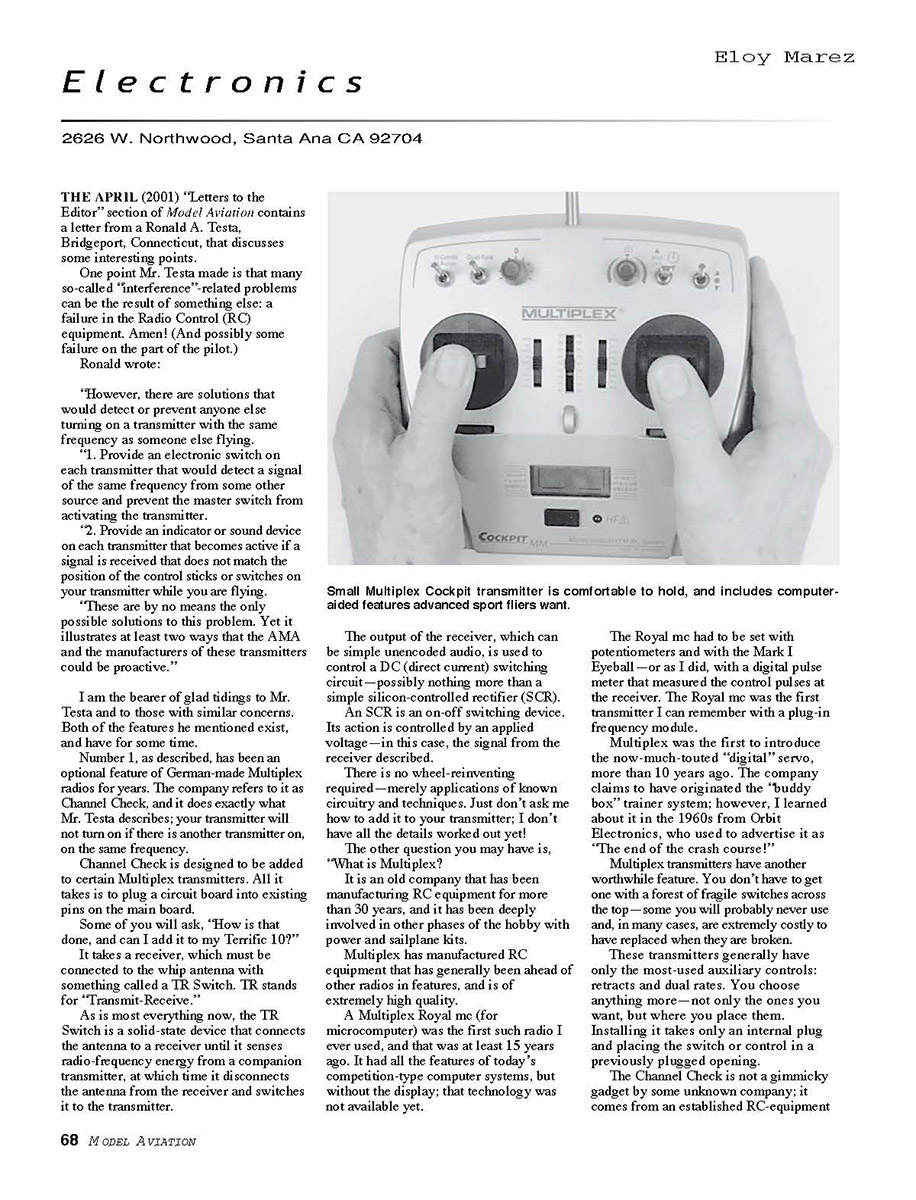
I have also used the companion Cockpit transmitter—a mid-level computer system with some interesting physical characteristics; it has performed reliably, and is used in each flying session.
Although the Channel Check is not available for the Cockpits at this writing, it will be soon. Check with the US supplier: Multiplex USA, 14751 Culver St., Van Nuys CA 91411; Tel: (818) 785-2046. You can also look on the Web site: www.multiplexrc.com.
Stick/position mismatch alarm (Number 2)
As for Mr. Testa's second suggestion, you have probably heard or even used this feature at one time or another. It is a shrill or ... [text unclear]
I'm not making fun of the idea, though my warped sense of humor does show now and then. Although this may be to be taken seriously, since flying poses some danger, we have to keep our sense of humor.
Even though it does have merit, this is more a practical idea. Again, the technology is at hand. We could easily measure the control input to the transmitter; i.e., the stick position. By using pulse-measuring circuitry fed by the receiver or position sensors at the servo or control surface, and transmitting that down to a transmitter-mounted receiver, we could compare the two. Any difference could be used to trigger an alarm—an audio tone completely different from the timer or low-battery warning that might already be in place.
This is the first practicality which practically rears its ugly head. Such a system would require a frequency far removed from the one the flier's transmitter is on; otherwise, the ground receiver would be completely swamped by said transmitter.
I am not talking just from one end of the 72 MHz band to the other; I'm talking about a completely different band, many megahertz away. Try to talk the Federal Communications Commission (FCC) into that one!
There are other practical considerations...
Electronics (continued)
There are other factors involved with things of this nature. One is the fact that some education—forced or voluntary—is involved, and not everyone will accept that.
How many people show up at your field without computer radios, with all of their advantages, stating, "I don't know anything about computers."
As those of you who have made the switch realize, you don't have to know anything about computers to use a "computer" radio; they are different things.
Cost is also a big factor. The tendency is to place safety items far down the list of necessities, and the preceding definitely falls into that category.
I can't see the majority rushing to pay for this kind of option when I hear and receive the number of criticisms I do regarding the high cost of radio equipment.
You can sink many bucks into electronic needs if you are planning to enter the RC equivalent of the World Cup, but the majority of us do not need or cannot even use the really complex and expensive equipment.
My first RC set that I did not build—a used F&M Enterprises reed (nonproportional) set—cost more 1960s dollars than a four-channel system with four servos, Ni-Cds, and a charger costs in today's dollars. No way is modern radio equipment expensive.
I do hear the criticism that one can buy consumer electronic items, television receivers, stereos, etc., which are far larger and just as complex, for much less money.
That is true, but it has to do with volume. Consumer-electronics manufacturers have a far larger market than all RC manufacturers lumped together.
It would be interesting to know how many Channel Checks Multiplex has sold. However, that information would probably not be significant since its major market is in Europe, where the more sophisticated, higher-priced equipment is seen in greater numbers than it is here.
Another area of the US as a market is one I have commented on before: Ni-Cd chargers. Although there have been significant improvements in such devices in the electronics world in recent years, ours have not changed since those Orbits and F&Ms I mentioned earlier.
Why?
Because any manufacturer that made a modern charger part of the system would have to raise the cost, which would probably price the maker out of the market.
Lloyd Usery has asked if cellular telephones, pagers, etc. can cause interference to RC models.
The answer is yes and no. (There goes that distorted sense of humor again!) Bear with me while I explain.
Cell phones cannot cause interference to anything on the 72 MHz band—the frequencies are too far removed.
However, there have been reports of a type of cell-phone interference when one carried by a flier rang while he was flying.
This reportedly only affects Pulse Code Modulation (PCM) systems. The cellular phone, which contains a transmitter, must signal back that it is receiving a call even before it is answered.
Since it's extremely close to the transmitter, the radio frequency generated must find its way into the unshielded transmitter circuitry and garble the encoding.
My tests with frequency modulation (FM) and PCM equipment on hand did not show any effect, but there is actually
not enough information available to arrive at a definite conclusion.
In view of the reports, turn your cell phone off or leave it in the pits when you are flying.
Or make your own test. With the airplane on the ground and with the system on, have someone call you and see if control is affected in any way.
I would be interested in the results. The more tests with different types of equipment, the better. Please include the type and frequency of your equipment, and the type of cell phone. Even "no interference" is valid information.
Pagers are more of a concern. Some actually operate on frequencies interspersed with ours. However, assuming that you are using a good-quality narrow-band receiver, pagers should not be a problem.
We enjoy interference-free flying every day, and there are pagers all across the country. I am sure the FCC places much tighter restrictions on pager operators than they do on us, including frequency tolerance.
I rate this one as "possible," but not "probable," unless you insist on still flying that 1970 Kraft or Orbit, in which case there are many things that can bite you.
Pager transmissions are relatively short; although one might cause a funny or two to your airplane, they should not cause a complete signal loss.
Now for the "etc." of Lloyd's questions. There are other things that can and will cause interference, including each other. The FCC apparently authorizes other users on 72 MHz, and the law actually reads that we are allowed to use them only on a noninterference basis — to us.
It's sad but true: we are not 100% free of possible interference. My only suggestion is to keep a record of unexplained, possibly interference-caused crashes at your flying field, and stay away from those channels on which repeated problems occur.
Most of the time we fly problem-free, and isn't it great? MA
(Editor's note: A schematic diagram was not included in the May "Electronics" column. The drawing is on page 84 of this issue.)
Transcribed from original scans by AI. Minor OCR errors may remain.

