
Electronics
Eloy Marez
2626 W. Northwood, Santa Ana CA 92704
A LETTER from Dick Perry of my home state of Texas touches on a subject I have occasionally mentioned: the gobbledygook that has emerged in our hobby, which seems to grow with each technical advancement.
Dick wrote:
"You end your May 2001 column with the question, 'What else out there confuses you?' I doubt there is enough paper on the planet to list the things that confuse me; however, here is one thing on which I would like your comments — that is the use of the abbreviations PPM (Pulse Position Modulation) and PWM.
"It is my opinion that the modulation scheme currently in use by our systems should be called PWM (Pulse Width Modulation), since it is the width of the incoming signal that determines the position of the servo output arm.
"I understand that Pulse Position Modulation (with regard to the complete pulse train) is the determining factor for which servo gets which pulse; however, once assembled, this does not change.
"The slippery part here is that the position of each pulse is encoded and then decoded (the first in the transmitter, decoded at the receiver-em). I believe this qualifies the position of the pulse(s) as 'modulation' but barely. I believe the predominate form of modulation here (disregarding AM [Amplitude Modulation] and FM [Frequency Modulation]) is Pulse Width Modulation.
"I suspect the PPM tag was hung on because all of the pulses downstream of the one being changed by stick position appear on the scope screen to move horizontally. They do not, however, change positions. Elevator is still Elevator, and so on. Perhaps it should be called Pulse Width/Position modulation.
"I'm very happy that we are finally getting 'four-stroke' and 'two-stroke' correct, although Mr. Lee of another magazine has suggested that the correct names should be: four-stroke/cycle and two-stroke/cycle. I'm also glad that we can now differentiate between 'motors' and 'engines.' I hold no hope for 'cells' and 'batteries.'
"Thank you, sir, for attending my babble. I feel much better now, having set all that straight."
Much of the terminology generally used in the Radio Control (RC) hobby is incorrect or deviates from general aviation and/or electronics terminology — and it bothers nitpickers like Dick and me.
It makes little difference in many cases; I never forget that this is a flying hobby, not primarily an electronics hobby.
However, since most of the radio terminology comes from the equipment-makers themselves — the so-called authorities — the least they could do is educate us properly.
The points that Dick makes are just the tip of the iceberg; where have you ever read a decent explanation for Variable Trace Radio (VTR), and what connection does the term have with flying or airplanes?
I don't think you will find the term in the pilot's handbook for the 747 or the F-18! That's garbage! I feel strongly that we, the very reason that RC equipment-makers exist in the first place, deserve more than advertising hype!
In a basic RC transmitter, ignoring all the gizmos and gadgets (I dislike "bells and whistles"!), there are three separate circuits: an encoder — which translates your control inputs — and at the other end, the radio frequency (rf) generator — which transmits the signal.
The rf is modified with the encoder output — the information to be transmitted — by the modulator. In RC, in some manner, encoding has become synonymous with modulation, or vice versa, and is almost never referred to.
The confusion is caused partly by the use of the word "modulation" as part of the name of what is basically encoding, such as in PCM (Pulse Code Modulation).
Such a use probably originated with the non-RC data transmission field where it was first used, probably in hardware applications without modulation of an rf signal.
In RC, many think of PCM as a completely different type of radio signal, and that is the cause of a misconception.
A couple of weeks ago as I write this, I ran into an accomplished flier at the local field who insisted that his PCM "superbucks" was completely interference resistant, up to and including other transmitters on the same frequency!
Although the RC companies never tell us this, but to reinforce the fact that PCM is purely encoding, in most cases the rf is modulated by FM. I write "in most cases" because in at least one transmitter — the JR Alpine — is an AM PCM-encoded system.
In all modern RC systems — AM, FM by any name, or PCM — the final receiver drive to the servos is a pulse of varying length; its width determines the servo drive position, per your commands.
At that point it is PWM — pure and simple. The information up to then could and has arrived in another form, such as PCM, but the width of the servo control signal conveys useful information.
In non-PCM systems, those referred to as AM or FM, the control information in the very transmitter I have had since the pioneer days of proportional RC has been PWM.
PPM does exist in the electronics world and was possibly used in early control pulsed equipment.
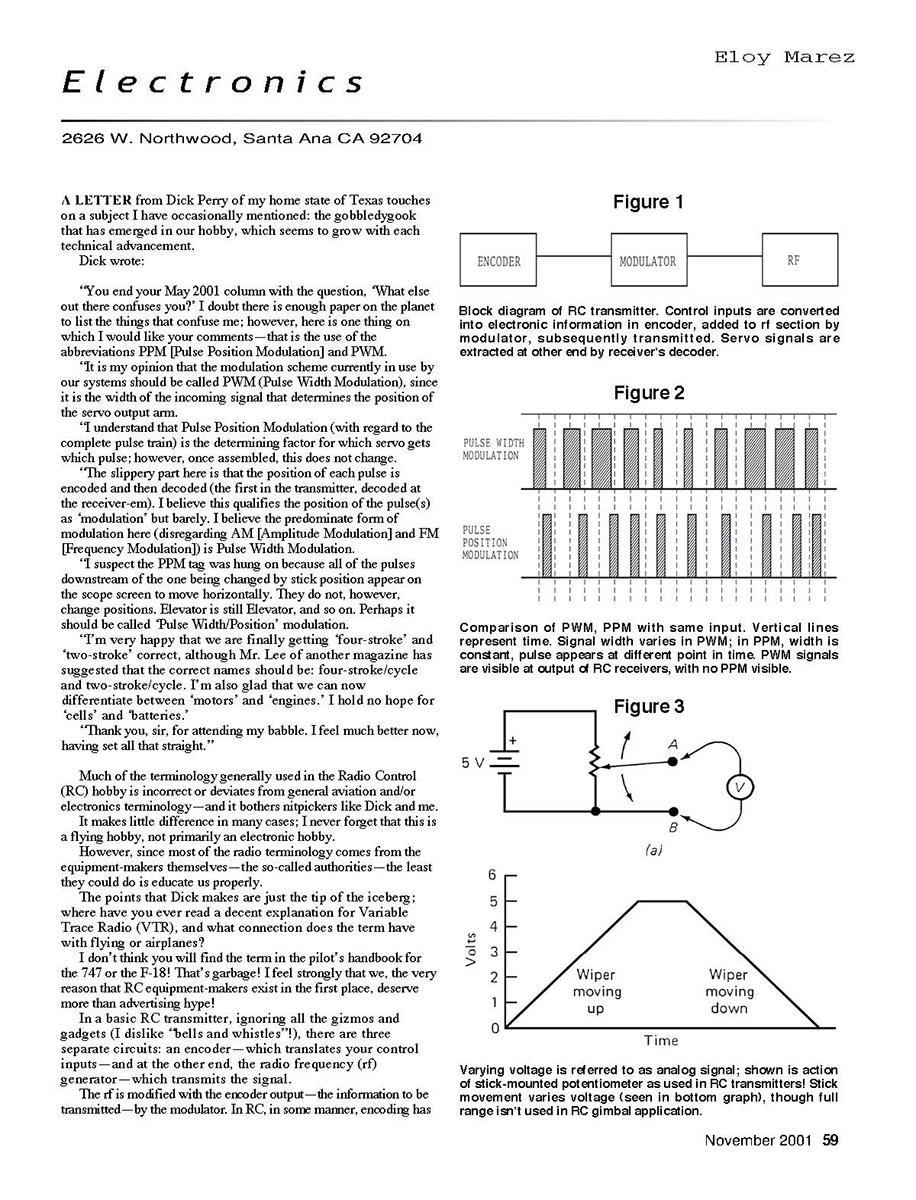
Its method of encoding information is in the width of a control pulse, but in a series of equal-length pulses whose position is varied in time, plus or minus, from a starting point (Refer to the sketch for a clearer picture).
Although it's not in use in today's radios, PPM is encoding — not true modulation, as used in rf devices; i.e., transmitters!
A bit ahead of this discussion, but pertinent at this point, I want to discuss "digital" — which has come to mean another form of RC magic — without getting buried with technical confusion.
There are two methods of generating electronic information: one, which uses voltage or one of its related effects (current, resistance) to encode and then decode information, and another in which the information is transformed into pulses.
The terms of pulses can be varied in one of many ways: in position or width, as described, or including true computer language with its bits, bytes, and numbers — all too complex for this hymn's discussion.
Your library or electronics store can provide thick books on the subject of digital electronics. In the truest sense of the word, if it is controlled by pulses, it's "digital".
You have probably read and been told that RC systems are not truly "digital" for one of various reasons. Yet in the early days of proportional radios, the first generation being analog, PWM emerged and was touted as "digital".
Through the years we have seen many publications and producers — all presented to us as digital, probably to convince us that we use the latest technology, that they are superior to the bygone item, and that we should buy one!
Still, there is the tendency to refer to the different equipment by one of its electronic features. That's not necessarily bad, since it does differentiate it from similar brothers, but it's confusing and, as Dick points out, incorrect.
At the beginning of that world-class maneuver of yours, your stick input didn't generate a PPM, a PWM, and certainly not a PCM signal; it created a change in a voltage level, and is therefore, all things, an old-fashioned, pre-silicon, analog signal.
True, the 'pot' — the variable resistor to which the stick is attached — is a voltage divider, an analog circuit. As the stick is moved, its output voltage is varied.
The control information, be it PPM or PCM, is not generated until the second stage, commonly called an R M or FM transmitter by an encoder integrated circuit (IC) produced especially for this application and in computer-based radios by a microprocessor — the heart of all computer circuits.
Using the flexible rules for naming, itself will make them significantly better than PCM or even DPCM units!
Slightly off the subject since it is not an electronic issue, Dick commented about a couple other incorrect word usages. A current-time encyclopedia from my local library uses the terms "two-stroke" and "four-stroke" and Clarence Lee's "two and four-stroke/cycle" interchangeably.
The encyclopedia clearly differentiates the two and uses "engine." "A device that burns a fuel to transform its stored energy into mechanical force," and "motor," "a device that does the same for electrical energy."
Although Dick claims that we airplane fliers have accepted the difference, the reverse is true in the electric R/C car world, where some drivers — usually the younger — refer to their electric motors as "engines."
But they have been subjected to a greater degree of brainwashing than we have; they buy electric toy-speed controlers they believe to be capable of handling hundreds of amps.
Such nomenclature applies mainly to available products directly from Grand Coulee Dam or California's big battery event in those days of electric power on flat, but they certainly aren't possible with a six-cell Ni-Cad battery. To my admiring incomplete knowledge, English is the only language with different words for "engine" and "motor." They are both "motor" in German and Spanish; they're "motore" to the Italians and the French use "moteur" for both. In Swahili? I forget at the moment!
Hey Dick, how about the use of "ignition" when "spark ignition" is actually referred to? Under the encyclopedia definition, all engines ignite fuel in one manner or another. Doing so by an externally generated spark is another matter.
Cells and batteries: In the correct usage, a single cell, such as a 1.5-volt alkaline or a 1.25-volt Ni-Cad, is a "cell." In the maker's lexicon, two or more cells connected is a "battery."
And the word "cycle" is used completely wrong in the battery industry; it means one charge and discharge period.
Discharging a battery under controlled conditions to measure its capacity is something entirely different, i.e., capacity measuring!
The "conventional Fail-safe" System: In the early 1990s, before the current proliferation of super-small and lightweight equipment, a single-channel system available from Cox Hobbies in a number of still-form airplanes became popular with small-airplane fans.
The transmitter was originally operated with two buttons — for left and right turns — and cleverly neutralized after a couple seconds, so the beginner could not hold the turn and overshoot.
It worked well but was awkward for someone already used to stick control, and I devised a conversion to stick and full proportional control.
Published in the now-departed Model Aviation magazine, the conversion drew a great deal of interest, and I heard from many who made the change.
The conversion was written in easy-to-follow "connect the red wire from point A to point B" instructions and was done easily and rapidly.
I guess good equipment and good ideas have hardly a month to live when I don't hear from someone who is looking for the conversion information. An e-mail to me at <REDACTED> will put you in touch with a copy of the original instructions and a source of parts, including the drop-in stick assembly.
Again: What else out there confuses you?
Transcribed from original scans by AI. Minor OCR errors may remain.

