
Electronics
Eloy Marez
A SIX-METER Monitor: CQ, CQ, CQ, de WIDBN!
For the uninitiated, that is a general ham-radio-operator call, for anyone who cares to answer, from me: WIDBN.
For the initiated, I'll explain that call sign. I am from Texas, but I started my ham career while based at Westover Air Force Base in Massachusetts and never changed, except when holding foreign calls in various places.
As do all those fortunate enough to hold a ham ticket, I prefer to fly on "Six Meters." I like the lack of Radio Control (RC) activity there and never having to wait for a pin or having someone turn on accidentally while I am in the air.
Although there is a gentlemen's agreement through the American Radio Relay League (ARRL)—the ham's equivalent of a modeler's AMA—that it will stay off the top end of the Six-Meter band we use, and the greater possibility of interference with television broadcasting if operating there, there is always the possibility of some—usually strong—interference.
I really like the security-blanket feeling of having a frequency monitor.
I have come up with the ultimate, at least as far as price is concerned, but first I'll clarify what is probably a confusing point to many nonhams: that Six-Meter business.
It is another erroneous term that has been adopted, such as "cycle" (as in battery), "PPM," "VTR," etc. We speak of frequency in "MHz" (megahertz) for the 72 and 75 (nonflying) bands and "meters" for the 50-53 MHz bands.
In effect, we are saying that something measures five feet in length and is one meter wide. Or that it weighs two pounds and 20 grams. We are using different units of measurement for the same thing.
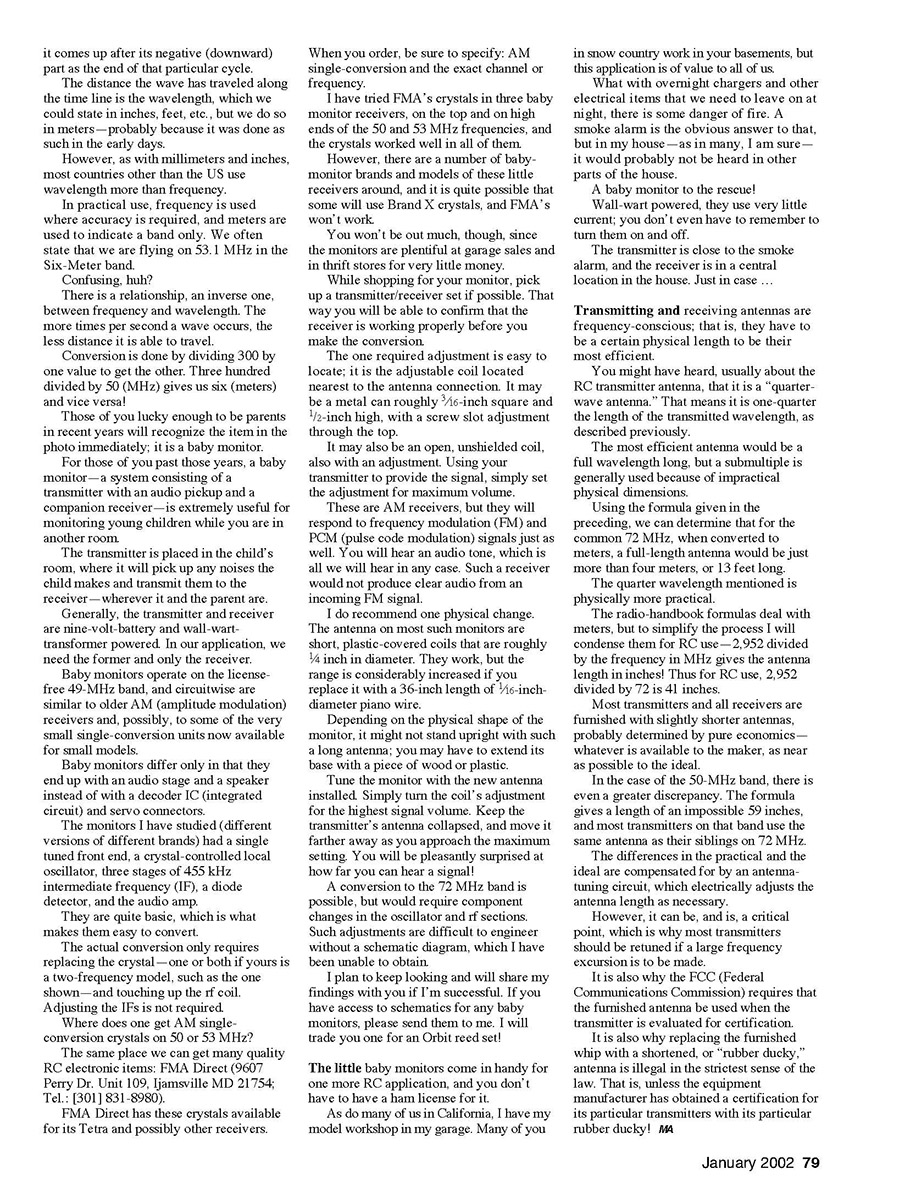
Take that frequency business first, since it is by far the most common. Radio-frequency (rf) energy is, in effect, an alternating wave. The "frequency" refers to the number of times per second that the wave completes one full cycle in its travel.
The terms "cycle" and "hertz" are the same; the latter is used to commemorate Heinrich Rudolph Hertz: the German pioneer who first explored, or clarified, the phenomenon.
Furthermore, kHz indicates one thousand cycles and MHz is one million of them! It just makes for easier math!
Frequencies of 20 to 20,000 (20 kHz) are referred to as audio frequencies—the normal range of human hearing.
Dogs and other animals can hear higher frequencies, and teenagers who continually listen to loud rock music soon lose the ability to hear the highs—but that is another story.
Frequencies higher than 20 kHz are called radio frequencies because they can be transmitted in the manner we are all so familiar with. Above that, frequencies are divided into bands referred to as low frequency (LF), high frequency (HF), very high frequency (VHF), etc.
The 72 and 75 RC frequencies fall in the VHF band, which runs from 30 to 300 MHz. Above that is the ultrahigh frequency (UHF) band: 300 to 3000 MHz.
The story goes that the British were the first to use the band and referred to it as VHF: very high frequency indeed! Oh well!
Please refer to the sketch of a typical alternating wave, shown at a very low rate; at even 20 kHz, in the space allowed we would see a solid, black block.
The time shown is one second. The number of up-and-down complete waves is the frequency—the number of times it occurs within the allotted time.
All this action is taking place at the speed of light: 300,000,000 meters per second or 186,000 miles per second. That is a lot of mph!
As the wave travels along, it is also covering distance; that is where "meters" comes into the picture. We refer to that as "wavelength," which is the distance the wave has traveled during one complete cycle.
We can use the point at which the wave starts to go positive (upward from the zero or centerline) as a start and the same point as the end.
The distance the wave has traveled along the time line is the wavelength, which we could state in inches, feet, etc., but we do so in meters—probably because it was done as such in the early days.
However, as with millimeters and inches, most countries other than the US use wavelength more than frequency.
In practical use, frequency is used where accuracy is required, and meters are used to indicate a band only. We often state that we are flying on 53.1 MHz in the Six-Meter band.
Confusing, huh?
There is a relationship, an inverse one, between frequency and wavelength. The more times per second a wave occurs, the less distance it is able to travel.
Conversion is done by dividing 300 by one value to get the other. Three hundred divided by 50 (MHz) gives us six (meters) and vice versa!
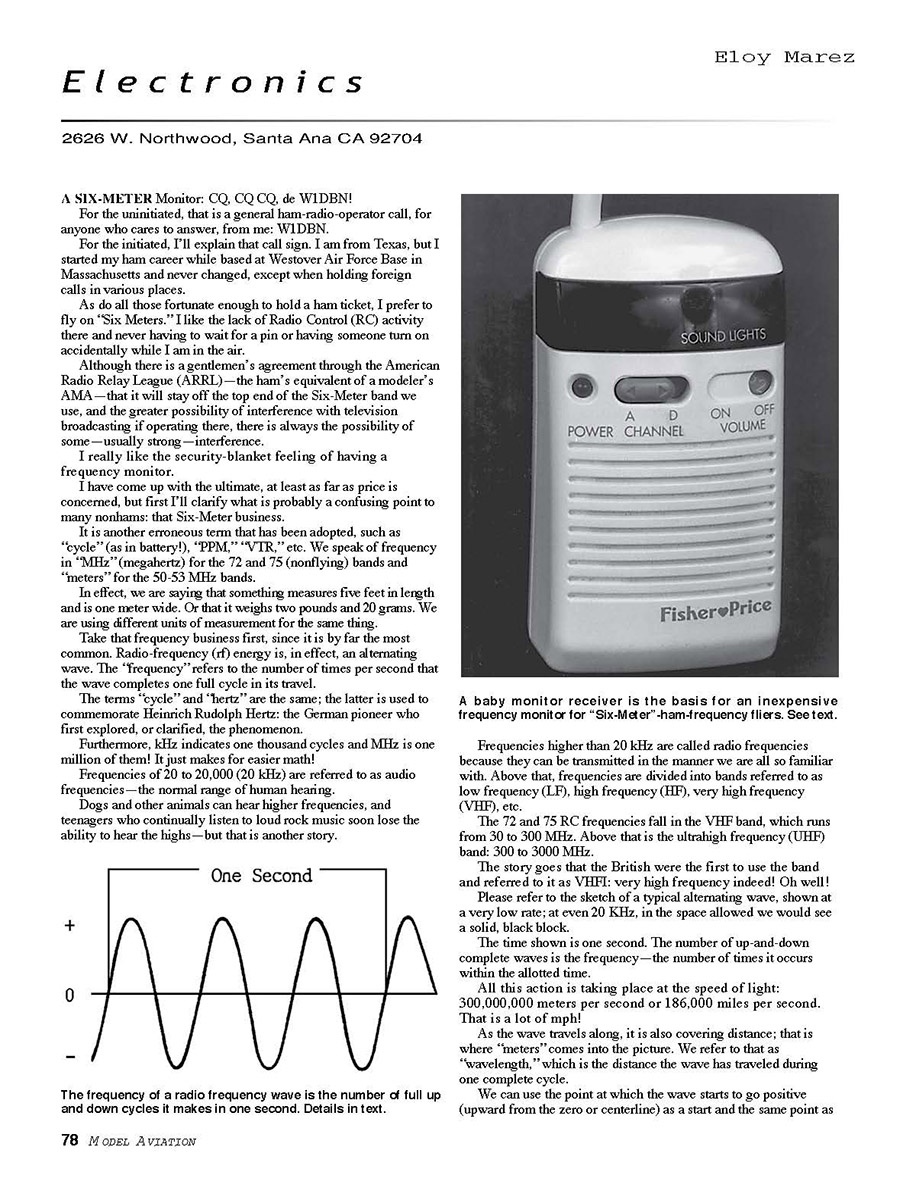
Those of you lucky enough to be parents in recent years will recognize the item in the photo immediately; it is a baby monitor.
For those of you past those years, a baby monitor—a system consisting of a transmitter with an audio pickup and a companion receiver—is extremely useful for monitoring young children while you are in another room.
The transmitter is placed in the child's room, where it will pick up any noise the child makes and transmit them to the receiver—wherever it and the parent are.
Generally, the transmitter and receiver are nine-volt-battery and wall-wart-transformer powered. In our application, we need the former and only the receiver.
Baby monitors operate on the license-free 49-MHz band, and circuitry are similar to older AM (amplitude modulation) receivers and, possibly, to some of the very small single-conversion units now available for small model radios.
Baby monitors differ only in that they end up with an audio stage and a speaker instead of with a decoder IC (integrated circuit) and servo connectors.
The monitors I have studied (different versions of different brands) had a single-tuned front end, a crystal-controlled local oscillator, three stages of 455 kHz intermediate frequency (IF), a diode detector, and the audio amp.
They are quite basic, which is what makes them easy to convert.
The actual conversion only requires replacing the crystal—one or both if yours is a two-frequency model, such as the one shown—and touching up the IF coil. Adjusting the IFs is not required.
Where does one get AM single-conversion crystals on 50 or 53 MHz?
The same place we can get many quality RC electronic items: FMA Direct (9607 Perry Dr., Unit 109, Ijamsville MD 21754; Tel. [301] 831-8980).
FMA Direct has these crystals available for its Tetra and possibly other receivers. When you order, be sure to specify: AM single-conversion and the exact channel or frequency.
I have tried FMA's crystals in three baby monitor receivers, on the top and on high ends of the 50 and 53 MHz frequencies, and the crystals worked well in all of them.
However, there are a number of baby-monitor brands and models of these little receivers around, and it is quite possible that some will use Brand X crystals, and FMA's won't work.
You won't be out much, though, since the monitors are plentiful at garage sales and in thrift stores for very little money.
While shopping for your monitor, pick up a transmitter/receiver set if possible. That way you will be able to confirm that the receiver is working properly before you make the conversion.
The one required adjustment is easy to locate; it is the adjustable coil located nearest to the antenna connection. It may be a metal can roughly 3/16-inch square and 1/2-inch high, with a screw slot adjustment through the top.
It may also be an open, unshielded coil, also with an adjustment. Using your transmitter to provide the signal, simply set the adjustment for maximum volume.
These are AM receivers, but they will respond to frequency modulation (FM) and PCM (pulse code modulation) signals just as well. You will hear an audio tone, which is all we will hear in any case. Such a receiver would not produce clear audio from an incoming FM signal.
I do recommend one physical change. The antenna on most such monitors are short, plastic-covered coils that are roughly 1/4 inch in diameter. They work, but the range is considerably increased if you replace it with a 36-inch length of 1/16-inch-diameter piano wire.
Depending on the physical shape of the monitor, it might not stand upright with such a long antenna; you may have to extend its base with a piece of wood or plastic.
Tune the monitor with the new antenna installed. Simply turn the coil's adjustment for the highest signal volume. Keep the transmitter's antenna collapsed, and move it farther away as you approach the maximum setting. You will be pleasantly surprised at how far you can hear a signal!
A conversion to the 72 MHz band is possible, but would require component changes in the oscillator and rf sections. Such adjustments are difficult to engineer without a schematic diagram, which I have been unable to obtain.
I plan to keep looking and will share my findings with you if I'm successful. If you have access to schematics for any baby monitors, please send them to me. I will trade you one for an Orbit reed set!
The little baby monitors come in handy for RC application, and you don't have to have a ham license for it.
As do many of us in California, I have my model workshop in my garage. Many of you in snow country work in your basements, but this application is of value to all of us.
What with overnight chargers and other electrical items that we need to leave on at night, there is some danger of fire. A smoke alarm is the obvious answer to that, but in my house—as in many, I am sure—it would probably not be heard in other parts of the house.
A baby monitor to the rescue! Wall-wart powered, they use very little current; you don't even have to remember to turn them on and off.
The transmitter is close to the smoke alarm, and the receiver is in a central location in the house. Just in case . . .
Transmitting and receiving antennas are frequency-conscious; that is, they have to be a certain physical length to be their most efficient.
You might have heard, usually about the RC transmitter antenna, that it is a 'quarter-wave' antenna. That means it is one-quarter the length of the transmitted wavelength, as described previously.
The most efficient antenna would be a full wavelength long, but a submultiple is generally used because of impractical physical dimensions.
Using the formula given in the preceding, we can determine that for the common 72 MHz, when converted to meters, a full-length antenna would be just more than four meters, or 13 feet long.
The quarter wavelength mentioned is physically more practical.
The radio-handbook formulas deal with meters, but to simplify the process I will condense them for RC use—2,952 divided by the frequency in MHz gives the antenna length in inches! Thus for RC use, 2,952 divided by 72 is 41 inches.
Most transmitters and all receivers are furnished with slightly shorter antennas, probably determined by pure economics—whatever is available to the maker, as near as possible to the ideal.
In the case of the 50-MHz band, there is an even greater discrepancy. The formula gives a length of an impossible 59 inches, and most transmitters on that band use the same antenna as their siblings on 72 MHz.
The differences in the practical and the ideal are compensated for by an antenna-tuning circuit, which electrically adjusts the antenna length as necessary.
However, it can, and is, a critical point, which is why most transmitters should be returned if a large frequency excursion is to be made.
It is also why the FCC (Federal Communications Commission) requires that the furnished antenna be used when the transmitter is evaluated for certification.
It is also why replacing the furnished whip with a shortened or 'rubber ducky' antenna is illegal in the strictest sense of the law. That is, unless the equipment manufacturer has obtained a certification for its particular transmitters with its particular rubber ducky! MA
Transcribed from original scans by AI. Minor OCR errors may remain.

