
Electronics
2626 W. Northwood, Santa Ana CA 92704
IN THE SEPTEMBER 2001 column I discussed the use of switch-equipped audio plugs as airborne equipment switches, as described in a Model Aviation article.
My concern is that fliers of conventional models would pick them up; the writer of the article recommends their use only for small airplanes — the so-called park flyers.
The mail immediately brought some agreeable comments, one which I must share. Jesse Shepherd of Bedford, Texas wrote:
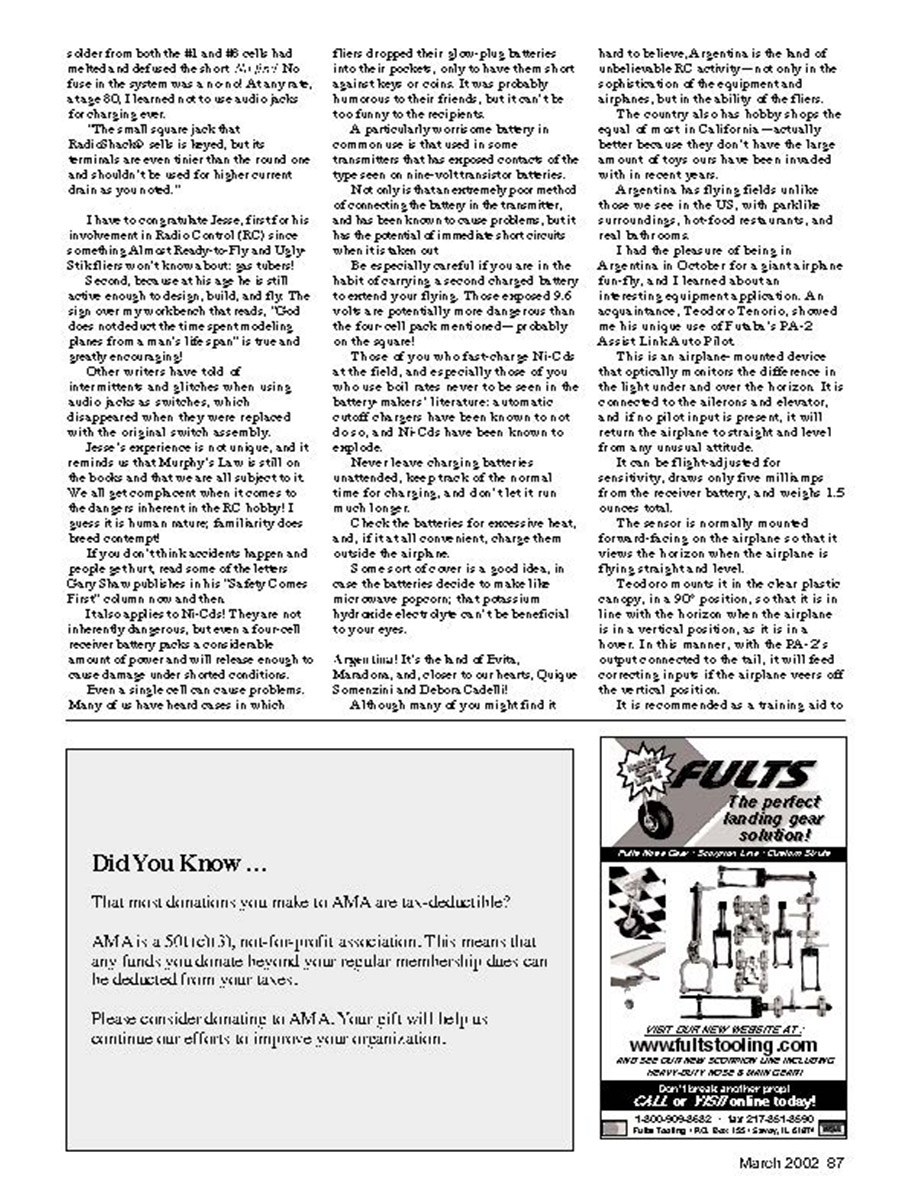
"I too have used the audio jacks since the days of reading plate current on the ancient gas tubers. I used them as battery charge jacks until April 01, '01 — I realized that they were marginal as per your article, but I had a few left, so I installed one in my Electric KP-44 EDF design prototype called 'Stinger-E' (future Model Airplane News design).
"After many flights I settled down to install a DM-20 motor in the fan to replace the 7 amp drain 4 cell max Mabuchi. I had used four 270s for the motor and four 150s for the receiver and an EMC (Electric Motor Control) from Bob Selman of Carthage MO. The new setup would permit me to use 8 cells and a new 7-P that can handle the motor and receiver.
"The manhandling of the new EMC installation and a DPDT (Double Pole Double Throw) switch to permit center-off, aft for charge, and forward for the motor circuit had caused the audio jack side terminal to rotate (it is not keyed)
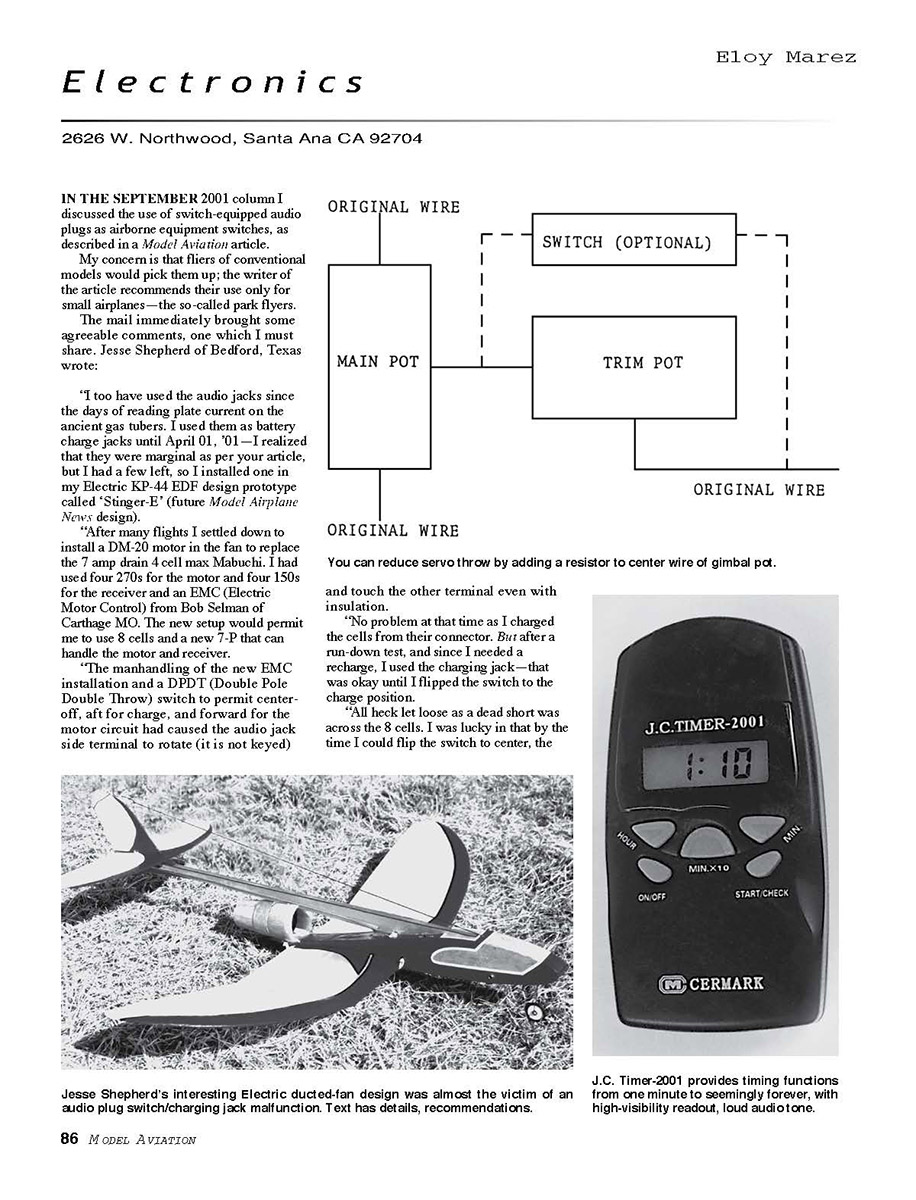
You can reduce servo throw by adding a resistor to center wire of gimbal pot.
and touch the other terminal even with insulation.
"No problem at that time as I charged the cells from the connector. But after a run-down test, and since I needed a recharge, I used the charging jack — that was okay until I flipped the switch to the charge position.
"All heck let loose as a dead short was across the 8 cells. I was lucky in that by the time I could flip the switch to center, the" solder from both the #1 and #6 cells had melted and defused the short. At any rate, no fuse in the system was around. As a result, at age 80, I learned not to use audio jacks for charging ever.
The small square jack that RadioShack sells is keyed, but its terminals are even thinner than the round one and shouldn't be used for higher current drains as you noted.
I have to congratulate Jesse, first for his involvement in Radio Control (RC) since sometime in Almost Ready-to-Fly and Ugly Sticklies you won't know about; go, tudes!
Second, because at his age he is still active enough to design, build, and fly. The sign over my workbench that reads, "God does not deduct the time spent modeling planes from a man's life span" is true and greatly encouraging.
Other writers have told of intermittent and glitchy when using audio jacks as switches, which disappeared when they were replaced with the original switch assembly.
Jesse's experience is so unique, and it reminds us that Murphy's Law is still on the books and that we are all subject to it. We all get complacent when it comes to the danger inherent in the RC hobby! I guess it's human nature; familiarity does breed contempt.
If you don't think accidents happen and people get hurt, read some of the letters Gary Shau publishes in his "Safety Comes First" column now and then.
It also applies to Ni-Cads! They are not inherently dangerous, but even a four-cell receiver battery pack has a considerable amount of power and will release enough to cause damage under shorted conditions.
Even a single cell can cause problems. Many of us have had cases in which fliers dropped their glow-plug batteries into their pockets, only to have them short against keys or coins. It was probably humorous to their friends, but it can't be too funny to the recipients.
A particularly worrisome battery in common use is that used in some transmitters that has exposed contacts of the type seen on nine-volt transistor batteries.
Not only is this an extremely poor method of connecting the battery in the transmitter, and has known to cause problems, but it has the potential of immediate short circuits when it is taken out.
Be especially careful if you are in the habit of carrying a second charged battery to extend your flying. Those exposed 9.6 volts are potentially more dangerous than the four-cell pack mentioned—probably on the verge!
Those of you who fast-charge Ni-Cds at the field, and especially those of you who use ball rates never to be seen in the battery makers' literature: automatic cutoff chargers have been known to not do so, and Ni-Cds have been known to explode.
Never leave charging batteries unattended, keep track of the normal time for charging, and don't let run much longer.
Check the batteries for excessive heat, and, if it all convenient, charge them outside the airplane.
Some sort of cover is a good idea, in case the batteries decide to make like microwave popcorn; that potassium hydroxide electrolyte can't be beneficial to your eyes.
Argentina! It's the land of Evita, Mendoza, and, closer to our hearts, Quique Somenzini and Debora Cadelli!
Although many of you might find it hard to believe, Argentina is the land of unbelievable RC activity—not only in the sophistication of the equipment and airplanes, but in the ability of the fliers.
The country also has hobby shops the equal of most in California—actually better because they don't have the large amount of toys our hobby has been invaded with in recent years.
Argentina has flying fields unlike those we see in the US, with parklike surroundings, hot-food stands, and real bathrooms.
I had the pleasure of being in Argentina in October for a giant airplane fun-fly, and I learned about an interesting equipment application. An acquaintance, Teodoro Tenorio, showed me his unique use of Futaba's PA-2 Assist Link-AutoPilot.
This is an airplane mounted device that optically monitors the difference in the light under and over the horizon. It is connected to the ailerons and elevator, and if no pilot input is present, it will return the airplane to straight and level from any unusual attitude.
It can be flight-adjusted for sensitivity, draws only five milliamps from the receiver battery, and weighs 1.5 ounces total.
The sensor is normally mounted forward-facing on the airplane so that it views the horizon when the airplane is flying straight and level.
Teodoro mounts it in the clear plastic canopy, in a 90° position, so that it is in line with the horizon when the airplane is in a vertical position, as it is in hover. In this manner, with the PA-2's output connected to the tail, it will feed correcting inputs if the airplane veers off the vertical position.
It is recommended as a training aid to those learning to hover, but it could also be an aid for an airplane that is difficult to keep in that attitude.
Does it surprise you that such ideas come from a far-off place that most people can't find on a world globe?
Argentina was the sixth country to fly a jet-powered airplane. Twelve inches to the foot, it was called the Pulqui. A modeling friend there is in the process of designing and building a turbine-powered model. More about that someday!
Beep! Beep! Some time ago in one of my columns I included a reminder to RC equipment designers and manufacturers that since many RCers are getting along in years, and what with the usual high ambient noise level at flying fields, it would be better if the audio signals, battery warnings, and timers available worked at a higher volume level.
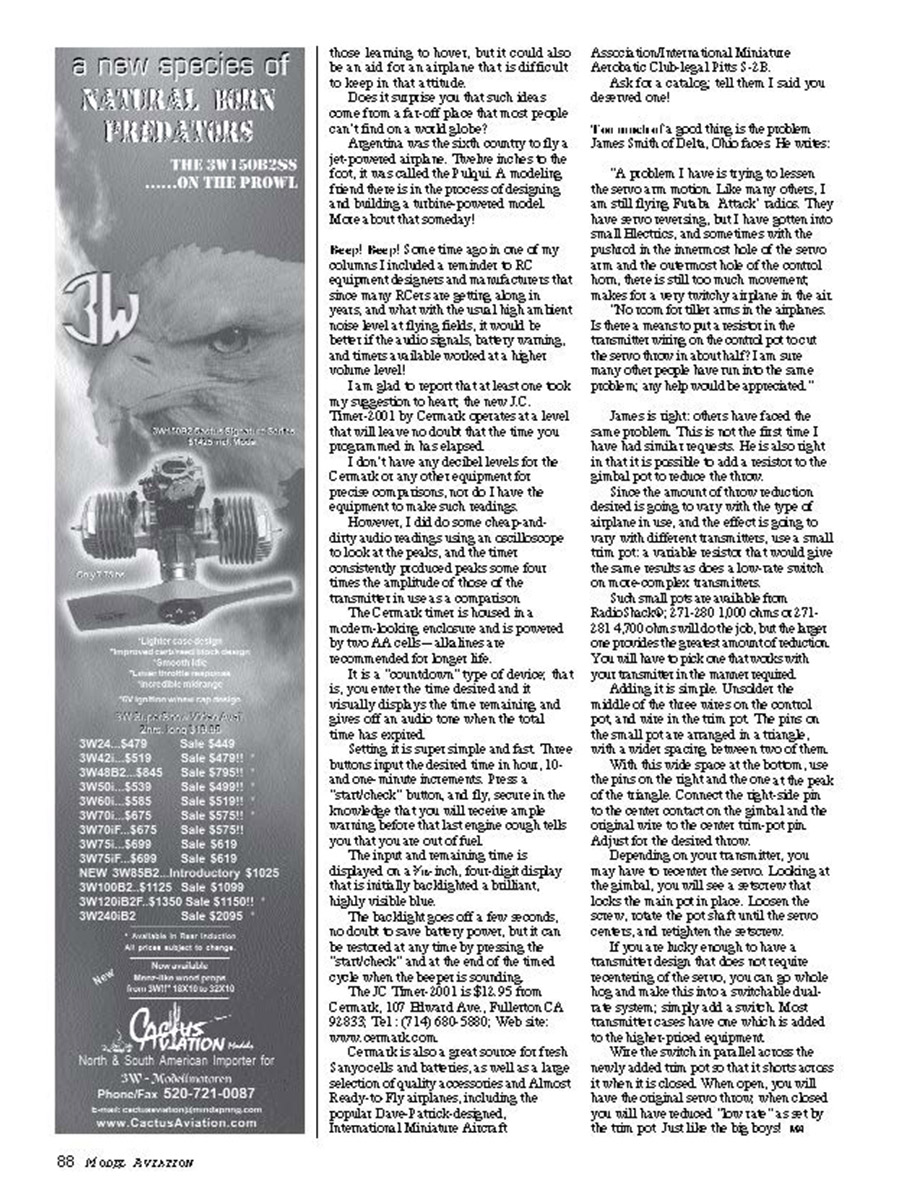
I am glad to report that at least one took my suggestion to heart; the new J.C. Timer-2001 by Cermak operates at a level that will leave no doubt that the time you programmed in has elapsed.
I don't have any decibel levels for the Cermak or any other equipment for precise comparisons, nor do I have the equipment to make such readings.
However, I did do some cheap-and-dirty audio recordings using an oscilloscope to look at the peaks, and the timer consistently produced peaks some four times the amplitude of those of the transmitter in use as a comparison.
The Cermak timer is housed in a modern-looking enclosure and is powered by two AA cells—all things are recommended for longer life.
It is a "countdown" type of device, that is, you enter the time desired and it visually displays the time remaining and gives off an audio tone when the total time has expired.
Setting it is super simple and fast. Three buttons input the desired time in hour, 10- and one-minute increments. Press a "start/check" button, and fly, secure in the knowledge that you will receive ample warning before that last engine cough tells you that you are out of fuel.
The input and remaining time is displayed on a 2 1/2-inch, four-digit display that is initially backlighted a brilliant, highly visible blue.
The backlight goes off a few seconds, no doubt to save battery power, but it can be tested at any time by pressing the "start/check" and at the end of the timed cycle when the beeper is sounding.
The JC Timer-2001 is $12.95 from Cermak, 1007 Rutland Ave., Fullerton CA 92833. Tel: (714) 680-5880; Web site: www.cermakcom.
Cermak is also a great source for fresh Sanyo cells and batteries, as well as a large selection of quality accessories and Almost Ready-to-Fly airplanes, including the popular Dave Patrick-designed, International Miniature Aircraft Association/International Miniature Aerobatic Club-legal Pitts S-2B.
Ask for a catalog; tell them I said you deserved one!
I'm much of a good thing is the problem, James Smith of Delta, Ohio faces: He writes:
"A problem I have is trying to lessen the servo arm motion. Like many others, I am still flying Futaba 'Attack' radios. They have servo reversers, but I have gotten into small Electrics, and sometimes with the pushrod in the innermost hole of the servo arm and the outermost hole of the control horn, there is still too much movement, makes for a very twitchy airplane in the air.
"No room for little arms in the airplanes. Is there a means to put a resistor in the transmitter wiring on the control pot to cut the servo throw in about half? I am sure many other people have run into the same problem; any help would be appreciated."
James is right; others have faced the same problem. This is not the first time I have had similar requests. He is also right in that it is possible to add a resistor to the signal pot to reduce the throw.
Since the amount of throw reduction desired is going to vary with the type of airplane in use, and the effect is going to vary with different transmitters, use a small trim pot: a variable resistor that would give the same result as does a low-rate switch on more complex transmitters.
Such small pots are available from RadioShack; 271-280 1,000 ohms or 271-281 4,700 ohms will do the job, but the larger one provides the greatest amount of reduction. You will have to pick one that works with your transmitter in the manner required.
Adding it is simple. Unsolder the middle of the three wires on the control pot, and wire in the trim pot. The pins on the small pot are arranged in a triangle, with a wider spacing between two of them. With this wider space at the bottom, use the pins on the right and the one at the peak of the triangle. Connect the right-side pin to the center contact on the gimbal and the original wire to the center trim-pot pin. Adjust for the desired throw.
Depending on your transmitter, you may have to re-center the servo. Looking at the gimbal, you will see a screw that locks the main pot in place. Loosen the screw, rotate the pot shaft until the servo centers, and tighten the screw.
If you are lucky enough to have a transmitter design that does not require recentering of the servo, you can go whole hog and make this into a switched dual-rate system; simply add a switch. Most transmitter cases have one which is added to the higher-priced equipment.
Wire the switch in parallel across the newly added trim pot so that it shorts across it when it is closed. When open, you will have the original servo throw; when closed you will have the reduced "low rate" as set by the trim pot. Just like the big boys!
Transcribed from original scans by AI. Minor OCR errors may remain.

