
Electronics
2626 W. Northwood, Santa Ana CA 92704
Publisher's note: The following column discusses the death of Adam Kirby, 11, at a routine club flying session in Great Britain last year, when he was killed by an out-of-control model airplane. While modelers worldwide still seek to fully understand the lessons of this tragic event, AMA president Dave Brown addressed this subject, and in particular two transmitters on the same frequency creating a condition of interference, in the April 2000 issue of Model Aviation.
Those who wish to read Dave's column but no longer have this issue can click on "Model Aviation" on the AMA Web site, www.modelaircraft.org.
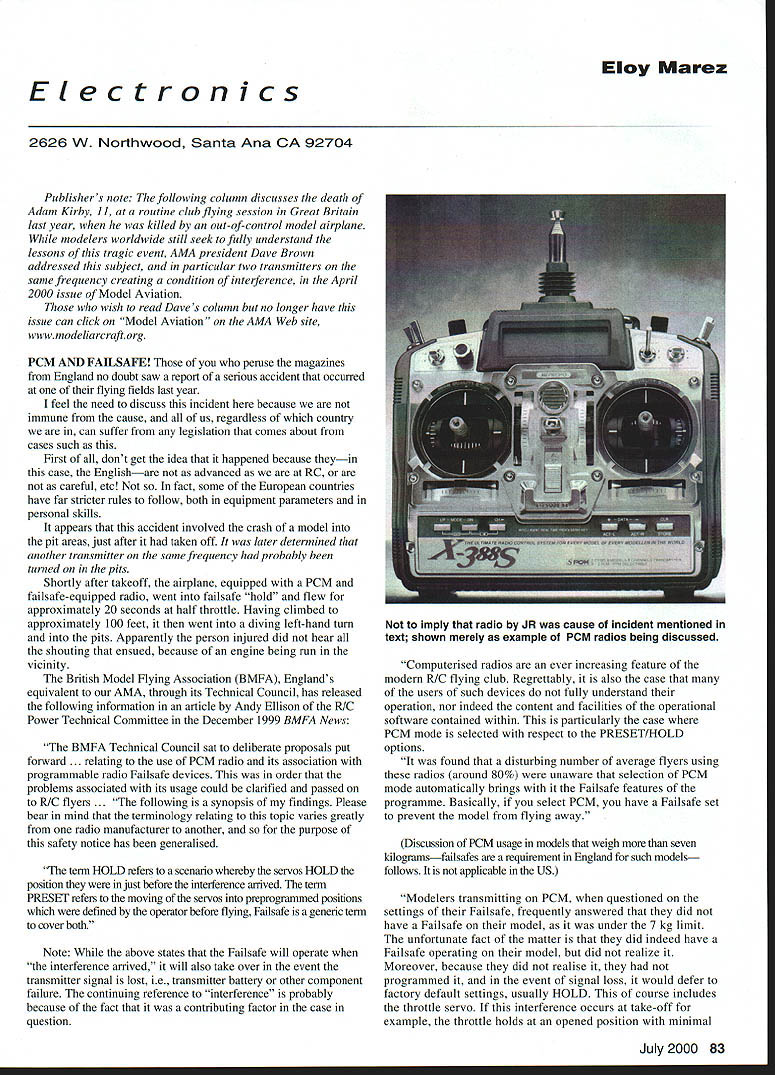
PCM AND FAILSAFE
Those of you who peruse the magazines from England no doubt saw a report of a serious accident that occurred at one of their flying fields last year.
I feel the need to discuss this incident here because we are not immune from the cause, and all of us, regardless of which country we are in, can suffer from any legislation that comes about from cases such as this.
First of all, don't get the idea that it happened because they—in this case, the English—are not as advanced as we are at RC, or are not as careful, etc! Not so. In fact, some of the European countries have far stricter rules to follow, both in equipment parameters and in personal skills.
It appears that this accident involved the crash of a model into the pit areas, just after it had taken off. It was later determined that another transmitter on the same frequency had probably been turned on in the pits.
Shortly after takeoff, the airplane, equipped with a PCM and failsafe-equipped radio, went into failsafe "hold" and flew for approximately 20 seconds at half throttle. Having climbed to approximately 100 feet, it then went into a diving left-hand turn and into the pits. Apparently the person injured did not hear all the shouting that ensued, because of an engine being run in the vicinity.
The British Model Flying Association (BMFA), England's equivalent to our AMA, through its Technical Council, has released the following information in an article by Andy Ellison of the R/C Power Technical Committee in the December 1999 BMFA News:
"The BMFA Technical Council sat to deliberate proposals put forward . . . relating to the use of PCM radio and its association with programmable radio Failsafe devices. This was in order that the problems associated with its usage could be clarified and passed on to R/C flyers . . .
"The following is a synopsis of my findings. Please bear in mind that the terminology relating to this topic varies greatly from one radio manufacturer to another, and so for the purpose of this safety notice has been generalised.
"The term HOLD refers to a scenario whereby the servos HOLD the position they were in just before the interference arrived. The term PRESET refers to the moving of the servos into preprogrammed positions which were defined by the operator before flying. Failsafe is a generic term to cover both."
Note: While the above states that the Failsafe will operate when "the interference arrived," it will also take over in the event the transmission signal is lost, i.e., transmitter battery or other component failure. The continuing reference to "interference" is probably because of the fact that it was a contributing factor in the case in question.
"Computerised radios are an ever increasing feature of the modern R/C flying club. Regrettably, it is also the case that many of the users of such devices do not fully understand their operation, nor indeed the content and facilities of the operational software contained within. This is particularly the case where PCM mode is selected with respect to the PRESET/HOLD options.
"It was found that a disturbing number of average flyers using these radios (around 80%) were unaware that selection of PCM mode automatically brings with it a Failsafe feature of the programme. Basically, if you select PCM, you have a Failsafe set to prevent the model from flying away."
(Discussion of PCM usage in models that weigh more than seven kilograms—failsafes are a requirement in England for such models—follows. It is not applicable in the US.)
"Modelers transmitting on PCM, when questioned on the settings of their Failsafe, frequently answered that they did not have a Failsafe on their model, as it was under the 7 kg limit. The unfortunate fact of the matter is that they did indeed have a Failsafe operating on their model, but did not realize it. Moreover, because they did not realize it, they had not programmed it, and in the event of signal loss, it would defer to factory default settings, usually HOLD. This of course includes the throttle servo. If this interference occurs at take-off for example, the throttle holds at an opened position with minimal deflection on the other control surfaces, the results can be disastrous.
"If you use a typical Computerised Transmitter, you should be aware of the following basic findings:
- Almost all sets give an automatic PRESET/HOLD feature as soon as PCM is selected. This Failsafe becomes operational if interference occurs at the receiver of the model. Control returns to the pilot when the interference ceases. If the interference does not cease, the pilot will not regain control.
- The Failsafe software cannot be totally inhibited. It will either hold all (HOLD) or go to positions preprogrammed by the pilot (PRESET). Some sets allow a combination of this feature, i.e. some channels will go to a PRESET position and some controls will HOLD at their last position.
- The default setting if nothing is programmed is to HOLD at last input position, including throttle. This will become operational after a predetermined interval set by the pilot (1.0 seconds, 0.5 seconds, or 0.25 seconds) or after a default interval if nothing is programmed. The interval is the length of time it takes, starting the moment interference occurs, until the servos assume their preset positions.
- The Failsafe does not work in the event of receiver nicad loss.
- Programming of the PRESET feature is done by opening the memory of the computer, putting the sticks, switches, and potentiometers in a selected position, and then closing the computer memory. This can be quite difficult to follow, even from the radio instruction manual.
- If a model normally flown on normal modulation (PPM) is swapped to PCM by a change of receiver, the Failsafe feature is again automatically selected even though none of the other settings in the transmitter are altered. There is no warning given to the pilot to remind him that he is now flying under the protection of PRESET/HOLD software."
"To illustrate the seriousness with which the BMFA are taking this matter, the Technical Council unanimously agreed to a plan of action which has been reported to the coroner's inquest and includes:
- The forwarding of our findings to all known radio manufacturers, highlighting the problem and requesting/advising that they:
i) Negate the problem through the use of revised software, i.e., inhibit the Failsafe function so that it must be selected to turn it on, and modify the factory settings for the throttle function so that it does not default to HOLD; and ii) Publish in the operations manual for the radio clear and concise instructions highlighting the potential danger of an "un-programmed" transmitter based radio Failsafe device.
- The findings are passed to the CIAM/FAI (International Committee for Aeromodelling/Fédération Aéronautique Internationale) with the expressed request that they distribute them to all National Aeromodelling Governing Bodies in a suitable publication.
- The CIAM/FAI/BMFA instigate an emergency general rule change to ensure that any powered models flown under the protection of a Radio Control Failsafe device must ensure that said device brings the motor/engine to run at its lowest speed (stopped, in the case of electric powered models), and specifically not to HOLD the last position of the motor/engine control."
Commentary and Recommendations
It is now soapbox time!
First of all, let us all admit that there is some danger involved with our favourite pastime. And it is not limited to large airplanes, as some seem to think. I have no doubt that an .049-powered racer or Control Line Speed airplane is capable of killing you if it happens to hit you just right. And one would be just as dead as if it had been one of those "7 kg" models mentioned.
Let us look at some of the terminology in use—a contributing factor when it comes to understanding not only the Failsafe functions, but all functions of our varied equipment.
We can start with the other mode mentioned, different from PCM (Pulse Code Modulation; computer-speak, if you will), that which is referred to as PPM (Pulse Position Modulation). It is totally incorrect, the actual system in use being Pulse Width Modulation (PWM). Even in a PCM system, the ultimate control information fed to the servos is PWM; that is why servos are all completely plug-in compatible. Even the new "super" and/or "digital" servos are PWM-controlled.
How do things like that happen? My guess is that when Pulse Width Modulation was first translated from the original foreign instructions, it came out incorrect, and for some reason all other instructions followed. Not only that, but some of the terminology in use has no actual reference to its effect.
For example, ATV and VTR (Adjustable Travel Volume and Variable Trace Ratio); neither is fully descriptive of its function. Volume is not a word normally used to express movement, or travel, which it does in this case. VTR has absolutely no meaning in electronics or aeronautics. As in the case of Failsafe, I seriously doubt if, outside of Tournament of Champions circles, we would find one flier who knows what it does.
I believe it is time for AMA and RCMA (Radio Control Manufacturers Association) to enter the picture, and as AMA has done in the case of narrowband receivers, stress the need for some standardization in terminology and thorough, easier-to-understand instructions. Anyone who believes that the latter are adequate should be called on to explain why the aftermarket instruction books and videos are available for some of the popular radio systems.
In the way of explanation about the preceding remark about narrowband receivers, it must be remembered that their use is "recommended" by AMA.
Editor's note: Item 3.3 of the AMA Frequency Management Plan in the Membership Manual states that "It is recommended that channels 00 through 60 use narrowband receivers…"
Narrowband transmission from the transmitter is a Federal requirement, via the FCC (Federal Communications Commission), but they do not legislate receiver bandwidth requirements.
For additional information, please see "RC Receivers and the FCC" on page 84 of this issue.
Concerning the qualifications of PCM radio owners, I am not surprised that 80% are unaware of this particular function of their systems. England is not alone in this respect; I see the same thing here in the US, not only about the Failsafe but about most of the more-sophisticated functions of the radio.
A vast majority of PCM radio owners use them as basic four-channel noncomputer radios. Let's face it: you don't really need a 10-channel PCM TOC-class radio to fly your Ugly Stick. Why have them at all? I guess there is some of the same snob appeal to a PCM system as there is to a BMW or Rolex.
There is little we can do about the Sunday flier, but it seems to me that we can have some control at club fields and contests. Possibly in the same manner we now check airplanes for safety items, we can also have field marshals quiz PCM owners as to their knowledge of their systems, and just how the Failsafe is programmed.
In the case, as mentioned, that the Failsafe does not function in the event of airborne battery failure, a backup battery system should be mandatory for certain airplanes.
Some of the cures have to start with the manufacturers. I feel very strongly that they have made a major contribution to the situation; as mentioned, the instructions leave a lot to be desired.
To start with, in all cases, instructions should be done by hands-on modelers, in plain electronic language if necessary, but using aviation-oriented terminology; and not forgetting for one sentence that the idea is to communicate and to educate, not to impress with advertising hoopla and confusing verbiage. And we must all remember that the idea behind all this is not to restrict us in any manner, but to protect us!
MA
Thanks to BMFA for assistance in preparing this column.
Transcribed from original scans by AI. Minor OCR errors may remain.

