
Electronics
There is an interesting electric/electronic project going on in my hometown of Santa Ana, California. Not exactly RC, but of interest to many readers: electric motor power. A Mr. Ed Dempsey is reported to have reached 250 mph in an electric car! And here most of us have been thinking that electric cars were the land-based equivalent of electric-powered sailplanes.
Not all pertinent information is available to me, but what facts I do know are quite interesting.
Mr. Dempsey is using Ni-MH (Nickel Metal Hydride) batteries, when all I can recall reading about them is that they are not capable of high current loads because of their internal resistance. Not only that, he is using C cells. Sure would be nice to know the exact makeup of his battery.
I'll bet you that electric-power devotees are thinking, "brushless motors." Not really; actually he is using AC (Alternating Current) motors. All AC motors are not created equal, and no information is available as to the exact type, other than that they are designed for 400 Hertz (Hz) power. We can be sure that for this particular application, they are custom-made.
The interesting question is where the 400 Hz AC is coming from. Batteries can deliver only DC (Direct Current), and furthermore, any change from DC to AC (or vice versa, as is more commonly done) results in some loss. The actual process is simple but always results in less useful wattage than is taken out of the source.
Any device that is pulling, say, 100 watts from the wall socket and converting it to light, heat, or DC current (like within this word processor of mine) is capable of furnishing only less than 100 watts to the powered device. A measure of the efficiency of any such device is the percentage of its output versus its input (in watts); I don't know of a single one that has yet reached 100 percent!
The efficiency of the AC motors, compared to their DC siblings, more than makes up for the loss inherent in the power supply. I wish I had more information to share with you. I mention it here because it is a sign of the future; probably later than sooner, but someday the technology and hardware will trickle down to us modelers. In the meantime, like it or not, we will have to accept that the highest power-to-weight ratio now available comes from "wet" sources.
Futaba Repairs
In the US Air Force, it is a well-accepted fact that no matter how you spread the word about something, there is always 10% that it never reaches. Apparently the same applies to RCers, as I have had a few phone and mail queries about "what happened to Futaba?"
For you 10-percenters, Futaba Corporation of America, as we knew it for so many years, no longer exists. Importation and distribution of Futaba RC equipment is now being done by Great Planes. As of this writing, service is still being done at the Futaba Service Center in Irvine, CA, but that might change in the future. Before sending equipment in for service, I would check with Great Planes or its retail outlet, Tower Hobbies, for the latest status.
Battery Failsafe
There is another point to consider in the failsafe controversy: some swear by it and some swear at it! At least at the servo-positioning part (everyone agrees that battery failsafe is a useful feature). And once more for you 10-percenters: battery failsafe is a feature that warns you when the Ni-Cds in your transmitter or receiver have become discharged to a critical level. In the transmitter, an audio tone will sound.
The receiver battery failsafe notifies you of impending disaster by pulling back on the engine throttle. With most systems, you can regain throttle control by pulling the stick to the idle position, then up again to whatever throttle setting you need to maneuver to set up a landing approach—because landing as soon as possible is always called for.
Enter the five-cell air battery favored by some, for the extra servo power and speed—on the order of 20%—resulting. The other result, apparently not thought of, is that the receiver failsafe is no longer operative. In fact, you could have a completely dead cell in the airborne battery and still get no warning from the failsafe.
In case you are not following, it is a voltage-operated device, probably set for 4.70 to 4.90 volts, and by the time a five-cell pack reaches that level, you won't need failsafe; your own "I ain't got it" will have let you and everyone else within earshot know that something is amiss. Remember that if you are a five-cell user, keep track of your available and actual flight times.
What Then?
If our battery failsafe is not working properly, what then can we depend on to prevent a re-kitting because of battery failure or discharge?
One possibility—not a failsafe as originally built into the RC system, but a battery monitor—is available from i4C Products. It has a very small (0.875 x 1.375-inch) self-contained digital battery voltage meter called the C-Volt that will read that five-cell pack voltage, and more.
- It is calibrated to read from 4.0 to 18.0 volts, with 0.01 volt resolution.
- Available in two versions:
- Flush-mounted version for fuselage side or instrument panel mounting (requires a mounting hole).
- Aluminum-cased surface-mount version (double-stick tape), logical for helicopters.
- Requires no installation or calibration, other than plugging it into an unused receiver servo port, or through a Y-harness if all channels are in use.
- Available with proper plugs for JR, Futaba, or Airtronics radios. Users of Hitec and Airtronics Z systems should ask for the JR version.
- Pricing: $39.95 for the flush-mounted version and $44.95 for the aluminum-cased version.
- To order direct: 6924 E. 92nd, Tulsa OK 74133-5318; Tel: (918) 492-9435, Fax: (918) 492-9375. Shipping and handling $5 when ordering direct.
Check with your dealer for availability.
More About Meters
Back in March, I discussed some of the misconceptions generally accepted where meters are concerned. Said discussion brought a letter from my home state of Texas, from Carl West, who teaches electronics and communications in a Texarkana college, no doubt so that he can afford RC airplanes.
Carl took my discussion a few steps further, including one point I want to share:
"There is a misconception that digital meters are more accurate than analog (ones with a needle) meters. Digital meters appear to be more accurate because of their display, which usually gives one or two decimal places. This cannot be further from the truth. Electronics is definitely 'pay for what you get and get what you pay for.' The internal characteristics of the meter determine its accuracy, not the display. I'm glad you mentioned this in your article about the 75 mA tolerance.
"You can get a pretty good general-purpose digital multimeter (volts, current, resistance) for about $40 to $50. I have one of these in the classroom. I also have meters that are much more accurate and analog that are about $800. This is not laboratory-grade equipment, but it serves the purpose."
C-Volt Again!
Since the subject of accuracy reared its head, I felt compelled to check out the C-Volt. Using one of the meters described above as "not lab quality but adequate," my comparison tests showed the C-Volt as being right on within all RC-related ranges.
Actually, a single-purpose unit with a limited range, such as this one, is quite easy to calibrate for extreme accuracy. When considering the purchase of a more complex multiuse instrument, if you get a chance to inspect the insides and find only one calibration pot, stay away from it. It will probably be right on at the calibration point, but the farther away from it you try to read, the greater the inherent error. Those "adequate" instruments, and definitely the lab-quality ones, have calibration adjustments on all ranges.
Metric Servo Specifications
No, not metric-servo specifications, but metric servo-specification!
When reading foreign sales materials and magazines, we often run into servo specs stated in kg-cm (kilograms per centimeter) instead of the ounce-inches we are used to. Have you ever wondered how to convert those specs to the more familiar term?
The calculator comes to the rescue: To convert kg-cm to oz-in, the formula is: kg-cm × 1.389 × 10^1. Or simply multiply the metric value by 14. Reverse the procedure to convert oz-in to kg-cm—divide by 14.
Hitec rates its standard HS300 servo at 3.0 kg-cm or 42 oz-in. Get out your calculator and try it!
Closing Note
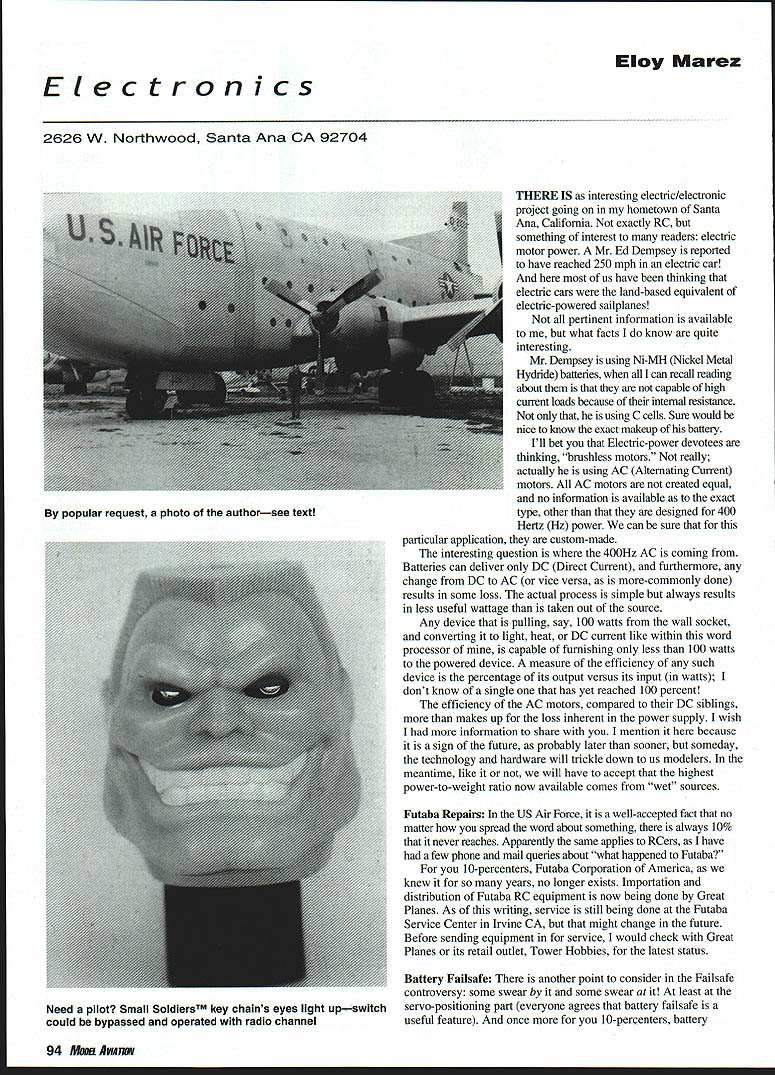
I have been asked many times (well, at least twice) why I never include pictures of myself in any of my writing efforts. I have yielded, and with apologies to some of you, I am enclosing a photo taken at the Pima Air Museum in Tucson. Yep, that's me, alongside an old friend, a radio Douglas C-124, actually one of many in which I accumulated more than 5,000 hours as a radio operator back in my blue-suit days. Enjoy! MA
Transcribed from original scans by AI. Minor OCR errors may remain.

