
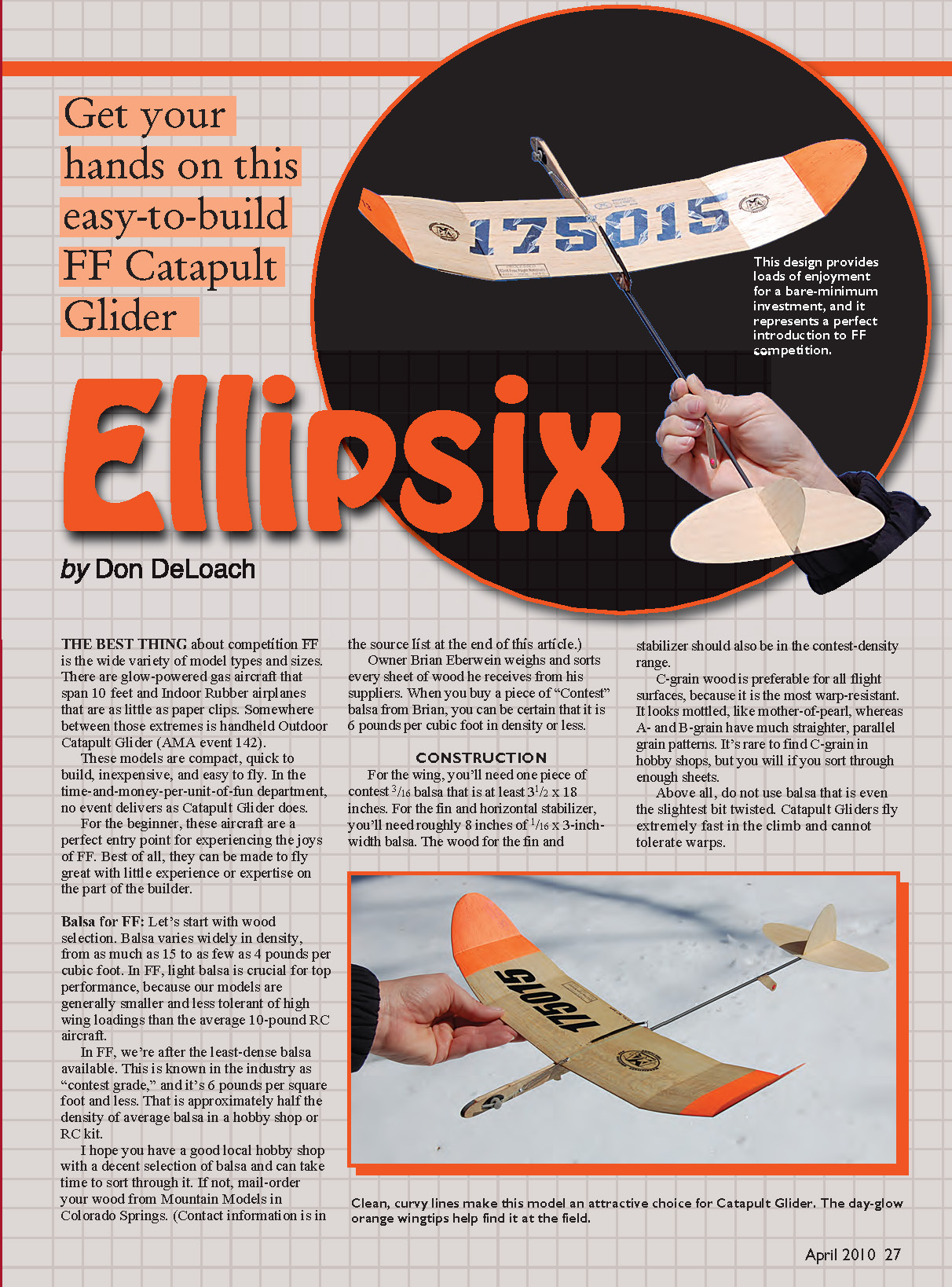
Ellipsix
by Don DeLoach
The best thing about competition free flight (FF) is the wide variety of model types and sizes. There are glow-powered gas aircraft that span 10 feet and indoor rubber airplanes that are as little as paper clips. Somewhere between those extremes is the handheld Outdoor Catapult Glider (AMA event 142).
These models are compact, quick to build, inexpensive, and easy to fly. In the time-and-money-per-unit-of-fun department, no event delivers like Catapult Glider does.
For the beginner, these aircraft are a perfect entry point for experiencing the joys of FF. Best of all, they can be made to fly great with little experience or expertise on the part of the builder.
Balsa for FF
Let's start with wood selection. Balsa varies widely in density, from as much as 15 to as few as 4 pounds per cubic foot. In FF, light balsa is crucial for top performance, because our models are generally smaller and less tolerant of high wing loadings than the average 10-pound RC aircraft.
In FF, we're after the least-dense balsa available. This is known in the industry as "contest grade," and it's 6 pounds per cubic foot and less. That is approximately half the density of average balsa in a hobby shop or RC kit.
I hope you have a good local hobby shop with a decent selection of balsa and can take time to sort through it. If not, mail-order your wood from Mountain Models in Colorado Springs (contact information is in the source list at the end of this article).
Owner Brian Eberwein weighs and sorts every sheet of wood he receives from his suppliers. When you buy a piece of "contest" balsa from Brian, you can be certain that it is 6 pounds per cubic foot in density or less.
Above all, do not use balsa that is even the slightest bit twisted. Catapult gliders fly extremely fast in the climb and cannot tolerate warps. The finished stabilizer and fin should be approximately 1/32 inch thick at their tips/edges as described below.
CONSTRUCTION
Wing and flight surfaces
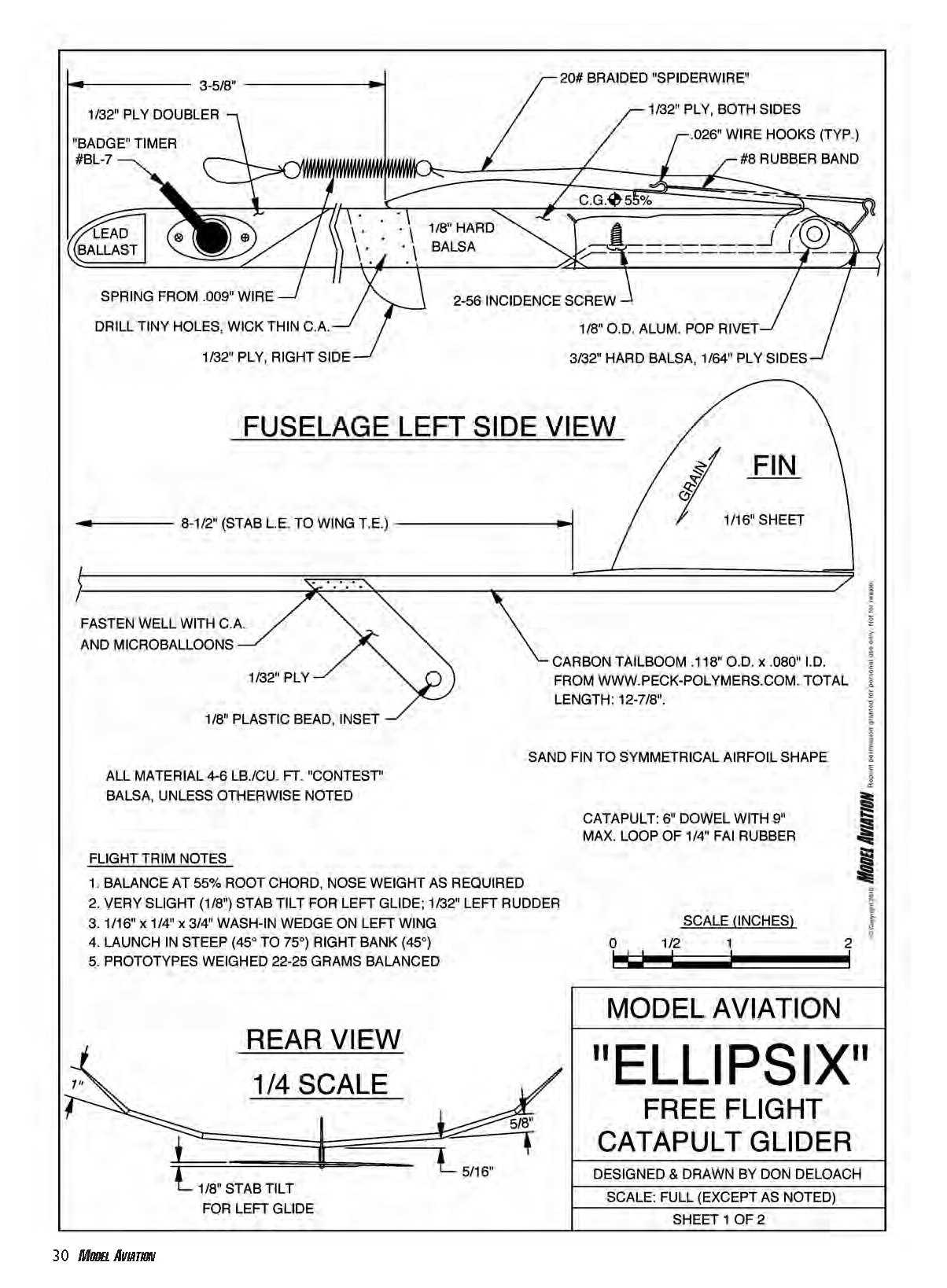
For the wing, you'll need one piece of contest 3/16 balsa that is at least 3-1/2 x 18 inches. For the fin and horizontal stabilizer, you'll need roughly 8 inches of 1/16 x 3-inch-width balsa. The wood for the fin and stabilizer should also be in the contest-density range.
C-grain wood is preferable for all flight surfaces because it is the most warp-resistant. It looks mottled, like mother-of-pearl, whereas A- and B-grain have much straighter, parallel grain patterns. It's rare to find C-grain in hobby shops, but you will if you sort through enough sheets.
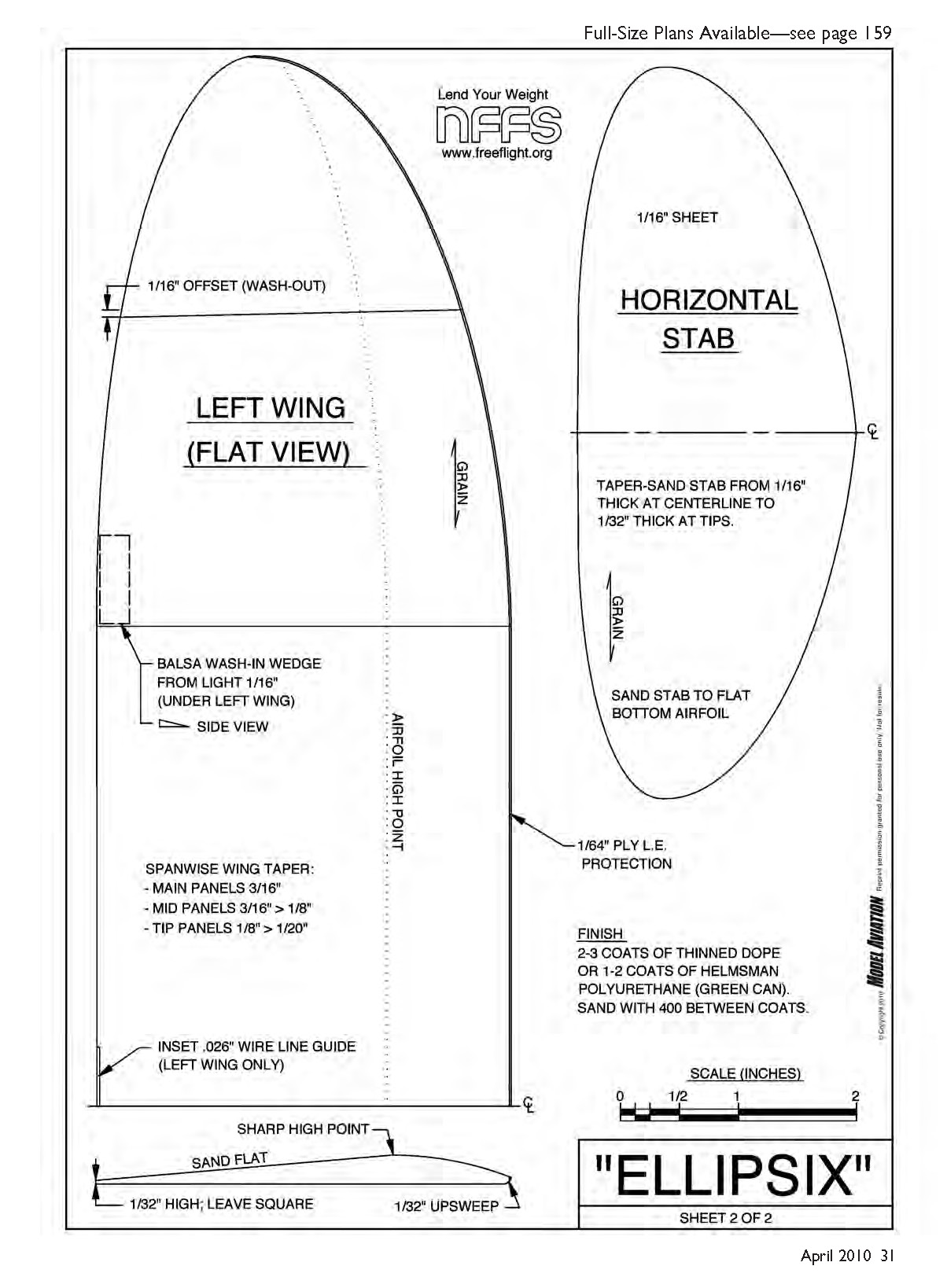
Cut the wing, fin, and stabilizer from the sheet balsa with a sharp #11 X-Acto blade or scalpel. Lightly moisten the 1/64-inch plywood strip and attach it to the wing leading edge (LE) using medium CA. This strip will prevent the inevitable gouges that result from rough landings.
Taper-sand the stabilizer from full thickness at the centerline to 1/32 inch at the tips, and then sand it to a flat-bottomed airfoil shape with the high point roughly 30% back from the LE. This is a noncritical operation; just try to keep it close. Don’t press down too hard with the sandpaper; that can crush the wood fibers and cause warps.
The fin should be tapered to 1/32 inch in thickness at its top edge and sanded to a symmetrical airfoil shape. Dab medium CA on the LE of the stabilizer and fin for dent protection, and then final-sand with 400-grit paper.
Shaping and final-sanding the wing airfoil is not difficult but is time-consuming. Allow at least an hour to get it right.
Start rough-shaping the wing airfoil with a razor plane. This is a simple operation if your blade is sharp and you work carefully in long, smooth strokes. If you don’t have a razor plane, 60-grit sandpaper will have to do.
Once you are finished rough-shaping, mark the airfoil high point with a pencil or, better yet, a strip of flexible masking tape. This will ensure a sharp airfoil high point, regardless of slips with the sanding block.
Sand the airfoil aft of the high point, taking care to keep the sanding block true and flat. This area (from the high point all the way to the TE) should be a straight chordwise taper, with no upper camber.
Strip off the high-point tape and reposition it for shaping the forward portion of the airfoil. Notice, on the plans, that this portion does have camber. Use long, consistent strokes of 100- and then 220-grit paper to get this right. Don’t forget the 1/32 inch of quarter-round upsweep on the lower surface.
Polish-sand the wing with 400-grit paper and get out your razor saw; it is time to cut the dihedral breaks. Using the finest saw, you have to carefully and slowly cut the five breaks. It doesn’t take much pressure on the saw to sever the soft balsa, so take care to keep the saw straight.
Next is sanding dihedral bevels into the wing-panel glue joints. This is easy; you need only a good base. Use the straight, smooth edge of a workbench or a plate of glass (my favorite). Butt the panel to be sanded to the edge of the workbench or glass plate. Slowly sand back and forth, tilting the sanding block slightly to approximate the bevel. Remove the wing panel after a few strokes and check your progress against a ruler.
Glue each panel together using medium CA, matching dihedral angles on each wing half. When all angles match, join the wing halves at the center dihedral break.
Fuselage
Ellipsix is designed to utilize the pop-up tailboom fuselage system that FF glider guru Stan Buddenbohm developed. I highly recommend that you purchase at least one of these prebuilt fuselages from Stan; they’re the best available for these small gliders.
If you don’t mind an hour of extra work (and you have the right materials), fabricating one of these fuselages at home is not too difficult. Start with a piece of hard 1/8 x 1/2 balsa that is approximately 8 inches long. This will be the fuselage pod onto which the wing is glued.
The tailboom is a length of 0.120-inch-OD tubular carbon with approximately a 0.020-inch wall thickness. The hinge base for the tailboom is a piece of extremely hard 3/32 balsa (or basswood) with 1/64 plywood sides. It needs to be fastened securely (and aligned perfectly) to the tailboom.
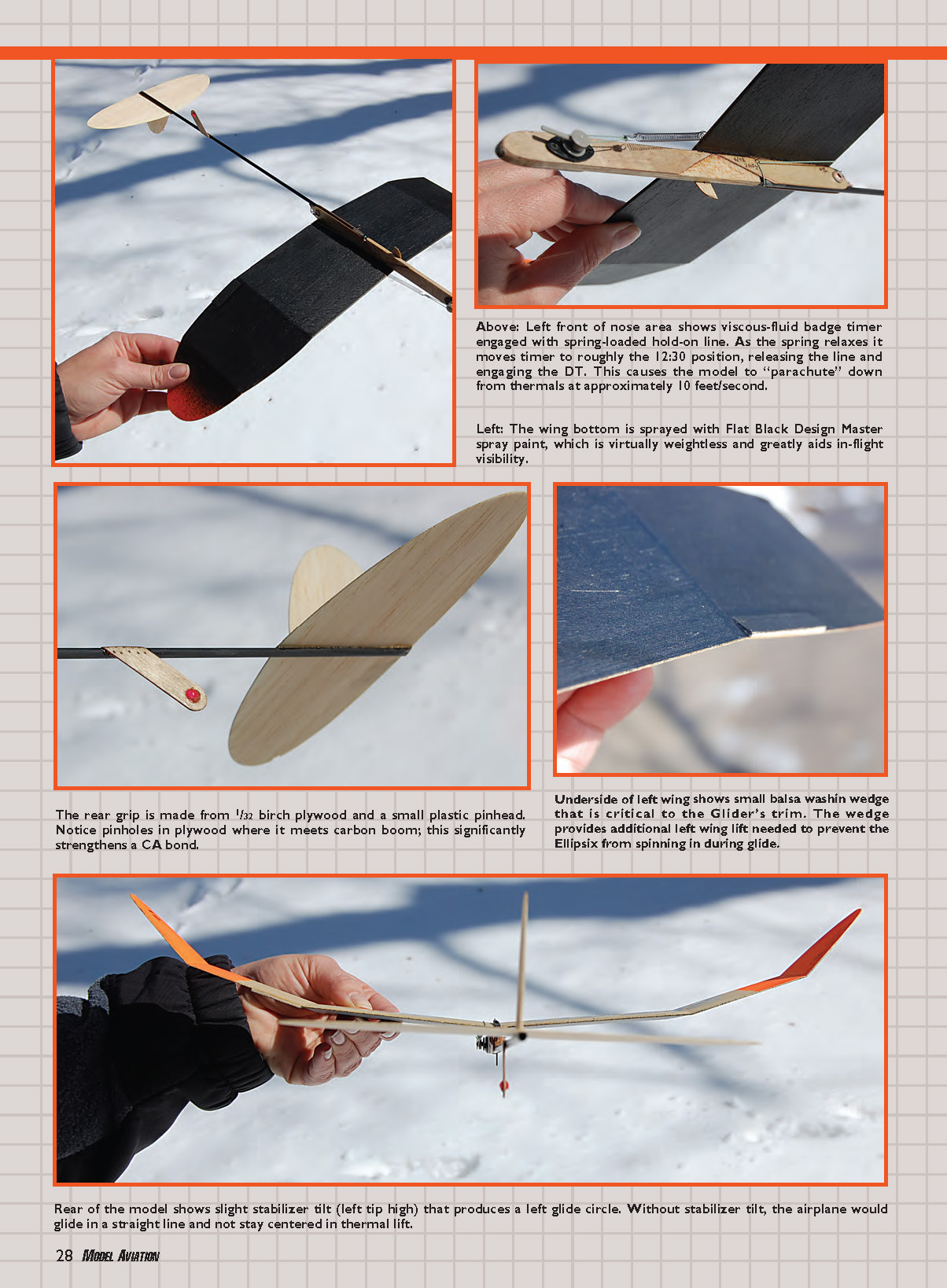
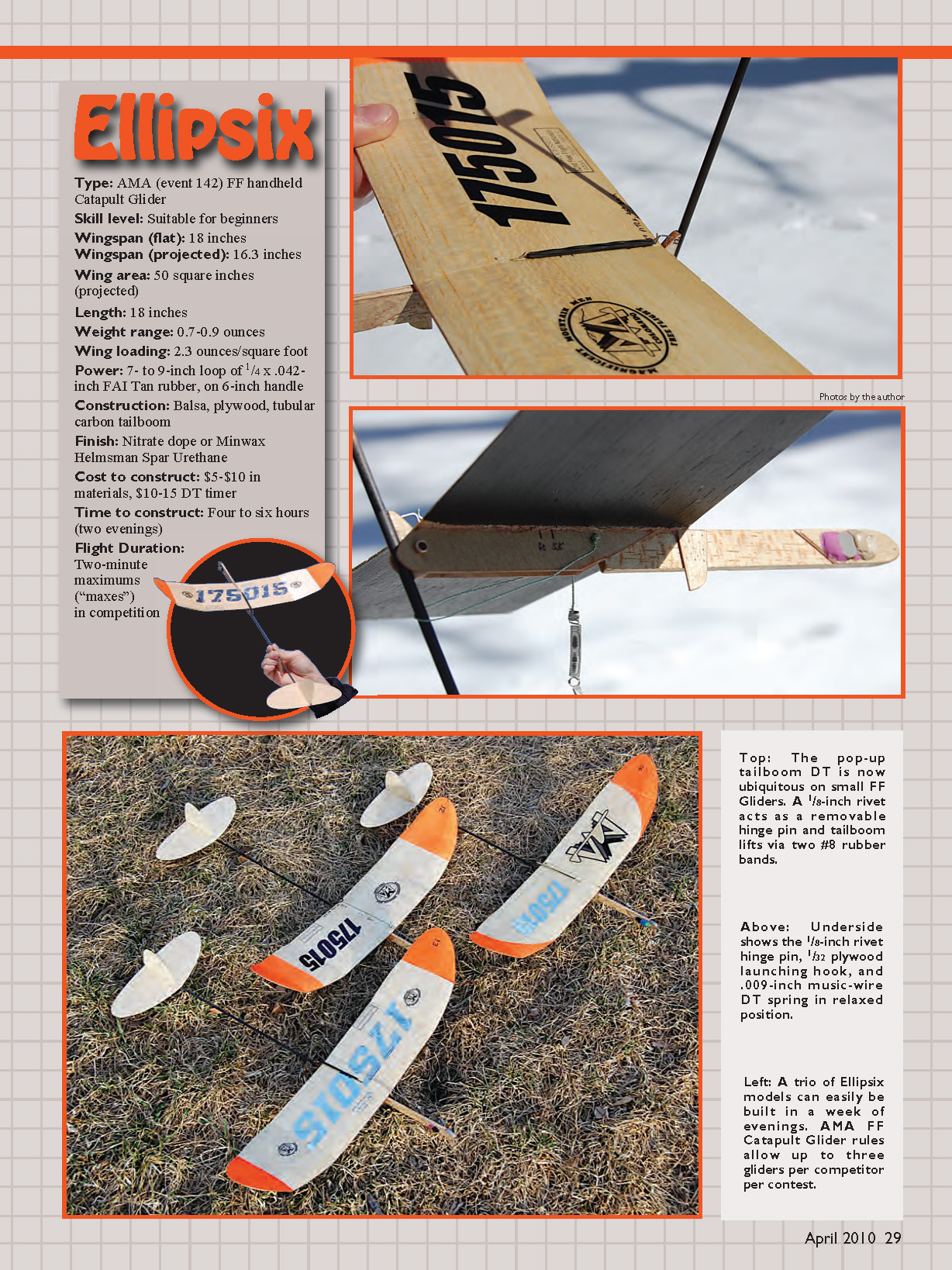
The tailboom hinges to the pod via a 1/8-inch-diameter aluminum pop rivet that is friction-fit through the 1/32 plywood “ears” on either side of the rear of the pod. Ensure that the fuselage pops up freely and easily with the force of a single #8 rubber band. Hang-ups equal flyaways.
Assembly
You are ready to glue on the flight surfaces. Start with the wing, taking care to line it up perfectly. If you are careless with this step, the Ellipsix will be hard to trim in the high-speed launch.
Glue the stabilizer onto the top of the fuselage. Note the slight stabilizer tilt for a left glide turn (with the left stabilizer tip 1/8 inch higher than the right when viewed from the rear); this is important. Too little stabilizer tilt is better than too much.
It is time to apply a finish to the flight surfaces. I normally use two or three coats of 50/50 thinned nitrate dope on all balsa, sanding lightly with 400-grit paper between coats. Others like to mix a small amount of talcum powder with the dope for a sanding-sealer effect. Still others use a light coat of clear Minwax polyurethane, mostly smeared off with a paper towel.
Use your favorite finishing method, but don't forget to color the model for visibility. I like Design Master spray paint from the Michael's chain of craft stores. It is extremely bright and weighs next to nothing.
Design Master "Carnation Red" and "Holiday Red" are excellent choices for the top surfaces. For the underside of the wings, a coat of Design Master "Flat Black" will greatly aid in-flight visibility, especially on cloudy days.
Final touches
After tending to a few more details, we'll be ready to test-fly.
- Securely attach the 1/32 plywood launching and rear hooks with thin CA.
- Attach a 1/32 plywood doubler to one side of the nose for extra durability and strength.
- Test your DT operation on the ground several times to make sure that it is working reliably.
Turn your attention to rigging the Spiderwire hold-down line that extends to the timer. The line should capture the front portion of the carbon tailboom and lock it into position under the midchord point under the wing.
Now route the line back to the TE and up over the top surface of the wing. Attach a 2- to 3-inch loop of the elastic thread that is supplied with the timer, and experiment with tension on the timer.
Ideally, you want the timer to rotate approximately a half revolution in slightly more than two minutes. This is perfect for the two-minute "maxes" flown in Catapult Glider competitions.
A better alternative to the elastic thread is a metal spring. These are available from Stan Buddenbohm, or you can wind one using .009 music wire on a .078 mandrel. Springs are consistent across all temperatures and don't dry out and weaken with time, as does elastic.
Test the timer several times on the ground, making sure that the tailboom is locked up solidly under tension and that each timer release results in the wing popping up every time. If the tailboom is binding in the hinge assembly, sand it a bit narrower or increase the rubber band tension. DTs must work every time; otherwise, they are simply an aggravation.
Last, don't forget the 1/16 balsa washin wedge glued on the left main wing panel. This is crucial, because it keeps the model from spinning into the left in the event of a nosedive or turbulent air. The Ellipsix, as do most catapult gliders, uses little incidence and a rearward CG, so careful trimming is a must.
Flying
Balance your model at 55% per the plans and head to the test field. Do a couple of hand glides and observe the aircraft's tendencies. If it is stallish, take out some incidence via the tailboom adjustment screw.
If the glider dives, add incidence until the nose comes up and it is near a stall. What you are after is a nice floating glide on the verge of a stall, with a left glide circle that is roughly 50–75 feet in diameter.
In preparation for the maiden catapult launch, bend in a small amount of left rudder (approximately 1/32"–1/20"). Set the DT to five to 10 seconds and hook up the Ellipsix to the rubber.
- Pull back all the way (full power).
- Bank the model 45° to the right (holding the launch stick in your left hand).
- Pitch the nose 45° up and let go.
Observe the flight path. Chances are you will see the glider pitch up to nearly vertical while doing the desired wide left roll, transitioning to the glide at close to 100 feet.
Rolling the aircraft on launch burns a little energy that could otherwise be used for altitude gain, but a consistent transition is more important than 10% or 20% more altitude.
The left rudder controls this left launch roll. If you are feeling brave as you continue trimming, you can take out some left rudder and incidence until the model launches nearly vertical with little or no roll. Be prepared for spotty transitions and the occasional death dive—the Ellipsix will go higher this way, however.
Anytime you make an incidence change, you must retrim the glide using CG shift. It is that simple. And if your glider won't transition well no matter what you do, add a bit of clay to the left wingtip.
Trimming a catapult glider for top performance is an individualized process. That's because your arm span and length of rubber loop determine how much power you have at launch. Long-armed fliers are at an advantage. But what is more important is that your rubber loop is short enough to be near breaking when it is in full launch extension.
The 9-inch maximum loop that the AMA rules allow is too long for anyone with a normal arm span. I have found 7-inch loops to be perfect for my average arm span.
Make your launch stick from a large-diameter dowel, such as a length of broomstick. Its bigger diameter gives you extra gripping power to extend it an extra couple inches forward for maximum stretch.
I use a 1/2-inch-OD screw eyelet in the top of my dowel, taking care that the entire length of the launch stick doesn't extend past 6 inches. In preparation for a contest, I often tie four or five fresh loops, because they wear out after four or five full-power launches.
—Don DeLoach [email protected]
Sources
- Mountain Models
- (719) 630-3186
- www.mountainmodels.com
- Stan Buddenbohm
- Box 1177
- Boulevard, CA 91905
- He has a catalog of excellent FF glider stuff, including DT fuselages and timer springs; hosted on the Krempetz FF Glider site:
- www.schnable.net/hosted/amaglider/index.html
- Michael's Craft Stores
- (800) 642-4235
- www.michaels.com
- Cabela's (for 20-pound-test Spiderwire fishing line)
- (800) 237-4444
- www.cabelas.com
- FAI Model Supply (for Badge BL-7 DT timers, Master Airscrew razor planes, Zona razor saws, 1/4-inch-wide rubber)
- (570) 882-9873
- www.faimodelsupply.com
- Don DeLoach
- 831 E. Willamette Ave.
- Colorado Springs, CO 80903
- Peck-Polymers (for loads of great FF items, scalpels and blades, razor planes, carbon tubing, balsa)
- (720) 833-9300
- www.peck-polymers.com
Transcribed from original scans by AI. Minor OCR errors may remain.

