
The Engine Shop
927 Pine Ave., Ozark AL 36360
Stefan Gasparin's CO2 motors
A major breakthrough in CO2 motors has been achieved by Stefan Gasparin of the Czech Republic.
Stefan was already noted for having made the world's smallest CO2 motor. He also manufactures a fantastic variety of multicylinder CO2 types, including five-, seven-, nine-, and 18-cylinder radials; five-, seven-, and nine-cylinder rotaries (akin to the engine type that powered Sopwith Camels and Fokker Triplanes in WW I); "flat fours"; four-, six-, and eight-cylinder inlines; and even a V-12!
Most of these jewel-like (and jewel-expensive) multicylinder power-plants have been bought by collectors, who display them in showcases instead of using them to fly airplanes.
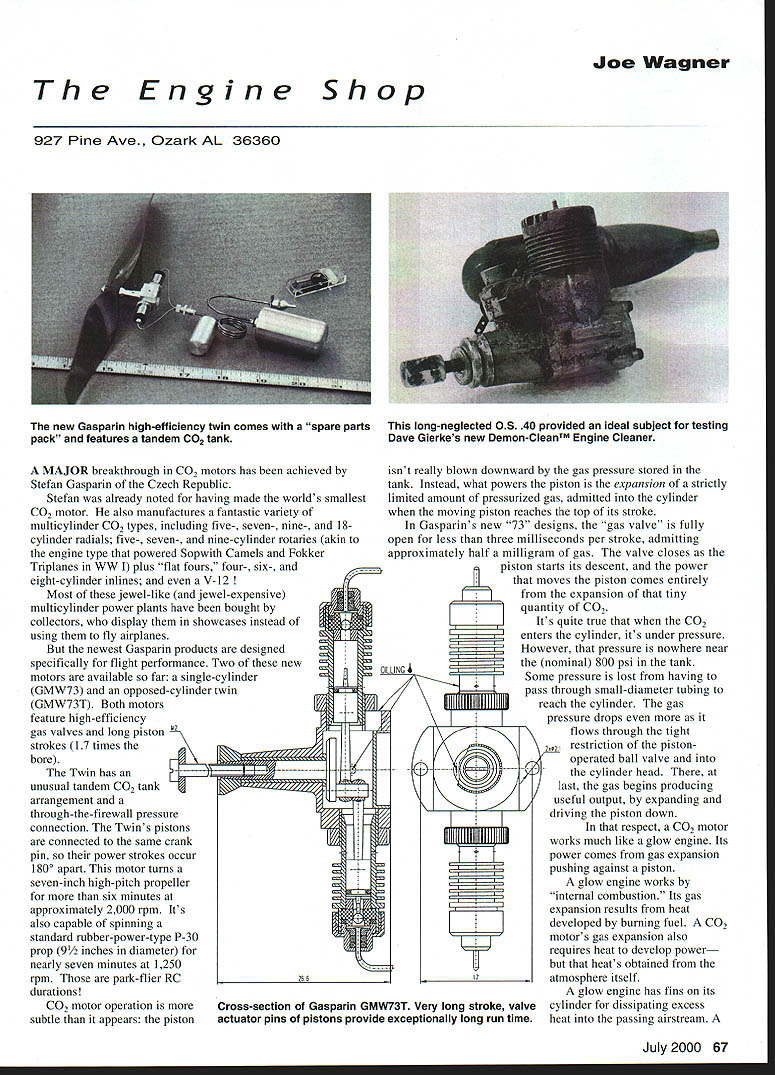
But the newest Gasparin products are designed specifically for flight performance. Two of these new motors are available so far: a single-cylinder (GMW73) and an opposed-cylinder twin (GMW73T). Both motors feature high-efficiency gas valves and long piston strokes (1.7 times the bore).
The Twin has an unusual tandem CO2 tank arrangement and a through-the-firewall pressure connection. The twin's pistons are connected to the same crank pin, so their power strokes occur 180° apart. This motor turns a seven-inch high-pitch propeller for more than six minutes at approximately 2,000 rpm. It's also capable of spinning a standard rubber-power-type P-30 prop (9½ inches in diameter) for nearly seven minutes at 1,250 rpm. Those are park-flier RC durations!
How CO2 motors work
CO2 motor operation is more subtle than it appears: the piston isn't really blown downward by the gas pressure stored in the tank. Instead, what powers the piston is the expansion of a strictly limited amount of pressurized gas, admitted into the cylinder when the moving piston reaches the top of its stroke.
In Gasparin's new "73" designs, the "gas valve" is fully open for less than three milliseconds per stroke, admitting approximately half a milligram of gas. The valve closes as the piston starts its stroke, and the power that moves the piston comes entirely from the expansion of that tiny quantity of CO2.
It's quite true that when the CO2 enters the cylinder, it's under pressure. However, that pressure is nowhere near the (nominal) 800 psi in the tank. Some pressure is lost from having to pass through small-diameter tubing to reach the cylinder. The gas pressure drops even more as it flows through the tight restriction of the piston-operated ball valve and into the cylinder head. There, at last, the gas begins producing useful output by expanding and driving the piston down.
In that respect, a CO2 motor works much like a glow engine. Its power comes from gas expansion pushing against a piston.
A glow engine works by internal combustion. Its gas expansion results from heat developed by burning fuel. A CO2 motor's gas expansion also requires heat to develop power — but that heat is obtained from the atmosphere itself.
A glow engine has fins on its cylinder for dissipating excess heat into the passing airstream. A CO2 motor has fins on its cylinder to gain heat from the passing airstream. That's important, because as any compressed gas expands, it loses heat. That limits its ability to expand further, unless it can acquire heat energy from somewhere else to replace the expansion losses.
That's not a trivial consideration with model CO2 motors, as demonstrated by their noticeable loss in power output when operated in humid weather. Frost accumulates on the cylinder fins, which interferes with warming by the airstream — and the motor's power decreases substantially.
Filling and tank considerations
One reason for the Gasparin GMW73T's double tank arrangement is to maximize the quantity of liquid CO2 that can be loaded. CO2 can remain in liquid form at room temperature if it's kept under enough pressure. (The "capsules" used to power pellet guns contain 12 grams of liquid CO2, at approximately 800 psi.)
Liquid CO2 is about 1,700 times denser than gaseous CO2. That's why, for maximum running duration, it's best to fill a CO2 motor's tank with as much liquid CO2 as possible. That's not as easy.
During the filling operation, the first liquid CO2 that enters the motor's tank instantly flashes into gas. It's the same situation as if you were pumping water into a red-hot steam boiler. As soon as fluid touches a surface that's much hotter than the liquid's boiling point (roughly -110°F for CO2), it vaporizes, and that generates pressure.
Back pressure produced during CO2 tank filling is what limits the amount of liquid CO2 the tank can hold. When the pressure inside the tank equals that from the external supply, no more inflow can occur.
It's common for a CO2-power flier to fill the model's tank, let the motor run while holding the airplane until the tank is empty, then quickly refill the tank. The chilling effect of the CO2 expanding within the tank as the motor runs reduces its temperature considerably. Then when the new filling begins, less "boil-off" occurs, and the tank accepts more liquid. That produces longer flight time.
The tandem tank of the GMW73T twin improves the "liquid-accepting capacity" of the larger (15.5cc) tank by providing a receptacle for some of the boil-off gas. That makes loading the tank quicker and more convenient, because you can get good flight duration from each filling without needing to go through a prefreeze routine.
However, a loss in efficiency occurs. Tests have shown that the GMW73 Twin can hold approximately 20% more liquid CO2 in a prechilled 15.5cc tank alone than in both tanks (totaling 18.5cc capacity) filled at room temperature. That means a longer, more-consistent power output is possible at the cost of a lengthier and more-complicated refilling procedure.
Availability
GMW73 motors are being sold by the Southern California Blacksheep as a club fund-raising project. Contact club treasurer Roy Hanson (21410 Nashville St., Chatsworth CA 91311; Tel.: [213] 747-7514) for current prices and availability. Each motor is custom-assembled and has a serial number.
By the way, I've recently learned that Bob Davis of Davis Model Products (Box 141, Milford CT 06460) is again making CO2 conversions of Cox .020 and .049 engines.
Demon-Clean Engine Cleaner
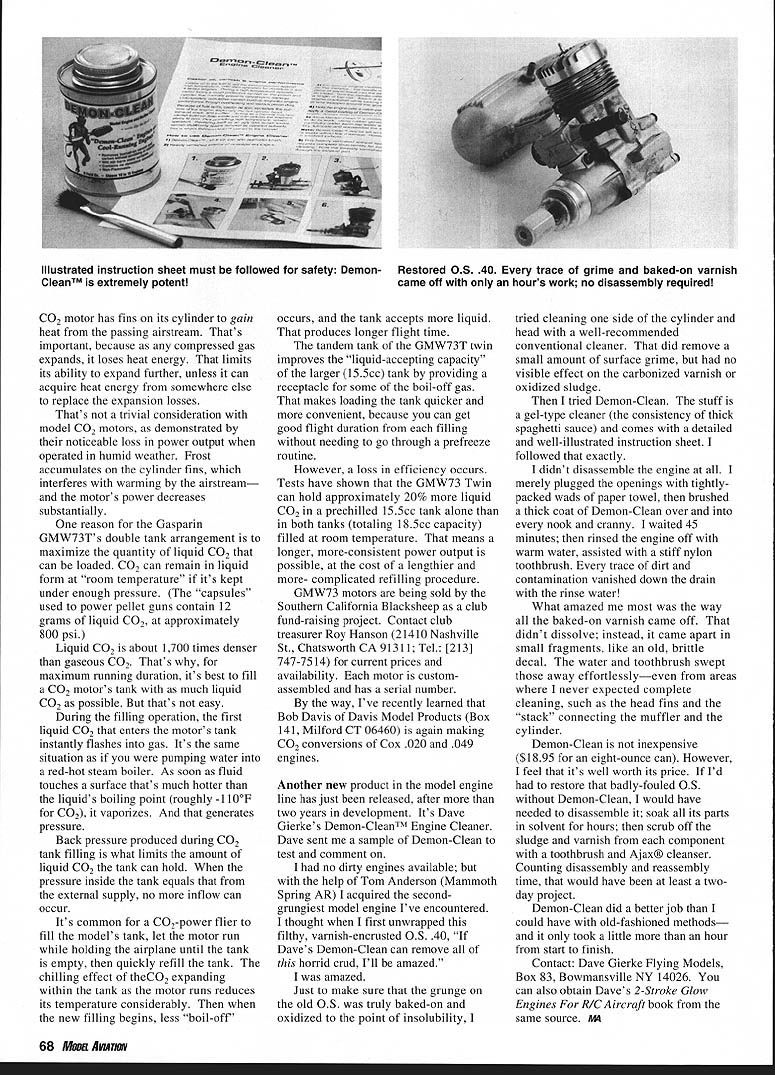
Another new product in the model engine line has just been released, after more than two years in development. It's Dave Gierke's Demon-Clean Engine Cleaner. Dave sent me a sample of Demon-Clean to test and comment on.
I had no dirty engines available; but with the help of Tom Anderson (Mammoth Spring AR) I acquired the second-grungiest model engine I've encountered. I thought when I first unwrapped this filthy, varnish-encrusted O.S. .40, "If Dave's Demon-Clean can remove all of this horrid crud, I'll be amazed."
I was amazed.
Just to make sure that the grunge on the old O.S. was truly baked-on and oxidized to the point of insolubility, I tried cleaning one side of the cylinder and head with a well-recommended conventional cleaner. That did remove a small amount of surface grime, but had no visible effect on the carbonized varnish or oxidized sludge.
Then I tried Demon-Clean. The stuff is a gel-type cleaner (the consistency of thick spaghetti sauce) and comes with a detailed and well-illustrated instruction sheet. I followed that exactly.
I didn't disassemble the engine at all. I merely plugged the openings with tightly packed wads of paper towel, then brushed a thick coat of Demon-Clean over and into every nook and cranny. I waited 45 minutes; then rinsed the engine off with warm water, assisted with a stiff nylon toothbrush. Every trace of dirt and contamination vanished down the drain with the rinse water!
What amazed me most was the way all the baked-on varnish came off. That didn't dissolve; instead, it came apart in small fragments, like an old, brittle decal. The water and toothbrush swept those away effortlessly—even from areas where I never expected complete cleaning, such as the head fins and the "stack" connecting the muffler and the cylinder.
Demon-Clean is not inexpensive ($18.95 for an eight-ounce can). However, I feel that it's well worth its price. If I'd had to restore that badly fouled O.S. without Demon-Clean, I would have needed to disassemble it; soak all its parts in solvent for hours; then scrub off the sludge and varnish from each component with a toothbrush and Ajax® cleanser. Counting disassembly and reassembly time, that would have been at least a two-day job.
Demon-Clean did a better job than I could have with old-fashioned methods — and it only took a little more than an hour from start to finish.
Contact: Dave Gierke, Flying Models, Box 83, Bowmansville NY 14026. You can also obtain Dave's 2-Stroke Glow Engines For R/C Aircraft book from the same source.
MA
Transcribed from original scans by AI. Minor OCR errors may remain.

