
The Engine Shop
ONE FUNDAMENTAL principle of propeller-driven airplane flight that model fliers often overlook is that although the engine provides the power, it's the propeller that pulls the airplane.
Some modelers seem to think strictly in terms of rpm when they discuss their power plants. Their theory is: "The higher the rpm, the better." But if that were true, we'd install flywheels on the noses of our airplanes instead of propellers.
As I've often demonstrated with Free Flight, Control Line, and Radio Control models, using a larger-than-customary propeller can significantly boost performance. Engine rpm drops, of course—but the gain in propulsive efficiency usually more than compensates for that loss.
Model fliers may protest, "But lugging an oversize prop causes engine overheating!" Well, yes; that does happen—yet it isn't a necessary consequence. Let's look into "ignition timing" to understand the overheating problem.
During a model engine piston's travel there's an optimum point for combustion to begin. If it starts later than that, power output decreases, because too much of the fuel-air mixture remains unburnt when the exhaust port opens. (That isn't necessarily bad; and can even be beneficial for certain model-flying purposes, as I'll explain later.)
Conversely, if combustion begins too soon—while the piston is still on its way toward the head—part of the combustion energy goes wasted. But this loss is definitely detrimental. It not only results in lower power output, because premature ignition works against the piston's travel and slows its motion, but it also generates excessive heat—the energy from the burning fuel must go somewhere if it's not being used to spin the crankshaft.
Worst of all, premature ignition causes serious overstress within the engine.
The effect of premature ignition
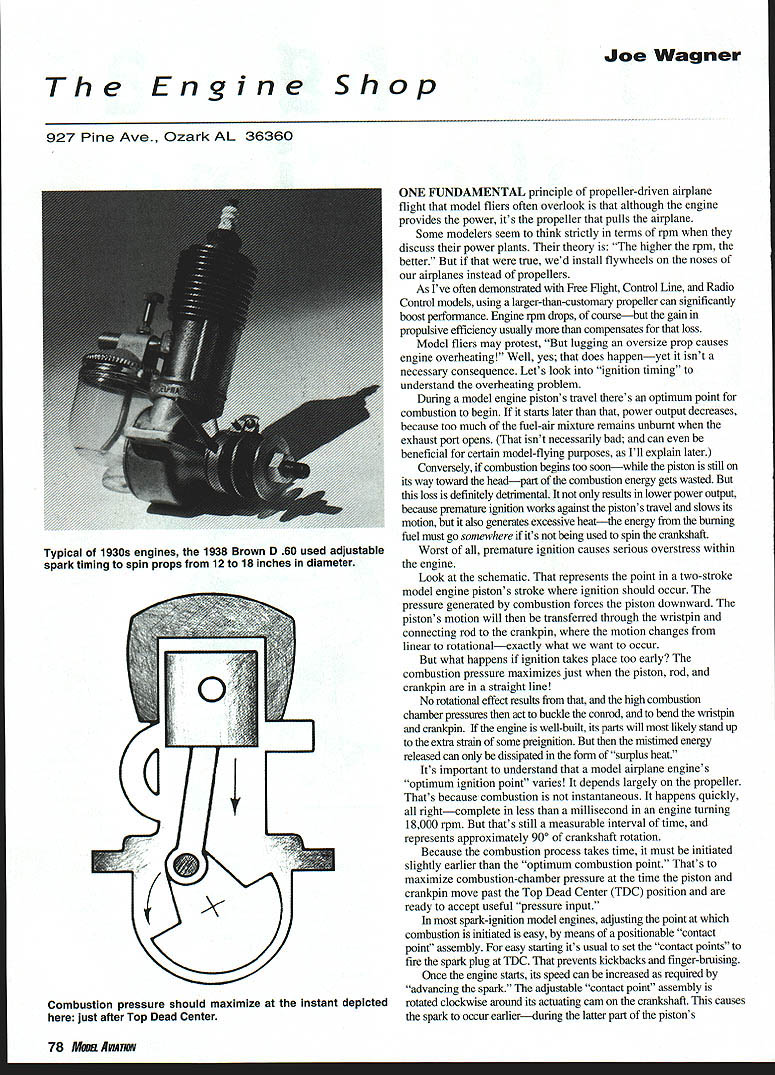
Look at the schematic. That represents the point in a two-stroke model engine piston's stroke where ignition should occur. The pressure generated by combustion forces the piston downward. The piston's motion will then be transferred through the wristpin and connecting rod to the crankpin, where the motion changes from linear to rotational—exactly what we want to occur.
But what happens if ignition takes place too early? The combustion pressure maximizes just when the piston, rod, and crankpin are in a straight line!
No rotational effect results from that, and the high combustion chamber pressures then act to buckle the conrod, and to bend the wristpin and crankpin. If the engine is well-built, its parts will most likely stand up to the extra strain of some preignition. But then the mistimed energy released can only be dissipated in the form of "surplus heat."
It's important to understand that a model airplane engine's "optimum ignition point" varies! It depends largely on the propeller. That's because combustion is not instantaneous. It happens quickly, all right—complete in less than a millisecond in an engine turning 18,000 rpm. But that's still a measurable interval of time, and represents approximately 90° of crankshaft rotation.
Because the combustion process takes time, it must be initiated slightly earlier than the "optimum combustion point." That's to maximize combustion-chamber pressure at the time the piston and crankpin move past the Top Dead Center (TDC) position and are ready to accept useful "pressure input."
Adjusting ignition in spark-ignition engines
In most spark-ignition model engines, adjusting the point at which combustion is initiated is easy, by means of a positionable "contact point" assembly. For easy starting it is usual to set the "contact points" to fire the spark plug at TDC. That prevents kickbacks and finger-bruising.
Once the engine starts, its speed can be increased as required by "advancing the spark." The adjustable "contact point" assembly is rotated clockwise around its actuating cam on the crankshaft. This causes the spark to occur earlier—during the latter part of the piston's upstroke—so that as combustion pressure peaks, the piston will have passed TDC and the pressure above it can do its job of rotating the shaft.
The faster the propeller spins, the more quickly the piston passes TDC. But each individual "combustion process" still takes about the same time (assuming that the fuel-air mixture remains the same). This means that it must be initiated a little sooner (by "advancing the spark") for every increase required in the engine's rpm. However, this process can't continue indefinitely!
When the engine no longer develops enough torque to make its propeller spin faster, any further "spark advance" becomes detrimental. It then causes overheating, "knocking," and excess stress on the working parts.
I've belabored this issue somewhat in order to emphasize the "process" that occurs in a propeller-spinning internal-combustion engine. Because it takes more power to turn a large-diameter propeller than a small one, the amount of "spark advance" possible with a big prop is less than with a small one. Trying to achieve "small-prop rpm" with a large prop by "advancing the spark" is never beneficial.
What about glow and diesel engines?
"But what does all this have to do with glow or diesel engines?" you may wonder.
The answer may not be obvious, especially with glow-ignition power plants. Diesels feature adjustable compression—and that's what controls their point of "combustion initiation." However, glow engines also have variable "combustion initiation" points, even though there are no convenient adjustments available for that.
The "heat range" and design of the glow plug affect when combustion begins; so do the fuel, blend, temperature, humidity, and barometric pressure.
Fifty years ago, a typical American glow engine (the Veco .31) was noted for easy hand-starting and excellent flight performance. For Control Line stunt flying it turned a 10 x 5 propeller at approximately 12,000 rpm—far faster than any spark-ignition engine of its size. Yet no one used electric starters; we didn't need to.
Instead, standard starting technique was to squirt a sizable slug of raw fuel into the engine's open exhaust stack, just before connecting the glow plug to its battery and beginning to hand-flick the propeller. The super-rich mixture caused the combustion process to slow, and thus provided the same "ignition-retarding" effect as a TDC setting for the "contact points" of a spark-ignition engine.
After the engine started, its temperature rose; and adjusting the needle valve for a leaner fuel-air mixture also caused a boost in operating temperature. These actions and reactions produced an "automatic ignition advance" that corresponded nicely with the engine speed increase.
It wasn't especially sensitive; big props loaded the engine more, but because they ran slower there weren't so many combustion cycles per second, and thus the net waste heat output didn't vary a great deal among different propeller sizes. I've run Veco .29s and .31s on 12- and 13-inch props with no ill effects. (Of course, most glow fuel in those days was relatively mild, with nitromethane content in the 10–15% range, and all-castor lubrication approximately 25% by volume. Very cool-running.)
Two/four-cycle break
In the lightweight, slow-flying Control-Line stunt airplanes favored by West Coast fliers, an engine-setting technique was perfected that we called the "two/four-cycle break." The needle was set so the engine ran rich enough in level flight to produce what we erroneously called "four-cycling." No, the engines didn't really fire every other revolution, though some believed they did. All that was happening was that the rich fuel-air mixture had a slower combustion time, and thus acted just like "retarding the spark" on a spark-ignition engine.
But when a sudden maneuver began—say, the start of a wingover—the "G-load" on the engine's fuel supply caused just enough added flow resistance to lean out the fuel-air mixture. The engine then responded with a noticeable boost in rpm (we called that the two-cycle break)—exactly when it was needed to power the model through its sharp, drag-inducing change of direction.
Preventing overheating with large props on glow engines
When using larger-than-usual props on glow engines: overheating can be avoided by preventing "preignition." Use cooler-heat-range glow plugs; milder, oilier fuel; and don't set the needle too lean.
The Norvel people have often been consulted by modelers who wish to use six- and seven-inch propellers on Big Mig .049s and .061s. Those engines derived from Russian competition Free Flight power plants, and were originally designed for high-rpm and pressure-fed fuel.
One "tuning measure" recommended by Norvel's Ed Stevens was to add more washers between the glowhead and the cylinder base. Decreasing the compression ratio has the same effect on a glow engine as on a diesel: the lower the compression, the more that "combustion initiation" is delayed.
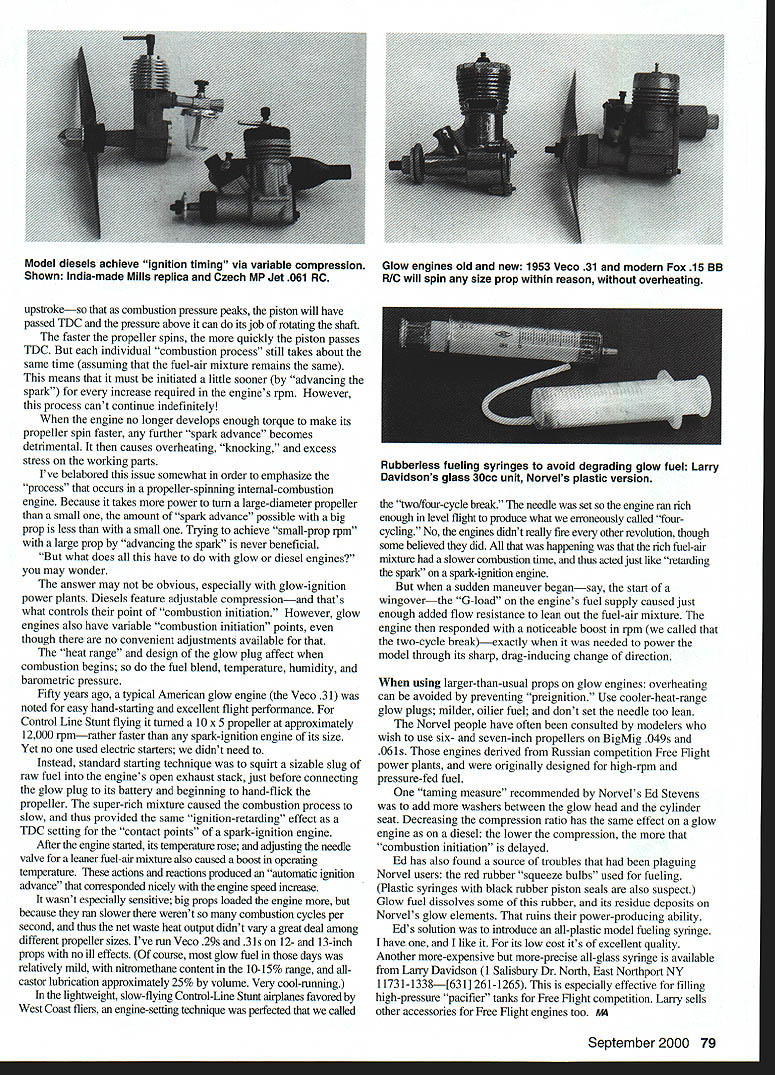
Ed has also found a source of troubles that had been plaguing Norvel users: the red rubber "squeeze bulbs" used for fueling. (Plastic syringes with black rubber piston seals are also suspect.) Glow fuel dissolves some of this rubber, and its residue deposits on Norvel's glow elements. That ruins their power-producing ability.
Ed's solution was to introduce an all-plastic model fueling syringe. I have one, and I like it. For its low cost it's of excellent quality. Another more-expensive but more-precise all-plastic syringe is available from Larry Davidson:
- 1 Salisbury Dr. North, East Northport NY 11731-1338
- (631) 261-1265
This is especially effective for filling high-pressure "pacifier" tanks for Free Flight competition. Larry sells other accessories for Free Flight engines too.
MA
Transcribed from original scans by AI. Minor OCR errors may remain.

