
The Engine Shop
TODAY'S model airplane engines are available in an amazing range of sizes, and for powering an almost unlimited variety of models.
Early model engines
The first model engines were big ones. The 1911 Baby—the earliest model engine offered for sale in the US—was a two-stroke of 2.67 cubic inches displacement. It weighed roughly four pounds, complete with its 18-inch cast-aluminum propeller, which it spun at approximately 2,300 rpm.
One reason for the large size of this pioneer model engine was that small spark plugs didn't exist in 1911. There was no reason for them then, or for the next 20 years.
In the early 1930s the AC spark plug company made thousands of half-size replicas of their automobile plugs as an advertising promotion. (These had cross holes drilled through the top of the center electrode, so the little plugs could be hung from charm bracelets or watch chains.)
Those novelty AC plugs made marketable products of the Baby Cyclone and Brown Junior model engines. After that, Champion saw a probable demand for an even smaller spark plug, manufactured that, and inspired the development of .29s, .23s, and smaller model engines.
Giant-sized and modern designs
Today, many model airplanes are powered by engines even larger in size than the 1911 Baby. Most of these are converted or redesigned chainsaw power units, or are from other nonmodeling applications.
I haven't written about these in this column, mostly because they're special-purpose engines whose "care and feeding" seem to be topics for the "RC Giants" column.
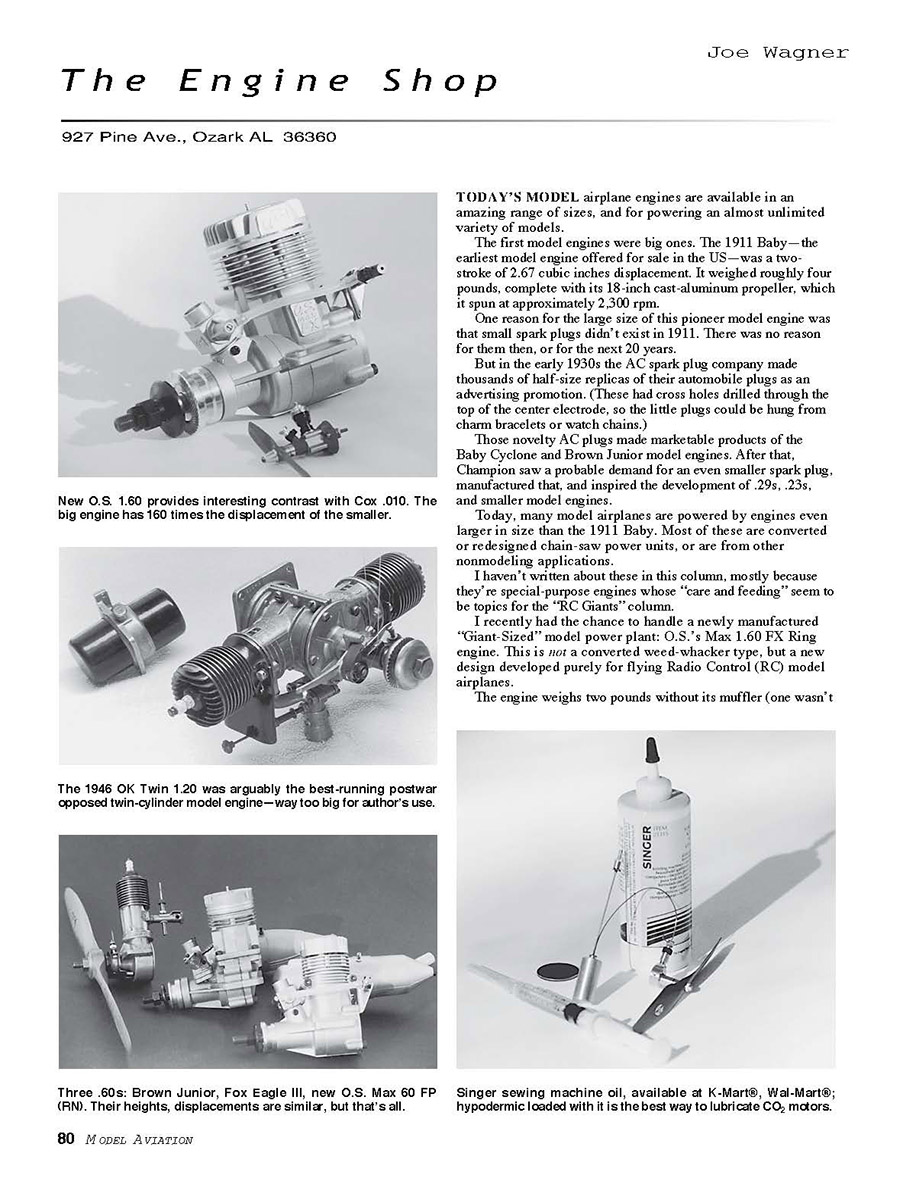
I recently had the chance to handle a newly manufactured "Giant-Sized" model power plant: O.S.'s Max 1.60 FX Ring engine. This is not a converted weed-whacker type, but a new design developed purely for flying Radio Control (RC) model airplanes.
The engine weighs two pounds without its muffler (one wasn't available yet for this big engine at the time), and swings 15- to 18-inch propellers.
The meticulous construction of this huge O.S. impressed me greatly. I wasn't able to run it, partly because of the lack of a muffler, but mostly because it was just too large to fit on even my biggest test stand. But the performance data supplied by O.S. surprised me.
This is rather a short-stroke engine design, with a bore of 1.323 and a stroke of 1.165. Yet the manufacturer cautions against high rpm. That's unusual for a short-stroker! According to O.S., the new 1.60 develops its maximum horsepower of 3.7 at only 9,000 rpm—and O.S. warns not to exceed 10,000 rpm.
That reminds me of the big model-airplane engines of the 1940s. The Forster .99 (still made today by R.I. Industries, Box 5, Sierra Madre CA 91025) was also a 9,000 rpm-maximum engine, and it swung 16- to 18-inch propellers.
But those were flat-pitch props; the big, new O.S. 1.60 calls for 10- and 12-inch-pitch airscrews.
After World War II ended and model-airplane engine production resumed, I bought an OK Twin 1.20. That was another slow-revving engine. It turned an 18 x 6 Flo-Torque at roughly 7,500 rpm—but I never put it in an airplane. It was too huge for any practical-size Free Flight model, and who would ever want to install an OK Twin in a Control Liner?
Personal history with popular sizes
The biggest engines I did much flying with were .60s. That's still a popular size today, and O.S. has just issued a new one. It's the O.S. 60 FP (RN), with its needle valve located almost four inches behind the propeller.
(One reason why we teenagers seldom got hurt flying "gas models" in the Good Old Days was that almost all the engines of that era had their needle valves located well behind the propeller disk.)
It's interesting to compare this new O.S. RC 60 with two earlier engines I own of the same displacement.
I still have an original 1937 Brown Junior. That's known as "the $21 Brown," and it features a lapped piston and a rudimentary intake throttle. (We called that a "choke nut.")
It swings a 14 x 4 at slightly less than 7,000 rpm, and complete with prop it weighs 8.2 ounces. Add another six ounces for the coil, condenser, flight timer, batteries, and wiring, for a total of, say, 14 ounces. (The Brown had no muffler, and never needed one!)
A Fox Eagle III .60 from the 1980s is a much more massive power plant than the Brown—and it needed to be, because it was designed with almost as high a compression ratio as a model diesel.
At the time, it seemed as if nitromethane wouldn't be available for model fuel use much longer, so Duke Fox designed his big Eagle .60 to run on "FAI Fuel": straight methanol and castor oil.
The Eagle III, with muffler but less propeller, weighs 22.4 ounces. A typical performance for it with FAI fuel is 12–13,000 rpm maximum using a 12 x 6 propeller. But my specimen isn't fully broken in yet (I fly mostly smaller models), and it may do better after further running.
The new O.S. 60 FP (RN) weighs 23.8 ounces without a prop. Mine hasn't been run at all yet—bad weather here has prevented most outdoor activity in the short time I've had the engine.
However, its performance specifications look impressive: 2,000–16,000 rpm with a 12 x 7, for example. I'm sure that this meticulously made, plain-bearing, lapped-piston engine will deliver that and more—after a proper break-in, of course.
One thing I especially like about the new O.S. engines is the fuel recommendation made by the factory. They call for 20% castor oil lubrication.
True, fuel with less oil—and synthetic instead of castor—may be less expensive to buy, and will surely leave less of a mess behind the exhaust outlet, but engine life and performance will suffer.
CO2 motors and lubrication
Speaking of oil returns us to the topic of CO2 motors I've discussed in the last two "The Engine Shop" columns. CO2s never get hot while running, and the pressure forces on their moving parts are small. Yet CO2s also need adequate lubrication.
Stefan Gasparin, maker of today's best-quality CO2 motors, says that his products need oiling approximately every five runs. More frequent oiling won't hurt—except for possibly, as Stefan remarks, producing an oil-soaked nose section on your model.
What kind of oil should you use?
Luckily, nothing exotic is needed. Plentiful, inexpensive Singer sewing-machine oil works fine. Unlike 3-in-1 oil, Singer's won't thicken much with time, nor will it harm the tiny O-rings used in Gasparin (and other) CO2 motors.
Applying the oil takes finesse, however. It must be injected directly into the exhaust and oiling ports of the motors, and those are rather small. A hypodermic needle is really the only way to go. You can get one from a friendly veterinarian, then carefully remove the sharp point with a fine-grit grindstone in a Dremel® tool.
(Singer sewing-machine oil makes good after-run oil for internal-combustion engines too. It's especially suitable for model diesels, because it doesn't contain the antioxidanting ingredients found in, for example, Marvel Mystery Oil. Those can make a model diesel reluctant to start.)
CO2 bulk filling accessories
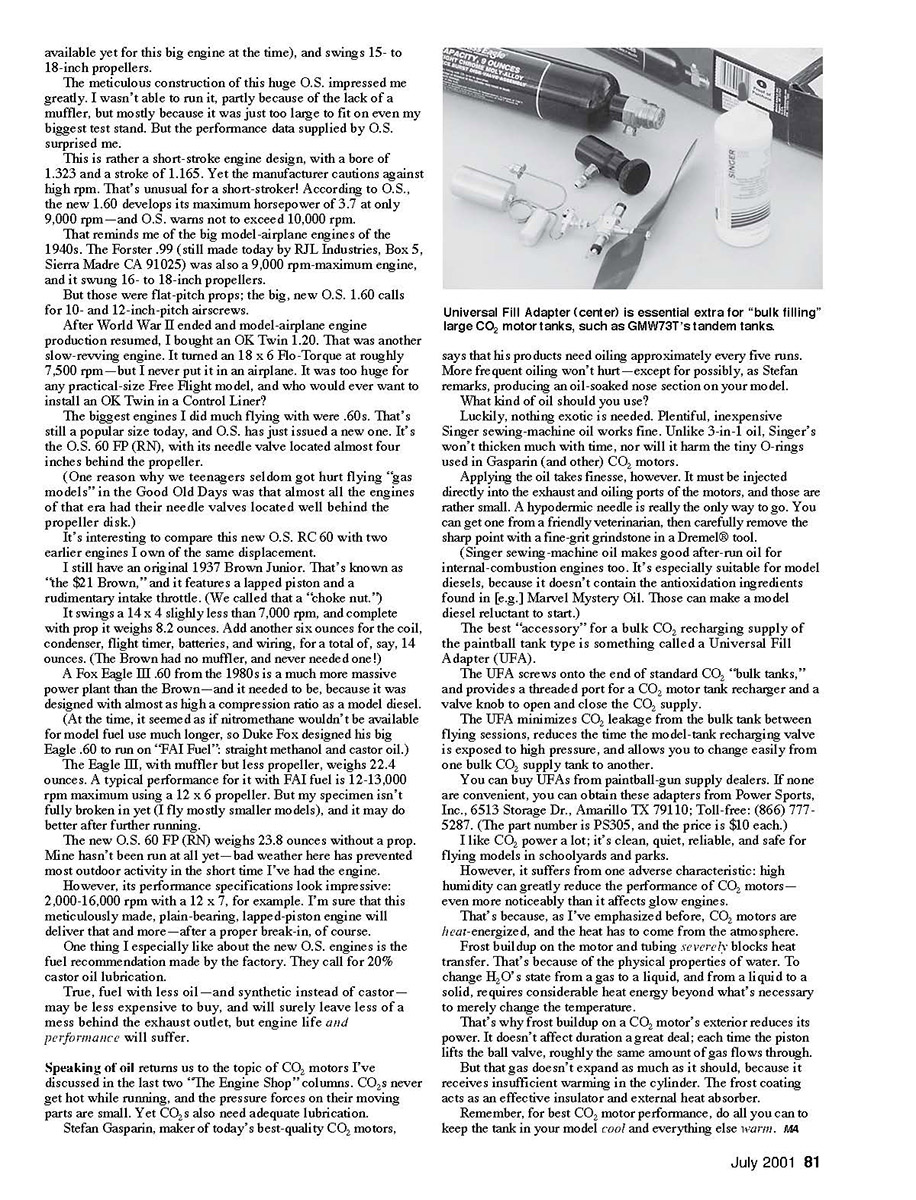
The best "accessory" for a bulk CO2 recharging supply of the paintball tank type is something called a Universal Fill Adapter (UFA).
The UFA screws onto the end of standard CO2 "bulk tanks," and provides a threaded port for a CO2 motor tank recharger and a valve knob to open and close the CO2 supply.
The UFA minimizes CO2 leakage from the bulk tank between flying sessions, reduces the time the model-tank recharging valve is exposed to high pressure, and allows you to change easily from one bulk CO2 supply tank to another.
You can buy UFAs from paintball-gun supply dealers. If none are convenient, you can obtain these adapters from Power Sports, Inc., 6513 Seagoville Dr., Amarillo TX 79110; Toll-free: (866) 777-5287. (The part number is P5305, and the price is $10 each.)
CO2 performance considerations
I like CO2 power a lot; it's clean, quiet, reliable, and safe for flying models in schoolyards and parks.
However, it suffers from one adverse characteristic: high humidity can greatly reduce the performance of CO2 motors—even more noticeably than it affects glow engines.
That's because, as I've emphasized before, CO2 motors are heat-engined, and the heat has to come from the atmosphere. Frost buildup on the motor and tubing severely blocks heat transfer. That's because of the physical properties of water. To change H2O's state from a gas to a liquid, and from a liquid to a solid, requires considerable heat energy beyond what's necessary to merely change the temperature.
That's why frost buildup on a CO2 motor's exterior reduces its power. It doesn't affect duration a great deal; each time the piston lifts the ball valve, roughly the same amount of gas flows through.
But that gas doesn't expand as much as it should, because it receives insufficient warming in the cylinder. The frost coating acts as an effective insulator and external heat absorber.
Remember, for best CO2 motor performance, do all you can to keep the tank in your model cool and everything else warm.
MA
Transcribed from original scans by AI. Minor OCR errors may remain.

