

The Engine Shop - 2004/09
Joe Wagner 212 S. Pine Ave., Ozark, AL 36360
Introduction
In recent columns I discussed the unusual valveless four-stroke model engines made by the British RCV company. I was impressed by my tests of the RCV58-CD ("CD" means Crankshaft Drive) and soon acquired one of the in-line engines, the RCV60‑SP. (These in-line power plants are also available in 90 and 120 cu. in. displacements.)
This article describes the 60‑SP’s design, operation, handling, and my running impressions.
Design highlights
- The 60‑SP uses a rotating cylinder sleeve driven 2:1 by a bevel gear train. The sleeve both times the porting for four-stroke operation and drives the propeller, so prop rpm is exactly half crankshaft rpm.
- The geared-down propeller speed allows use of large-diameter, high-pitch props and gains the efficiency benefits of reduction gearing.
- Gearing: hardened-steel helical-type bevel gears distribute each firing impulse over two meshing teeth rather than one, reducing fatigue failure risk.
- Piston: a steel piston with a single thin ring; unusually short side height (about half its diameter).
- Cylinder sleeve: hardened-steel, smooth continuous bore with no port cutouts; provides uninterrupted side support for the piston.
- Combustion chamber: a separate front section with an internal diameter roughly half the cylinder bore and a single radial port that lines up with a radial port in the rotating sleeve.
- Intake and exhaust: intake uses a rotating slotted valve to admit the charge; the rotating sleeve has exhaust and transfer ports to time crankcase-charged mixture transfer into the cylinder to accomplish a conventional four-stroke sequence.
- Timing adjustment: the sleeve can be rotated slightly relative to the crankcase to adjust intake and exhaust timing; two thin O-ring seals at the sleeve ends keep the crankcase sealed while allowing rotation.
Propellers and performance
- RCV recommends the APC 16 x 12 prop for the 60‑SP.
- Props I tried: APC 16 x 12; Master Airscrew Classic 18 x 8; and two 16 x 8s with wider blades.
- Full-throttle prop rpm recorded between:
- 4,400 rpm with the 18 x 8
- 5,300 rpm with either 16 x 8
- RCV advises a maximum propeller speed of roughly 5,500 rpm to avoid over-revving damage.
Fuel and power:
- Recommended fuel: about 10–15% nitromethane in a quality synthetic oil blend.
- I used 10% nitro for initial break-in and 15% for performance testing; the engine responded smoothly with predictable throttle transitions.
Durability and wear
- After break-in and disassembly to inspect port timing and check for wear, I found no visible wear on components. The piston showed no side scuffing despite its short height.
- The continuous-bore hardened sleeve and bearing support minimize piston cocking and side wear.
- The helical bevel gears and dual-ball-bearing supports reduce concentrated fatigue and contribute to longevity.
- Lubrication: oil is delivered to moving parts and all four ball bearings by combustion pressure forcing oil through minute clearance gaps between the rotating sleeve and its housing. After more than two hours of testing the engine ran cleanly and showed minimal wear.
Operation and starting
- The crankshaft spins in dual ball bearings and contains a bevel gear that drives the sleeve. The rotating cylinder runs in dual ball bearings; the propeller is driven from the front of the rotating sleeve assembly.
- Starting is different from conventional engines:
- The external end of the crankshaft contains a socket-head screw used as a driver key.
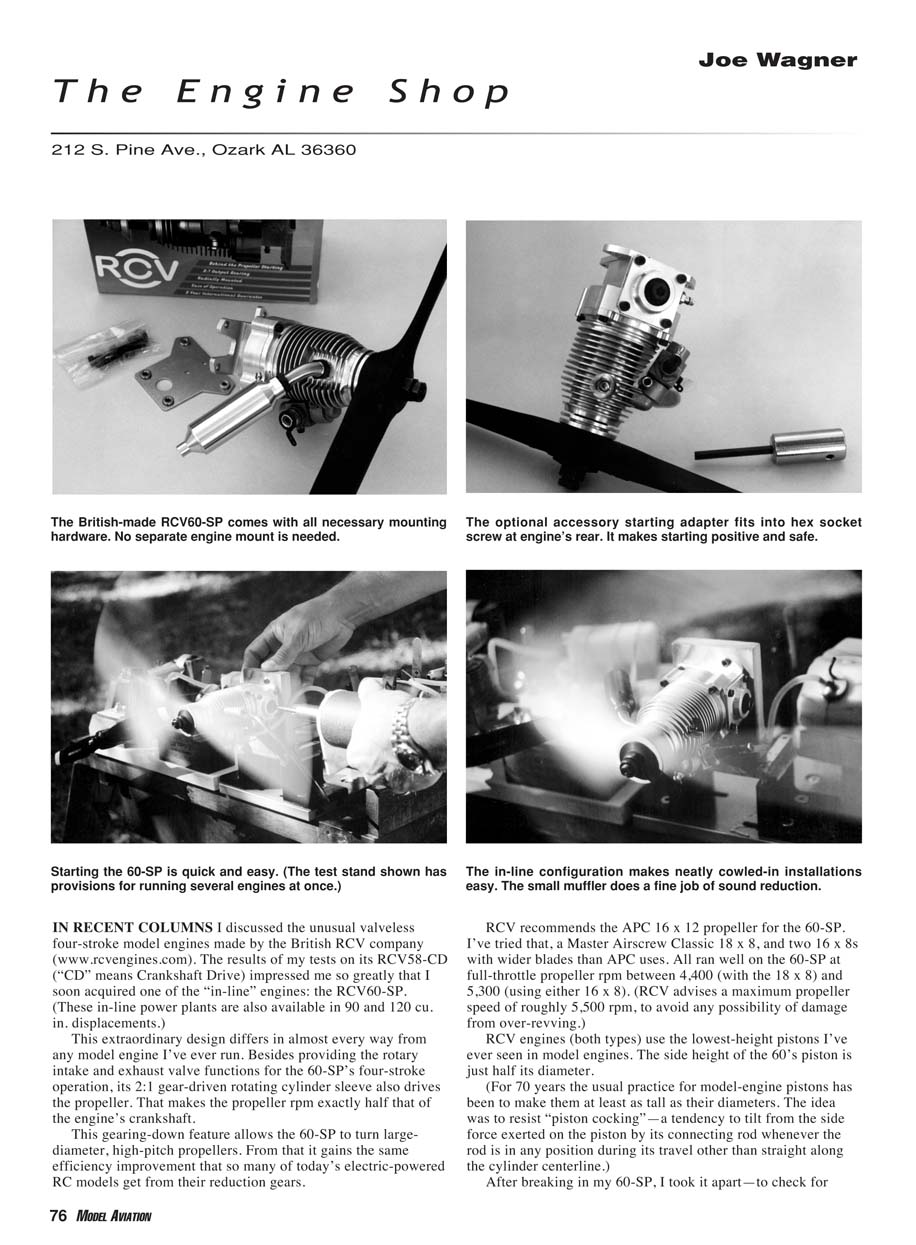
- A separately available adapter fitted to a standard electric starter drives the engine; hand-flipping the propeller failed for me.
- Best starting procedure: finger-choke the carburetor inlet while hand-flipping until fuel is felt at the finger, connect the glow plug, then apply the starter with the throttle slightly less than half open. The engine fires right up.
- An optional accessory starting adapter fits into the hex-socket screw at the engine’s rear for positive, safe starting.
Mounting, weight, and vibration
- The SP-series engines require radial mounting to a solid-plywood firewall. RCV supplies a metal backplate for the rear of the firewall and a set of socket-head metric cap screws and washers.
- Mounting can be tedious because the cap screws are located close to the engine case; a one-quarter turn at a time with a standard Allen wrench may be necessary.
- Weight: complete with mounting plate, screws, and muffler the 60‑SP weighs 23 ounces. For comparison, a Rossi two-stroke .60 weighs 28 ounces with muffler but without a mount. The 60‑SP is somewhat bulky—noticeably bigger than an O.S. FS‑70 II Surpass.
- Vibration characteristics:
- Piston motion fore-and-aft produces longitudinal vibration as the main mode.
- There is also a torsional vibration mode caused by once-per-revolution power impulses driving the propeller.
- Total vibration is not severe but differs from conventional engines. Recommended firewall thickness:
- 60‑SP: minimum 3/16 inch hard plywood
- 90 and 120 RCVs: minimum 1/4 inch
Port position change and installation flexibility
- Factory assembly: carburetor on the bottom, glow plug on the right, muffler on the left (as seen facing the propeller).
- The SP engines allow repositioning of the carburetor and muffler to suit airframe installation. The RCV instruction manual provides step-by-step guidance, including how to correctly retime the rotary valve after repositioning.
Practical notes and anecdotes
- I used Omega 10% nitromethane four-stroke fuel, which met RCV recommendations and provided ample power. With an 18‑inch prop I had to attach an anchor cable to my portable engine test stand to keep the 40+ pound rig from being pulled around the workshop deck.
- After several hours of running I noted no signs of distress; periodic checking of sleeve timing and the thin O-rings is the maintenance I anticipate.
Industry notes and Rossi plug information
- RCV’s rotary-cylinder-valve four-stroke design has attracted industrial interest; a major American corporation awarded RCV a multimillion-dollar development contract for industrial applications.
- More engine news:
- Stefan Gasparin has discontinued his line of CO2 motors.
- AeroDyne has gone out of business, removing a West Coast source of quality model diesel fuel.
- Rossi engines: new U.S. importer is SG Model Engines, Box 280303, Northridge, CA 91328; Web: http://shop.vendio.com/RossiEnginesUSA.
- Rossi glow plugs:
- Rossi offers plugs in seven different heat ranges for nonthrottled engines (small engines need hotter plugs; large engines need colder plugs).
- Rossi makes RC-type glow plugs in two heat ranges: Hot for engines under .24 cu. in., and Cold for larger sizes.
- There is a special Rossi glow plug line for four-stroke model engines.
- In my next column I will report on the latest Rossi RC .60 engine.
Joe Wagner The Engine Shop 212 S. Pine Ave., Ozark, AL 36360
Transcribed from original scans by AI. Minor OCR errors may remain.

