
The Engine Shop
I recently tested a pair of newly issued and innovative .40-size RC engines. These turned out to be the smoothest-running model engines I’ve ever handled. One is a glow-plug type; the other is a diesel. Both start extremely easily by hand. Since I’ve broken them in, a finger choke and one or two flips of the propeller are all it takes to get either of them going.
Norvel AX-40 (glow)
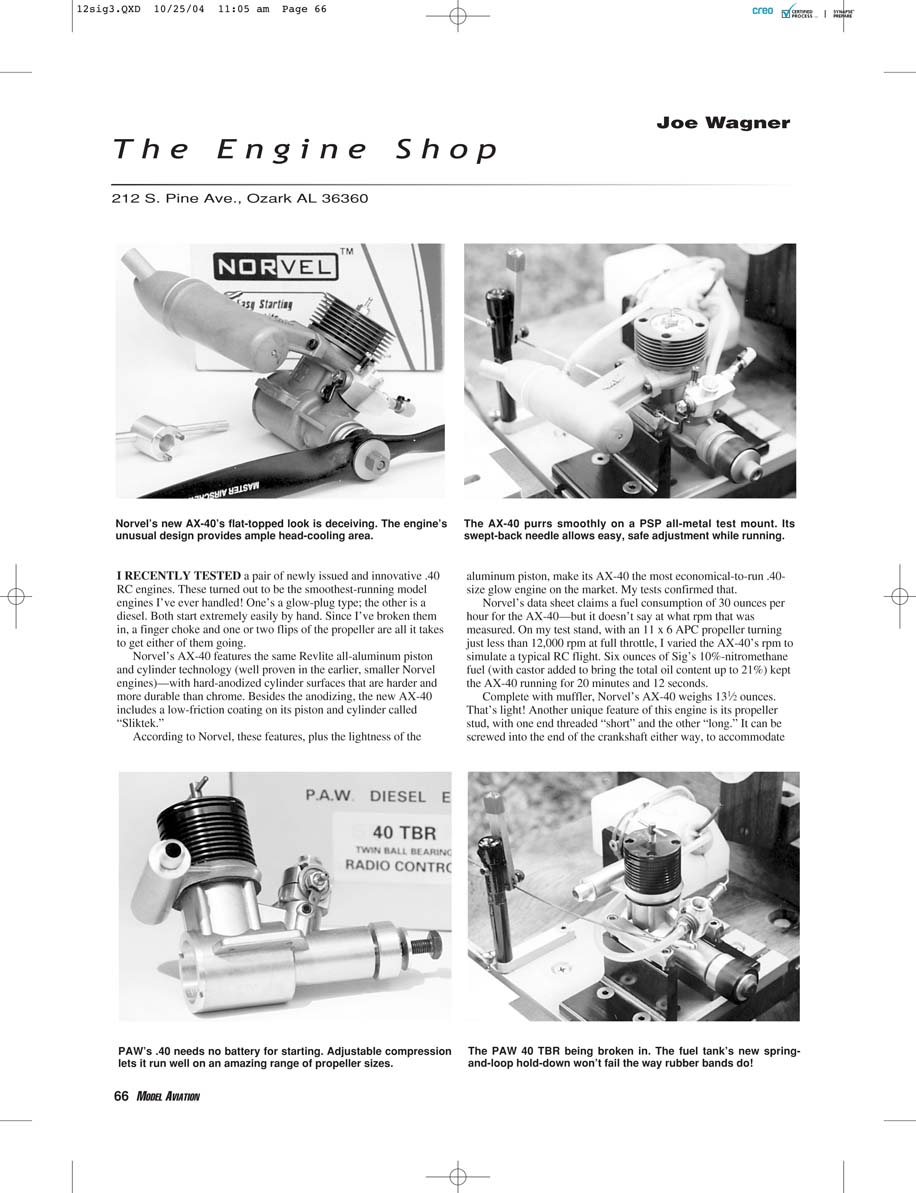
Norvel’s AX-40 features the same Revlite all-aluminum piston and cylinder technology (well proven in the earlier, smaller Norvel engines), with hard-anodized cylinder surfaces that are harder and more durable than chrome. Besides the anodizing, the new AX-40 includes a low-friction coating on its piston and cylinder called “Sliktek.” According to Norvel, these features, plus the lightness of the aluminum piston, make the AX-40 the most economical-to-run .40-size glow engine on the market. My tests confirmed that.
Norvel’s data sheet claims a fuel consumption of 30 ounces per hour for the AX-40—but it doesn’t say at what rpm that was measured. On my test stand, with an 11 x 6 APC propeller turning just under 12,000 rpm at full throttle, I varied the AX-40’s rpm to simulate a typical RC flight. Six ounces of Sig 10% nitromethane fuel (with castor added to bring the total oil content up to 21%) kept the AX-40 running for 20 minutes and 12 seconds.
Complete with muffler, the AX-40 weighs 13-1/2 ounces. That’s light. Another unique feature is its propeller stud, with one end threaded “short” and the other “long.” It can be screwed into the crankshaft either way to accommodate thick- or thin-hub propellers without altering the shaft length. To retain the propeller, the AX-40 uses a longer-than-usual hex nut equipped with a captive washer. (This nut has a 10 mm hex, which is just slightly too big to fit into the typical American four-way prop wrench.)
The AX-40’s carburetor is a dual-needle, cam-actuated type, with a swept-back needle for maximum behind-the-propeller clearance. The needle taper is long and smooth, providing a nicely nonsensitive adjustment. There’s even an O-ring seal on the needle shaft to stop any air leakage. Further technical details of this engine—and all other Norvel products—can be found at www.norvel.com. (I rather enjoyed the Russian-flavored English in the AX-40’s descriptive text, such as “… reducing oil output onto club fields.”)
Progress Aero Works (PAW) 40 TBR diesel
The other exceptionally smooth-running .40-size engine is the British-made Progress Aero Works (PAW) 40 TBR diesel. “TBR” stands for Twin Ball Race. PAW appears to be the only model-engine company still specializing in model diesel power plants. It is family-owned and has been making high-quality model diesels continuously since 1946. The present engine sizes range from .03 cu. in. to .60 cu. in.—every one a sturdy, dependable, long-lasting, and powerful machine.
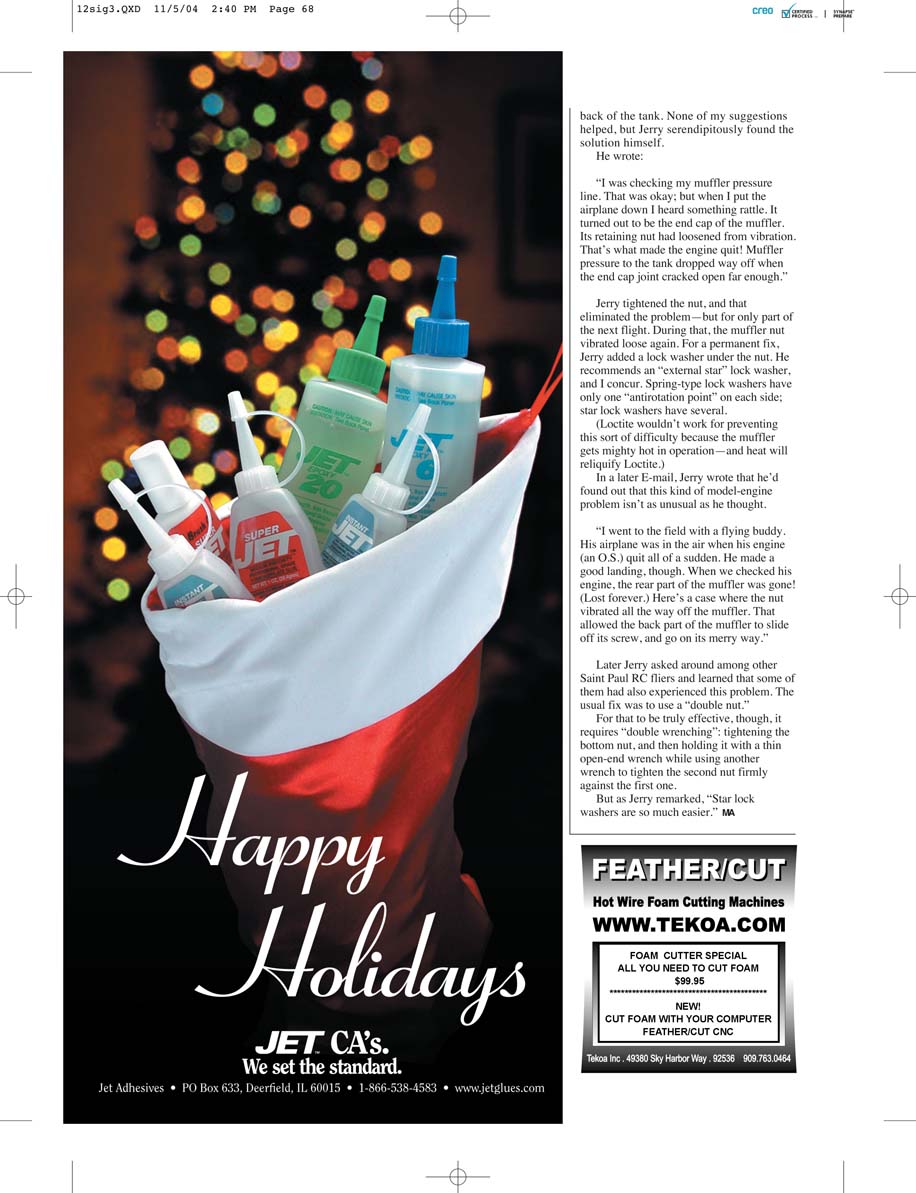
The PAW 40 TBR RC weighs just a half ounce more than the Norvel, despite using a steel sleeve and a cast-iron piston. One reason for the PAW’s light weight is its small muffler. That’s a standard PAW feature that I greatly appreciate. For one thing, the small nut that retains a muffler can vibrate loose and cause sudden in-the-air engine failure. For another, the muffler outlet shape allows easy, reliable attachment of an exhaust extension. I use vinyl aquarium tubing to make the connection, with K&S thin-wall aluminum tube for the extension itself. The tube can be quite long and need not be large in diameter because PAW diesels aren’t affected much by exhaust back pressure.
The variable-compression feature of model diesel engines provides exceptional versatility in propeller selection. My 40 TBR hand-starts and runs equally well on propeller sizes from 9 x 6 to 16 x 6. Just to see what would happen, I put an ancient wooden Tornado 24 x 4 on the engine. No problem: it started right up and perked steadily along at almost 5,000 rpm, throttle wide open.
One innovation in PAW's new .40 RC diesel is its carburetor design. Earlier PAW RC diesels used a starkly simple air-bleed type of barrel throttle. Those worked dependably enough, although their response wasn't particularly linear. The new carburetor—PAW calls it the Varijet—has a cam-actuated lateral sliding action and a needle that doesn't rotate with the barrel (as those on earlier PAW carburetors do).
The Varijet’s throttle response is much more linear than the original PAW carburetors. With a 12 x 6 Graupner propeller, I managed reliable idling as slow as 1,800 rpm.
All PAW RC diesels are factory-assembled with their carburetor needles oriented “straight across.” I’ve found that PAW carburetors can easily be repositioned to angle the needle back as much as 15°. That makes for safer adjustment and has no adverse effect on throttle actuation that I’ve noticed.
Complete information about PAW's full line of products—including technical details, engine instruction sheets, and fuel formulae—can be found at www.progress.charitydays.co.uk/index.htm. The U.S. importer is Eric Clutton:
- Address: 913 Cedar Ln., Tullahoma, TN 37388
- Tel.: (931) 455-2256
Eric also has a Web site: www.cafes.net/doctorclod/s. Eric hand-starts every engine he sells before shipping and provides an individual settings sheet with the optimum needle and compression settings for that engine—plus a list of suggested propeller sizes.
Suggested propeller sizes Eric recommended for my PAW 40 TBR:
- 11 x 5
- 11 x 6
- 11 x 8
- 12 x 5
- 12 x 6
- 13 x 5
- 13 x 6
- 14 x 5
Test-stand improvements: tank mounting
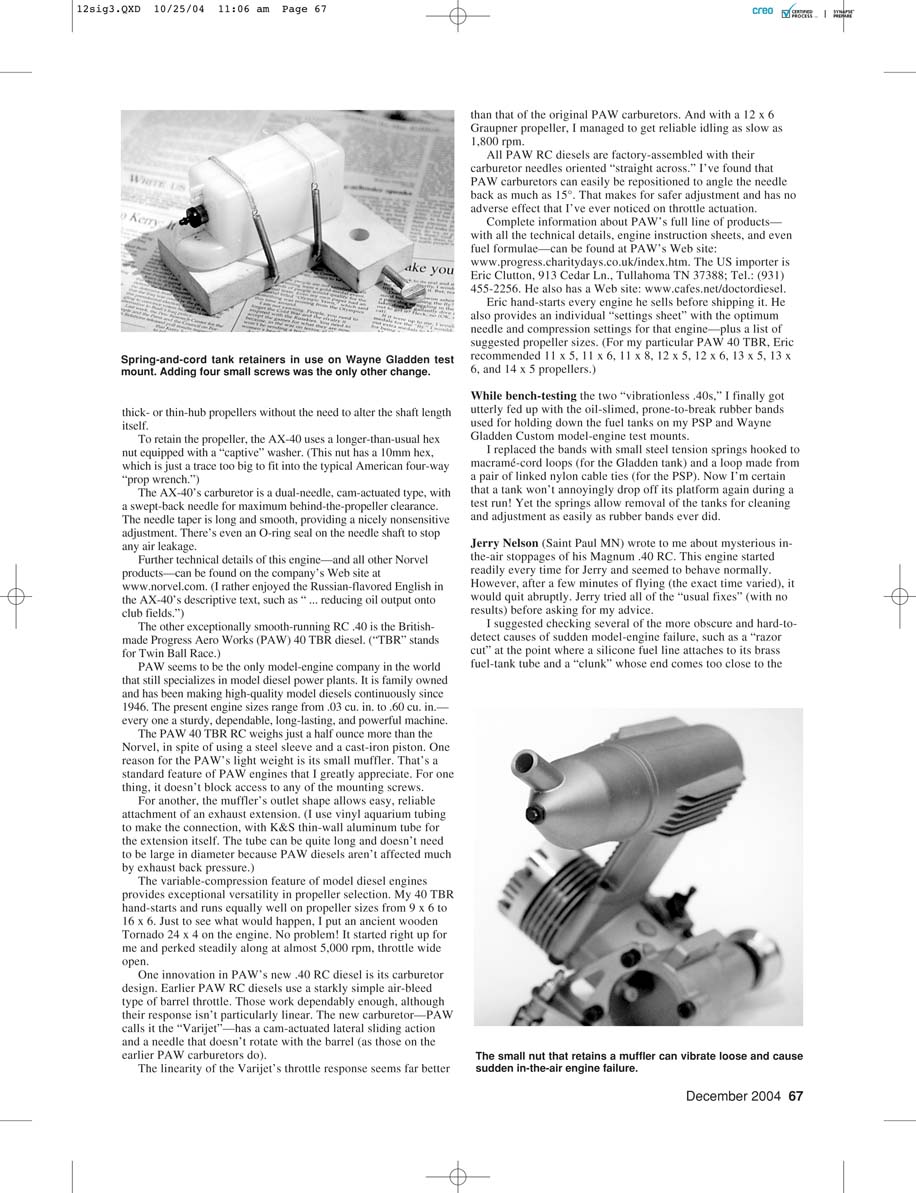
While bench-testing the two “vibrationless .40s,” I finally got fed up with the oil-slimed, prone-to-break rubber bands used for holding down the fuel tanks on my PSP and Wayne Gladden Custom model-engine test mounts. I replaced the bands with small steel tension springs hooked to macramé cord loops (for the Gladden tank) and a loop made from a pair of linked nylon cable ties (for the PSP). Now I’m certain a tank won’t annoyingly drop off its platform again during a test run. Yet the springs allow removal of the tanks for cleaning and adjustment as easily as rubber bands ever did.
Muffler nut and in-flight stoppage: a case study
Jerry Nelson (Saint Paul, MN) wrote to me about mysterious in-the-air stoppages of his Magnum .40 RC. The engine started readily every time and seemed to behave normally. However, after a few minutes of flying (the exact time varied), it would quit abruptly. Jerry tried all the usual fixes with no results before asking for my advice.
I suggested checking several obscure and hard-to-detect causes of sudden model-engine failure, such as a razor cut at the point where a silicone fuel line attaches to its brass fuel-tank tube, and a clunk whose end comes too close to the back of the tank. None of my suggestions helped, but Jerry serendipitously found the solution himself.
He wrote: "I was checking my muffler pressure line. That was okay; but when I put the airplane down I heard something rattle. It turned out to be the end cap of the muffler. Its retaining nut had loosened from vibration. That's what made the engine quit! Muffler pressure to the tank dropped way off when the end cap joint cracked open far enough."
Jerry tightened the nut, and that eliminated the problem—but only for part of the next flight. During that flight, the muffler nut vibrated loose again. For a permanent fix, Jerry added a lock washer under the nut. He recommends an external-star lock washer, and I concur. Spring-type lock washers have only one antirotation point on each side; star lock washers have several.
Loctite wouldn’t work for preventing this sort of difficulty because the muffler gets very hot in operation—and heat will re-liquify Loctite.
In a later e-mail, Jerry wrote that he'd found this kind of model-engine problem isn’t as unusual as he thought.
"I went to the field with a flying buddy. His airplane was in the air when his engine (an O.S.) quit all of a sudden. He made a good landing, though. When we checked his engine, the rear part of the muffler was gone! (Lost forever.) Here's a case where the nut vibrated all the way off the muffler. That allowed the back part of the muffler to slide off its screw, and go on its merry way."
Later Jerry asked around among other Saint Paul RC fliers and learned that some of them had also experienced this problem. The usual fix was to use a double nut. For that to be truly effective, though, it requires double wrenching: tighten the bottom nut, then hold it with a thin open-end wrench while using another wrench to tighten the second nut firmly against the first one. But as Jerry remarked, "Star lock washers are so much easier."
—MA
Transcribed from original scans by AI. Minor OCR errors may remain.

