

The Engine Shop - 2005/04
Joe Wagner 212 S. Pine Ave., Ozark AL 36360
Propeller slippage: the problem
A bothersome aspect of four-stroke model-airplane engines is propeller slippage and loosening. That can be hard to overcome. It happens because the operating forces that cause it act much like an auto mechanic’s impact wrench: each individual torque pulse isn’t particularly strong, but repeated in rapid succession the total effect multiplies hugely.
As a four-stroke, single-cylinder model engine runs, its crankshaft produces the powerful counterclockwise torque impulse that drives the propeller during only roughly 120° of its rotation. But there is just one power impulse in each two revolutions of the shaft. During the exhaust, intake, and compression strokes—which together last roughly five times as long as the power impulse—the propeller’s rotational momentum is all that keeps the shaft turning until the next power pulse begins.
This back-and-forth transition, between the shaft driving the propeller and the propeller then driving the shaft, happens thousands of times for every minute the engine runs. In doing so it produces thousands of strong “torque pulses,” and that often loosens the prop nut.
Most of today’s four-stroke model engines use deeply serrated propeller drivers plus a double nut to secure the propeller. That works fine much of the time, but sometimes it’s not quite enough to eliminate all slippage.
Why reinforced plastic props can slip
Today’s popular reinforced plastic propellers perform well on four-stroke engines because their greater mass (compared to same-size wooden props) provides more flywheel effect. These heavier props keep engines running reliably, especially at idle. But the reinforced plastic material these propellers are made from has high compressive strength. Because of that, the serrations on engine drivers don’t embed much into the prop hub’s rear surface, even when the prop nut is tightened hard.
That minimizes the surface contact area between a prop hub and its driver and often allows the “impact-wrench effect” to cause slippage.
Slippage costs some power, but the worst effect is burnishing and wearing down the propeller-hub back surface. That induces more slippage and can lead to a vicious cycle of increasing wear and slipping—eventually loosening the prop nuts enough that they can come off in flight.
My solution: rollpin positive drive
Many RC fliers have experienced this problem, and I have too. It seems more likely with larger engines. Before breaking in my new RCV91-CD valveless four-stroke I decided to modify its prop driver to make slippage impossible.
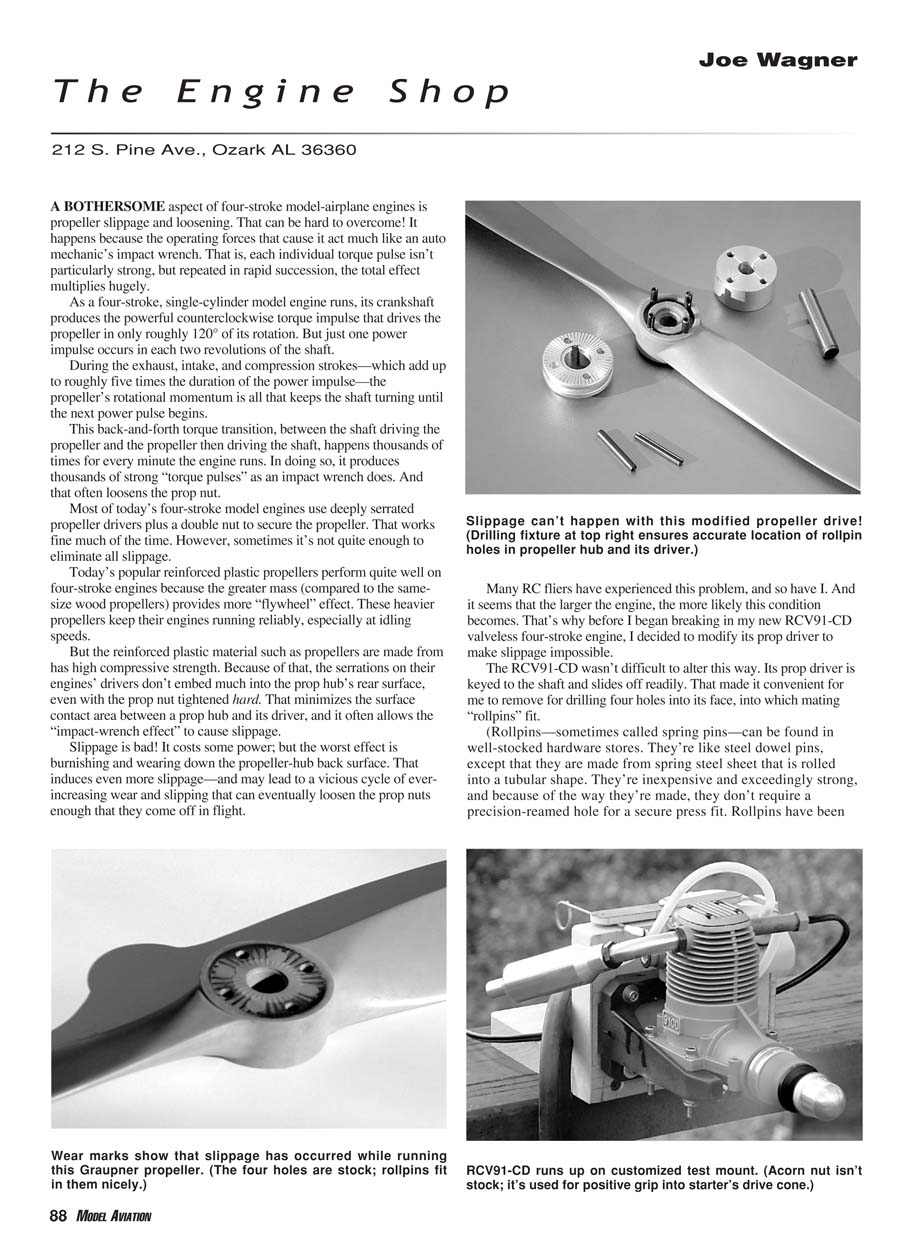
The RCV91-CD’s prop driver is keyed to the shaft and slides off readily, so I removed it and drilled four holes into its face to accept mating rollpins. Rollpins (sometimes called spring pins) are available at well-stocked hardware stores. They’re like steel dowel pins but are made from spring-steel sheet rolled into a tubular shape. They’re inexpensive, very strong, and because of their manufacture they don’t require a precision-reamed hole for a secure press fit. Rollpins have been used before for slip-proof propeller drives (early O.S. 1.20 FS twins came with two installed in their prop drivers).
Because I’d already experienced propeller slippage with smaller RCV engines, I decided to use four 1/8-inch (nominal) rollpins to provide absolutely positive drive for the 14 x 6 APC propeller the RCV91-CD’s owner’s guide calls for. That’s probably overkill, but I prefer overkill to underkill.
I installed the rollpins into the propeller; they’re a tight press fit there. The corresponding holes I drilled into the RCV’s prop driver are slightly larger, to allow the propeller to be removed. This arrangement also lets me use pinless propellers if I want.
Tooling and precision
Precision is vital for this rework. To ensure accurate hole location in both the driver and the propeller I made a drill guide with a 5/16-inch hole through its center to fit the RCV’s crankshaft. To align the drill guide on the prop hub I used a 5/16-inch precision steel dowel pin.
Yes, making this tooling requires extra work and must be done carefully, but it’s essential for proper fits. Installed on the RCV91-CD, my positive drive worked perfectly. I even ran the engine with the prop nut only mildly snugged down—no problem; the propeller cannot slip. I’ll modify all my four-stroke engines the same way (and probably my larger two-strokers too).
About the RCV91-CD
The RCV91-CD uses the efficient rotary cylinder-valve four-stroke principle of earlier RCV engines. The cylinder sleeve rotates, driven at half shaft speed via bevel gears. A reduced-diameter boss at the top of the sleeve contains a combustion chamber and a single radial port. As the sleeve rotates that port lines up sequentially with the intake port, the glow plug, and the exhaust.
This principle seems to work especially well on the 91-CD. Mine started easily on the first try. I did need to keep the glow plug (an O.S. Type F) energized during the first few minutes because I began the break-in in rather cold weather (about 48°F). After two tanks of fuel (Omega 10%) and slightly leaning the high-speed needle, the engine continued running dependably after I disconnected the glow energizer battery.
My RCV91-CD isn’t fully broken in yet. The best reliable idle I’ve managed so far is 3,100 rpm, with a high speed of 8,400 rpm using the 14 x 6 APC. I think after another 30–40 minutes of test-stand running the engine will reach the factory’s performance figures of 2,200 rpm idle and 9,100 rpm maximum (with the 14 x 6).
Mounting and hardware observations
I encountered some minor difficulties mounting the RCV91-CD. I used Great Planes’ .60–1.20 adjustable mount, which is the right size for the RCV’s beam-mount lugs—though the lugs are not on the thrustline. Because of the engine’s design, its shaft centerline is 0.14 inch above the top surface of the beam mount.
The Great Planes mount is a two-piece assembly that permits spacing the beams as needed. The RCV91-CD fit right in the middle of the mount’s adjustment range and the as-molded top surfaces of its beams were acceptably flat. But because of inevitable shrinkage in heavy-walled plastic parts, my mount’s beams were a full 7/16 inch closer at the front than at the rear.
That required rework. I removed most of the material from the inside front surfaces of the mounting beams with a belt sander, working slowly and checking fit frequently (I had only one mount). When the beam inner surfaces were close to parallel I finished with a tungsten-carbide abrasive steel sanding strip. The work took a while, but for an engine as well made and powerful as the RCV91-CD I wanted everything to be right. I’ll be using the same mount in an airplane.
When handling the RCV91-CD I noticed its gaskets—for the cylinder top cover and the carburetor attachment—gradually compressed with time. I tightened their screws firmly, but within a few days the gaskets relaxed enough that another one-sixth of a turn could be put on each of the six screws involved. This happened at least four times, and the screws may need tightening again.
Starting and choke access
Electric starting is required for all my RCV engines. I’ve tried repeatedly to hand-start them and almost succeeded with the 91 (it has a snappier compression feel than the 58-CD or the 60-SP). A starter gets the RCV91-CD going promptly, provided the engine’s inlet passage is good and wet. Achieving that took some work.
With the engine screwed firmly into the Great Planes mount, access to the carburetor intake for hand-choking was almost unobtainable. I cut off the front portion of the molded-in nose-wheel wire boss in the adjustable mount’s top rear, which helped greatly. In a model, the problem may be harder to solve because of more limited access than in my open test-mount setup. It might be a good idea to design an RCV engine installation with a remote choke—an arm or lever operable from outside the cowl to cover the engine’s intake opening and allow priming for quick starts.
Correspondence
In a recent letter, late R/C pioneer and Model Aviation Hall of Fame member Hal deBolt asked:
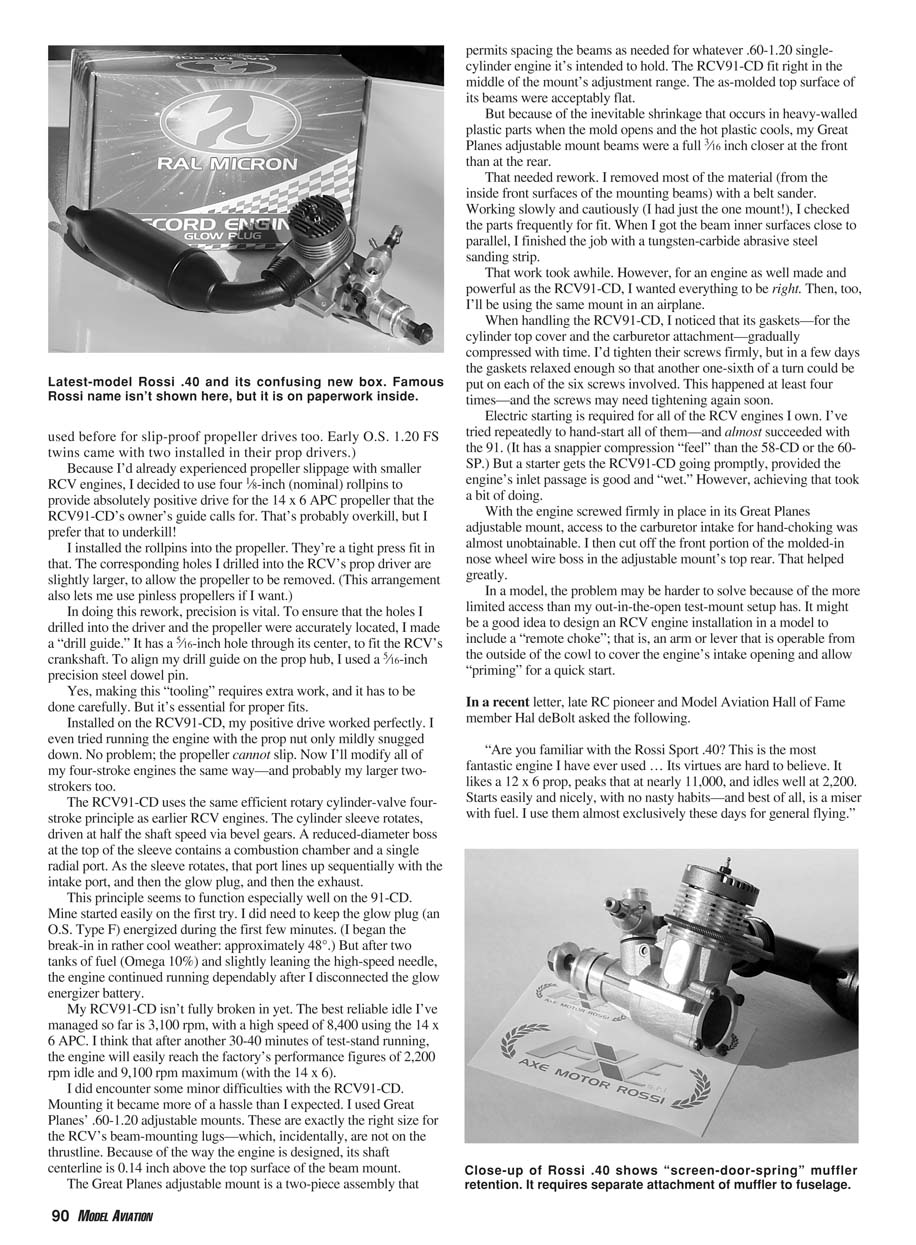
"Are you familiar with the Rossi Sport .40? This is the most fantastic engine I have ever used ... Its virtues are hard to believe. It likes a 12 x 6 prop, peaks at nearly 11,000, and idles well at 2,200. Starts easily and nicely, with no nasty habits—and best of all, a miser with fuel. I use them almost exclusively these days for general flying."
Transcribed from original scans by AI. Minor OCR errors may remain.

