
The Engine Shop — Joe Wagner
Judging from the ads in today's model-airplane publications and mail-order catalogs, it might appear that electric power dominates the field of model-airplane propulsion. E-power is popular, all right, but internal-combustion (IC) model engines are still very much alive. That's evidenced by the never-ending parade of new IC engines. At least two have come out every month in the last couple of years. (I'll report on three new engines later in this column.)
Two good friends of mine have built and flown electric-powered RC, but they've returned to the IC fold after one or two flying seasons. I asked one of them about that, and he said, "Electric power is okay—but it just doesn't have any personality!" Thinking about that remark—and why I agree with my friend—I decided that part of an IC engine's "personality" is that it so often presents us with a bit of quirky behavior (just like a human!). Getting effective performance from ICs requires more know-how and ingenuity than merely flipping a switch.
Rossi .40: a puzzling balk and an easy fix
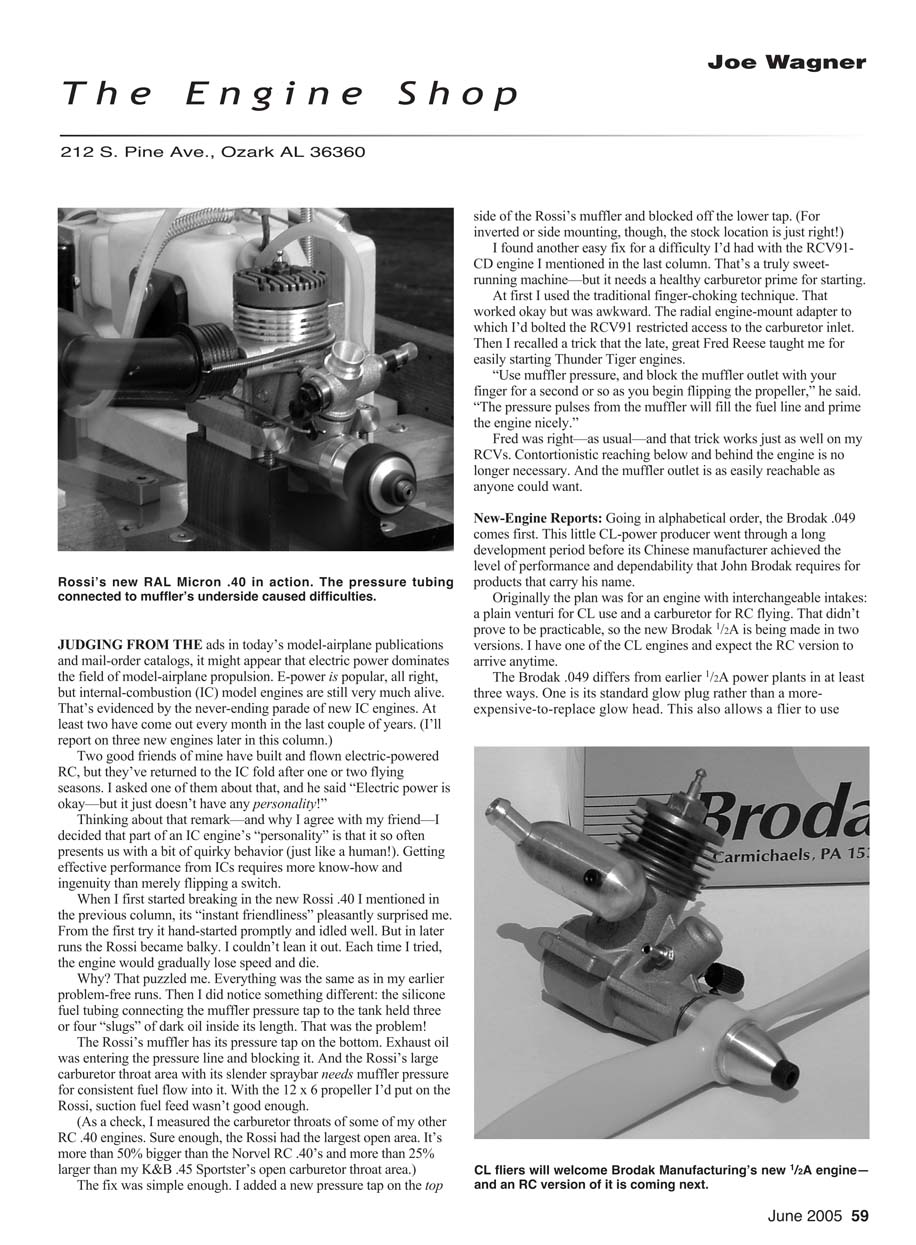
When I first started breaking in the new Rossi .40 I mentioned in the previous column, its "instant friendliness" pleasantly surprised me. From the first try it hand-started promptly and idled well. But in later runs the Rossi became balky. I couldn't lean it out. Each time I tried, the engine would gradually lose speed and die. Why? That puzzled me. Everything was the same as in my earlier problem-free runs.
Then I noticed something different: the silicone fuel tubing connecting the muffler pressure tap to the tank held three or four slugs of dark oil inside its length. That was the problem. The Rossi's muffler has its pressure tap on the bottom, so exhaust oil was entering the pressure line and blocking it. And the Rossi's large carburetor throat area with its slender spraybar needs muffler pressure for consistent fuel flow into it. With the 12x6 propeller I'd put on the Rossi, suction fuel feed wasn't good enough.
As a check, I measured the carburetor throats of some of my other RC .40 engines. Sure enough, the Rossi had the largest open area. It's more than 50% bigger than the Norvel RC .40's and more than 25% larger than my K&B .45 Sportster's open carburetor throat area.
The fix was simple: I added a new pressure tap on the top side of the Rossi's muffler and blocked off the lower tap. (For inverted or side mounting, though, the stock location is just right.)
RCV91-CD: an easier starting trick
I found another easy fix for a difficulty I'd had with the RCV91-CD engine I mentioned in the last column. That's a truly sweet-running machine—but it needs a healthy carburetor prime for starting. At first I used the traditional finger-choking technique. That worked okay but was awkward. The radial engine-mount adapter to which I'd bolted the RCV91 restricted access to the carburetor inlet.
Then I recalled a trick that the late, great Fred Reese taught me for easily starting Thunder Tiger engines: "Use muffler pressure, and block the muffler outlet with your finger for a second or so as you begin flipping the propeller," he said. "The pressure pulses from the muffler will fill the fuel line and prime the engine nicely."
Fred was right—as usual—and that trick works just as well on my RCVs. Contortionistic reaching below and behind the engine is no longer necessary. The muffler outlet is as easily reachable as anyone could want.
New-Engine Reports
Going in alphabetical order, here are three new IC model engines I've examined.
Brodak .049
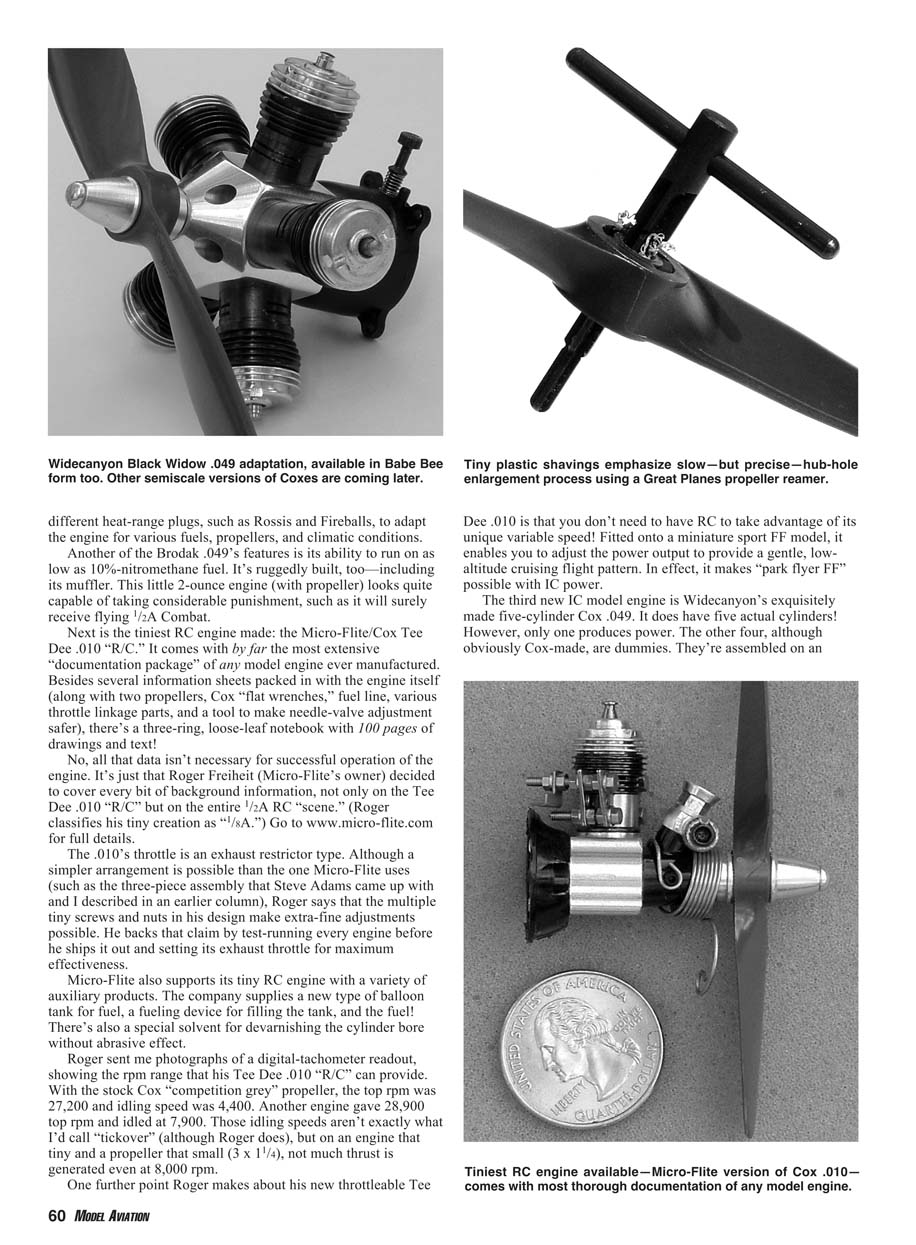
The Brodak .049 is a little CL power producer that went through a long development period before its Chinese manufacturer achieved the level of performance and dependability that John Brodak requires for products that carry his name. Originally the plan was for an engine with interchangeable intakes: a plain venturi for CL use and a carburetor for RC flying. That didn't prove practicable, so the new Brodak .049 is being made in two versions. I have one of the CL engines and expect the RC version to arrive anytime.
The Brodak .049 differs from earlier 1/2A power plants in at least three ways:
- It uses a standard glow plug rather than a more-expensive-to-replace glow head, allowing use of different heat-range plugs (such as Rossis and Fireballs) to adapt the engine for various fuels, propellers, and climatic conditions.
- It can run on as little as 10% nitromethane fuel.
- It's ruggedly built, including a sturdy muffler.
This little 2-ounce engine (with propeller) looks quite capable of taking considerable punishment, such as it will surely receive flying 1/2A Combat.
Micro-Flite/Cox Tee Dee .010 "R/C"
This is the tiniest RC engine made, and it comes with by far the most extensive documentation package of any model engine I’ve seen. Besides several information sheets packed with the engine (along with two propellers, Cox flat wrenches, fuel line, throttle linkage parts, and a tool to make needle-valve adjustment safer), there's a three-ring, loose-leaf notebook with 100 pages of drawings and text.
Roger Freiheit (Micro-Flite's owner) decided to cover every bit of background information, not only on the Tee Dee .010 "R/C" but on the entire 1/2A RC scene. (Roger classifies this tiny creation as "1/8 A.") Go to www.micro-flite.com for full details.
The .010's throttle is an exhaust-restrictor type. Although a simpler arrangement is possible (such as the three-piece assembly Steve Adams came up with and I described in an earlier column), Roger says that the multiple tiny screws and nuts in his design make extra-fine adjustments possible. He backs that claim by test-running every engine before he ships it and setting its exhaust throttle for maximum effectiveness.
Micro-Flite also supports the engine with a variety of auxiliary products: a new type of balloon tank for fuel, a fueling device for filling the tank, the fuel itself, and a special solvent for devarnishing the cylinder bore without abrasive effect.
Roger sent me photographs of a digital-tachometer readout showing the rpm range that the Tee Dee .010 "R/C" can provide. With the stock Cox "competition grey" propeller, one engine topped out at 27,200 rpm and idled at 4,400. Another engine gave 28,900 top rpm and idled at 7,900. Those idling speeds aren't exactly what I'd call "tickover" (although Roger does), but with the tiny propeller (3 x 1-1/4), not much thrust is generated even at 8,000 rpm.
One further point Roger makes is that you don't need RC to take advantage of the variable speed. Fitted onto a miniature sport free-flight model, it enables you to adjust the power output to provide a gentle, low-altitude cruising flight pattern—making "park flyer FF" possible with IC power.
Widecanyon five-cylinder Cox .049 (semiscale)
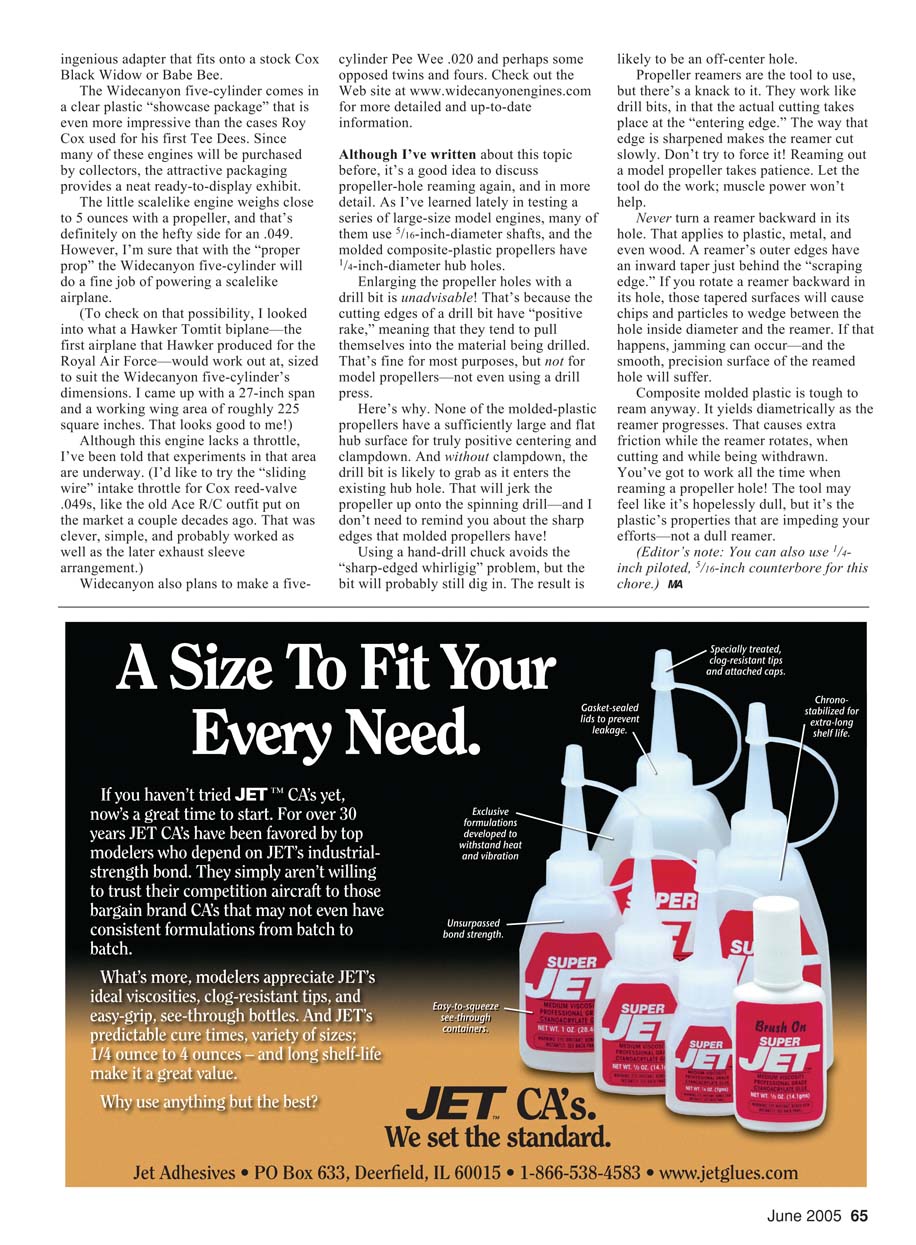
Widecanyon has produced an exquisitely made five-cylinder Cox .049. It really does have five cylinders, but only one produces power; the other four are dummies (they are Cox-made and assembled on an adapter to appear as a semiscale radial cluster). It's billed as a Black Widow .049 adaptation and is available in Babe Bee form too. Other semiscale versions of Cox engines are coming later.
The engine uses an ingenious adapter that fits onto a stock Cox Black Widow or Babe Bee. It comes in a clear plastic showcase package that is even more impressive than the cases Roy Cox used for his first Tee Dees. Since many of these engines will be purchased by collectors, the attractive packaging provides a neat ready-to-display exhibit.
The little scalelike engine weighs close to 5 ounces with a propeller, which is hefty for an .049. However, with the proper prop it should do a fine job powering a scalelike airplane. To check that, I sized a Hawker Tomtit biplane (the first airplane Hawker produced for the RAF) to suit the Widecanyon five-cylinder's dimensions and came up with a 27-inch span and a working wing area of roughly 225 square inches—that looks workable.
Although this engine lacks a throttle, experiments are underway. I'd like to try the "sliding wire" intake throttle for Cox reed-valve .049s, like the old Ace R/C outfit marketed decades ago—that was clever, simple, and probably worked as well as later exhaust sleeve arrangements.
Widecanyon also plans a five-cylinder Pee Wee .020 and perhaps some opposed twins and fours. Check www.widecanyonengines.com for more detailed and up-to-date information.
Propeller-hole reaming: advice and cautions
Although I've written about this before, it's a good idea to discuss propeller-hole reaming again, and in more detail. Many large-size model engines use 5/16-inch-diameter shafts, while the molded composite-plastic propellers often have 1/4-inch-diameter hub holes.
Enlarging propeller holes with a drill bit is unadvisable. Drill bits have a positive rake and tend to pull themselves into the material being drilled. None of the molded-plastic propellers have a sufficiently large and flat hub surface for truly positive centering and clampdown, and without clampdown the drill bit is likely to grab as it enters the existing hub hole. That can jerk the propeller up onto the spinning drill—dangerous given the sharp edges of molded propellers. Using a hand-drill chuck avoids some risk, but the bit will probably still dig in and produce an off-center hole.
Propeller reamers are the correct tool, but there is a knack to using them:
- Reamers work like drill bits in that the actual cutting takes place at the entering edge, but the way that edge is sharpened makes the reamer cut slowly. Don't force it—let the tool do the work.
- Never turn a reamer backward in its hole (plastic, metal, or wood). A reamer's outer edges have an inward taper just behind the scraping edge; rotating backward can wedge chips between the reamer and the hole and cause jamming.
- Composite molded plastic is tough to ream. It yields diametrically as the reamer progresses, causing extra friction while cutting and withdrawing. Work steadily and patiently; if the tool feels dull, it's often the material, not the reamer.
If you prefer another method, you can also use a 1/4-inch piloted, 5/16-inch counterbore for this chore.
(Editor's note: You can also use a 1/4-inch piloted, 5/16-inch counterbore for this chore.)
Transcribed from original scans by AI. Minor OCR errors may remain.

