
Alternatives to chroming for enhanced compression
Joe Wagner | [email protected]
Irv St. George (Selah, WA) wrote to me about a problem with a SuperTigre .40 he owns. According to him, "It runs good, and I like it. But it has very low compression." Irv went on to mention his idea of having the SuperTigre's piston chrome plated to improve the engine's compression.
I replied that chrome-plating a sport-flying model engine piston merely to boost "cold compression" isn't likely to be worth the time, cost, or trouble it takes to achieve the proper-running fit. Chromium plating for engineering purposes is far more involved and costly than applying decorative chrome.
True, snappy cold compression makes an engine feel potent when you flip its propeller, but that doesn't necessarily have much beneficial effect on the running engine (it does help in hand-starting).
Decades ago, one of my favorite CL Precision Aerobatics (stunt) models was powered by a well-used McCoy .19. Its piston was so worn that a vigorous flip could spin the propeller through two or even three complete revolutions. To start that engine I'd squirt a shot of 3-in-One oil into the exhaust just before hooking up the glow plug. Once I got the engine going, it ran fine and delivered ample power. My friend and champion stunt flier Bob Palmer had a Mac .19 that was as worn as mine was. He's the one who taught me the trick of how to start it.
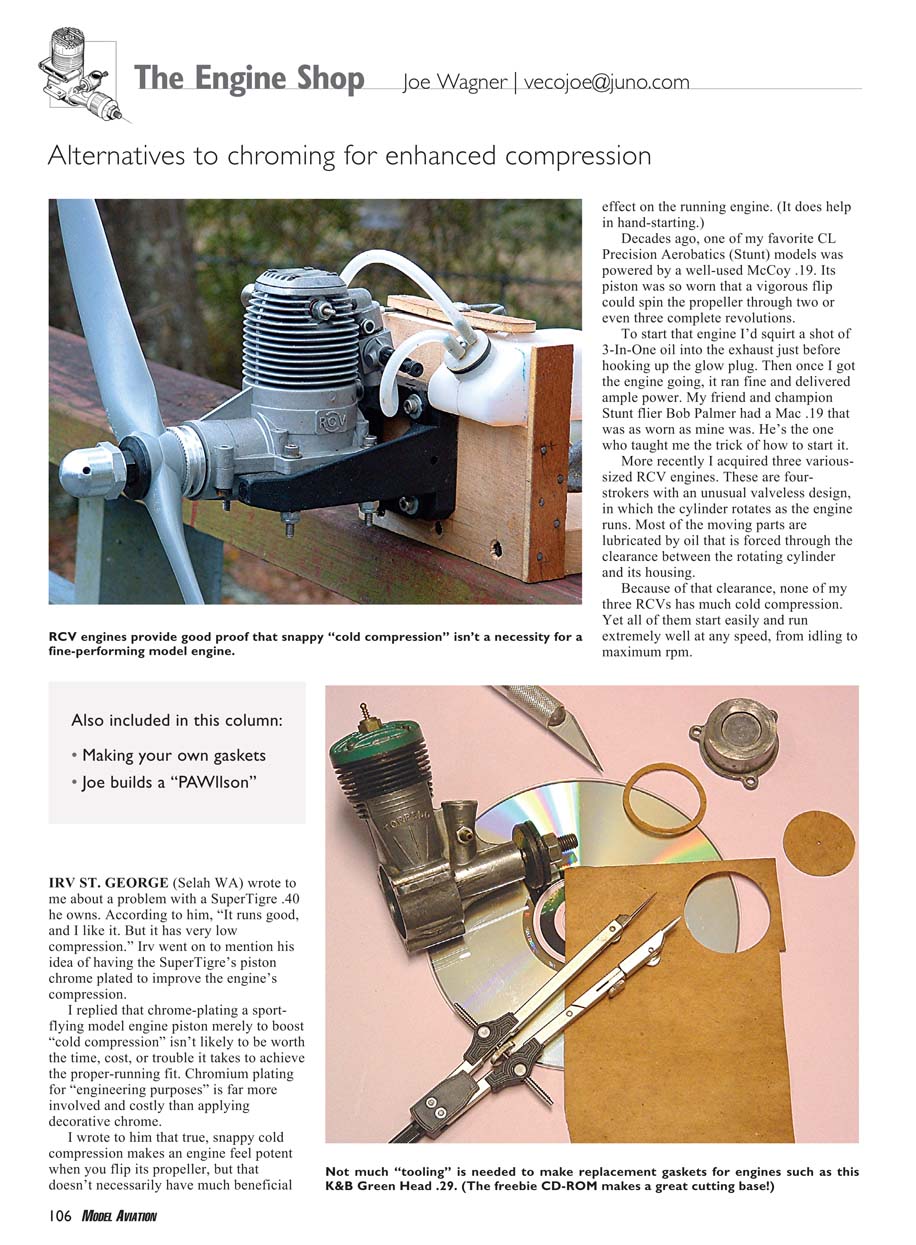
More recently I acquired three various-sized RCV engines. These are four-strokers with an unusual valveless design in which the cylinder rotates as the engine runs. Most of the moving parts are lubricated by oil that is forced through the clearance between the rotating cylinder and its housing. Because of that clearance, none of my three RCVs has much cold compression. Yet all of them start easily and run extremely well at any speed, from idling to maximum rpm.
Irv didn't indicate what fuel he was using. I assume it's one of the commercial brands. Try adding a 4-ounce bottle of drugstore castor oil to a quart of glow fuel. That should improve the SuperTigre's cold compression—and it will require no additional break-in time (as a chromed piston would). It will probably add a couple hundred to the top-end rpm too.
Making your own gaskets
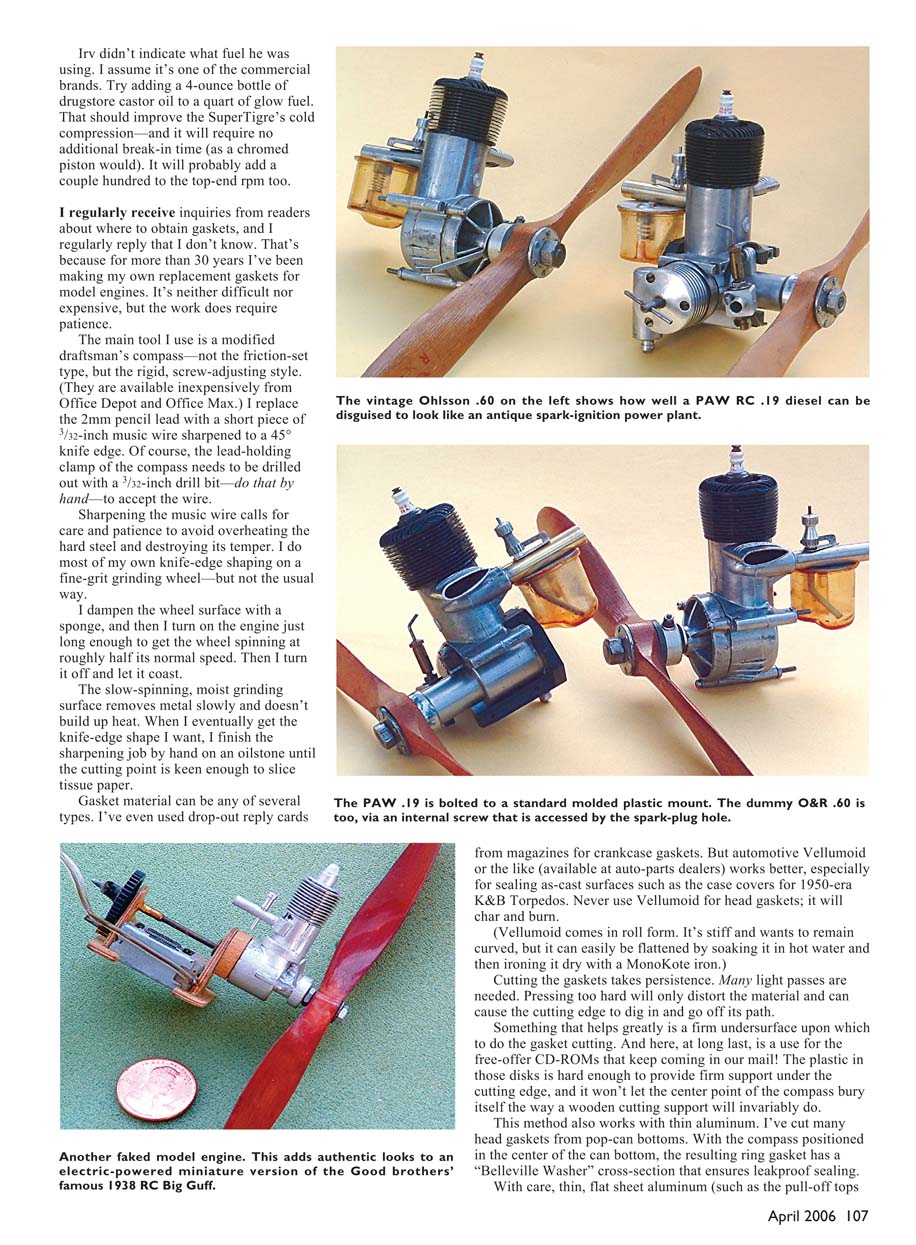
I regularly receive inquiries from readers about where to obtain gaskets, and I regularly reply that I don't know. That's because for more than 30 years I've been making my own replacement gaskets for model engines. It's neither difficult nor expensive, but the work does require patience. The main tool I use is a modified draftsman's compass—not the friction-set type, but the rigid, screw-adjusting style (available inexpensively from Office Depot and Office Max).
How I modify and use the compass:
- Replace the 2 mm pencil lead with a short piece of 3/32-inch music wire sharpened to a 45° knife edge.
- Drill out the lead-holding clamp of the compass with a 3/32-inch drill bit—do that by hand—to accept the wire.
- Sharpening the music wire calls for care and patience to avoid overheating the hard steel and destroying its temper.
- I do most of the knife-edge shaping on a fine-grit grinding wheel:
- Dampen the wheel surface with a sponge.
- Turn on the grinder just long enough to get the wheel spinning at roughly half its normal speed, then turn it off and let it coast.
- The slow-spinning, moist grinding surface removes metal slowly and doesn't build up heat.
- Finish the sharpening job by hand on an oilstone until the cutting point is keen enough to slice tissue paper.
Gasket material options:
- Drop-out reply cards from magazines can be used for crankcase gaskets.
- Automotive Vellumoid (available at auto-parts dealers) works better for many crankcase gaskets, especially for sealing as-cast surfaces such as the case covers for 1950-era K&B Torpedos.
- Never use Vellumoid for head gaskets; it will char and burn.
- Vellumoid comes in roll form and is stiff; it can be flattened by soaking in hot water and then ironing dry with a MonoKote iron.
Cutting tips:
- Cutting the gaskets takes persistence—many light passes are needed. Pressing too hard will only distort the material and can cause the cutting edge to dig in and go off its path.
- A firm undersurface helps greatly. Free-offer CD-ROMs make excellent supports: the plastic is hard enough to provide firm support and won't let the center point of the compass bury itself the way a wooden cutting support will.
This method also works with thin aluminum. I've cut many head gaskets from pop-can bottoms. With the compass positioned in the center of the can bottom, the resulting ring gasket has a "Belleville washer" cross-section that ensures leakproof sealing.
With care, thin, flat sheet aluminum (such as the pull-off tops from beverage cans) will also do for crankcase gaskets. I cut them with a fresh #11 hobby blade, taking several light passes to complete the cut. The bottoms of peanut cans can be compass-cut to make glow-head and cylinder-to-case gaskets for engines that range from early Browns to late-model Coxes.
Diesels and experimental combinations
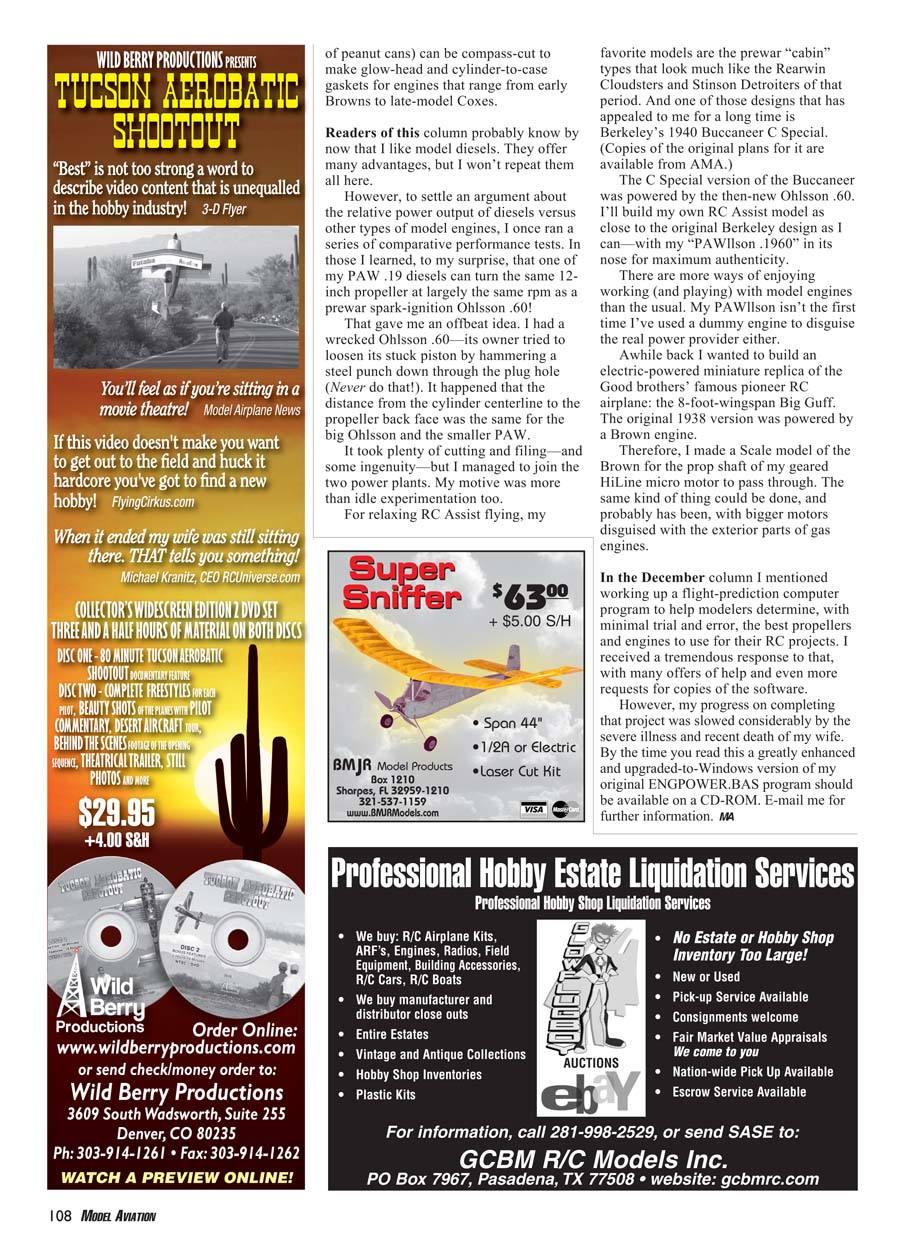
Readers of this column probably know by now that I like model diesels. They offer many advantages. To settle an argument about the relative power output of diesels versus other types of model engines, I once ran a series of comparative performance tests. To my surprise, one of my PAW .19 diesels can turn the same 12-inch propeller at largely the same rpm as a prewar spark-ignition Ohlsson .60!
That gave me an offbeat idea. I had a wrecked Ohlsson .60—its owner tried to loosen its stuck piston by hammering a steel punch down through the plug hole (never do that!). It happened that the distance from the cylinder centerline to the propeller back face was the same for the big Ohlsson and the smaller PAW. It took plenty of cutting and filing—and some ingenuity—but I managed to join the two power plants. My motive was more than idle experimentation.
For relaxing RC-assist flying, my favorite models are the prewar "cabin" types that look much like the Rearwin Cloudsters and Stinson Detroiters of that period. One design that has appealed to me for a long time is Berkeley's 1940 Buccaneer C Special (copies of the original plans are available from the AMA). The C Special version of the Buccaneer was powered by the then-new Ohlsson .60. I'll build my own RC-assist model as close to the original Berkeley design as I can—with my "PAWllson .1960" in its nose for maximum authenticity.
There are more ways of enjoying working (and playing) with model engines than the usual. My PAWllson isn't the first time I've used a dummy engine to disguise the real power provider either. Awhile back I wanted to build an electric-powered miniature replica of the Goody brothers' famous pioneer RC airplane: the 8-foot-wingspan Big Guff. The original 1938 version was powered by a Brown engine. Therefore, I made a scale model of the Brown for the prop shaft of my geared HiLine micro motor to pass through. The same kind of thing could be done, and probably has been, with bigger motors disguised with the exterior parts of gas engines.
Flight-prediction program update
In the December column I mentioned working up a flight-prediction computer program to help modelers determine, with minimal trial and error, the best propellers and engines to use for their RC projects. I received a tremendous response to that, with many offers of help and even more requests for copies of the software.
However, my progress on completing that project was slowed considerably by the severe illness and recent death of my wife. By the time you read this, a greatly enhanced and upgraded-to-Windows version of my original ENGPOWER.BAS program should be available on a CD-ROM. E-mail me for further information.
Transcribed from original scans by AI. Minor OCR errors may remain.

