
A look at the new O.S. .55 AX high-performance engine
Joe Wagner | [email protected]
O.S. .55 AX overview
O.S. Engines never runs out of new ideas, such as the double-ball-bearing O.S. .55 AX ABL. (The last three letters stand for Advanced Bimetallic Liner, which is an improvement on the "ABC" system. The ABL design uses a double layer of chrome and nickel electroplating in its brass liner bore. This provides stronger bonding between the plating and the sleeve and greater durability in service.)
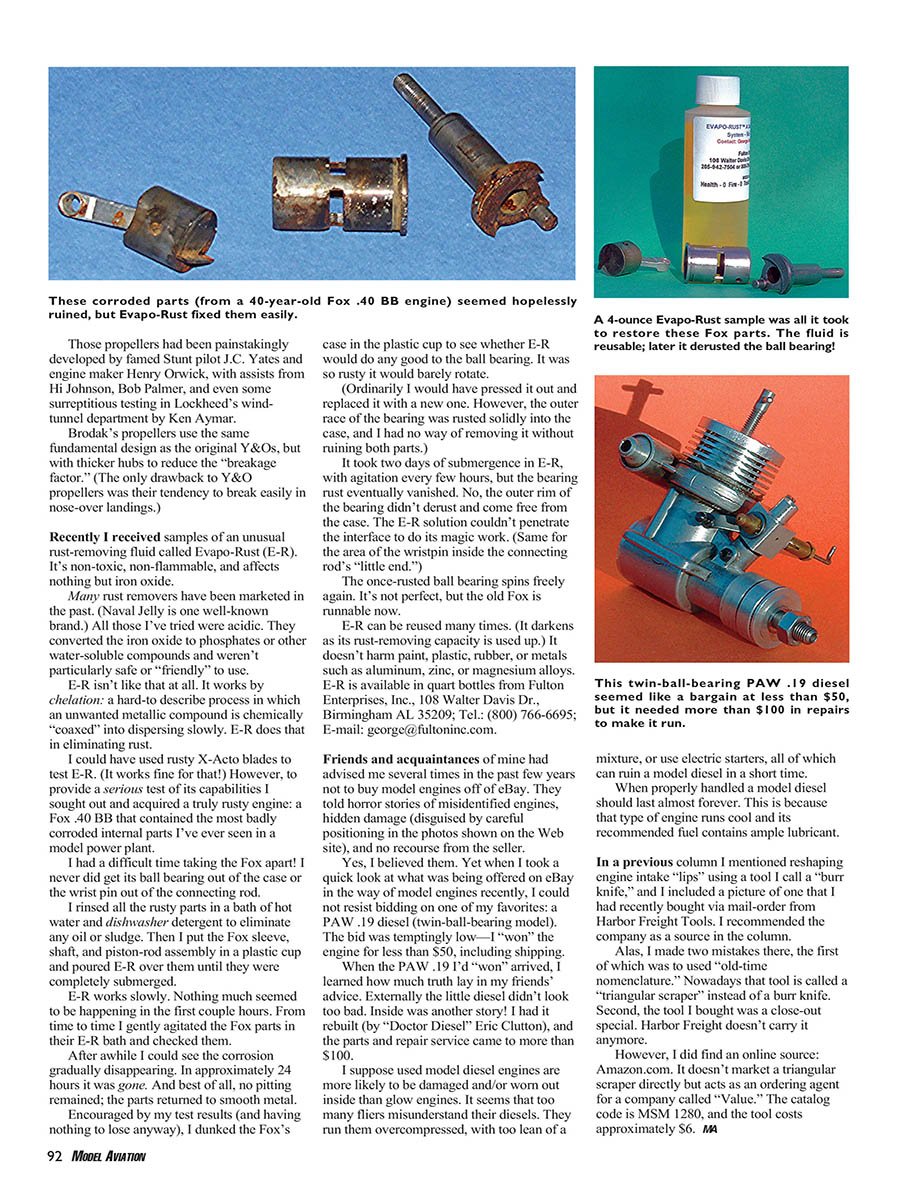
Externally the O.S. .55 AX is easy to identify by several distinctive features:
- Slanted head fins, taller at the rear for improved cooling.
- A swept-back needle valve with an angled extension.
- A rectangular cross-section muffler that O.S. calls the "Power Box."
The taller rear fins offer more effective head-cooling area and permit better airflow over and through them than the usual arrangement. The angled needle includes a flexible extension — an old-time feature I’ve always liked. The .55 AX comes with a 3-1/2-inch length of high-tensile stainless-steel flex cable that can be cut to the desired length and assembled between knurled knobs with socket-head setscrews. A rigid wire extension can also be used.
The .55 AX carburetor is easy to adjust. Its mixture-control feature, although sensitive, is straightforward. The instruction manual explains in detail how to adjust the mixture and how to tell when it needs readjustment.
As do all model engines with aluminum pistons and brass sleeves, the O.S. .55 AX has a tapered bore. However, the new ABL process evidently allows closer fitting than usual. Even though I felt a slight "pinch" when the piston passed through top dead center, it was far from a "squeaky fit." I had no trouble hand-starting the .55 AX from cold. (The manual advises using an electric starter, but hand-starting gives a good feel for a new model engine. A heavy-duty leather glove keeps fingers safe from propeller damage.)
Comparison: Brodak .25 CL vs Johnson .29
Further experimentation with Brodak’s .25 CL engine (mentioned in an earlier column) showed some interesting points. For my own comparison I used one of my favorite CL Aerobatics (Stunt) engines: the 1956 Johnson .29.
The two engines weigh approximately the same: 7.1 ounces for the Johnson and 7.6 ounces for the Brodak, including the muffler. They deliver almost the same power. The Brodak .25's high output is probably due to its carefully optimized porting and the greater efficiency provided by its lightweight aluminum piston. Less power is wasted starting and stopping a heavy cast-iron piston twice in each revolution. The Brodak also runs noticeably smoother than the Johnson.
In these comparisons I used John Brodak’s wood propellers. They are an improved version of the old Y&O propellers that were favorites with West Coast fliers in the post-World War II years. Those propellers had been painstakingly developed by famed stunt pilot J.C. Yates and engine maker Henry Orwick, with assists from Hi Johnson, Bob Palmer, and even some surreptitious testing in Lockheed's wind-tunnel department by Ken Aymar.
Brodak's propellers use the same fundamental design as the original Y&Os but with thicker hubs to reduce breakage. (The only drawback to Y&O propellers was their tendency to break easily in nose-over landings.)
Evapo-Rust (E-R) test
Recently I received samples of an unusual rust-removing fluid called Evapo-Rust (E-R). It's non-toxic, non-flammable, and affects only iron oxide.
How it works:
- Unlike acidic rust removers (e.g., Naval Jelly) that convert iron oxide to soluble compounds, E-R works by chelation — a process that chemically "coaxes" the unwanted oxide into dispersing slowly.
- E-R does not harm paint, plastic, rubber, or metals such as aluminum, zinc, or magnesium alloys.
- E-R can be reused many times; it darkens as its rust-removing capacity is used up.
To test E-R seriously, I sought out a very rusty engine: a Fox .40 BB that contained some of the most badly corroded internal parts I've seen in a model power plant. Disassembly was difficult; I could not remove the ball bearing from the case or the wrist pin from the connecting rod.
I rinsed all rusty parts in a bath of hot water and dishwasher detergent to remove oil and sludge. Then I submerged the Fox sleeve, shaft, and piston-rod assembly in a plastic cup and poured E-R over them.
E-R works slowly. After a few hours little seemed to happen, but with occasional gentle agitation I watched the corrosion gradually disappear. In approximately 24 hours the visible corrosion was gone and the parts returned to smooth metal with no pitting.
Encouraged, I dunked the Fox case (with its seized ball bearing) into E-R. The bearing was so rusty it would barely rotate. It took two days of submergence with agitation every few hours, but the bearing rust eventually vanished. The outer race of the bearing, however, did not derust enough to separate from the case — E-R could not penetrate that tightly joined interface (same with the wristpin area inside the connecting rod's little end). The once-rusted ball bearing now spins freely again. It's not perfect, but the old Fox is runnable.
E-R is available in quart bottles from Fulton Enterprises, Inc., 108 Walter Davis Dr., Birmingham, AL 35209; Tel: (800) 766-6695; E-mail: [email protected].
Buying used model engines on eBay
Friends had warned me several times in recent years not to buy model engines off eBay. They told horror stories of misidentified engines, hidden damage disguised by careful positioning in photos, and no recourse from sellers.
When I recently looked at old engines offered on eBay, I saw why. Prices were very low and "fat" engines were being offered as bargains. One engine I bid on was a PAW .19 (twin-ball-bearing model). The bid was temptingly low — I "won" the engine for less than $50, including shipping.
When the PAW .19 arrived, the reality matched my friends' warnings. Externally the little diesel looked fine; inside was another story. It had been rebuilt (by "Doctor Diesel" Eric Clutton), and the parts and repair service totaled more than $100.
Used model diesel engines may be more likely to be damaged and overhauled than glow engines. Many fliers misunderstand diesels: they run them overcompressed, with too lean a mixture, or use electric starters — all of which can ruin a model diesel quickly.
When properly handled, a model diesel should last almost forever. Diesel engines run cool and their recommended fuels contain ample lubricant.
Triangular scraper (formerly called a "burr knife")
In a previous column I mentioned reshaping engine intake "lips" using a tool I called a "burr knife" and included a picture of one I bought by mail-order from Harbor Freight Tools. I recommended the company as a source, but I made two mistakes.
- Terminology: The modern name for that tool is triangular scraper, so it won't be found under my old description.
- Availability: The tool I bought was a close-out special; Harbor Freight doesn't carry it anymore.
I did find an online source. Amazon.com acts as an ordering agent for a company called "Value." The catalog code is MSM 1280, and the tool costs approximately $6.
Transcribed from original scans by AI. Minor OCR errors may remain.

