
The Engine Shop - 2007/08
Joe Wagner | [email protected]
Beware of lean needle settings—especially on four-stroke engines!
This begins my 11th year with this column and my seventh decade of foozling about with model engines. In all that time I've owned, operated, and flown with more than a thousand of them. In doing all that I've probably made almost every mistake possible. That's how I've become so experienced! (It's well known that experience is what you receive soon after the urgent need for it occurs.)
One thing I've learned above all else is to beware of lean needle settings. They cause more model-engine problems than almost anything else. Patrick LeRay (Shreveport, Louisiana) recently emailed me about his troubles with a four-stroker. "Is prop spitting just something one has to live with, with four-stroke engines?" he wrote. "I've just had this happen as I was bench-running one, when I leaned it too much by mistake ..." He went on with details of how, in spite of firmly tightened prop nuts—the main nut and the jam nut ahead of that—the entire drive assembly flew off soon after he started the engine. That happened from a backfire: the fuel/oil/air charge fired while the piston was still on its way up. The sudden stop of crankshaft rotation caused the spinning propeller's inertia to unscrew the retaining nuts and set the whole propeller-drive assembly free. So what caused the backfire? How could a lean needle setting do that?
Theoretically a lean fuel-to-air mixture ought to offer maximum engine efficiency. It allows almost all the fuel to burn, converting most of its energy content into heat and expansion. And there's the problem: as heat builds up in the engine, it effectively raises the compression, and that can cause too-early firing of the mixture. In model diesels we notice this phenomenon as it happens and back off the compression to compensate. But there's no way to do that with a glow engine. That's why it's best to set your needle a little on the rich side. The excess fuel entering the combustion chamber acts as additional cooling.
I asked my friend Zach Allerton (New Castle, Pennsylvania) about his tuning techniques for four-strokers. He has been flying RC with those almost exclusively since the 1980s. Zach told me that once he gets one of his engines broken in and properly adjusted, he "... never has to touch the needle valve one notch either way." This is the way it should be.
As I've written in the past, the four-stroke engines are the least troublesome to operate as long as you take care of them and treat them with respect. Use plenty of oil, in the fuel and when you're finished flying for the day. I like a fuel with at least 20% oil—no less.
Zach wrote:
"If the stock fuel has less, then I add good old castor oil right off the drug store or supermarket shelves. A 4-ounce bottle added to a gallon of fuel seems like enough to give me the blue smoke trail I like to see.
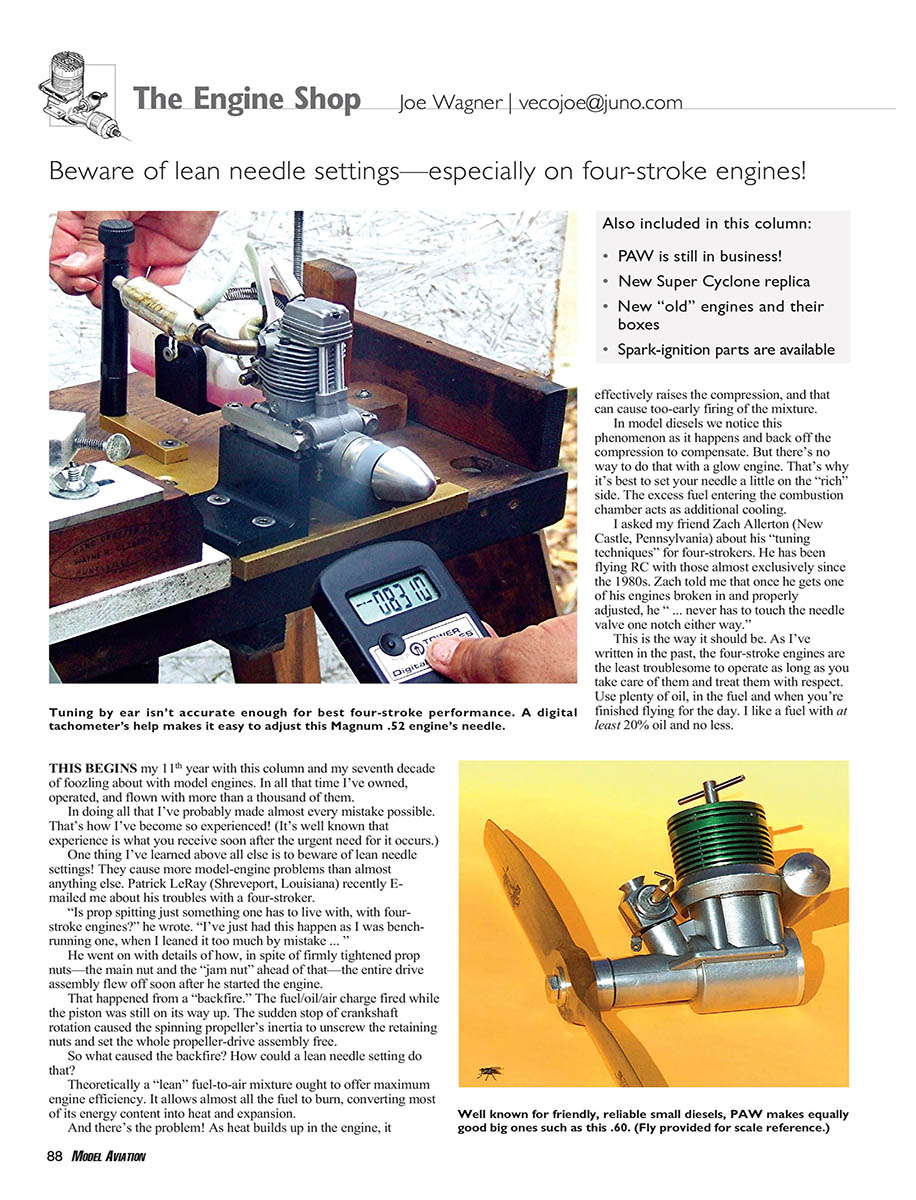
"Plus, I never fly with the engine peaked out. I always run it rich. I don't trust my ears alone for adjusting the needle.
"Using a tachometer, I'll lean the needle valve out for max rpm; then back off about 200 rpm. My O.S. engines seem very happy running about 9,000 to 9,200 rpm turning the propeller. I've found that makes the best combo for airplane and engine.
"If you run it lean on the ground, then when in the air the engine will more than likely backfire and throw the prop nut, washer, and propeller off. Hopefully the drive washer and key will remain on. If not, you'll have an expensive flight to record. Also, the four-stroke engine seems to like a weighty propeller. That provides a good flywheel effect.
"I've flown with Enya, Saito, and Magnum four-strokers, but haven't been involved with the YS engines (yet). They are all good engines—if you treat them right!"
PAW diesels and other current engines
There's a large amount of model-engine information available on the Internet, but some of it is erroneous. For instance, a recent report that the British Progress Aero Works (PAW) has gone out of business is bogus. That company—the only one in the world that offers a complete line of model diesel engines—is still actively in production.
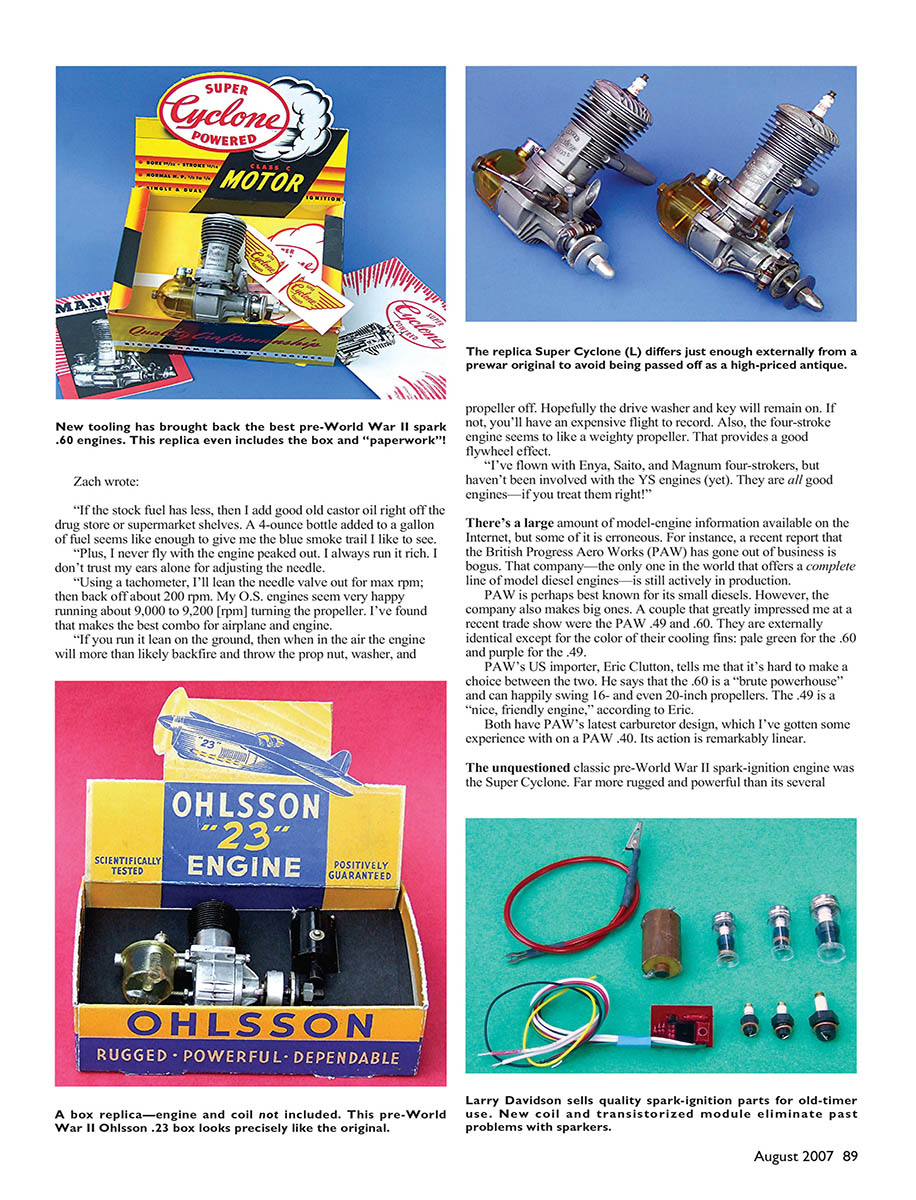
PAW is perhaps best known for its small diesels. However, the company also makes big ones. A couple that greatly impressed me at a recent trade show were the PAW .49 and .60. They are externally identical except for the color of their cooling fins: pale green for the .60 and purple for the .49.
PAW's U.S. importer, Eric Clutton, tells me that it's hard to make a choice between the two. He says that the .60 is a "brute powerhouse" and can happily swing 16- and even 20-inch propellers. The .49 is a "nice, friendly engine," according to Eric.
Both have PAW's latest carburetor design, which I've gotten some experience with on a PAW .40. Its action is remarkably linear.
Replicas and reproductions of classic engines
The unquestioned classic pre-World War II spark-ignition engine was the Super Cyclone. Far more rugged and powerful than its several competitors in "Class C," the Super "Cyke" was reissued after the war. Not just once, either. One after another, at least four companies acquired the original tooling for the engine and put it back in limited production.
The Super Cyclone is here again—but with new tooling and today's state-of-the-art manufacturing techniques. Even the original box, owner's manual, and hobby-shop window-display poster have been meticulously duplicated. The new maker is Walt Huhn (665 Chaparro Rd., Covina CA 91722; [email protected]).
I still have my old faithful, original Super Cyclone. It's in excellent condition, even after six decades. Placed side by side, Walt's new version looks almost identical to it, although he has lengthened the exhaust stack, substituted socket-head screws, and made a few other changes in detail to prevent his engine from being mistaken for one of the early models.
On the topic of old-time engine replication, a fair amount of that has been going on recently. Shilen Aerosports (205 Metro Park Blvd., Ennis TX 75120; [email protected]) makes exquisite replicas of the early spark-ignition K&B Torpedo that come in three sizes: .24, .29, and .32.
The company also carries a neat .19 sparker that is not a replica but uses old-time design characteristics with modern manufacturing methods. I've got to buy one of those for myself one of these days.
Woody Bartell (3706 N. 33rd St., Galesburg MI 49053; [email protected]) has a wide variety of old-time engine replicas available, from Syncro Bees to McCoy racing .60s. And to top that, George Milano (1606 E. Rowland Ave., West Covina CA 91791; [email protected]) offers exact reproductions of old-time model-engine boxes! He offers them for Bunches, Atwoods, Vivells, Dennymites, Ohlssons, and several others.
The boxes are not cheap, but I can hardly believe how realistic George's work is. The prewar Ohlsson .23 box I just bought from him looks precisely like it came out of an old-time hobby-shop window, with slightly faded colors, somewhat frayed edges, and all.
Spark-ignition components and accessories
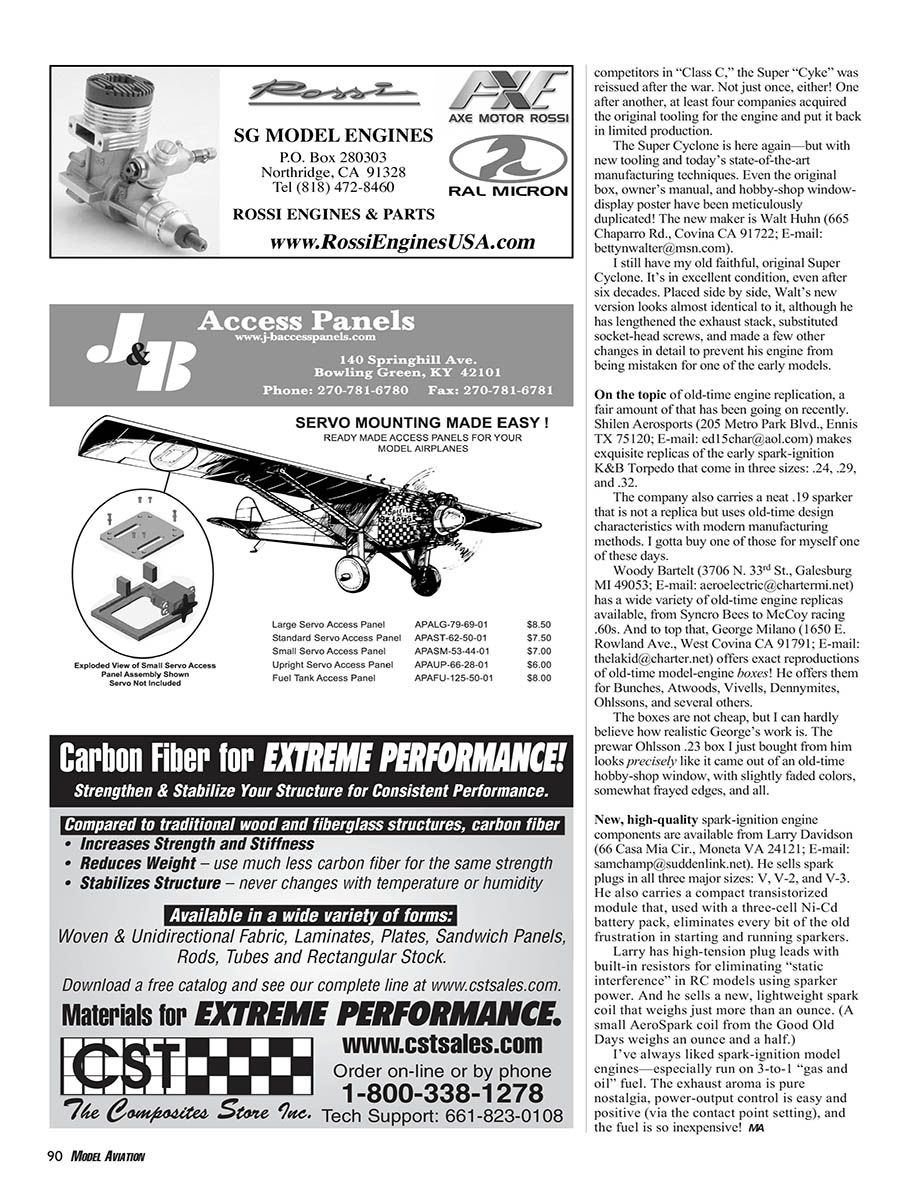
New, high-quality spark-ignition engine components are available from Larry Davidson (66 Casa Mia Cir., Moneta VA 24121; [email protected]). He sells spark plugs in all three major sizes: V, V-2, and V-3. He also carries a compact transistorized module that, used with a three-cell Ni-Cd battery pack, eliminates every bit of the old frustration in starting and running sparkers.
Larry has high-tension plug leads with built-in resistors for eliminating static interference in RC models using sparker power. He also sells a new, lightweight spark coil that weighs just more than an ounce. A small AeroSpark coil from the good old days weighs an ounce and a half.
I've always liked spark-ignition model engines—especially run on 3-to-1 "gas and oil" fuel. The exhaust aroma is pure nostalgia, power-output control is easy and positive (via the contact point setting), and the fuel is so inexpensive!
MA
Transcribed from original scans by AI. Minor OCR errors may remain.

