
Has the 1/2A golden era come to an end?
Joe Wagner | [email protected]
Recent e-mail from a reader alerted me that a major era in aeromodeling may be coming to an end. In the past several years 1/2A glow engines have gradually but relentlessly become less popular. The 1/2As were once the mainstay of the model-airplane business. They arrived at exactly the right time, too. When the first .049 engines were released late in the 1940s, the model-and-hobby industry was in a serious downturn. That held especially true for model power plants.
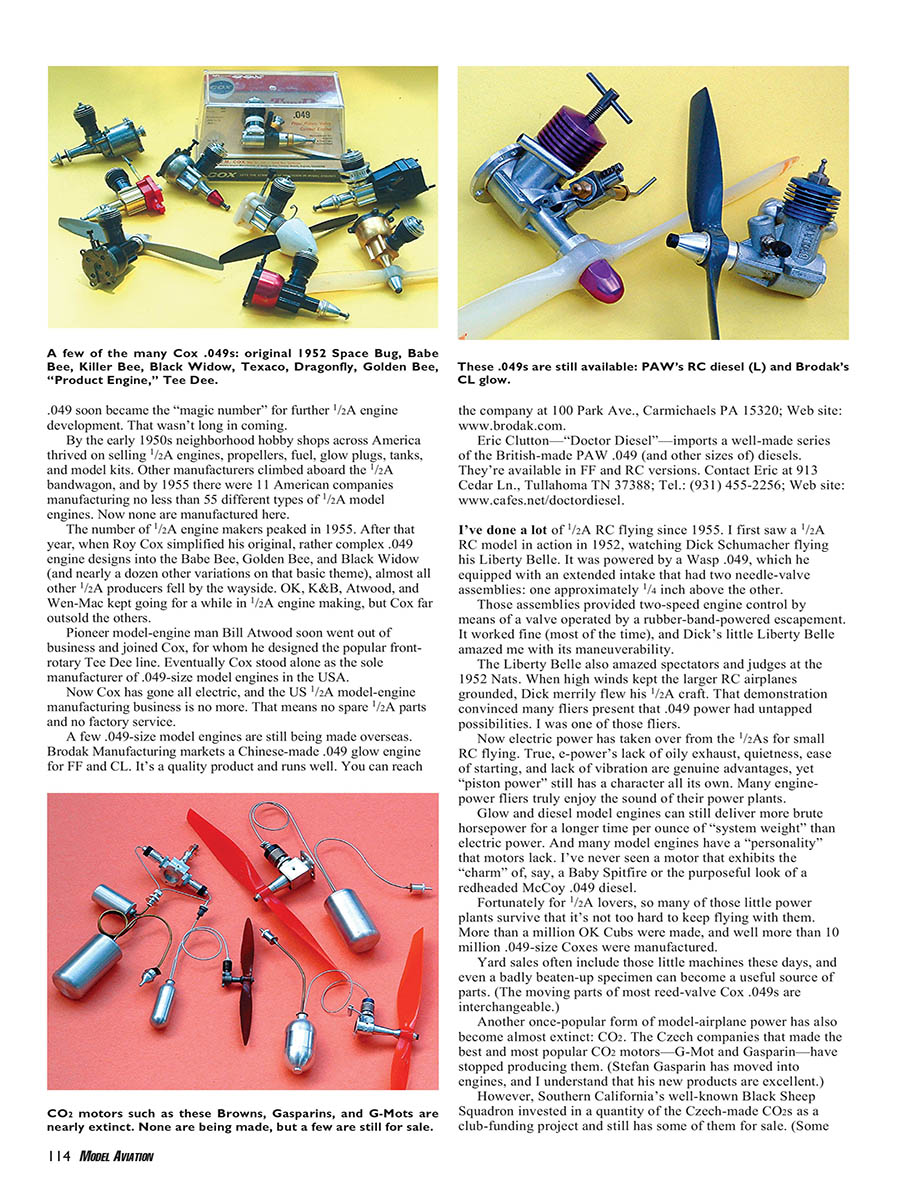
Glow plugs had only been available for slightly more than a year, and no designed-for-glow engines had yet appeared on hobby-shop shelves. Free-flight modeling had slumped, control-line was just beginning to hit its stride, and radio control remained a distant hope for the future. Then, near Christmas in 1948, K&B's incredibly tiny Infant appeared. At .020 cu. in., it was one-fifth the displacement of the then-smallest model engines on the market: the .097 Super Atom and the Arden .099.
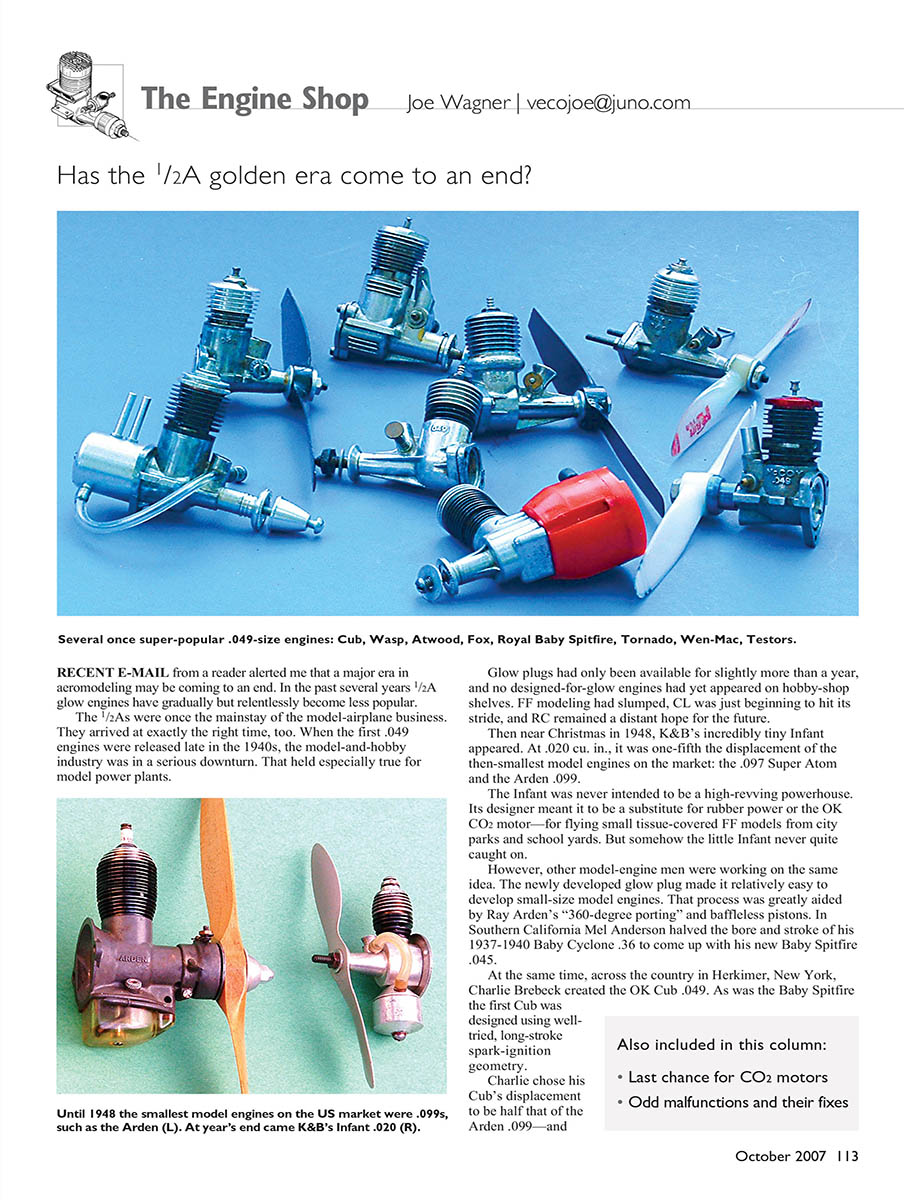
The Infant was never intended to be a high-revving powerhouse. Its designer meant it to be a substitute for rubber power or the OK CO2 motor—for flying small tissue-covered free-flight models from city parks and school yards. But somehow the little Infant never quite caught on. However, other model-engine men were working on the same idea. The newly developed glow plug made it relatively easy to develop small-size model engines. That process was greatly aided by Ray Arden's "360-degree porting" and baffleless pistons. In Southern California Mel Anderson halved the bore and stroke of his 1937–1940 Baby Cyclone .36 to come up with his new Baby Spitfire .045. At the same time, across the country in Herkimer, New York, Charlie Brebeck created the OK Cub .049. As with the Baby Spitfire, the first Cub was designed using well-tried, long-stroke spark-ignition geometry.
Charlie chose his Cub's displacement to be half that of the Arden .099—and .049 soon became the "magic number" for further 1/2A engine development. That wasn't long in coming.
By the early 1950s neighborhood hobby shops across America thrived on selling 1/2A engines, propellers, fuel, glow plugs, tanks, and model kits. Other manufacturers climbed aboard the 1/2A bandwagon, and by 1955 there were 11 American companies manufacturing no less than 55 different types of 1/2A model engines. Now none are manufactured here.
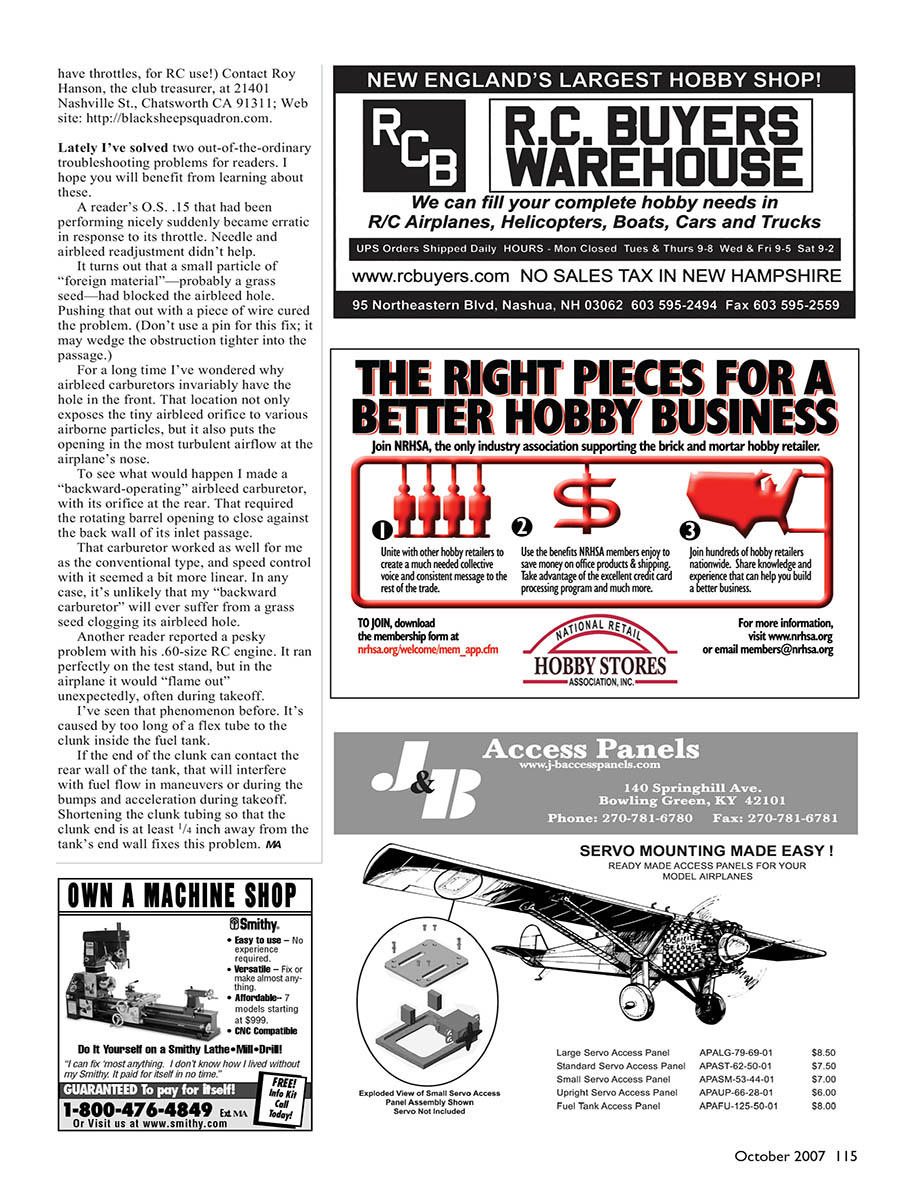
The number of 1/2A engine makers peaked in 1955. After that year, when Roy Cox simplified his original, rather complex .049 engine designs into the Babe Bee, Golden Bee, and Black Widow (and nearly a dozen other variations on that basic theme), almost all other 1/2A producers fell by the wayside. OK, K&B, Atwood, and Wen-Mac kept going for a while in 1/2A engine making, but Cox far outsold the others. Pioneer model-engine man Bill Atwood soon went out of business and joined Cox, for whom he designed the popular front-rotary Tee Dee line. Eventually Cox stood alone as the sole manufacturer of .049-size model engines in the USA.
Now Cox has gone all-electric, and the U.S. 1/2A model-engine manufacturing business is no more. That means no spare 1/2A parts and no factory service domestically.
Sources for .049 and diesel 1/2A engines today
A few .049-size model engines are still being made overseas:
- Brodak Manufacturing markets a Chinese-made .049 glow engine for free-flight and control-line. It's a quality product and runs well.
- Brodak Manufacturing, 100 Park Ave., Carmichaels, PA 15320
- Web site: www.brodak.com
- Eric Clutton—"Doctor Diesel"—imports a well-made series of the British-made PAW .049 (and other sizes) diesels. They're available in free-flight and radio-control versions.
- Eric Clutton, 913 Cedar Ln., Tullahoma, TN 37388; Tel.: (931) 455-2256
- Web site: www.cafes.net/doctordiesel
I've done a lot of 1/2A RC flying since 1955. I first saw a 1/2A RC model in action in 1952, watching Dick Schumacher flying his Liberty Belle. It was powered by a Wasp .049, which he equipped with an extended intake that had two needle-valve assemblies: one approximately 1/4 inch above the other. Those assemblies provided two-speed engine control by means of a valve operated by a rubber-band-powered escapement. It worked fine (most of the time), and Dick's little Liberty Belle amazed me with its maneuverability.
The Liberty Belle also amazed spectators and judges at the 1952 Nats. When high winds kept the larger RC airplanes grounded, Dick merrily flew his 1/2A craft. That demonstration convinced many fliers present that .049 had untapped possibilities. I was one of those fliers.
Now electric power has taken over from the 1/2As for small RC flying. True, electric power's lack of oily exhaust, quietness, ease of starting, and lack of vibration are genuine advantages, yet "piston power" still has a character all its own. Many engine-power fliers truly enjoy the sound of their power plants.
Glow and diesel model engines can still deliver more brute horsepower for a longer time per ounce of system weight than electric power. And many model engines have a "personality" that electric motors lack. I've never seen a motor that exhibits the charm of, say, a Baby Spitfire or the purposeful look of a redheaded McCoy .049 diesel.
Fortunately for 1/2A lovers, so many of those little power plants survive that it's not too hard to keep flying with them. More than a million OK Cubs were made, and well more than 10 million .049-size Coxes were manufactured. Yard sales often include those little machines these days, and even a badly beaten specimen can become a useful source of parts. (The moving parts of most reed-valve Cox .049s are interchangeable.)
CO2 motors
Another once-popular form of model-airplane power has also become almost extinct: CO2. The Czech companies that made the best and most popular CO2 motors—G-Mot and Gasparin—have stopped producing them. (Stefan Gasparin has moved into engines, and I understand that his new products are excellent.)
However, Southern California's well-known Black Sheep Squadron invested in a quantity of the Czech-made CO2s as a club-funding project and still has some of them for sale. (Some have throttles, for RC use.)
- Contact: Roy Hanson, Black Sheep Squadron, 21401 Nashville St., Chatsworth, CA 91311
- Web site: http://blacksheepsquadron.com
Troubleshooting
Lately I've solved two out-of-the-ordinary troubleshooting problems for readers. I hope you will benefit from learning about these.
- Blocked airbleed on an O.S. .15
- Symptom: Engine that had been performing nicely suddenly became erratic in response to its throttle. Needle and airbleed readjustment didn't help.
- Diagnosis: A small particle of foreign material—probably a grass seed—had blocked the airbleed hole.
- Fix: Push the obstruction out with a piece of wire. (Don't use a pin; it may wedge the obstruction tighter into the passage.)
- Note: For a long time I've wondered why airbleed carburetors invariably have the hole in the front. That location exposes the tiny airbleed orifice to airborne particles and puts the opening in the most turbulent airflow at the airplane's nose. I made a "backward-operating" airbleed carburetor with its orifice at the rear (requiring the rotating barrel opening to close against the back wall of its inlet passage). That carburetor worked as well as the conventional type, and speed control with it seemed a bit more linear. It is also less likely to suffer grass-seed clogs.
- Flameout during flight or takeoff caused by clunk tubing
- Symptom: A .60-size RC engine ran perfectly on the test stand but would flame out unexpectedly in the airplane, often during takeoff.
- Diagnosis: The flex tube to the clunk inside the fuel tank was too long. If the clunk can contact the rear wall of the tank, it can interfere with fuel flow during maneuvers or the bumps and acceleration of takeoff.
- Fix: Shorten the clunk tubing so that the clunk end is at least 1/4 inch away from the tank's end wall.
—MA
Transcribed from original scans by AI. Minor OCR errors may remain.

