

The Engine Shop
Joe Wagner | [email protected]
Saito FA‑62A Golden Knight (GK)
My first glance at Saito’s FA‑62A Golden Knight (GK) four‑stroker strongly attracted me to it. This engine’s sparkling black‑and‑gold finish makes it stand out from the competition. Now that I have one, I’m attracted to it more than ever.
As are all of Saito’s four‑stroke engines, the .62A GK is exceptionally well designed and built. It carries a three‑year guarantee that proves how firmly the company stands behind its products. The owner’s manual that came with my engine covers the full range of Saito’s current power plants. They are similarly designed and constructed, with dual ball bearings (the rear one shielded and the front one sealed) and Saito’s one‑piece cylinder‑and‑head unit, which eliminates any need for head gasketing. Saito’s line of engines ranges from .30 to 1.25. (All are available in the Golden Knight version or a plain metal finish.)
Saito thoughtfully packages with each engine a set of three Allen wrenches needed to adjust the valves, a small “box wrench” for adjusting screw locknuts, and a pair of tiny hardened‑steel feeler gauges for establishing the correct tappet gap. The manual explains how to set the tappet gap and recommends checking (and adjusting if necessary) after an hour or two of running time.
Now for operation. The Saito manual offers a wide range of propeller sizes. I chose a Graupner 12.5 x 6, which fits in the middle of the suggested range of diameters and pitches.
Fuel, starting, and break‑in
Saito specifies fuel with 10%–15% nitromethane and 20% oil. Since most glow fuels contain only 16%–18% oil, I routinely add enough castor to bring the lube percentage up to at least 20% for all my glow engines. A gallon contains 128 fluid ounces (floz); adding 1.5 floz of oil raises the lube percentage by roughly 1 point. To be on the safe side I add 6 floz of castor to any glow fuel that doesn’t specify its oil content. For example: 128 floz at 16% oil contains 20.5 floz oil. Adding 6 floz makes the total fuel 134 floz with 26.5 floz oil; 26.5/134 = 19.7% oil.
Even in 52° weather the .62 GK hand‑started easily (I wore a leather glove for safety). That “instant starting” came after I had cranked out the after‑run oil that Saito’s instructions told me to inject before starting to guarantee adequate lubrication for the first run. I also followed Saito’s break‑in instructions exactly.
I mounted the engine in one of Wayne Gladden’s break‑in/test stands, available from F&G Products. This mount offers maximum adaptability with an adjustable‑position tank mount, throttle lever, and adjustable engine width. I preset the needle according to the manual: 2½ turns open. That proved perfect for a first run—rich and smoky at 3,600 rpm.
Choking the Saito .62A GK was unnecessary. I put my finger over the muffler exit and flipped the prop briskly so exhaust pressure would force fuel through the line and provide a “wet prime.” After the GK started, I let it run that way for 12 minutes, then shut it off and let it cool.
Since the Saito GK has an aluminum piston running in a chrome‑plated aluminum bore, I didn’t use the repeated brief‑run procedures I employ with steel‑sleeved, lapped‑piston engines. Aluminum parts don’t change dimensionally as iron alloys do when heat‑cycled.
After 40 minutes of total running time I got a full‑throttle rpm of 9,450. The best minimum idle I managed wasn’t especially low—roughly 2,700 rpm—but I expect that to drop noticeably with further running and judicious tweaking of the idle needle.
Accessories and publications of interest
I received two new model‑engine‑related publications that would interest modelers who:
- Appreciate the history of American‑made model‑airplane engines, own some of them, and like to know the value of older specimens.
- Possess metalworking machinery and like to use it to make and modify model engines.
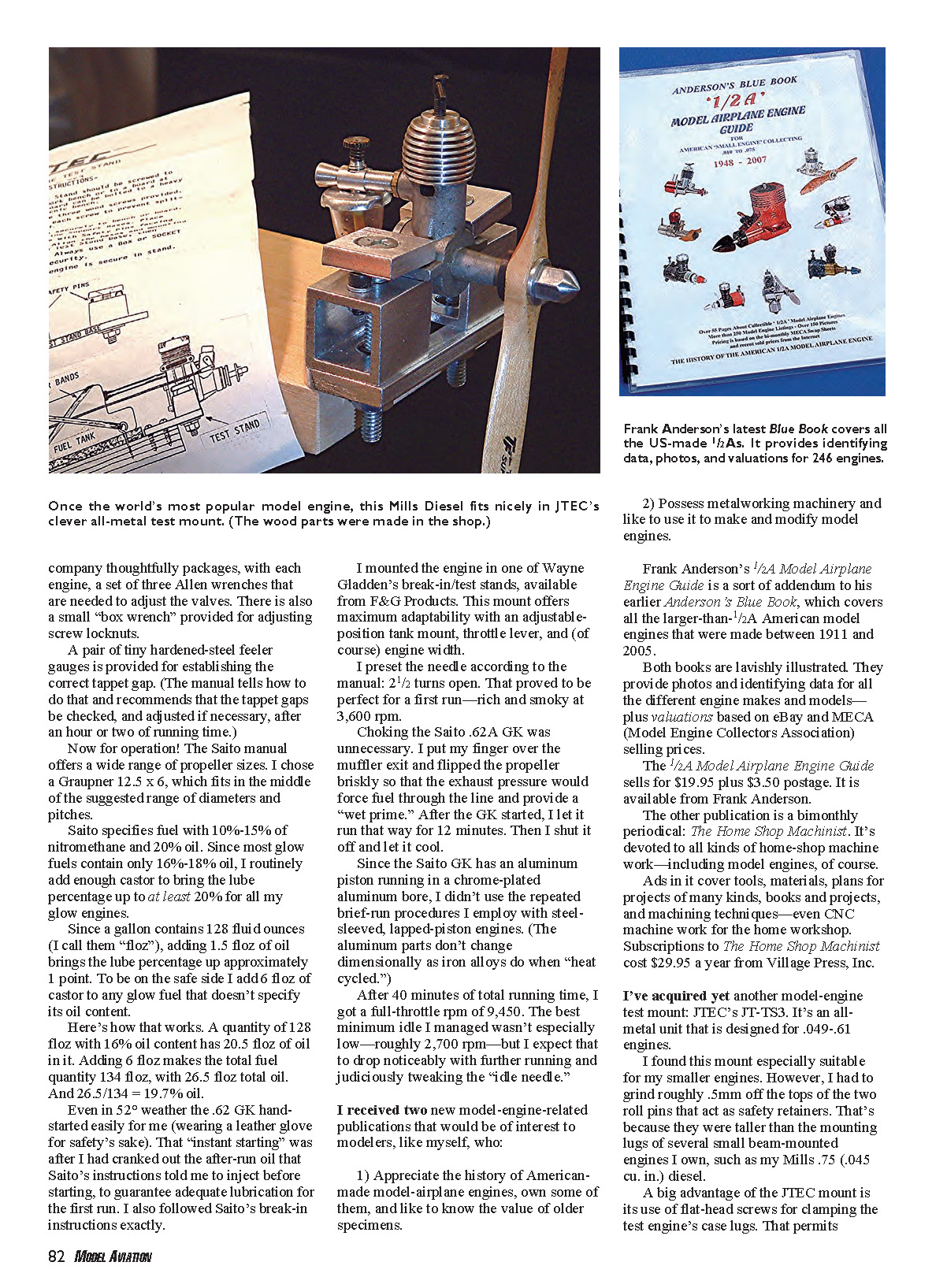
Frank Anderson’s 1/2A Model Airplane Engine Guide is a sort of addendum to his earlier Anderson’s Blue Book, which covers all the larger‑than‑1/2A American model engines made between 1911 and 2005. Both books are lavishly illustrated and provide photos and identifying data for different engine makes and models—plus valuations based on eBay and MECA (Model Engine Collectors Association) selling prices. The 1/2A Model Airplane Engine Guide sells for $19.95 plus $3.50 postage and is available from Frank Anderson.
The other publication is a bimonthly periodical, The Home Shop Machinist. It’s devoted to all kinds of home‑shop machine work—including model engines. Ads cover tools, materials, plans for projects of many kinds, books, and machining techniques—even CNC machine work for the home workshop. Subscriptions cost $29.95 a year from Village Press, Inc.
Test mounts
I’ve acquired another model‑engine test mount: JTEC’s JT‑TS3. It’s an all‑metal unit designed for .049–.61 engines. I found this mount especially suitable for my smaller engines. However, I had to grind roughly 0.5 mm off the tops of the two roll pins that act as safety retainers because they were taller than the mounting lugs of several small beam‑mounted engines I own, such as my Mills .75 (.045 cu. in.) diesel.
A big advantage of the JTEC mount is its use of flat‑head screws for clamping the test engine’s case lugs. That permits the screws to sit flush, avoiding interference with the engine’s mounting lugs and providing a secure clamp.
Transcribed from original scans by AI. Minor OCR errors may remain.

