
The Engine Shop
Joe Wagner | [email protected]
Model engine fuels and lubricants
Fuels for spark-ignition ("gas") engines
A subject that comes up regularly in mail from readers is fuels for various types of model engines. I wrote about model diesel fuel in my previous column; this time my topic is fuels for glow and "gas" engines.
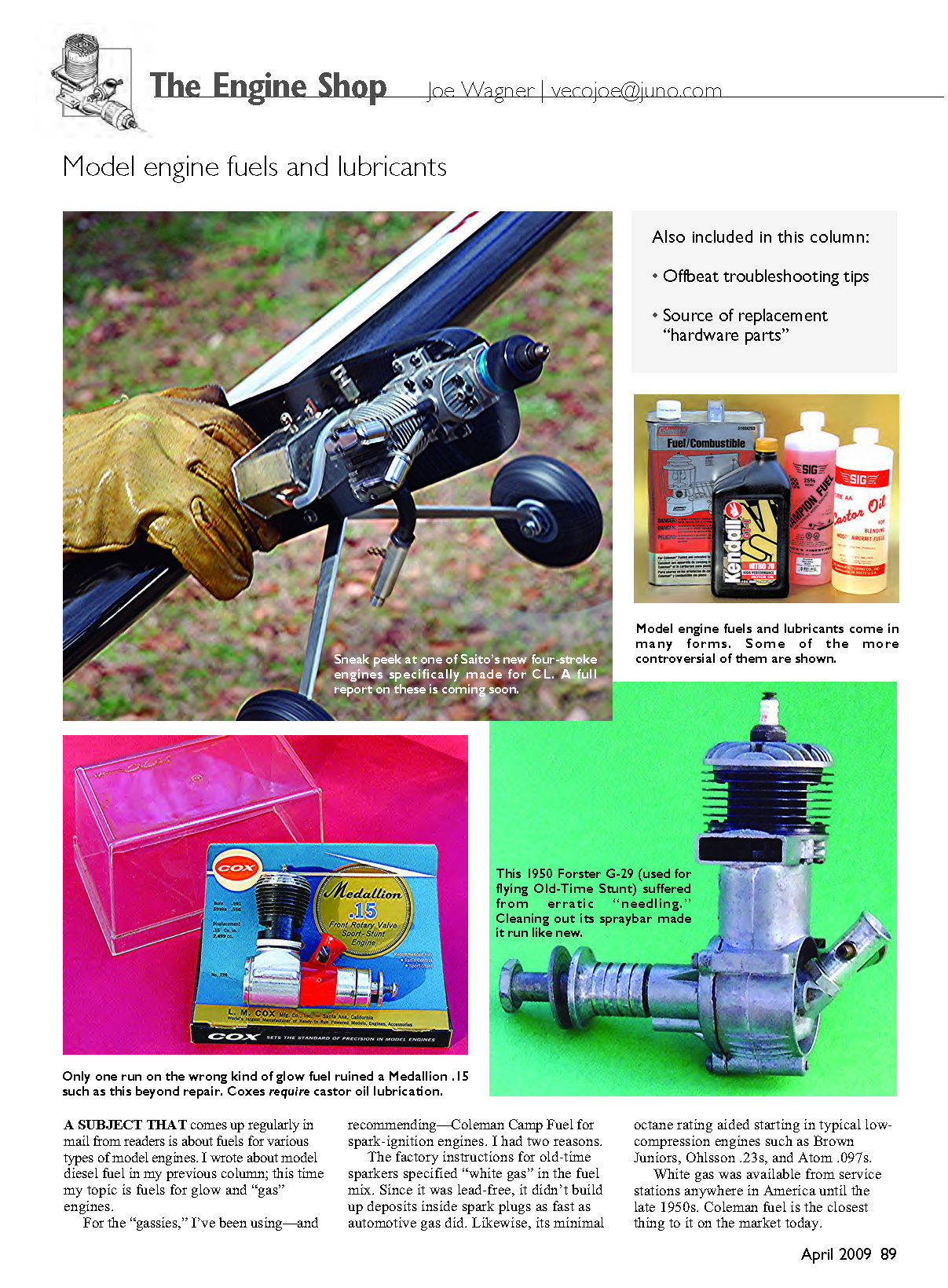
For the "gassies," I've been using—and recommending—Coleman Camp Fuel for spark-ignition engines, and I had two reasons. The factory instructions for old-time sparkers specified "white gas" in the fuel mix. Since it was lead-free, it didn't build up deposits inside spark plugs as fast as automotive gas did. Likewise, its minimal octane rating aided starting in typical low-compression engines such as Brown Juniors, Ohlsson .23s, and Atom .097s.
White gas was available from service stations anywhere in America until the late 1950s. Coleman fuel is the closest thing to it on the market today.
Most of today's automotive gasoline contains alcohol, which damages the plastic fuel tanks with which so many prewar spark-ignition engines came equipped. It also has a detrimental effect on the plastic gaskets in older-model Walbro carburetors. I mentioned that in my recent columns about the Cermark SPE 26cc and MLD 28cc gas engines. However, since then I've learned that recent-model Walbro model-engine carburetors use improved gasket materials; automotive gas blends don't harm them.
One point about Coleman fuel that has been brought up to me several times is that it supposedly makes model engines "run hot." It does that, and for two reasons. First, gasoline contains roughly double the heat energy of methanol, the major ingredient in glow fuel. Many modelers have become so used to the heat characteristics of glow engines that they're surprised by the higher temperature a gas-fueled engine normally develops. Second, gas engines run hot when modelers lean them out excessively. They attempt to boost rpm to something comparable to what a glow engine develops. With any type of internal-combustion engine, the leaner the mixture, the hotter it runs.
Heat, oil content, and oil functions
Another factor that affects model engine heat output is oil content: its type and its amount. Too many modelers assume that the purpose of oil in their model engine fuel is merely to make the moving parts slippery and free-moving. That's just one purpose. Others are equally important:
- Producing a load-bearing, rust-resisting film on working parts (for example, absorbing high pressures at both ends of connecting rods that transfer piston power to the shaft).
- Cooling: a substantial amount of excess combustion-chamber heat is carried out in the exhaust by the ejected oil. Many modelers consider exhaust oil to be "wasted" and believe that because the engine spits out oil copiously there must be too much of it in the fuel. Usually there isn't—the exhaust oil has already done its work inside the engine and is now fulfilling its heat-removal function.
- Detonation inhibition: oil acts as an antidetonant—akin to water injection in WWII fighter engines. Detonation produces much unwanted heat; adequate oil content helps prevent that.
Oil types
Three basic kinds of oil are used in model engines: mineral, castor, and synthetic. Each has good and bad characteristics.
- Mineral oil: Inexpensive and provides good rust prevention. However, its viscosity drops as temperature rises, so the hotter it gets the less effective it becomes as a lubricant. Mineral oil will burn if it gets too hot, producing carbon deposits in the combustion chamber.
- Castor oil: Has the highest film strength of any model-engine lubricant. Its viscosity increases as temperature rises, making it especially good in high-performance engines. Castor is also an effective antidetonant. Downsides are that its residue is messy and hard to remove from the engine exterior and the airplane; with time and heat exposure, castor oxidizes into a thick, enamel-like coating that can glue a piston in its cylinder or make a crankshaft impossible to rotate in its bearing.
- Synthetic oil: Minimizes friction, won't burn or oxidize, and is easy to clean off. But it provides little rust protection and its film strength is far lower than castor's. For that reason many glow fuels contain a blend of castor and synthetic oil that works well in most modern model engines.
Specific recommendations and experiences
For SAM fliers and others who still use old-time spark-ignition engines and gas-and-oil fuel, "70-weight" mineral oil is the lowest viscosity that minimizes wear in engines such as Ohlssons and Super Cyclones. It's hard to find now. However, many auto-parts dealers carry Kendall Nitro 70 oil. I've used that, and it works well for me—especially in a 2-1/2-to-1 mixture of Coleman's fuel and Nitro 70.
That brings up a controversial point: the percentage of oil in fuel. It might seem that the lower the oil content, the more power the engine should develop, since oil doesn't burn. By lowering its percentage, more fuel seems available in each fresh charge, thus producing increased power—right? Wrong. What determines the power output of any internal-combustion engine isn't the amount of fuel in its combustion chamber but the amount of oxygen. You can put more fuel into the chamber by opening the needle valve wider; that doesn't increase power output—quite the contrary.
I've found that adding castor oil—the drugstore kind works fine—to the commercial glow fuel I buy usually adds power. That's probably because of a combination of lowering friction, increasing compression, and preventing detonation. Plus, extra castor content is good insurance against damage from a lean run.
A personal lesson: while flying CL one day I thought I had brought a full can of my high-oil-content fuel but picked up the wrong can that held only a couple of tankfuls. Two flights weren't enough. When another flier offered me some of his fuel, I accepted without thinking. In less than a minute of my third flight, the Cox .15 in my Chickadee Precision Aerobatics (Stunt) model quit. Its piston seized in its cylinder, the rod bent, and the case was damaged—all for the lack of a mere 5% or so of castor oil in the fuel.
Yes, castor oil has its detriments. I encountered an odd one when helping an Old-Time Stunt flier solve a mysterious problem in his Forster G-29: its needle valve refused to function consistently and acted as if the needle point were bent. The trouble turned out to be a buildup of congealed castor oil inside the spraybar. Cleaning that out solved the problem.
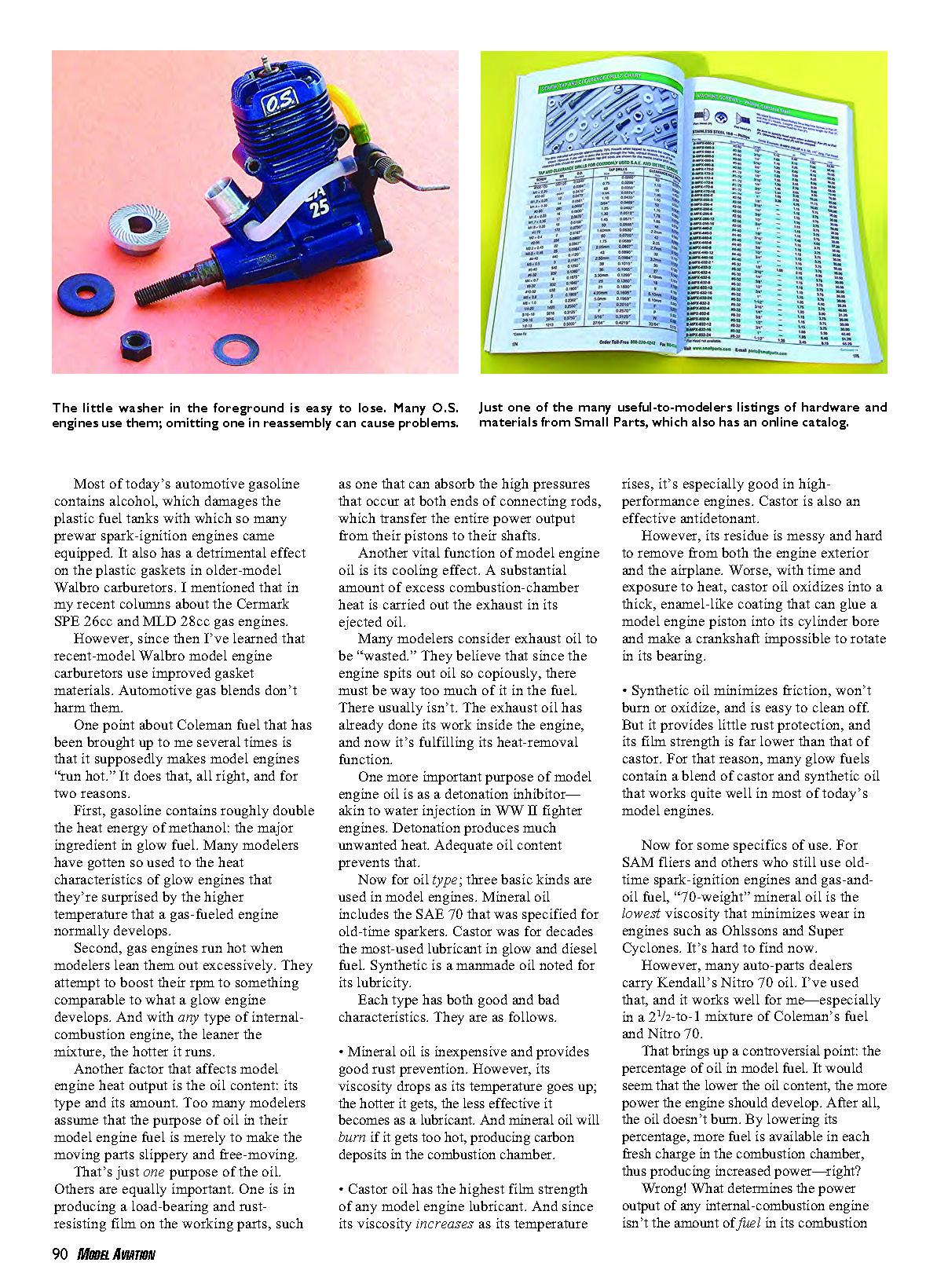
On the subject of odd problems, three times in the last couple of months readers have e-mailed me about the same trouble: formerly sweet-running O.S. engines whose behavior suddenly changed. They made "funny noises" when starting, burned out glow plugs, and simply didn't "run right" anymore. All of these problems stemmed from the same cause: a missing washer.
O.S. engines—and others—include a thin, hardened-steel washer that fits between the crankcase front and the back of the propeller driver. This absorbs the rearward thrust that an electric starter produces. A missing washer allows the shaft to move backward—often enough for the crankpin to scrape the inside of the backplate.
What I think happened in my readers' cases was that, when changing a broken propeller or trying a different one, the propeller driver was removed. If the washer adhered to the driver, it could easily have dropped off into the grass unnoticed.
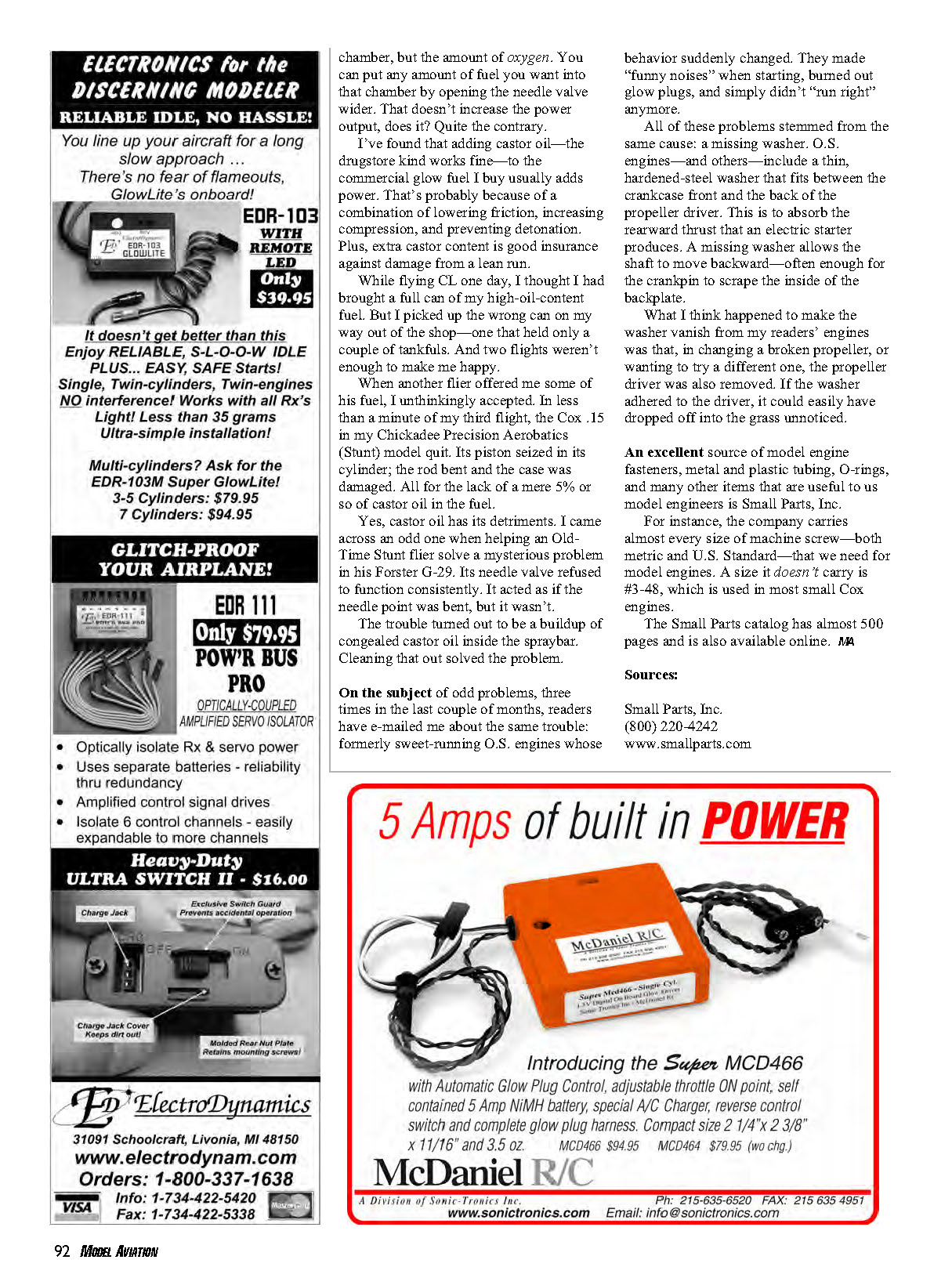
An excellent source of model-engine fasteners, metal and plastic tubing, O-rings, and many other items useful to model engineers is Small Parts, Inc. For instance, the company carries almost every size of machine screw—both metric and U.S. Standard—that we need for model engines. A size it doesn't carry is #3-48, which is used in most small Cox engines. The Small Parts catalog has almost 500 pages and is also available online.
Sources
- Small Parts, Inc.
- (800) 220-4242
- www.smallparts.com
MA
Transcribed from original scans by AI. Minor OCR errors may remain.

