
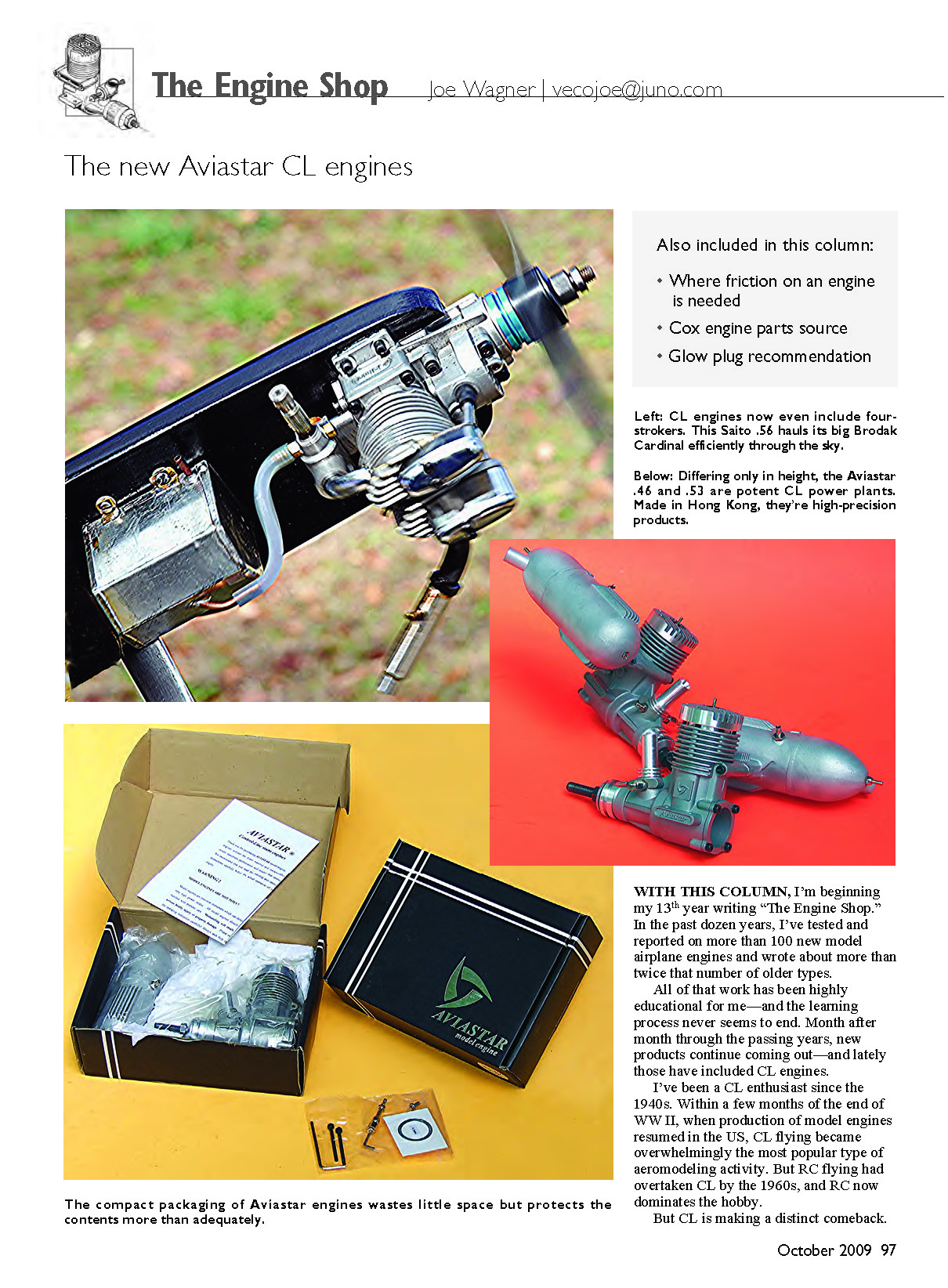

The new Aviastar CL engines
Joe Wagner | [email protected]
Introduction
With this column, I'm beginning my 13th year writing "The Engine Shop." In the past dozen years I’ve tested and reported on more than 100 new model airplane engines and written about more than twice that number of older types. All of that work has been highly educational for me—and the learning process never seems to end. Month after month, new products continue to arrive; lately those have included CL engines.
I’ve been a CL enthusiast since the 1940s. Within a few months of the end of WWII, when production of model engines resumed in the U.S., CL flying became overwhelmingly the most popular form of aeromodeling. RC flying had overtaken CL by the 1960s, and RC now dominates the hobby. But CL is making a distinct comeback. There is good evidence of that in the number of new, designed‑strictly‑for‑CL engines appearing on the market.
Recent CL engines
Other new offerings
See my article about Saito’s big four‑strokers in the August 2009 MA and Tom Dixon’s (Marietta, Georgia) Double Star line of two‑stroke power plants that I reviewed in a recent column.
Aviastar introduction
John Brodak—America’s foremost promoter and manufacturer in CL—now markets a new series of CL engines: the double‑ball‑bearing Aviastars. These are ABC types, with aluminum pistons running in brass sleeves that have chrome‑plated bores. Three sizes are available so far: a .46, a .53, and a .61.
As is common with ABC engines, the Aviastars have a noticeable "pinch" at the top of the stroke. That’s caused by a slightly tapered bore; it’s smaller at the top to allow for heat expansion when the engine is running. Because of that, I wasn’t able to hand‑start any of the three Aviastars right out of their boxes—the top pinch was a trifle too draggy for hand starting.
Break‑in and starting
Electric starting worked fine. I followed the Aviastar break‑in instructions exactly, and after the recommended one hour of accumulated running time per engine I could easily hand‑start all three.
For break‑in I used the larger‑diameter propellers that the instruction sheets listed for each engine:
- .46: 12 x 4
- .53: 12 x 6 (a longer‑stroke, higher‑torque version of the .46)
- .61: 13 x 4
My Aviastars came packaged without glow plugs. Tom Dixon advised me to try Sig’s idle‑bar‑type plugs (item SIGGP003) in these engines. He supplies those with all of his Double Stars, so that’s what I did. The Sig plugs worked fine in all three Aviastars, even at rich needle settings.
Why use an RC‑type plug in a CL engine
The reason for using an RC‑type plug in a CL engine is that its heat‑retaining capability provides dependable running during the “four‑cycle/two‑cycle break” style of operation many CL precision aerobatics (Stunt) pilots prefer. The engine runs rich throughout most of the flight, only breaking into a two‑cycle mode when the model makes a rapid change of direction. The sudden burst of high rpm produces a slipstream that hits the deflected elevators and produces sharper, more precise cornering.
Engine features and performance
Intake stacks and tuned intake
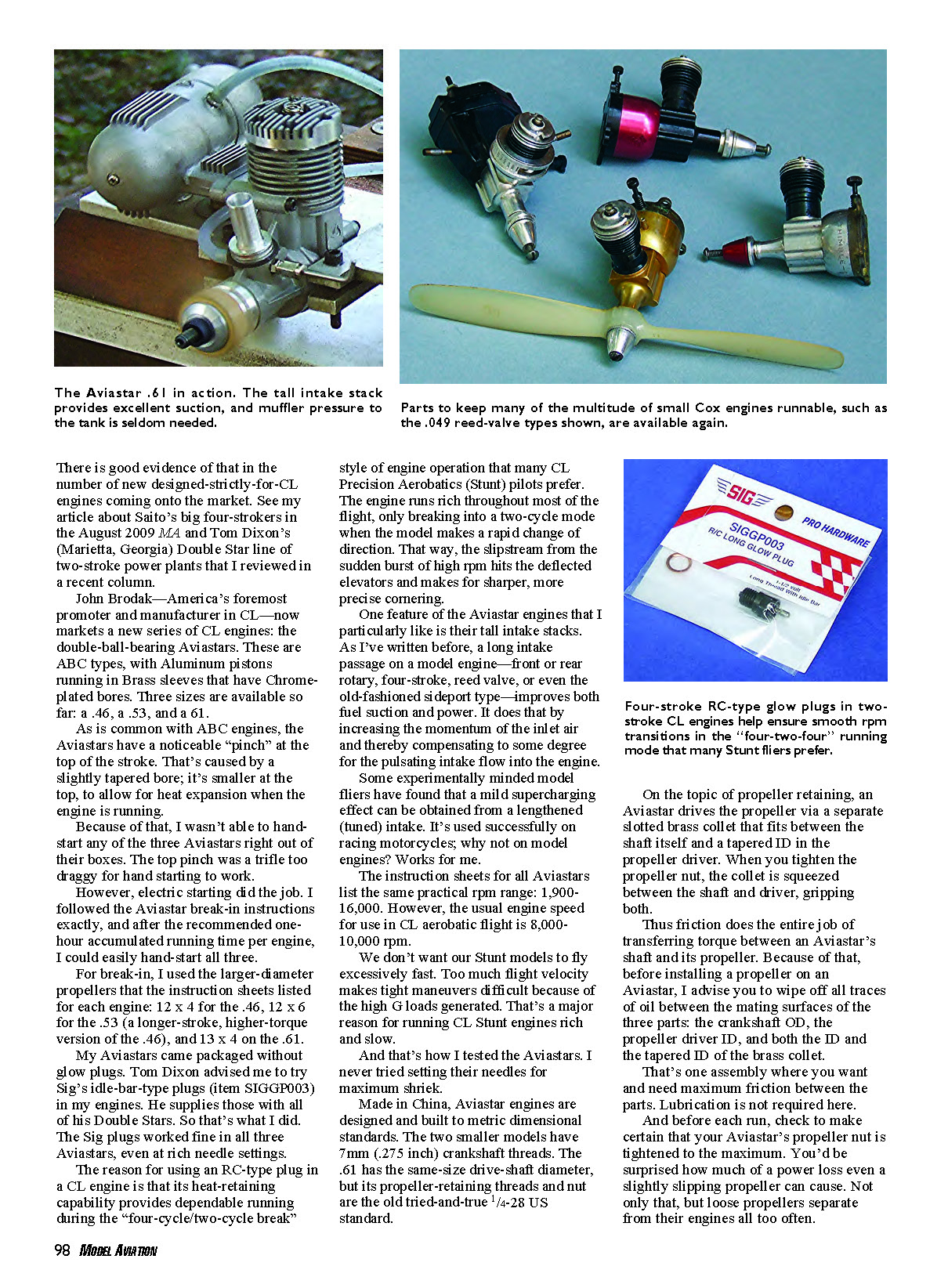
One feature I particularly like is the Aviastar’s tall intake stacks. A long intake passage on a model engine—front or rear rotary, four‑stroke, reed valve, or sideport—improves both fuel suction and power by increasing the momentum of the inlet air and thereby compensating for the pulsating intake flow.
Some experimental modellers have found a mild supercharging effect from a lengthened (tuned) intake. It’s used successfully on racing motorcycles; why not on model engines? It works for me.
Recommended operating speeds
The instruction sheets for all Aviastars list the same practical rpm range: 1,900–16,000. However, the usual engine speed for CL aerobatic flight is 8,000–10,000 rpm. We don’t want our Stunt models to fly excessively fast: too much flight velocity makes tight maneuvers difficult because of the high G loads generated. That’s a major reason for running CL Stunt engines rich and slow. I tested the Aviastars this way and never tried setting their needles for maximum rpm.
Made to metric standards
Made in China, Aviastar engines are designed and built to metric dimensional standards. The two smaller models have 7 mm (0.275 inch) crankshaft threads. The .61 has the same drive‑shaft diameter, but its propeller‑retaining threads and nut are the old 1/4‑28 U.S. standard.
Propeller retention and assembly
An Aviastar drives the propeller via a separate slotted brass collet that fits between the shaft and a tapered ID in the propeller driver. When you tighten the propeller nut, the collet is squeezed between the shaft and driver, gripping both. Thus friction transfers torque between the shaft and propeller.
Because of that, before installing a propeller on an Aviastar, wipe off all traces of oil between the mating surfaces of the three parts: the crankshaft OD, the propeller driver ID, and both the ID and the tapered end of the brass collet. This is one assembly where you want and need maximum friction—lubrication is not required.
Before each run, check that the Aviastar propeller nut is tightened to the maximum. You’d be surprised how much power loss even a slightly slipping propeller can cause; loose propellers also separate from their engines all too often.
Mufflers
Aviastars have large mufflers—almost as big as the engines to which they attach—yet they are not heavy because they are thin‑walled, expansion‑chamber types. They contain no internal baffles.
The small locknut on the back end of the screw that holds an Aviastar muffler together is not a retaining nut. The long fore‑and‑aft screw through the muffler threads into the rear half of the assembly; the small nut merely acts as a jam nut. I mention this because the mufflers on two of the Aviastars I tested weren’t quite firmly screwed together when I received them. I was briefly baffled when I tried to tighten them; torquing the small outer nut had no effect. I had to loosen that nut, tighten the screw from the front, and retighten the small jam nut.
Also, Aviastar mufflers come with pressure fittings installed. For flying with uniflow‑type tanks, this fitting isn't needed. The engine package contains a machine screw to replace the pressure fitting, thus sealing its opening.
Cox parts and Cox International
Since the first model airplane engines were offered for sale in America in 1911, there have been more than 270 different American model engine manufacturers. Of them all, the company with by far the highest number of engines sold was Cox.
I can't determine the exact total number of Cox model engines manufactured before the Cox Company was sold to Estes Industries in 1996 (from the 1952 Space Bug .049 to the 1996 Venom .049), but it exceeds 12 million. Many of those engines still exist today and can perform as well as ever, but they occasionally require replacement parts. Those parts have been difficult to find until recently.
A new source for Cox parts has emerged: Cox International. Visit them for full information about what they have in stock. (See the "Sources" list for contact information.) The prices seem reasonable. Not every part for every engine is available, but as the proprietors (Bernie and Xena) state:
- "We are in the process of setting up manufacturing to continue production of some more popular parts and accessories—all with original Cox tooling—and partly with former Cox OEM [original equipment manufacturer] suppliers."
That's good news for the many who fly 1/2A‑powered models.
Sources
- Saito Engines
(800) 338‑4639 www.saitoengines.com
- Tom Dixon
Box 671166 Marietta, GA 30066 http://tomdixon.tripod.com/engines.htm
- Brodak Manufacturing
(724) 966‑2726 www.brodak.com
- Sig Manufacturing
(800) 247‑5008 www.sigmfg.com
- Cox Engines
(250) 398‑2600 www.coxengines.ca
Transcribed from original scans by AI. Minor OCR errors may remain.

