
The Engine Shop
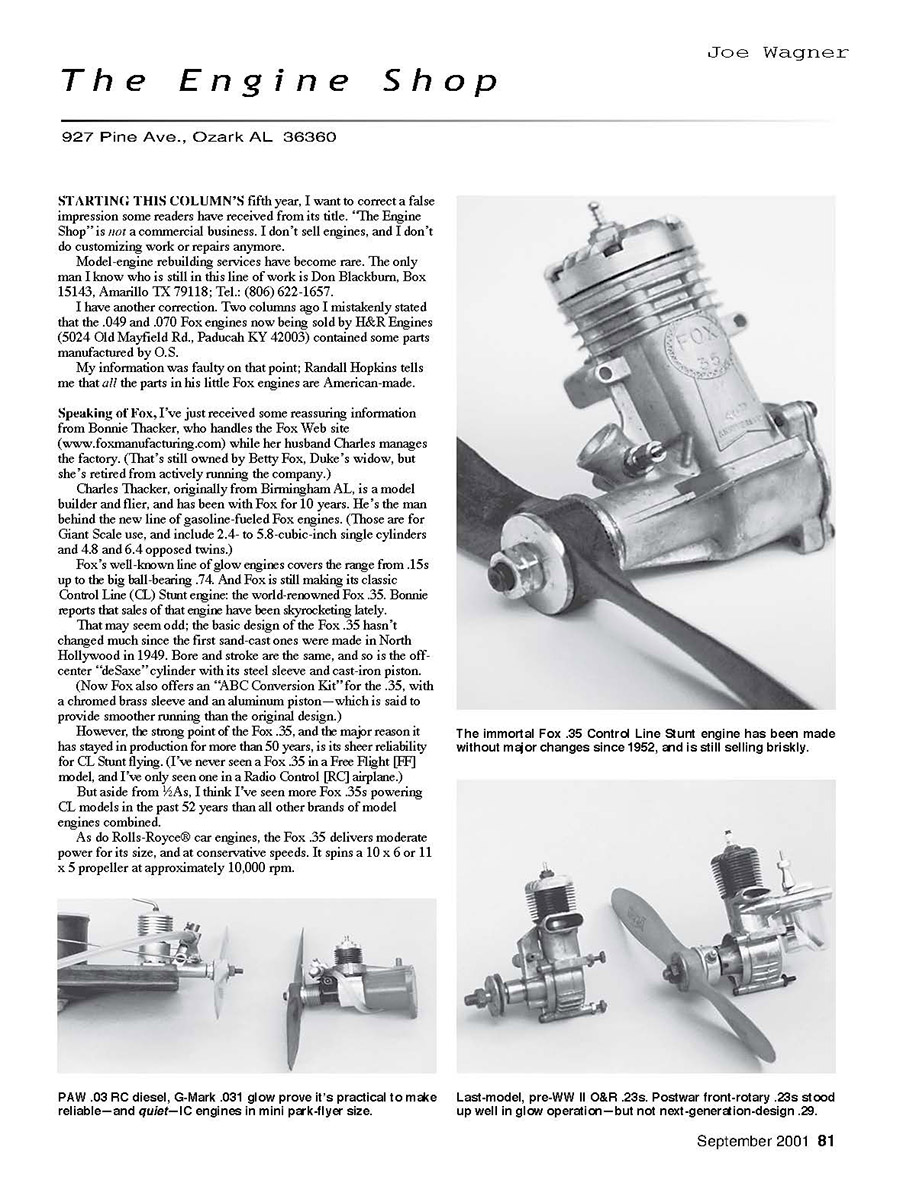
Many Stunt fliers run their Fox .35s even slower than that, deliberately operating with rich needle settings.
An 11 x 5 at 9,400 rpm will fly a Stunt model such as a Nobler or a Veco Chief at roughly 45 mph — which gives a comfortable lap time (on 70-foot lines) of approximately six seconds, yet develops adequate thrust to keep the lines tight in Wingovers and Vertical 8s. (Editor's note: Many would question those figures.)
Competition FF and CL Racing events demand screeching rpm, but there's no need for that in other types of powered model flying.
Of course, there's always been "popular demand" for more power — in automobiles, aircraft, outboard motors, garden tractors, lawn-mowers, etc., even when the added power serves no truly useful purpose.
That "demand" doomed the VW® Beetle; its four-cylinder air-cooled rear engine lost its legendary reliability from repeated boosts to its horsepower output.
The same thing happened 20 years earlier, and destroyed what used to be the biggest model-airplane engine company in the world: Ohlsson & Rice.
The prewar "sideport" O&R engines established an unsurpassed reputation for reliability and "friendliness." After the war the same designs ran as well as ever — as they do today in Society of Antique Modelers (SAM) events.
But the relentless urge for "More power!" took over — especially after the glow plug came along in 1947.
Changing the O&R sideport engines to front rotary induction (for increased rpm), then bumping up the old faithful .23 design to a .29 (for increased power output) put too much stress on the engine.
Connecting rods bent; then when those were strengthened, the spot-welds between the cylinder and case became a new failure point. By 1950 the Ohlsson & Rice company was defunct.
The point I'm driving at is that in noncompetition model flying, you don't need "ultimate shriek" rpm to have fun with your airplane. This is amply proven by the immense popularity today of "slow flyer" and "park flyer" RC models.
True, electric motors power almost all of these. However, a few of the small internal-combustion (IC) engines are nearly as quiet.
[Text truncated]
Transcribed from original scans by AI. Minor OCR errors may remain.

