
The Engine Shop
Joe Wagner
927 Pine Ave., Ozark AL 36360
BY DEFINITION, the purpose of model-airplane engines is to provide power for flying miniature aircraft. Yet now these engines serve a wide variety of uses in addition to that.
No, I don't mean for powering a bicycle, a jeweler's lathe, a small electric generator, or a pump—although I've seen model engines used in all those applications.
Some people employ model engines as "trophy acquirers." This use is expensive, but its participants seem happy to pay the price. All competition-grade engines are "custom-made" by highly skilled experts who don't work cheap.
As long ago as the 1950s, fanatic Free Flight (FF) and Control Line (CL) Speed competitors in Southern California would rent a world-class engine for a single contest. The price? Approximately $300.
I don't believe that practice persists to today. However, I do know a couple of competitors in international FF events who have paid $2,000 and more for an engine.
And an odd thing about these fellows: they don't seem to mind much that these expensive power plants of theirs can only put out peak performance briefly before needing to be rebuilt.
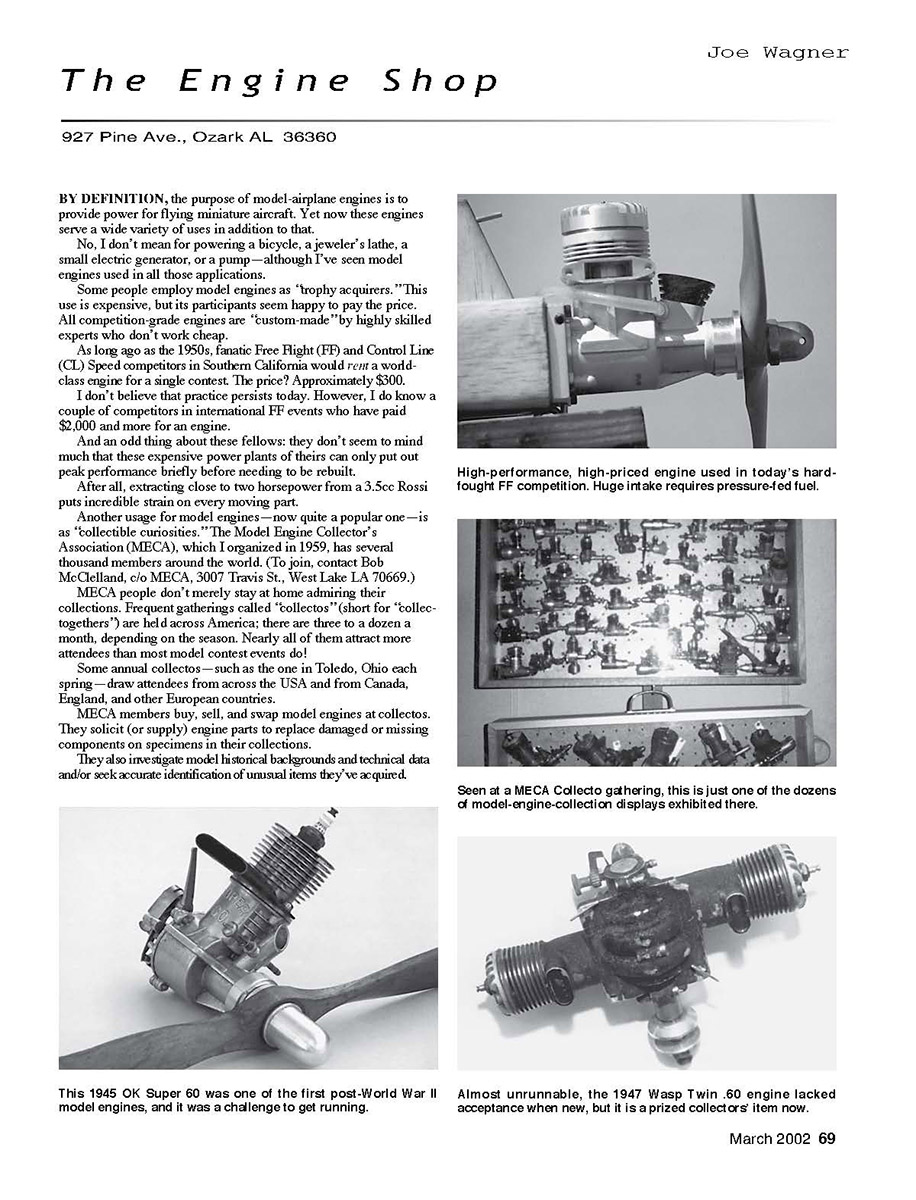
After all, extracting close to two horsepower from a 3.5cc Rossi puts incredible strain on every moving part.
Another usage for model engines—now quite a popular one—is as "collectible curiosities." The Model Engine Collector's Association (MECA), which I organized in 1959, has several thousand members around the world. (To join, contact Bob McClelland, c/o MECA, 3007 Travis St., West Lake LA 70669.)
MECA people don't merely stay at home admiring their collections. Frequent gatherings called "collectors" (short for "collector get-togethers") are held across America; there are three to a dozen a month, depending on the season. Nearly all of them attract more attendees than most model contest events do!
Some annual collectors — such as the one in Toledo, Ohio each spring — draw attendees from across the USA and from Canada, England, and other European countries.
MECA members buy, sell, and swap model engines at collectors. They solicit (or supply) engine parts to replace damaged or missing components on specimens in their collections.
They also investigate model historical backgrounds and technical data and/or seek accurate identification of unusual items they've acquired.
And model-engine collectors compete! But not in flying activities. They vie with each other to produce the most impressive displays.
One peculiar thing about model-engine collecting: the most prized specimens today are, more often than not, low-quality "clunkers." That's because they're rare.
A troublesome, fragile engine such as a Wasp Twin .60 or a Syncro Bee .14 was almost useless for flying a model airplane. It didn't take modelers long to learn that and to tell all their friends.
Few of these unsatisfying engines were sold before the manufacturer went out of business — or at least discontinued that particular product. That's why they're hard to find; and that's the fact that most model-engine "clunkers," originally bought by optimistic modelers in the hope of flying airplanes with them, got disgustedly tossed in the trash by their unhappy owners.
Now the few survivors are worth considerable money. Some "old clunker" model engines are sought for today for a different reason.
Several times, older modelers have told me, "I owned one of those engines when I was a boy. I paid hard-earned money for it, and never got it to run. What a huge disappointment that was! But I'll bet I could do better now. Any idea where I could find one?"
I've fallen victim to that urge myself. Twice in recent years I've bought an old-time engine for no other reason than to find out whether I could get it to work.
It rankled in my mind, even after half a century, that I'd never been able to start a GHQ or an OK Super 60 in the Good Old Days. (I can do that now!)
But some of yesteryear's model engines were kind of fun to mess with, despite their elementary design and limited power.
The Engine Shop
They're still fondly remembered by old-time modelers. That's led to their being reborn in the 21st century as runnable, desirable—and flyable—replicas.
Spark-ignition replicas available include K&B Torpedo in .24, .29, and .32 back-plate-inch displacement from Shilen Aeroparts (205 Metro Park Blvd., Ennis TX 75120, Tel.: (972) 875-1442).
Two more new old-time sparkers that Woody Bartlett (3706 N 93rd St., Clawson MI 48026; Tel: (616) 665-9693; E-mail: [email protected]) has recently revived are the 1940 Ranger "T" and the 1946 Super Atom .098.
The Atom design was — and is — unique. It had no needle valve; its fuel mixture was controlled by a rotatable throttle tube. The Atom's piston has two moving parts. The designer (Ray Arden, who later gave us the first model-engine glow plug) called this a "piston within a piston."
There's an inner section (to which the connecting rod is attached) and a separate outer section. The two units move together through most of the stroke.
But at the bottom of the "power stroke," after the exhaust ports open, the outer part of the piston stops while the inner portion continues downward.
That opens an annular gap at the top, between the two parts of the piston, and that gap provides the "bypass opening" for the fresh fuel-air charge to enter the cylinder. That sounds complicated — and it is — but it works.
And the little .098 Atom had perhaps the widest range of runnable propeller sizes of any non-diesel model engine. Atoms spun seven-inch props in CL models. And the late, great Ken Willard once powered one of the big Scale FF airplanes with an Atom that turned an 18-inch propeller.
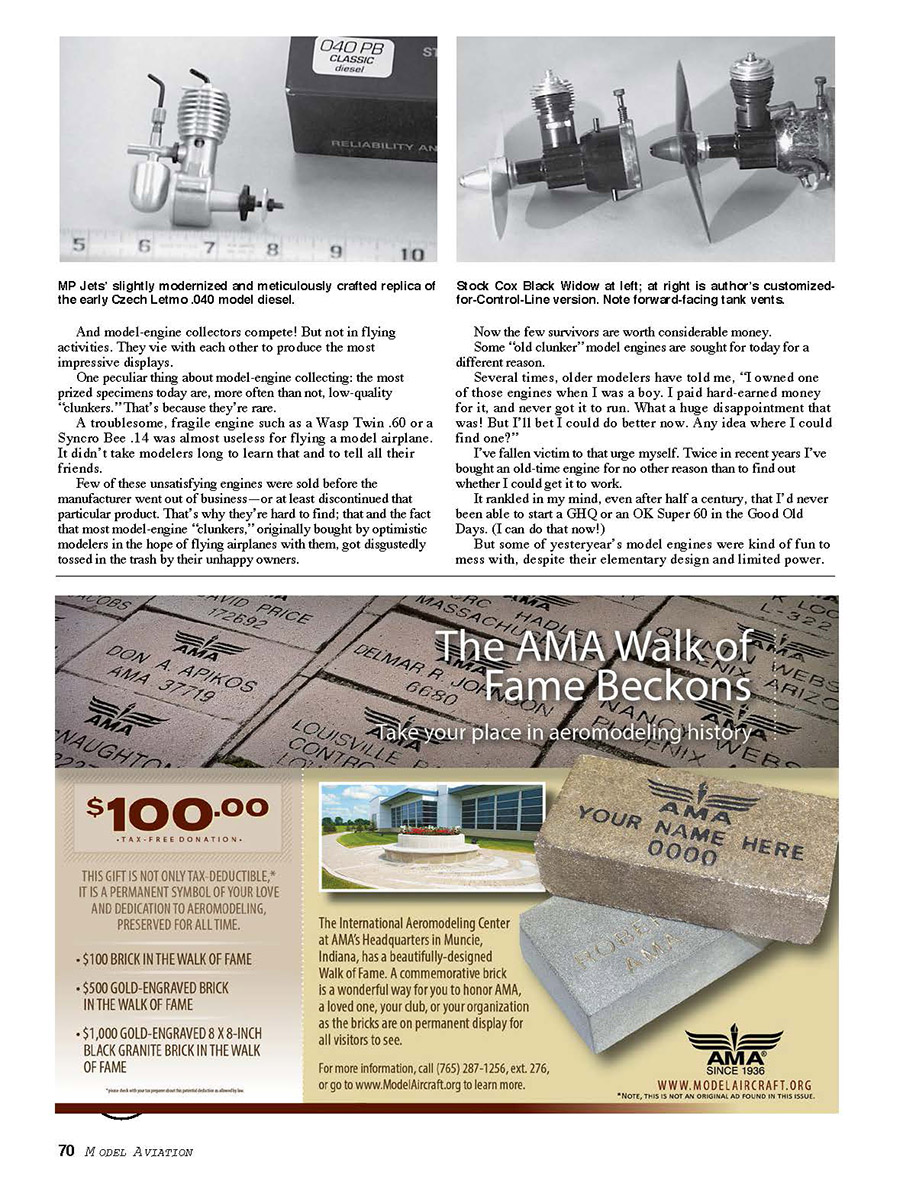
Replicas of model diesels are also popular. The Czech MP Jets company has produced two exquisitely made versions of the original Lemo .04 diesel. One is a replica; the other is a close copy of that, but features a more practical mounting method.
Ed Caron imports these and other model-diesel replicas, such as the Mills. (Contact Caron Engine Imports, 814 E. Bacon Ave., Phoenix AZ 85022 Tel.: (602) 266-1654.)
Another modifying usage of model engines — one that's been popular for many years — is running them on a test stand.
I don't mean for fun them or for finding the optimum carburetor adjustment; what I'm referring to is done simply for the fun of watching the propeller spin and hearing the sound of the exhaust. (And "to see if it'll run"!)
I don't understand why this rather pointless activity is enjoyable, but it is. I've done it and will doubtless do it again — probably soon.
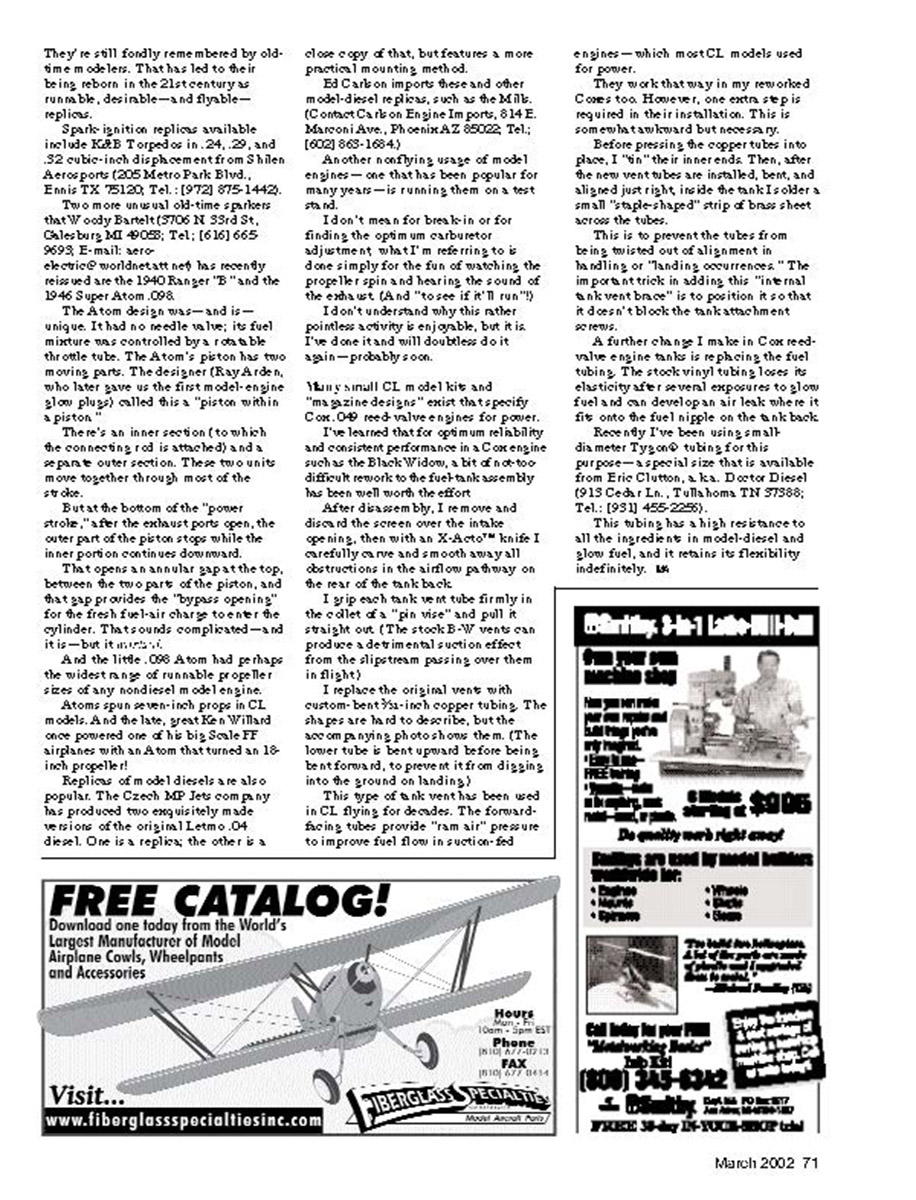
Tiny small CL model kits and "magazine design" engines that specify Cox .049 reed-valve engines for power. I've learned that for optimum reliability and consistent performance in a Cox engine such as the Black Widow, a bit of one-time difficult rework to the fuel-tank assembly has been well worth the effort.
After disassembly, I remove and discard the screen over the intake opening, then with an X-Acto knife I carefully carve away all obstructions in the airflow pathway on the rear of the tank back.
I grip a small vent tube firmly in the collet of a "pin vise" and pull it straight out. The stock B-W vent can produce a detrimental suction effect from the slipstream passing over them in flight.
I replace the original vents with custom-bent 3/32-inch copper tubing. The shapes are hard to describe, but the accompanying photos show them. (The lower tube is bent upward before being reformed, to prevent it from digging into the ground on landing.)
This type of tank vent has been used in CL flying for decades. The forward-facing tubes provide "ram air" pressure to improve fuel flow in suction-fed engines — which most CL models used for power.
They work that way in my reworked Coxes too. However, one extra step is required in the installation. This is somewhat awkward but necessary.
Before pressing the copper tubes into place, I "tin" their inner ends. Then, after the new vent tubes are installed, bent, and aligned just right, inside the tank I solder a small "staple-shaped" strip of brass sheet across the tubes.
This is to prevent the tubes from being twisted out of alignment in handling or "landing occurrences." The important trick in adding this "internal tank vent brace" is to position it so that it doesn't block the tank attachment screws.
A further change I make in Cox reed-valve engine tanks is rephasing the fuel tubing. The stock vinyl tubing loses its elasticity after several exposures to glow fuel and can develop an air leak where it fits onto the fuel nipple on the tank back.
Recently I've been using small-diameter Tygon tubing for this purpose — a special size that is available from Eric Clutton, a.k.a. Doctor Diesel (913 Cedar Ln., Tullahoma TN 37388; Tel.: (931) 455-2256).
This tubing has a high resistance to all the ingredients in model-diesel and glow fuel, and it retains its flexibility indefinitely.
Transcribed from original scans by AI. Minor OCR errors may remain.

