
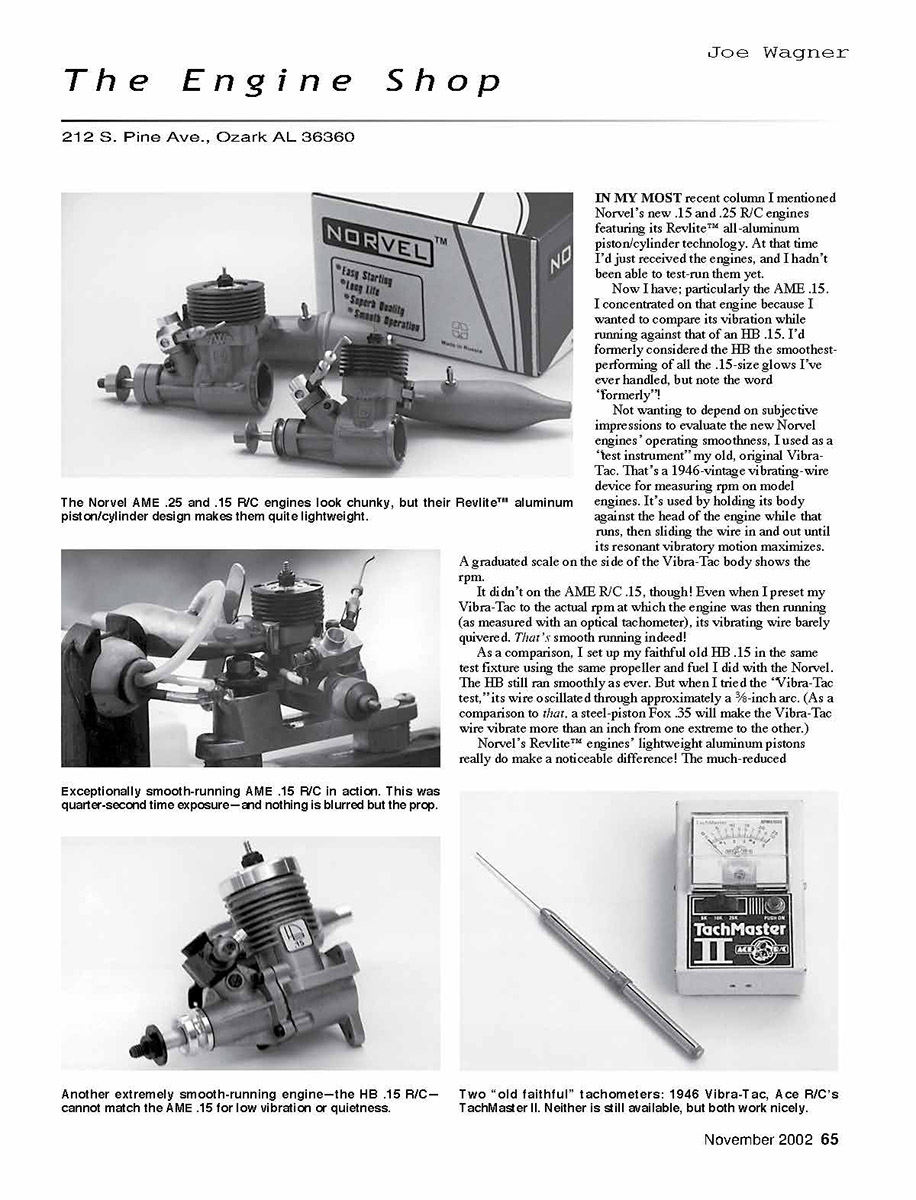
The Engine Shop
IN MY MOST recent column I mentioned Norvel's new .15 and .25 R/C engines featuring its RevLite™ all-aluminum piston/cylinder technology. At that time I'd just received the engines, and I hadn't been able to test-run them yet.
Now I have; particularly the AME .15. I concentrated on that engine because I wanted to compare its vibration while running against that of an HB .15. I'd formerly considered the HB the smoothest-performing of all the .15-size glows I've ever handled, but note the word "formerly"!
Not wanting to depend on subjective impressions to evaluate the new Norvel engines' operating smoothness, I used as a "test instrument" my old, original Vibra-Tac. That's a 1946-vintage vibrating-wire device for measuring rpm on model engines. It's used by holding its body against the head of the engine while that runs, then sliding the wire in and out until its resonant vibratory motion maximizes. A graduated scale on the side of the Vibra-Tac body shows the rpm.
It didn't on the AME R/C .15, though! Even when I preset my Vibra-Tac to the actual rpm at which the engine was then running (as measured with an optical tachometer), its vibrating wire barely quivered. That's smooth running indeed!
As a comparison, I set up my faithful old HB .15 in the same test fixture using the same propeller and fuel I did with the Norvel. The HB still ran smoothly as ever. But when I tried the "Vibra-Tac test," its wire oscillated through approximately a 3/8-inch arc. (As a comparison to that, a steel-piston Fox .35 will make the Vibra-Tac wire vibrate more than an inch from one extreme to the other.)
Norvel's RevLite™ engines' lightweight aluminum pistons really do make a noticeable difference! The much-reduced vibration output means less power is being wasted while bringing the piston mass to a stop and reversing its motion, as happens in all model engines twice in each revolution.
The lighter the piston, the more of the power produced in the engine's combustion chamber is available to rotate the propeller—and the less of that power gets wasted in shaking up the airplane.
I was also pleasantly surprised at how cool the AME .15 ran. Although it has no head fins, the total finned area of the Norvel Revlite™ cylinder is at least as large as that of any "conventional" glow engine.
Also, the waste combustion heat has no metal-to-metal boundaries to cross. That's because Revlite™ cylinders are one-piece solid-aluminum alloy. They conduct excess heat away so efficiently, I could hold a finger without discomfort on the top fin of the .15 while it ran at full throttle.
But I didn't find the AME R/C .15 entirely flaw-free. For one thing, it turned out to be tricky to install its muffler. It's held in place by a spring steel clip and is sealed by a silicone O-ring. I wrote "a" silicone O-ring even though two are supplied—and two are called for in the Norvel instructions. One O-ring is supposed to be inserted into a cavity in the muffler. I used that one.
The other O-ring supposedly goes over the engine's exhaust port. But when I tried attaching the muffler to the engine with both O-rings in place, I could not get it to go on. It's even a force fit to install the muffler with a single O-ring. I learned that first hooking the aft flange of the muffler in place worked best. Even so, I had to take special care not to let the spring clip move backward while I squeezed the front muffler flange into place.
Once the .15's muffler snaps into its clip, it seems quite firmly attached—and despite the single O-ring seal, I noticed no oil seepage at the muffler-to-case junction.
The AME R/C engines' mufflers turned out to be exceptionally quiet. I can't tell about that myself because of my deafness. However, I ran the AME .15 R/C for roughly an hour total, with my test bench standing on the rear "deck" of my home while my wife was inside, less than 25 feet away. She later told me that she'd never noticed the AME running. (She heard the HB .15 when I ran that, though.)
Another problem I had with the Norvel AME .15 and .25 R/Cs was too-small holes in their throttle arms. Those are approximately 1mm diameter (.040)—way undersize for a standard American Radio Control (R/C) clevis (5/64-inch diameter) to fit.
Drilling out the holes took a little finesse; the throttle arms are evidently spring hardened. They can be drilled, but I'd never try doing that with any kind of power drill. Instead I used a pin vise and a .067-diameter drill bit. That gave me trouble because .067 is just too big to fit in a pin vise's "4/6" collet and just too small to be gripped in the "5/32 inch" collet.
The solution was to wrap a thin strand of copper wire (mine came from a scrap length of stranded lamp cord) several tight turns around the shank of the drill bit. That lets the 5/32-inch collet clamp tightly onto the bit. A truly firm grip on the bit is needed because of the spring-temper hardness of the AME throttle arms. They're not easy to drill through, even with their 1mm "starting holes."
Once I mounted the AME .15 in my test stand, it started right up by hand. (As do Thunder Tigers, AMEs seem to prefer being quite "wet" when hand-starting.) But the AME .15 will probably need more break-in time than the hour of intermittent running it has on it so far. The Norvel instructions imply that one hour total running-in time should be adequate, but that hasn't been enough on mine; its idling reliability isn't yet quite what I want for my own R/C flying.
Considering the sapphirelike surface hardness of Norvel's Revlite™ hard-anodized cylinder bores, I didn't really expect a quick break-in. But after the running-in process is complete for my AME R/Cs, I do expect an exceptionally long service life from them.
I recently relearned a lesson that I first learned 50 years ago: it's unsafe to leave model-engine parts submerged in certain solvents for any length of time.
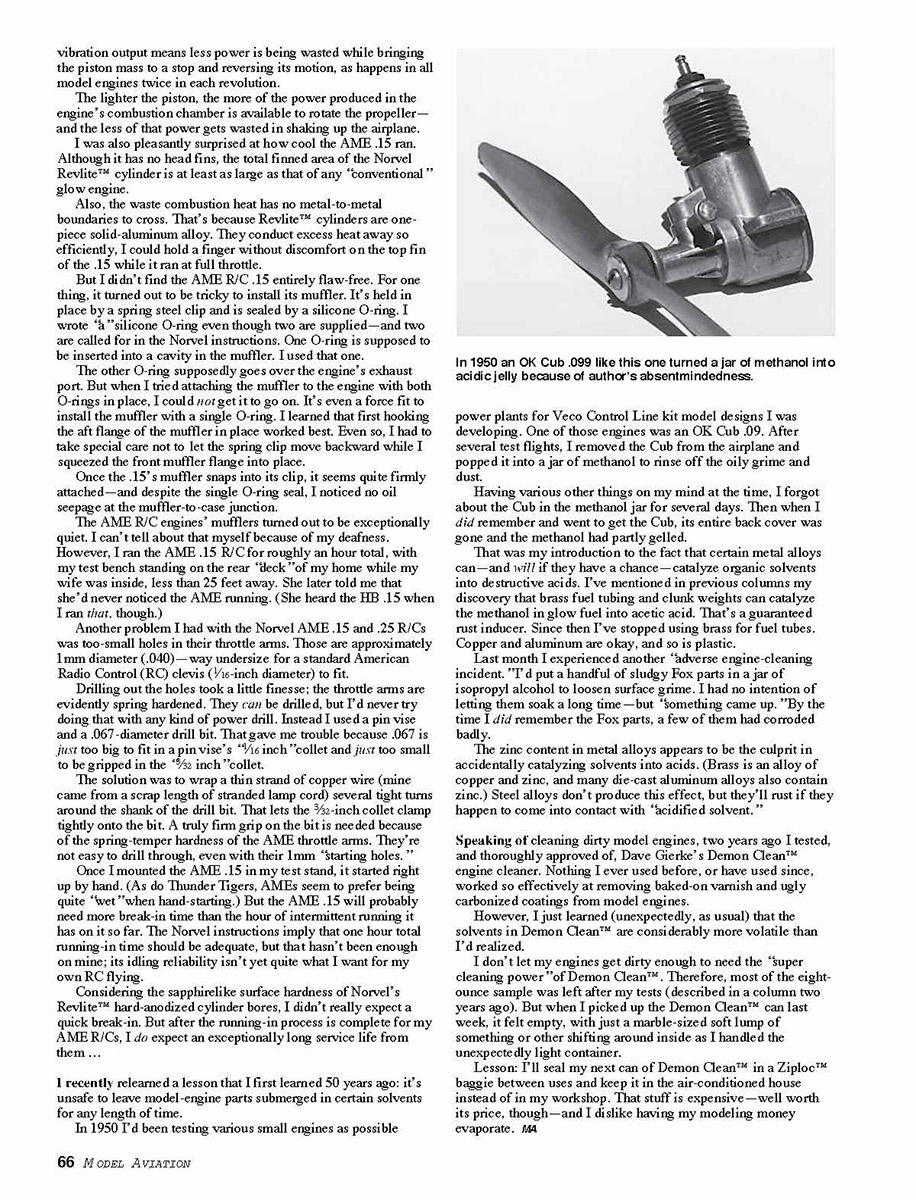
In 1950 I'd been testing various small engines as possible power plants for Veco Control Line kit model designs I was developing. One of those engines was an OK Cub .09. After several test flights, I removed the Cub from the airplane and popped it into a jar of methanol to rinse off the oily grime and dust.
Having various other things on my mind at the time, I forgot about the Cub in the methanol jar for several days. Then when I did remember and went to get the Cub, its entire back cover was gone and the methanol had partly gelled.
That was my introduction to the fact that certain metal alloys can—and will if they have a chance—catalyze organic solvents into the destructive acids. I've mentioned in previous columns my discovery that brass fuel tubing and clunk weights can catalyze the methanol in glow fuel into acetic acid. That's a guaranteed rust inducer. Since then I've stopped using brass for fuel tubes. Copper and aluminum are okay, and so is plastic.
Last month I experienced another "adverse cleaning incident." I'd put a handful of sludgy Fox parts in a jar of isopropyl alcohol to loosen surface grime. I had no intention of letting them soak a long time—but "something came up." By the time I did remember the Fox parts, a few of them had corroded badly.
The zinc content in metal alloys appears to be the culprit in accidentally catalyzing solvents into acids. (Brass is an alloy of copper and zinc, and many die-cast aluminum alloys also contain zinc.) Steel alloys don't produce this effect, but they'll rust if they happen to come into contact with "acidified" solvent.
Speaking of cleaning dirty model engines, two years ago I tested, and thoroughly approved of, Dave Gierke's Demon Clean™ engine cleaner. Nothing I ever used before, or have used since, worked so effectively at removing baked-on varnish and ugly carbonized coatings from model engines.
However, I just learned (unexpectedly, as usual) that the solvents in Demon Clean™ are considerably more volatile than I'd realized.
I don't let my engines get dirty enough to need the "super cleaning power" of Demon Clean™. Therefore, most of the eight-ounce sample I was left after my tests (described in a column two years ago). But when I picked up the Demon Clean™ can last week, it felt empty, with just a marble-sized soft lump of something or other shifting around inside as I handled the unexpectedly light container.
Lesson: I'll seal my next can of Demon Clean™ in a Ziploc™ baggie between uses and keep it in the air-conditioned house instead of in my workshop. That stuff is expensive—well worth its price, though—and I dislike having my modeling money evaporate. MA
Transcribed from original scans by AI. Minor OCR errors may remain.

