
The Engine Shop
Eric Henderson | <REDACTED>
Breaking down the beauty of a YS engine
THE MIGHTY YS engine mystery: Ask any RC hobbyist about the performance of the Yamada Manufacturing Company Ltd. (YS) four-cycle engine, and you will get different answers. You likely will hear about pumped fuel, pressurized tanks, rear-induction carburetor, air chamber, and supercharger.
The YS is an ingenious four-cycle engine. The company makes several varieties with different technical designs. The machines are built around a core crankcase/camshaft gear, with rear-induction design.
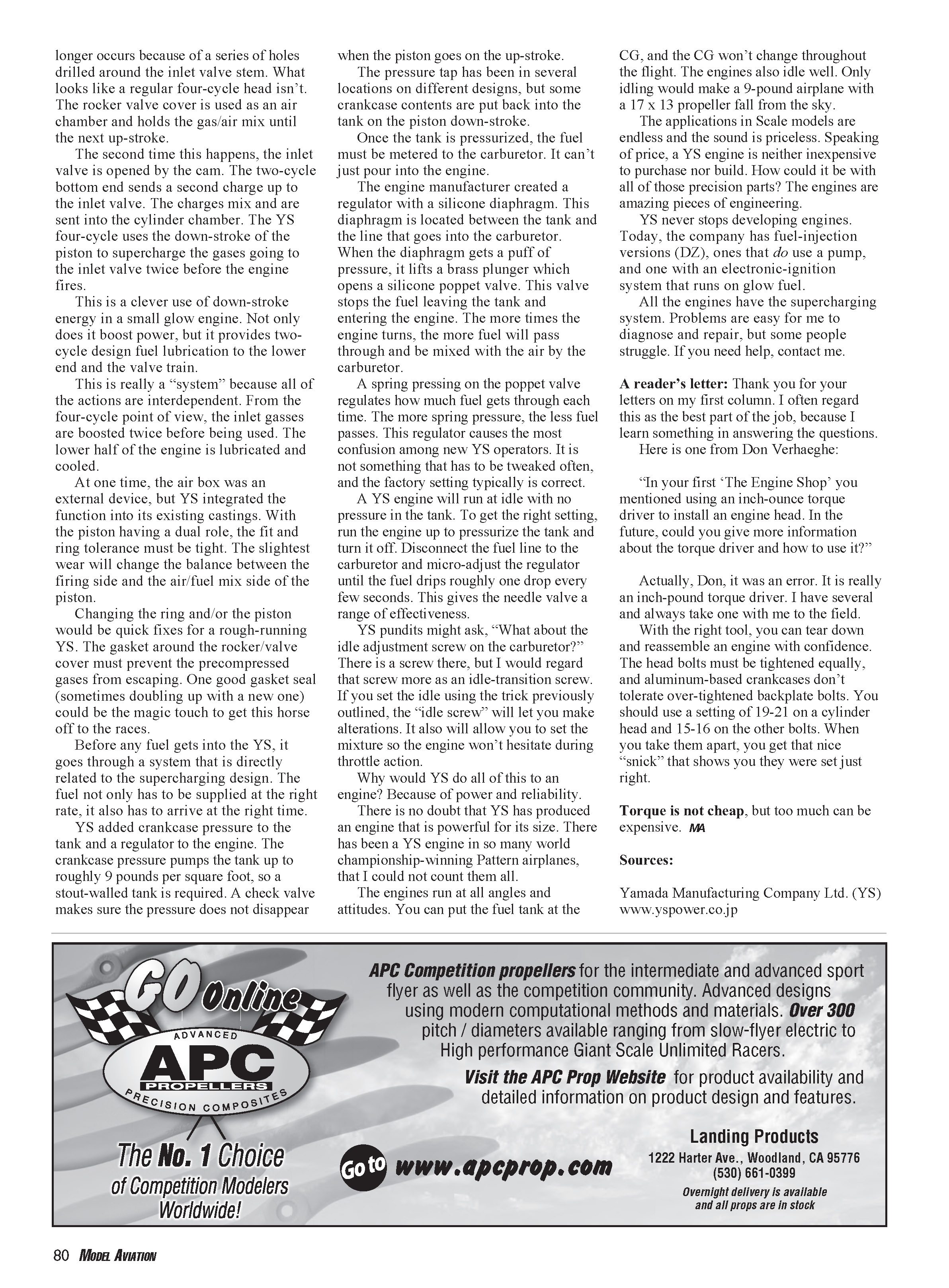
In this article, I will dissect the YS 140 Sport, which owes its heritage to the YS 140 FS. Yamada engines are famous for economy of design; the manufacturer has reused and refined many of the same parts in nearly all of its engines. Subtle changes have been made each time, such as moving the crank-pin to change a 120 engine to a 140.
I chose to review the YS 140 Sport because until now, the other designs were basically this type of configuration. The YS Sport is a hybrid engine. The bottom half can be described as a two-cycle and the top half as a four-cycle.
Like any conventional engine, it has a crankshaft. The camshaft is driven at half of the speed of the crankshaft to time the engine to fire every other time the piston reaches top dead center (TDC). It uses a helical gear to allow the one-piece camshaft to be placed at 90° relative to the shaft and in line with the valve lifters.
The cylinder head looks ordinary with two valves, pushrods, lifters, rocker arms, and an inlet and exhaust port. Beyond these basics, there are many differences.
The carburetor is on the back of the engine. The air/fuel mix does not go directly to the cylinder head. The carburetor has two sides: one side diverts the mix into the lower half of the engine and the other half takes the mix from the crankcase to the inlet manifold.
There is a one-piece carburetor rotating valve that operates both openings at once. The mix is drawn in by the piston going on its first up-stroke—not unlike the action of a two-cycle engine. The lower crankcase is now full of a fuel-mist/air mix.
As the piston comes down, the mix is forced out of the crankcase but leaves through the other side of the carburetor. A rotary valve or disk driven by the crankshaft creates this action. This disk has openings that time when the gasses are allowed in and out. It is timed to match the up- and down-strokes of the piston. The mix heads toward the inlet valve, but the valve is closed because the engine is about to fire.
In early YS four-cycle engines, the gasses got squashed. This no longer occurs because of a series of holes drilled around the inlet valve stem. What looks like a regular four-cycle head isn't. The rocker valve cover is used as an air chamber and holds the gas/air mix until the next up-stroke.
The second time this happens, the inlet valve is opened by the cam. The two-cycle bottom end sends a second charge up to the inlet valve. The charges mix and are sent into the cylinder chamber. The YS four-cycle uses the down-stroke of the piston to supercharge the gases going to the inlet valve twice before the engine fires.
This is a clever use of down-stroke energy in a small glow engine. Not only does it boost power, but it provides two-cycle design fuel lubrication to the lower end and the valve train.
This is really a "system" because all of the actions are interdependent. From the four-cycle point of view, the inlet gasses are boosted twice before being used. The lower half of the engine is lubricated and cooled.
At one time, the air box was an external device, but YS integrated the function into its existing castings. With the piston having a dual role, the fit and ring tolerance must be tight. The slightest wear will change the balance between the firing side and the air/fuel mix side of the piston.
Changing the ring and/or the piston would be quick fixes for a rough-running YS. The gasket around the rocker/valve cover must prevent the precompressed gases from escaping. One good gasket seal (sometimes doubling up with a new one) could be the magic touch to get this horse off to the races.
Before any fuel gets into the YS, it goes through a system that is directly related to the supercharging design. The fuel not only has to be supplied at the right rate, it also has to arrive at the right time.
YS added crankcase pressure to the tank and a regulator to the engine. The crankcase pressure pumps the tank up to roughly 9 pounds per square foot, so a stout-walled tank is required. A check valve makes sure the pressure does not disappear when the piston goes on the up-stroke.
The pressure tap has been in several locations on different designs, but some crankcase contents are put back into the tank on the piston down-stroke.
Once the tank is pressurized, the fuel must be metered to the carburetor. It can't just pour into the engine.
The engine manufacturer created a regulator with a silicone diaphragm. This diaphragm is located between the tank and the line that goes into the carburetor. When the diaphragm gets a puff of pressure, it lifts a brass plunger which opens a silicone poppet valve. This valve stops the fuel leaving the tank and entering the engine. The more times the engine turns, the more fuel will pass through and be mixed with the air by the carburetor.
A spring pressing on the poppet valve regulates how much fuel gets through each time. The more spring pressure, the less fuel passes. This regulator causes the most confusion among new YS operators. It is not something that has to be tweaked often, and the factory setting typically is correct.
A YS engine will run at idle with no pressure in the tank. To get the right setting, run the engine up to pressurize the tank and turn it off. Disconnect the fuel line to the carburetor and micro-adjust the regulator until the fuel drips roughly one drop every few seconds. This gives the needle valve a range of effectiveness.
YS pundits might ask, "What about the idle adjustment screw on the carburetor?" There is a screw there, but I would regard that screw more as an idle-transition screw. If you set the idle using the trick previously outlined, the "idle screw" will let you make alterations. It also will allow you to set the mixture so the engine won't hesitate during throttle action.
Why would YS do all of this to an engine? Because of power and reliability.
There is no doubt that YS has produced an engine that is powerful for its size. There has been a YS engine in so many world championship-winning Pattern airplanes, that I could not count them all.
The engines run at all angles and attitudes. You can put the fuel tank at the CG, and the CG won't change throughout the flight. The engines also idle well. Only idling would make a 9-pound airplane with a 17 x 13 propeller fall from the sky.
The applications in Scale models are endless and the sound is priceless. Speaking of price, a YS engine is neither inexpensive to purchase nor build. How could it be with all of those precision parts? The engines are amazing pieces of engineering.
YS never stops developing engines. Today, the company has fuel-injection versions (DZ), ones that do use a pump, and one with an electronic-ignition system that runs on glow fuel.
All the engines have the supercharging system. Problems are easy for me to diagnose and repair, but some people struggle. If you need help, contact me.
A reader's letter
Thank you for your letters on my first column. I often regard this as the best part of the job, because I learn something in answering the questions.
Here is one from Don Verhaeghe:
"In your first 'The Engine Shop' you mentioned using an inch-ounce torque driver to install an engine head. In the future, could you give more information about the torque driver and how to use it?"
Actually, Don, it was an error. It is really an inch-pound torque driver. I have several and always take one with me to the field.
With the right tool, you can tear down and reassemble an engine with confidence. The head bolts must be tightened equally, and aluminum-based crankcases don't tolerate over-tightened backplate bolts. You should use a setting of 19-21 on a cylinder head and 15-16 on the other bolts. When you take them apart, you get that nice "snick" that shows you they were set just right.
Torque is not cheap, but too much can be expensive.
Sources
Yamada Manufacturing Company Ltd. (YS) www.yspower.co.jp
Transcribed from original scans by AI. Minor OCR errors may remain.

