
Evergreen Model and Museum Complex
By Roger Weeks
Modeling and full-scale aviation history come together at this amazing facility
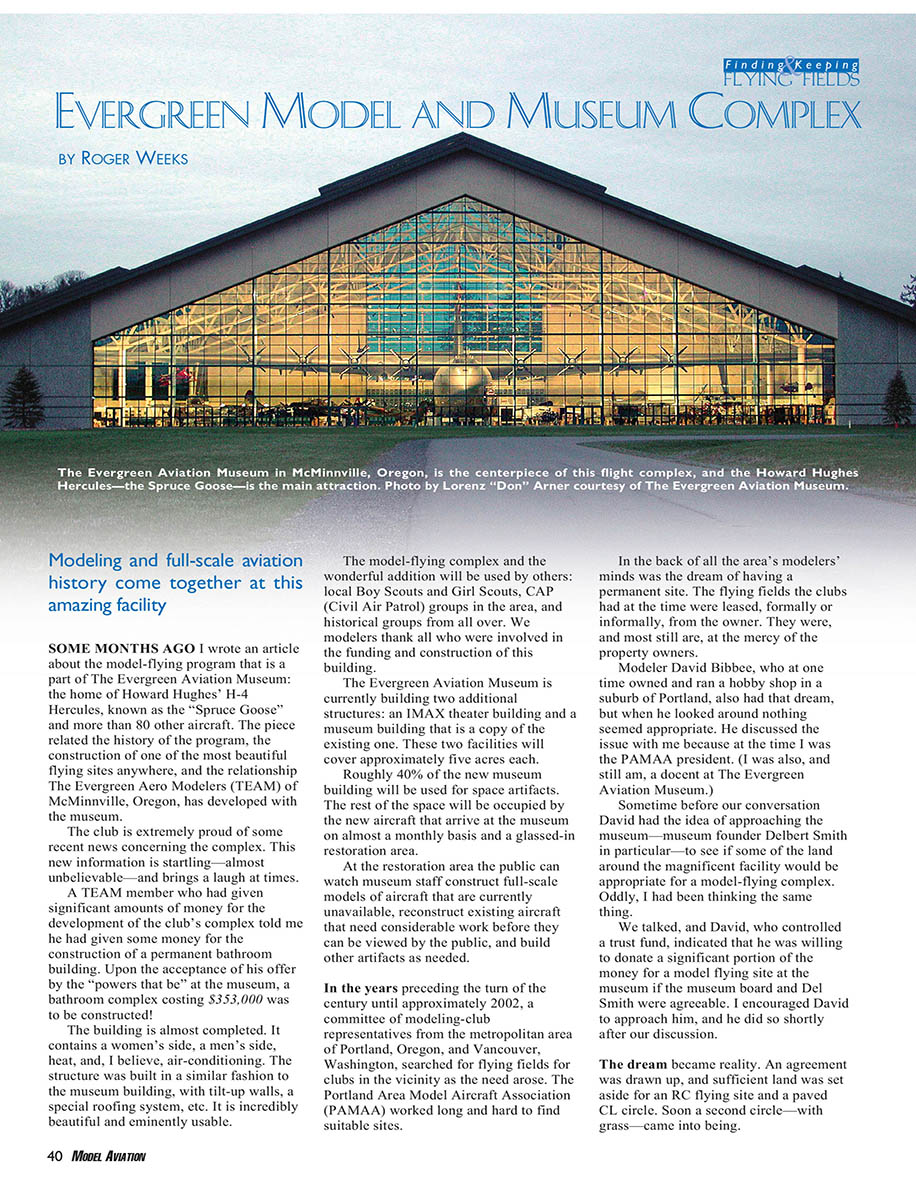
Some months ago I wrote an article about the model-flying program that is a part of The Evergreen Aviation Museum, the home of Howard Hughes' H-4 Hercules — the "Spruce Goose" — and more than 80 other aircraft. The piece related the history of the program, the construction of one of the most beautiful flying sites anywhere, and the relationship The Evergreen Aero Modelers (TEAM) of McMinnville, Oregon, has developed with the museum.
The club is extremely proud of some recent news concerning the complex. This new information is startling—almost unbelievable—and brings a laugh at times. A TEAM member who had given significant amounts of money for the development of the club's complex told me he had given some money for the construction of a permanent bathroom building. Upon the acceptance of his offer by the "powers that be" at the museum, a bathroom complex costing $353,000 was to be constructed!
The building is almost completed. It contains:
- a women's side and a men's side
- heating and, I believe, air-conditioning
- construction similar to the museum building (tilt-up walls, special roofing system)
It is incredibly beautiful and eminently usable.
The model-flying complex and the wonderful addition will be used by others: local Boy Scouts and Girl Scouts, Civil Air Patrol (CAP) groups in the area, and historical groups from all over. We modelers thank all who were involved in the funding and construction of this building.
The Evergreen Aviation Museum is currently building two additional structures: an IMAX theater building and a museum building that is a copy of the existing one. These two facilities will each cover approximately five acres. Roughly 40% of the new museum building will be used for space artifacts. The rest of the space will be occupied by new aircraft that arrive at the museum on almost a monthly basis and by a glassed-in restoration area.
At the restoration area the public can watch museum staff construct full-scale models of aircraft that are currently unavailable, reconstruct existing aircraft that need considerable work before they can be viewed by the public, and build other artifacts as needed. In addition, visitors can sometimes watch staff or club members fly aircraft they construct or fly RC models via the buddy-box system. Weeklong aviation "camps" take place at the museum during the summer months.
In the years preceding the turn of the century until approximately 2002, a committee of modeling-club representatives from the metropolitan area of Portland, Oregon, and Vancouver, Washington, searched for flying fields for clubs in the vicinity as the need arose. The Portland Area Model Aircraft Association (PAMAA) worked long and hard to find suitable sites.
In the back of all the area's modelers' minds was the dream of having a permanent site. The flying fields the clubs had at the time were leased, formally or informally, from property owners. They were, and most still are, at the mercy of the property owners.
Modeler David Bibbee, who at one time owned and ran a hobby shop in a suburb of Portland, also had that dream. When he looked around nothing seemed appropriate. He discussed the issue with me because at the time I was the PAMAA president (I was also, and still am, a docent at The Evergreen Aviation Museum).
Sometime before our conversation David had the idea of approaching the museum — museum founder Delbert Smith in particular — to see if some of the land around the facility would be appropriate for a model-flying complex. Oddly, I had been thinking the same thing. We talked, and David, who controlled a trust fund, indicated that he was willing to donate a significant portion of the money for a model-flying site at the museum if the museum board and Del Smith were agreeable. I encouraged David to approach him, and he did so shortly after our discussion. The dream became reality.
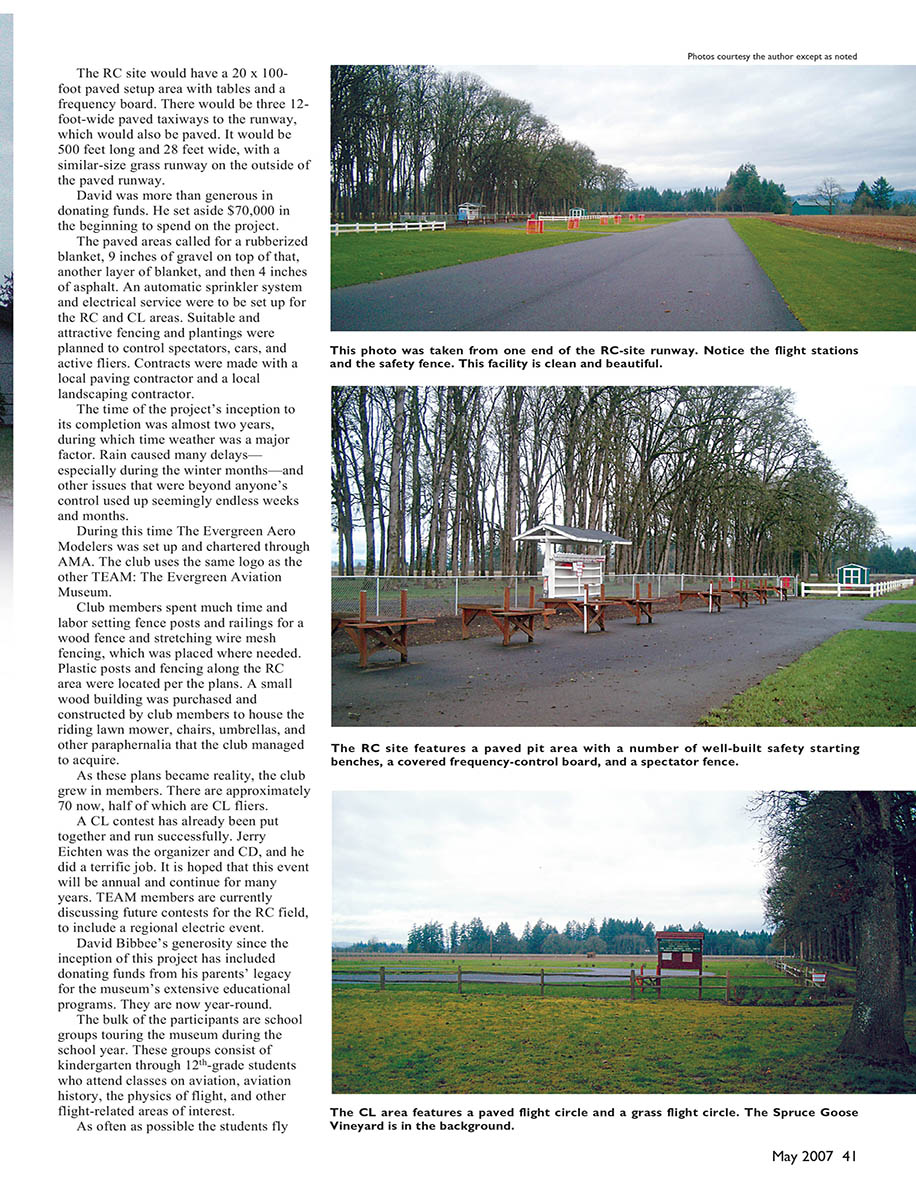
An agreement was drawn up, and sufficient land was set aside for an RC flying site and a paved CL area. The CL area would have a 20 x 100-foot paved setup area with tables and a frequency board. There would be three 12-foot-wide paved taxiways to the runway, which would also be paved. The runway would be 500 feet long and 28 feet wide, with a similar-size grass runway on the outside of the paved runway.
David was more than generous in donating funds. He set aside $70,000 in the beginning to spend on the project.
The paved areas called for the following construction:
- a rubberized blanket
- 9 inches of gravel on top of that
- another layer of blanket
- 4 inches of asphalt
An automatic sprinkler system and electrical service were to be set up for the RC and CL areas. Suitable and attractive fencing and plantings were planned to control spectators, cars, and active fliers. Contracts were made with a local paving contractor and a local landscaping contractor.
The time from the project’s inception to its completion was almost two years, during which time weather was a major factor. Rain caused many delays—especially during the winter months—and other issues beyond anyone’s control used up seemingly endless weeks and months.
During this time The Evergreen Aero Modelers was set up and chartered through the Academy of Model Aeronautics (AMA). The club uses the same logo as the museum: The Evergreen Aviation Museum.
Club members spent much time and labor setting fence posts and railings for a wood fence and stretching wire mesh where needed. Plastic posts and fencing along the RC area were located per the plans. A small wood building was purchased and constructed by club members to house the riding lawn mower, chairs, umbrellas, and other paraphernalia that the club managed to acquire.
As these plans became reality, the club grew in membership. There are approximately 70 members now, about half of which are CL fliers.
A CL contest has already been organized and run successfully. Jerry Eichten was the organizer and contest director, and he did a terrific job. It is hoped that this event will be annual and continue for many years. TEAM members are currently discussing future contests for the RC field, including a regional electric event.
David Bibbee’s generosity since the inception of this project has also included donating funds from his parents’ legacy for the museum’s extensive educational programs. These programs are now year-round.
The bulk of the participants are school groups touring the museum during the school year. These groups consist of kindergarten through 12th-grade students who attend classes on aviation, aviation history, the physics of flight, and other flight-related topics. As often as possible the students fly from the CL area; oftentimes they get to go to the RC area and fly under controlled conditions as part of their experience. The museum staff and volunteers enjoy working with the students.
The museum has purchased several "wet"-powered aircraft for club and museum members to use in the educational programs. They currently have five AirCore trainers that use O.S. .46 LA engines and Futaba radios.
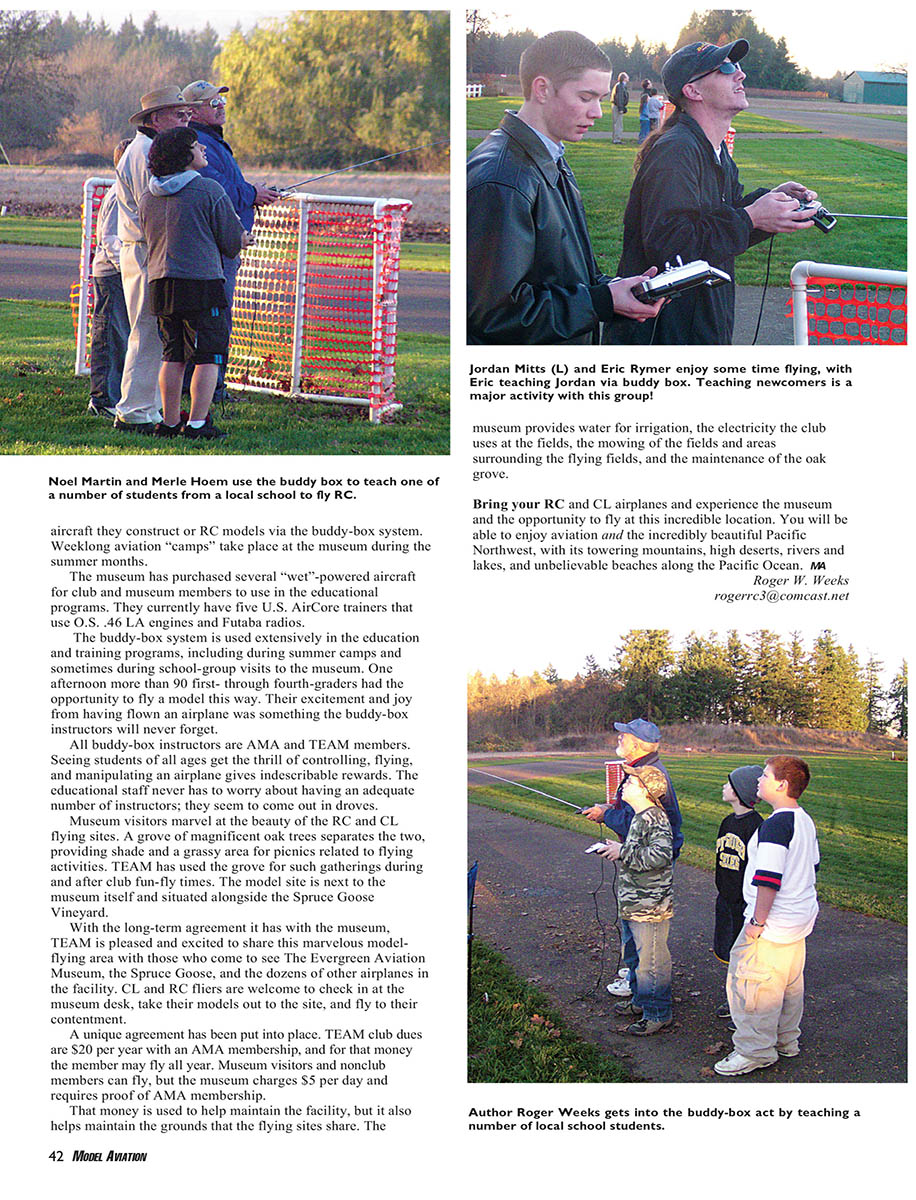
The buddy-box system is used extensively in the education and training programs, including during summer camps and sometimes during school-group visits to the museum. One afternoon more than 90 first- through fourth-graders had the opportunity to fly a model this way. Their excitement and joy from having flown an airplane was something the buddy-box instructors will never forget.
All buddy-box instructors are AMA and TEAM members. Seeing students of all ages get the thrill of controlling, flying, and manipulating an airplane gives indescribable rewards. The educational staff never has to worry about having an adequate number of instructors; they seem to come out in droves.
Museum visitors marvel at the beauty of the RC and CL flying sites. A grove of magnificent oak trees separates the two, providing shade and a grassy area for picnics related to flying activities. TEAM has used the grove for such gatherings during and after club fun-fly times. The model site is next to the museum itself and situated alongside the Spruce Goose Vineyard.
With the long-term agreement it has with the museum, TEAM is pleased and excited to share this marvelous model-flying area with those who come to see The Evergreen Aviation Museum, the Spruce Goose, and the dozens of other airplanes in the facility. CL and RC fliers are welcome to check in at the museum desk, take their models out to the site, and fly to their contentment.
A unique agreement has been put into place. TEAM club dues are $20 per year with an AMA membership, and for that money the member may fly all year. Museum visitors and non-club members can fly, but the museum charges $5 per day and requires proof of AMA membership.
That money is used to help maintain the facility, but it also helps maintain the grounds that the flying sites share. The museum provides water for irrigation, the electricity the club uses at the fields, the mowing of the fields and areas surrounding the flying fields, and the maintenance of the oak grove.
Bring your RC and CL airplanes and experience the museum and the opportunity to fly at this incredible location. You will be able to enjoy aviation and the incredibly beautiful Pacific Northwest, with its towering mountains, high deserts, rivers and lakes, and unbelievable beaches along the Pacific Ocean.
Roger W. Weeks [email protected]
Transcribed from original scans by AI. Minor OCR errors may remain.

