
eWeek
Three hundred pilots embrace the quieter side of modeling
by Greg Gimlick
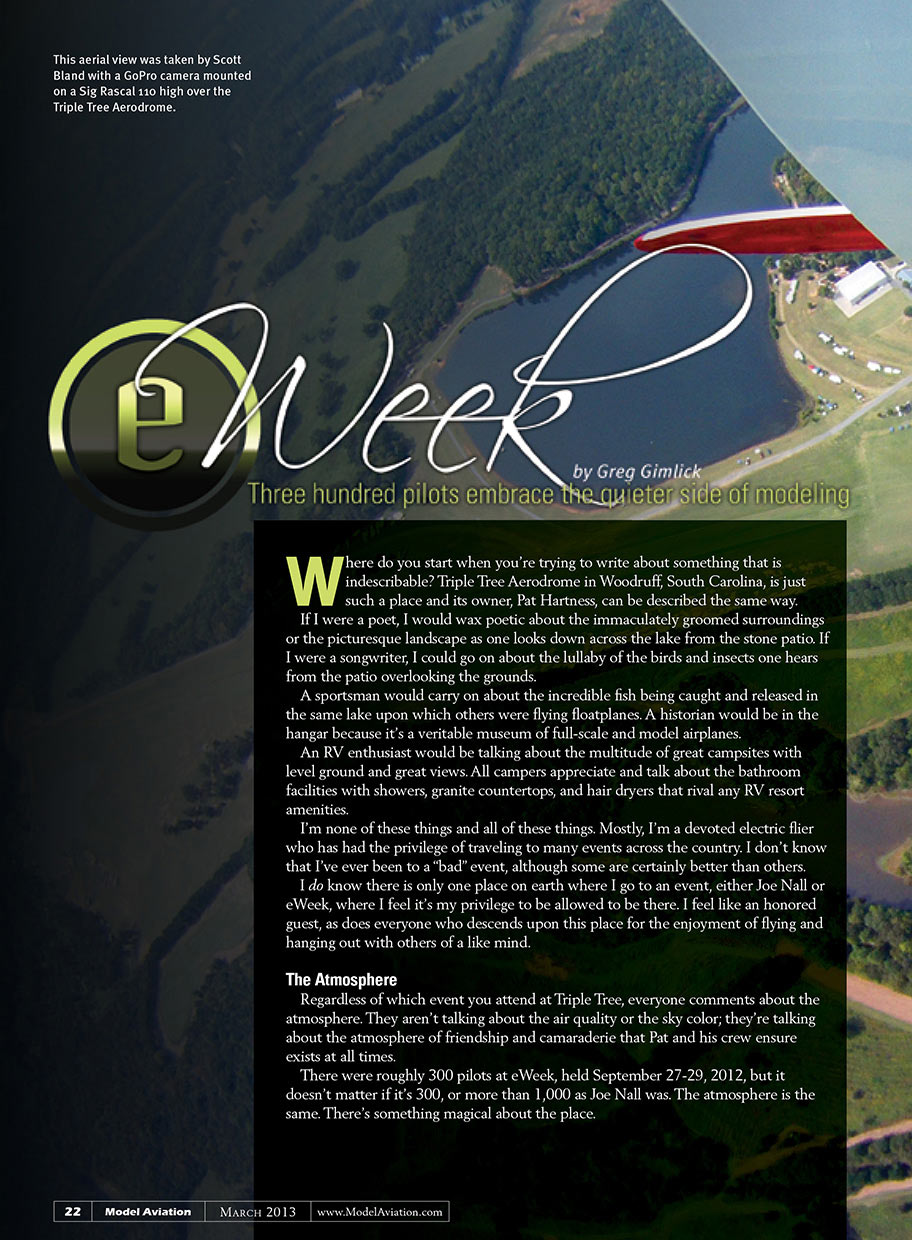
Where do you start when you're trying to write about something that is indescribable? Triple Tree Aerodrome in Woodruff, South Carolina, is just such a place and its owner, Pat Hartness, can be described the same way. If I were a poet, I would wax poetic about the immaculately groomed surroundings or the picturesque landscape as one looks down across the lake from the stone patio. If I were a songwriter, I could go on about the lullaby of the birds and insects one hears from the patio overlooking the grounds.
A sportsman would carry on about the incredible fish being caught and released in the same lake upon which others were flying floatplanes. A historian would be in the hangar because it's a veritable museum of full-scale and model airplanes. An RV enthusiast would be talking about the multitude of great campsites with level ground and great views. All campers appreciate and talk about the bathroom facilities with showers, granite countertops, and hair dryers that rival any RV resort amenities.
I'm none of these things and all of these things. Mostly, I'm a devoted electric flier who has had the privilege of traveling to many events across the country. I don't know that I've ever been to a "bad" event, although some are certainly better than others.
I do know there is only one place on earth where I go to an event, either Joe Nall or eWeek, where I feel it's my privilege to be allowed to be there. I feel like an honored guest, as does everyone who descends upon this place for the enjoyment of flying and hanging out with others of a like mind.
The Atmosphere
Regardless of which event you attend at Triple Tree, everyone comments about the atmosphere. They aren't talking about the air quality or the sky color; they're talking about the atmosphere of friendship and camaraderie that Pat and his crew ensure exists at all times.
There were roughly 300 pilots at eWeek, held September 27–29, 2012, but it doesn't matter if it's 300, or more than 1,000 as Joe Nall was. The atmosphere is the same. There's something magical about the place.
Where else can you go to a brief pilots' meeting that began with the Pledge of Allegiance facing the giant American flag that overlooked the site and honored veterans? When Bob Sadler reviewed the pertinent information regarding the layout, etc., he followed with some simple rules for the event:
- Don’t be a knucklehead.
- Have fun.
- Be safe.
- Come back and see us; we’re glad you came!
Other notable things that made it a unique event included:
- No noon demos. This is a flying event for the “normal” flier.
- There are no generators fouling the air with noise and exhaust. Power stations are throughout the pit area for everyone to use.
- No nonstop PA system commentary, only the sound of electric airplanes flying.
- Attendees are treated as guests in every respect.
The Layout
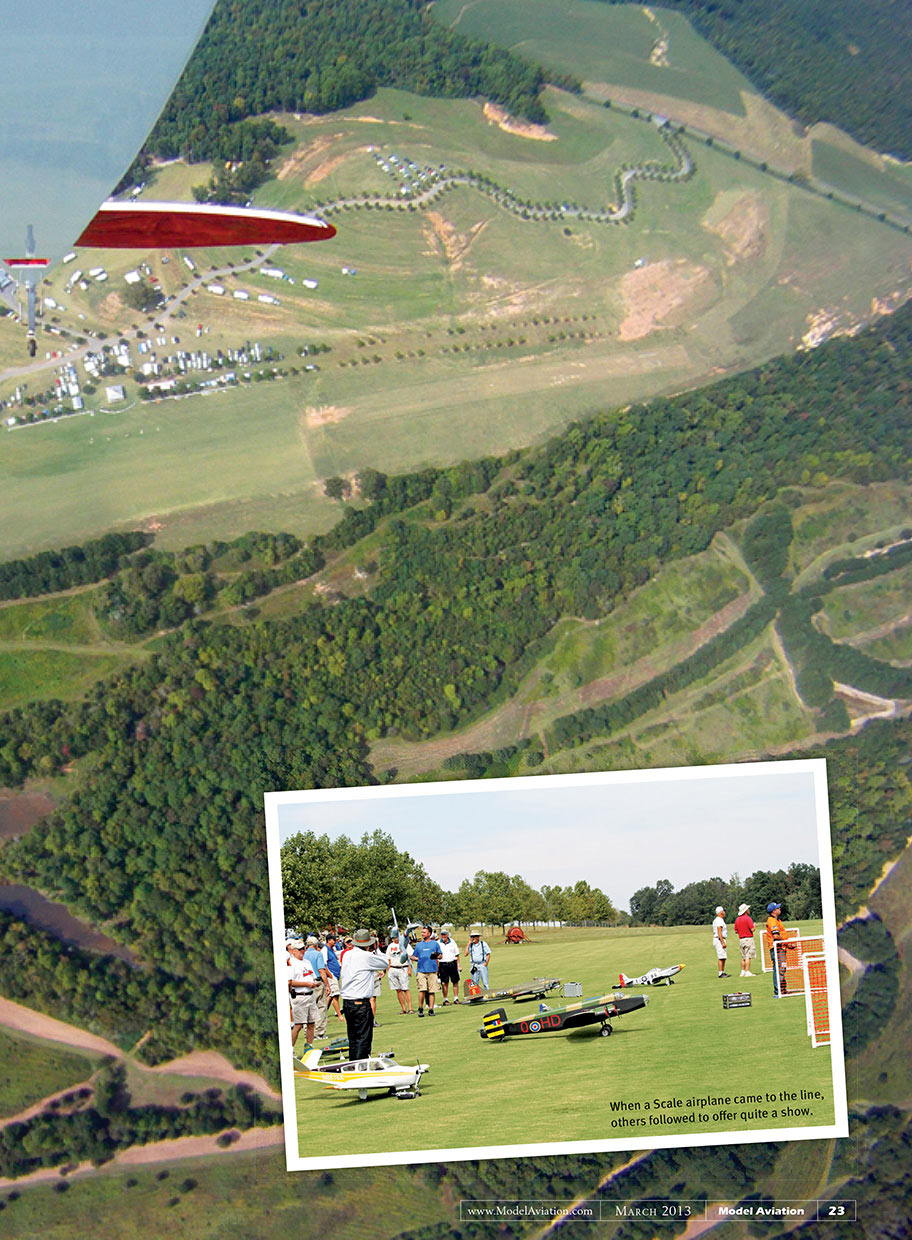
If you’ve never attended an event at Triple Tree, the venue’s layout may take you by surprise. This is no small piece of property! The main flightline is a piece of a full-scale runway and the grass is putting-green grass.
There are separate areas designated for various types of aircraft, which ensures there are no conflicts and provides plenty of pilot stations. This site hosts events that have more than 1,000 pilots, so hosting a few hundred electric fliers is no problem.
The main flightline is a straightforward, racetrack-style pattern for all sport and scale models flying that routine. Aerobatics are allowed, but there was no 3-D–type flying over the field. The 3-D pilots had their own field with its own camping area and bathhouse.
Between the main flightline and the 3-D flightline is the park flyer area with camping and several pilot stations. The lake can accommodate any size of floatplane. Farther up the hill is a dedicated helicopter field with multiple stations.
Because electric fliers often fly several types of airplanes or helicopters, this may seem inconvenient. That was not the case, because of the ample transportation provided by Pat’s crews, employing school buses to go to various venues.
I parked my motor home at the beginning of the week and didn’t bring a car or golf cart, but I never felt as though I was isolated or couldn’t get to a site where I wanted to fly. It may be different from what you’re accustomed to, but there is never a conflict between fliers because of it.
A Day at the Beach!
That’s right—beach! Only Pat Hartness would have the vision to have a beach that far from the ocean in South Carolina, but Enoree Beach is located on the western end of the full-scale runway and will soon open for all to enjoy. It’s a source of pride for Pat to offer a sandy beach on the clear waters of the Enoree River for families to enjoy while visiting Triple Tree.
The Food
Multiple food vendors were present throughout the week, but the biggest and best was on Saturday night! That's the night the organizers threw a giant barbecue. I've never seen more efficient feeding of the masses. I only wish that during my Army career it would have worked this flawlessly!
This year's feast included barbecue, turkey, baked beans, cole slaw, hot dogs, tea, water, soda, and some great cookies! There was so much food that we were invited to go through the line for seconds.
The crew had tables and chairs set up for us outside of the hangar that allowed us to watch the grounds where some others continued to fly while we ate. The sun setting over the lake and the casual atmosphere of friends sharing a meal made a fitting end to the week's activities.
The Airplanes
A fly-in requires some flying and there was no shortage of that during eWeek! Aircraft of all types were represented along with all skill levels. One of the coolest things I saw was the amount of instruction going on, regardless of which field I visited.
People were learning to fly at the park flyer area, and others who knew how to fly were learning 3-D techniques at the 3-D field. Father and son/daughter teams were seen often at the main field employing buddy boxes and having a great time.
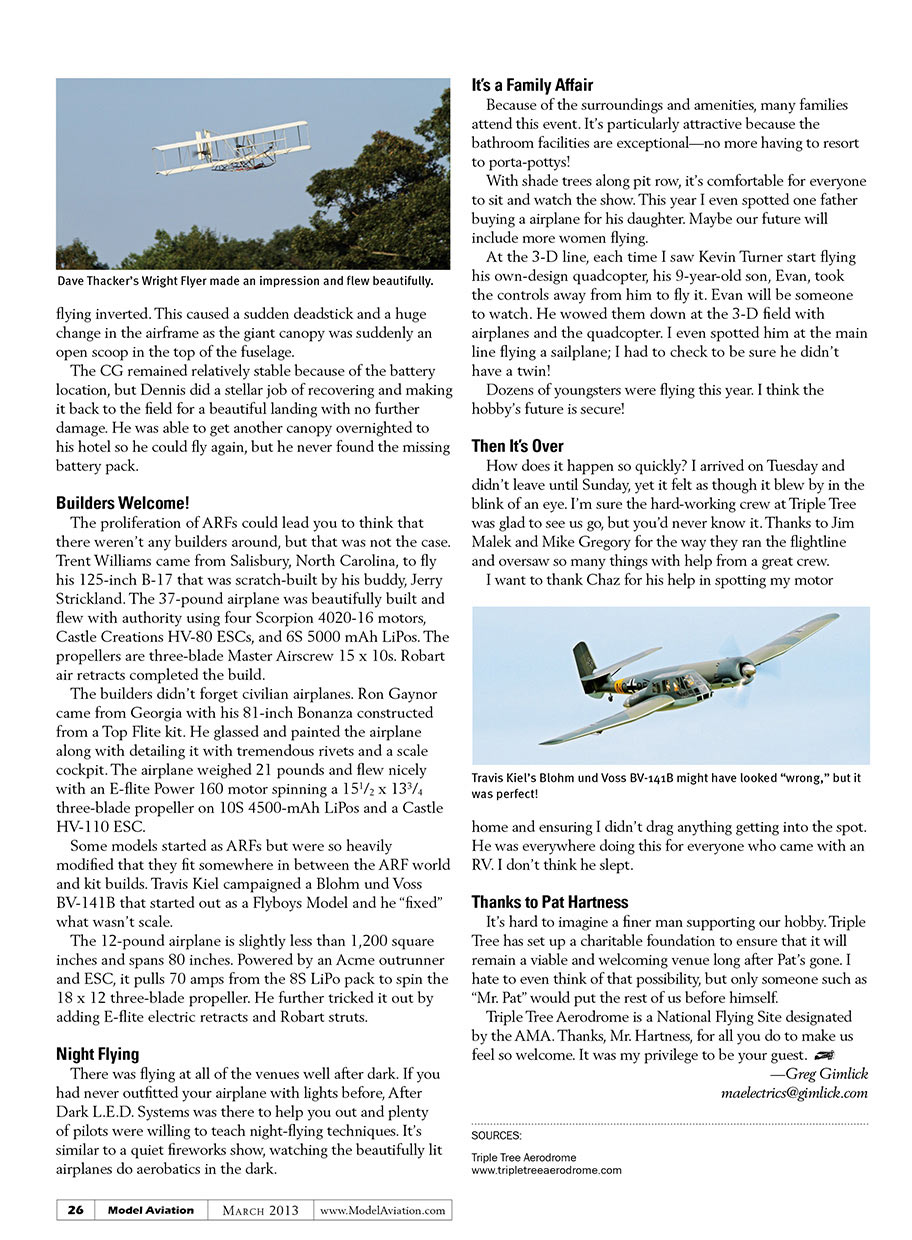
Aircraft came in all shapes and sizes. The slowest was probably Dave Thacker's Wright Flyer, which he flew several times to great response from the crowd. That's "Radical Dave" of Radical RC, and I think he sold all of his kits before the week was out.
The fastest aircraft was a toss-up among several EDFs ranging from 40mm ducted fans up to 90mm. Dennis Shrewsbury came from West Virginia with a trailer full of giant-scale models that were a hit among the crowd.
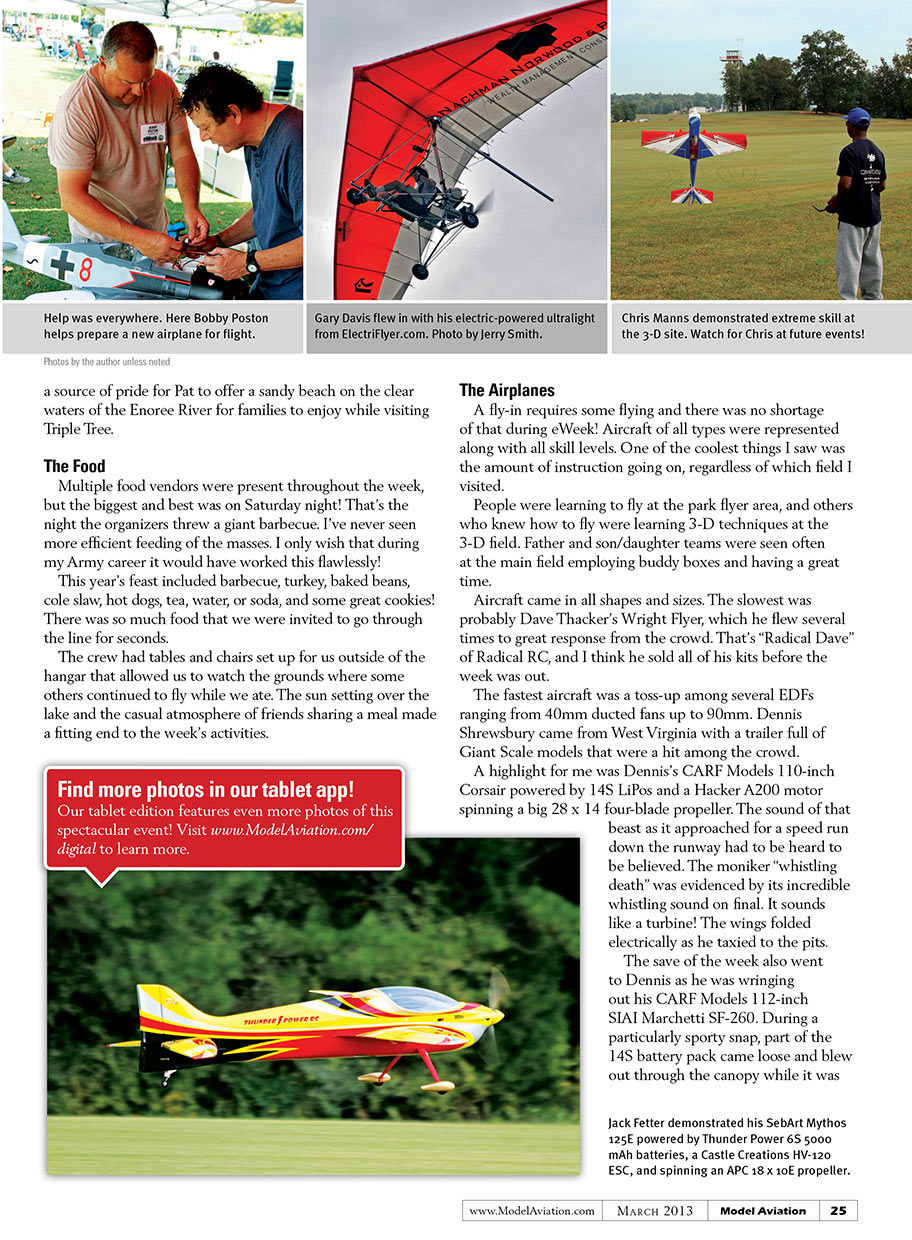
A highlight for me was Dennis's CARF Models 110-inch Corsair powered by 14S LiPos and a Hacker A200 motor spinning a big 28 x 14 four-blade propeller. The sound of that beast as it approached for a speed run down the runway had to be heard to be believed. The moniker "whistling death" was evidenced by its incredible whistling sound on final. It sounds like a turbine! The wings folded electrically as he taxied to the pits.
The save of the week also went to Dennis as he was wringing out his CARF Models 112-inch SIAI Marchetti SF-260. During a particularly sporty snap, part of the 14S battery pack came loose and blew out through the canopy while it was flying inverted. This caused a sudden deadstick and a huge change in the airframe as the giant canopy became an open scoop in the top of the fuselage.
The CG remained relatively stable because of the battery location, but Dennis did a stellar job of recovering and making it back to the field for a beautiful landing with no further damage. He was able to get another canopy overnighted to his hotel so he could fly again, but he never found the missing battery pack.
Builders Welcome!
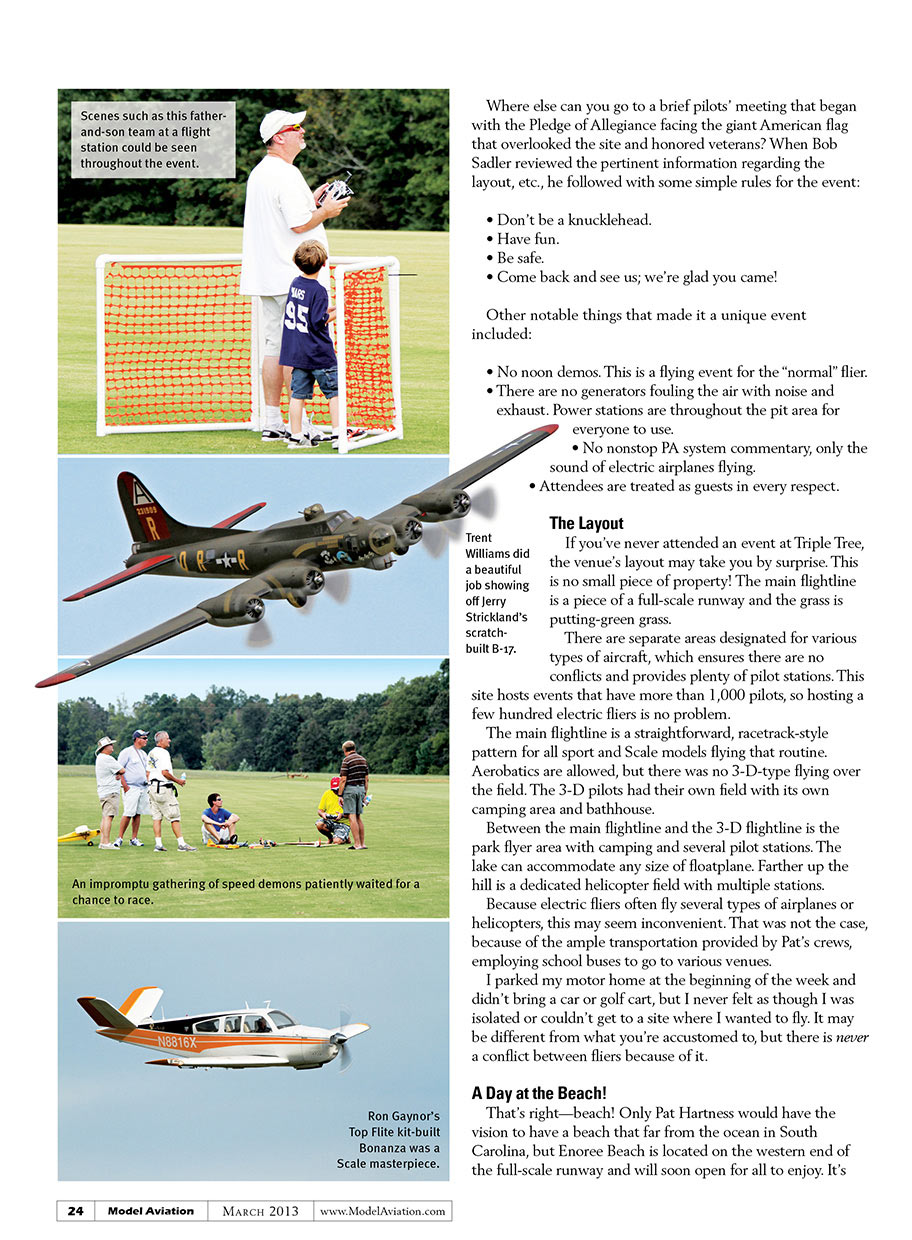
The proliferation of ARFs could lead you to think that there weren’t any builders around, but that was not the case. Trent Williams came from Salisbury, North Carolina, to fly his 125-inch B-17 that was scratch-built by his buddy, Jerry Strickland. The 37-pound airplane was beautifully built and flew with authority using four Scorpion 4020-16 motors, Castle Creations HV-80 ESCs, and 6S 5000 mAh LiPo packs. The propellers are three-blade Master Airscrew 15½ x 10s. Robart air retracts completed the build.
The builders didn’t forget civilian airplanes. Ron Gaynor came from Georgia with his 81-inch Bonanza constructed from a Top Flite kit. He glassed and painted the airplane along with detailing it with tremendous rivets and a scale cockpit. The airplane weighed 21 pounds and flew nicely with an E-flite Power 160 motor spinning a 15½ x 13¾ three-blade propeller on 10S 4500-mAh LiPos and a Castle HV-110 ESC.
Some models started as ARFs but were so heavily modified that they fit somewhere in between the ARF world and kit builds. Travis Kiel campaigned a Blohm und Voss BV-141B that started out as a Flyboys model and he “fixed” what wasn’t scale.
The 12-pound airplane is slightly less than 1,200 square inches and spans 80 inches. Powered by an Acme outrunner and ESC, it pulls 70 amps from the 8S LiPo pack to spin the 18 x 12 three-blade propeller. He further tricked it out by adding E-flite electric retracts and Robart struts.
Night Flying
There was flying at all of the venues well after dark. If you had never outfitted your airplane with lights before, After Dark L.E.D. Systems was there to help you out and plenty of pilots were willing to teach night-flying techniques. It’s similar to a quiet fireworks show, watching the beautifully lit airplanes do aerobatics in the dark.
It’s a Family Affair
Because of the surroundings and amenities, many families attend this event. It’s particularly attractive because the bathroom facilities are exceptional—no more having to resort to porta-potties!
With shade trees along pit row, it’s comfortable for everyone to sit and watch the show. This year I even spotted one father buying an airplane for his daughter. Maybe our future will include more women flying.
At the 3-D line, each time I saw Kevin Turner start flying his own-design quadcopter, his 9-year-old son, Evan, took the controls away from him to fly it. Evan will be someone to watch. He wowed them down at the 3-D field with airplanes and the quadcopter. I even spotted him at the main line flying a sailplane; I had to check to be sure he didn’t have a twin!
Dozens of youngsters were flying this year. I think the hobby’s future is secure!
Then It’s Over
How does it happen so quickly? I arrived on Tuesday and didn’t leave until Sunday, yet it felt as though it blew by in the blink of an eye. I’m sure the hard-working crew at Triple Tree was glad to see us go, but you’d never know it. Thanks to Jim Malek and Mike Gregory for the way they ran the flightline and oversaw so many things with help from a great crew.
I want to thank Chaz for his help in spotting my motor home and ensuring I didn’t drag anything getting into the spot. He was everywhere doing this for everyone who came with an RV. I don’t think he slept.
Thanks to Pat Hartness
It’s hard to imagine a finer man supporting our hobby. Triple Tree has set up a charitable foundation to ensure that it will remain a viable and welcoming venue long after Pat’s gone. I hate to even think of that possibility, but only someone such as “Mr. Pat” would put the rest of us before himself.
Triple Tree Aerodrome is a National Flying Site designated by the AMA. Thanks, Mr. Hartness, for all you do to make us feel so welcome. It was my privilege to be your guest.
— Greg Gimlick [email protected]
Sources
- Triple Tree Aerodrome
- www.tripletreeaerodrome.com
Transcribed from original scans by AI. Minor OCR errors may remain.

