
Exploring EPA Superfund Sites
by Tom Gunnarson and Liz Helms
A notice in New Jersey’s Burlington County R/C Club newsletter read:
“Wanted: model airplane flying site. $500 reward! Specifications:
- Runway should be at least 100 x 400 feet.
- There must be an over flight area.
- There must be an access road which remains passable during and after rain.
- It must be far enough away from neighbors’ houses so as not to present noise problems.”
Does that seem familiar? There are roughly 2,500 model-aircraft clubs chartered by AMA. Most of those have at least one available flying site, a few have access to two or more sites, and probably an equal number have no place to fly. The loss of flying sites is becoming prevalent, and urban expansion, zoning regulations, and endangered-species protection are some of the environmental causes. Many of these grounds are out of our control.
Noise issues, lack of rules or failure to enforce rules, or trespassing to retrieve downed aircraft can alienate those on neighboring properties. Overflight on nearby properties or other areas of public land that are used for other purposes (such as baseball parks) and unsafe or even dangerous flying can lead to the loss of a suitable site.
Unreasonable or inappropriate actions by some club members—such as test flights early Sunday morning or breaking in an engine without a muffler after dusk when you can’t fly anyway—are reasons why communities choose to close flying sites. Although they are controllable, many of these issues are seldom addressed until it is too late.
Flying sites were fairly easy to come by in the past. It was no big deal to drive to a field on the outskirts of town; you could get there in roughly 15 minutes. Today people want to “get away from it all,” so they move to the outer edges of their towns—where those same flying sites are. They don’t want the noise, the traffic, or the intrusion of fliers in their “space,” even if the club owns the adjoining property and was there first. Because of urban expansion, it is common these days for model fliers to have to drive an hour or more to get to their fields.
The loss of flying sites is a serious threat to the future of aeromodeling, especially in highly populated areas. But a yearlong project spearheaded by Joe Beshar—the AMA flying-site assistance coordinator for the eastern region—may soon lead to new flying fields across the country.
There are tens of thousands of abandoned hazardous-waste sites in our nation. Superfund—an Environmental Protection Agency (EPA) project—is the federal government’s program to clean up those areas. Launched in 1980, under the Superfund program abandoned, accidentally spilled, or illegally dumped hazardous waste that poses a current or future threat to human health or the environment is cleaned up.
A Superfund site is any land in the country that the EPA has identified as a candidate for cleanup. The EPA works closely with communities; Potentially Responsible Parties (PRPs); scientists and researchers; contractors; and state, local, tribal, and federal authorities. Together they identify hazardous-waste sites, test the sites’ conditions, formulate cleanup plans, and clean up the sites.
The Superfund Redevelopment Program facilitates the return of cleaned-up land to productive use, which can be industrial or commercial. The sites can accommodate factories and shopping malls; they can be used for housing, public works facilities, transportation, and other community infrastructure; or they can be appropriated for ecological resources such as wildlife preserves and wetlands. The EPA is working closely with private organizations such as the U.S. Soccer Foundation, the National Football League, and Major League Baseball to obtain their support for communities to use Superfund sites for recreational purposes.
However a site is used, the community benefits because the property is adding economic, social, or ecological value.
Procuring Superfund Sites for Club Use
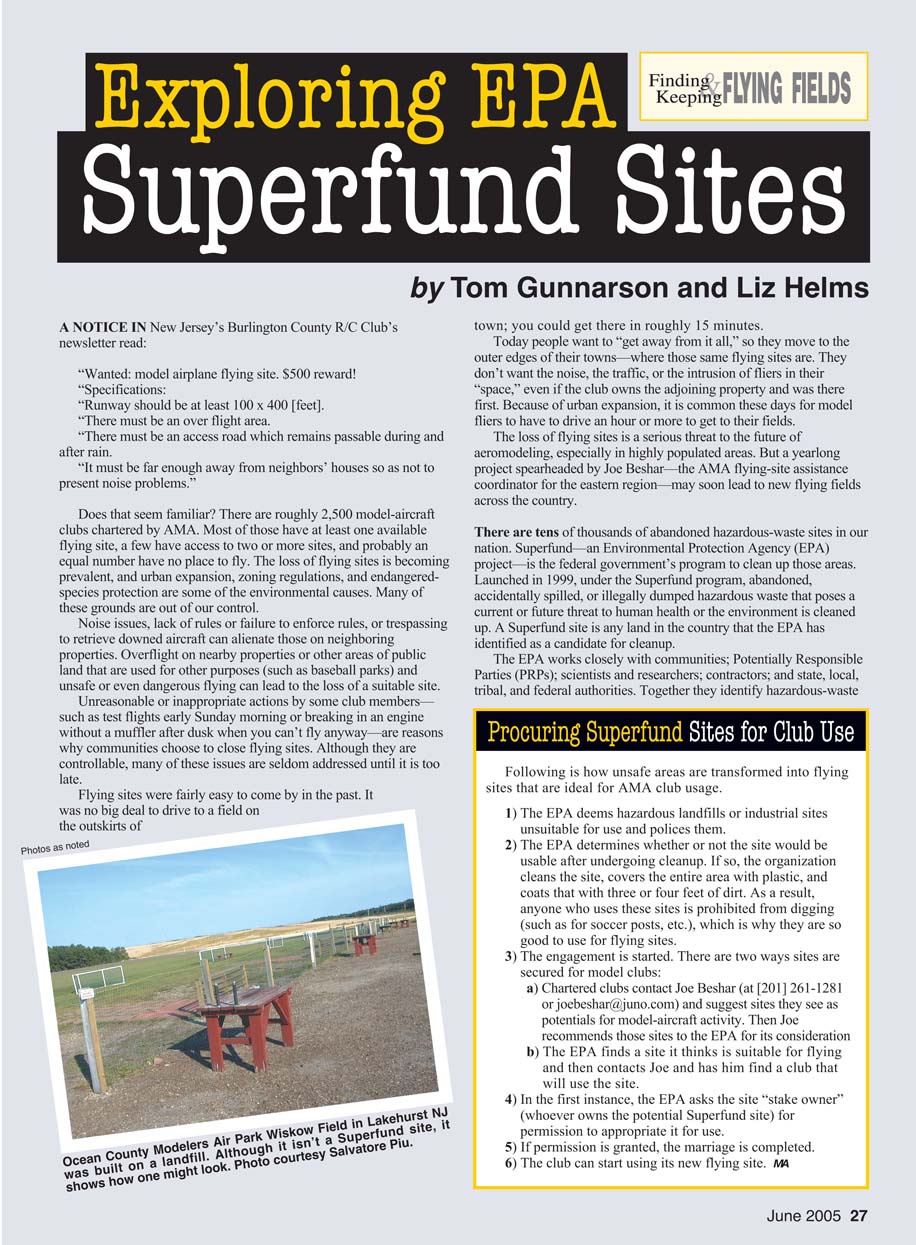
Following is how unsafe areas are transformed into flying sites that are ideal for AMA club use.
- The EPA deems hazardous landfills or industrial sites unsuitable for unrestricted use and polices them.
- The EPA determines whether the site would be usable after undergoing cleanup. If so, the organization cleans the site, applies protective barriers as needed (for example, covers and caps), and places several feet of clean soil over the area. As a result, anyone who uses these sites is prohibited from digging (such as for soccer posts, etc.), which is why they are often well suited for flying sites.
- Engagement is started. There are two ways sites are secured for model clubs:
- a) Chartered clubs contact Joe Beshar (at (201) 261-1281 or [email protected]) and suggest sites they see as potentials for model-aircraft activity. Joe then recommends those sites to the EPA for consideration.
- b) The EPA finds a site it thinks is suitable for flying and then contacts Joe to find a club that will use the site.
- In the first instance, the EPA asks the site “stake owner” (whoever owns the potential Superfund site) for permission to appropriate it for use.
- If permission is granted, the partnership is completed.
- The club can start using its new flying site, subject to any use restrictions the EPA has put in place.
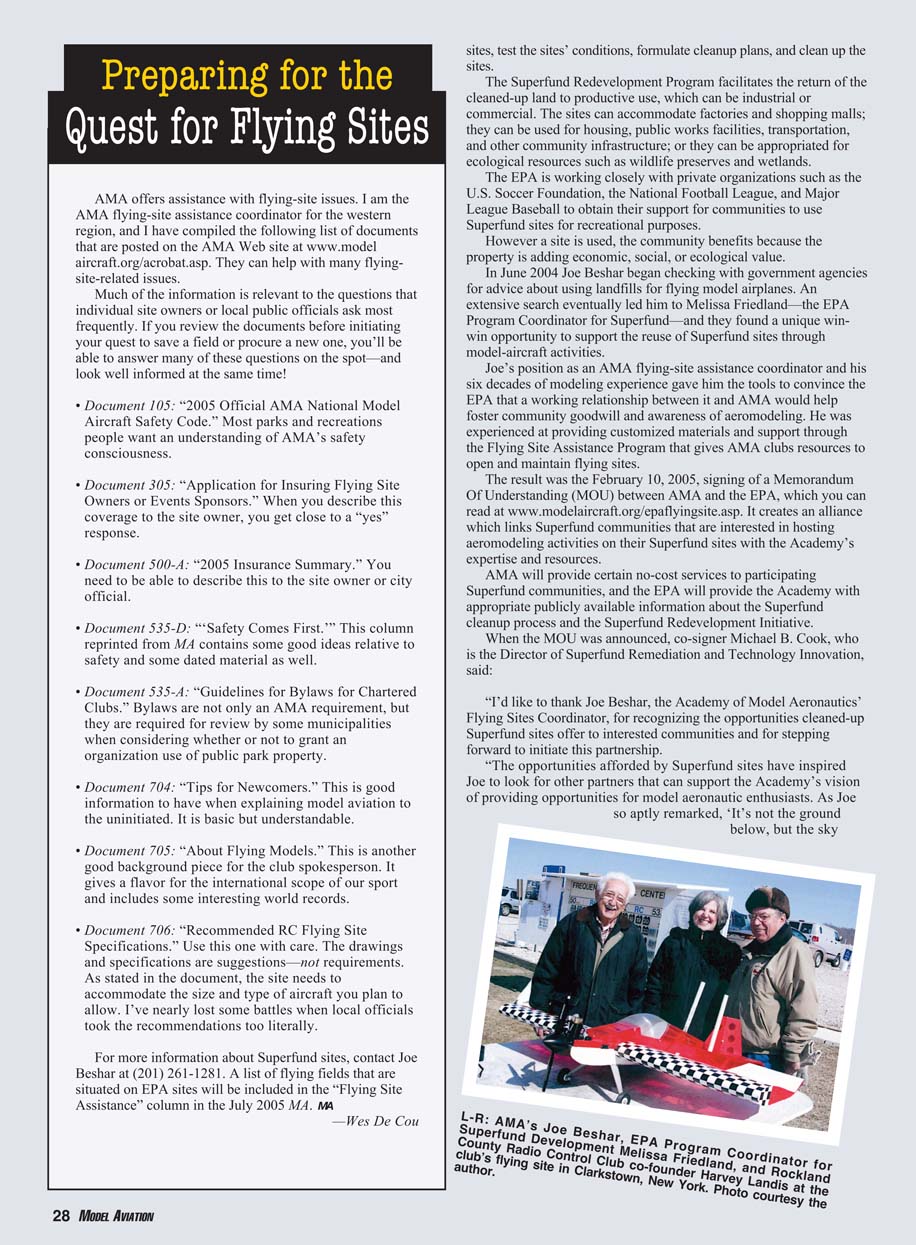
In June 2004 Joe Beshar began checking with government agencies for advice about using landfills for flying model airplanes. An extensive search eventually led him to Melissa Friedland—the EPA Program Coordinator for Superfund—and they found a unique win-win opportunity to support the reuse of Superfund sites through model-aircraft activities.
Joe's position as an AMA flying-site assistance coordinator and his six decades of modeling experience gave him the tools to convince the EPA that a working relationship between it and AMA would help foster community goodwill and awareness of aeromodeling. He was experienced at providing customized materials and support through the Flying Site Assistance Program that gives AMA clubs resources to open and maintain flying sites.
The result was the February 10, 2005, signing of a Memorandum Of Understanding (MOU) between AMA and the EPA, which you can read at www.modelaircraft.org/epaflyingsite.asp. It creates an alliance which links Superfund communities that are interested in hosting aeromodeling activities on their Superfund sites with the Academy's expertise and resources.
AMA will provide certain no-cost services to participating Superfund communities, and the EPA will provide the Academy with appropriate publicly available information about the Superfund cleanup process and the Superfund Redevelopment Initiative.
When the MOU was announced, co-signer Michael B. Cook, Director of Superfund Remediation and Technology Innovation, said:
"I'd like to thank Joe Beshar, the Academy of Model Aeronautics' Flying Sites Coordinator, for recognizing the opportunities cleaned-up Superfund sites offer to interested communities and for stepping forward to initiate this partnership.
"The opportunities afforded by Superfund sites have inspired Joe to look for other partners that can support the Academy's vision of providing opportunities for model aeronautics enthusiasts. As Joe so aptly remarked, 'It's not the ground below, but the sky.'"
EPA/AMA Q-and-A
Following are answers the EPA provided to basic questions about its partnership with AMA.
Q: What is the Memorandum of Understanding (MOU) between EPA and the Academy of Model Aeronautics and what is its purpose? A: The MOU between the Academy and EPA is an alliance which links Superfund communities interested in hosting aeromodeling activities on their Superfund sites with the expertise and resources of the Academy.
Q: What is the Academy of Model Aeronautics and what does it do? A: The Academy of Model Aeronautics ("Academy") is a non-profit organization dedicated to making aeromodeling the foremost sport/hobby in the world through promotion, development, education about, and general advancement of modeling activities. The Academy's priorities include:
- Representing roughly 170,000 members nationwide from every walk of life, economic background, and age group who are interested in building and flying model airplanes.
- Chartering more than 2,500 model-airplane clubs across the country. The Academy offers its chartered clubs official contest sanctions, insurance, and assistance in getting and keeping flying sites.
- Organizing the annual National Aeromodeling Championships in Muncie, Indiana—the world's largest model airplane competition.
- Sanctioning more than 3,000 model-airplane competitions nationwide each year, and certifying official model-flying records on a national and international level.
- Providing a liaison between local chartered clubs and the Federal Aviation Administration, the Federal Communications Commission, and other government agencies, in addition to local governments, zoning boards, and parks departments.
Q: How do I know if it's safe to reuse a Superfund site for model aeronautics? A: Any reuse must be consistent with the selected remedy. If all contamination at a site is eliminated, the site is available for unrestricted use.
At sites where protective measures are in place for wastes that remain safeguarded in underground containment areas after the cleanup, EPA ensures that the measures will provide adequate protection for the uses anticipated for the site, and will restrict uses that might not be safe or might impair the protective measures. EPA will never compromise its standards of protection in order to support site reuse.
For more information about appropriate future uses for your site, contact the site's remedial project manager.
Q: Does EPA support uses other than model aeronautics? A: Yes. EPA supports the appropriate reuse of Superfund sites. Appropriate site uses can be recreational facilities, such as golf courses, parks, ball fields, or aeromodeling sites; they can be industrial or commercial uses, such as factories and shopping malls; they can also be ecological resources, such as wildlife preserves and wetlands.
How a site will be used is a local decision. However a site is used, the community benefits because the property is again adding economic, social, or ecological value.
Q: What makes a site appropriate for flying model airplanes? A: Appropriate aeromodeling sites vary in size, starting with an area that is 120 yards per side without trees, boulders, fences, or steep ravines and going up to sites that are 120 acres or larger. EPA must evaluate the site and determine that conditions are safe for aeromodeling activities.
Q: Why would communities want to work with the Academy? A: To support members of the community who are interested in flying model airplanes. In addition, the Academy will help maintain sites by:
- Mowing and maintaining the landscape surfaces on the portions of Superfund sites that the Academy is using.
- Maintaining fences on the portions of Superfund sites that the Academy is using.
The Academy asserts that model aviation is educational and career-building and serves as an alternative to other less beneficial activities practiced by today's youth. There are no physical barriers to aeromodeling; it is open to people of all ages, from juniors to senior citizens.
Appreciation for flying model airplanes has been shared by astronauts such as Hoot Gibson, Frank Borman, and Buzz Aldrin. In addition, the Academy says that model aviation is an educational sport and hobby which encourages early interest in research and development of future products.
Paul MacCready, developer of the Gossamer Albatross; Chuck Yeager, the first to break the sound barrier; Burt Rutan, designer of the around-the-world Voyager; and many others have cited model aviation as being a great value to the community and the nation.
Q: Does the Academy of Model Aeronautics have any responsibility for cleanup, operations and maintenance, or implementation or enforcement of institutional controls? A: No. While the Academy of Model Aeronautics may take over maintenance of some parts of the remedy in place at a site, the Academy is not legally responsible for any prior contamination on the site or for activities related to its remediation or maintenance.
Q: Whom do I contact for more information? A: For more information about the Academy of Model Aeronautics, contact Joe Beshar, Flying Sites Coordinator for the Academy of Model Aeronautics, at (201) 261-1281.
Since the MOU was signed, EPA has chosen 30 of 1,500 Superfund sites for initial evaluation and will work with AMA and interested local chartered clubs to determine their suitability for model-flying activities. Joe will remain actively involved in visiting regional EPA offices as necessary to bring them up to speed and spread the good news about positive developments taking place between AMA and the EPA.
Joe credits many people with helping make this agreement possible, including Helen Brownwell of the Pacific Northwest EPA office; Kirstin Sprinkle and John Harris of E-Squared, Inc. (a consultant to EPA); Elizabeth Southland—Director of Assessments and Remediation Division of the Superfund Program; and volunteer AMA assistant Bruce Guimara.
AMA President Dave Brown said:
"The more we can work with government agencies in positive ways, the more credibility and legitimacy AMA gains when engaging other agencies for similar agreements. Gaining and maintaining flying sites is a high priority for AMA members. The opportunity with EPA, opened by the effort of Joe Beshar, is a shining example of what we can do to be proactive for the hobby."
To get an idea of the scope of Superfund activity, visit the National Priorities List (NPL) Web site at www.epa.gov/superfund/sites/npl/npl.htm. The NPL is intended primarily to guide the EPA in determining which sites warrant further investigation. From there you can locate NPL sites, check their cleanup progress, and get information about new and proposed sites.
Tom Gunnarson 7205 Peekskill Dr. Frederick, MD 21702
Transcribed from original scans by AI. Minor OCR errors may remain.

