
Extreme Flight Championships
Mark Fadely
A pinnacle of aerobatic and 3-D flight for airplane and helicopter pilots
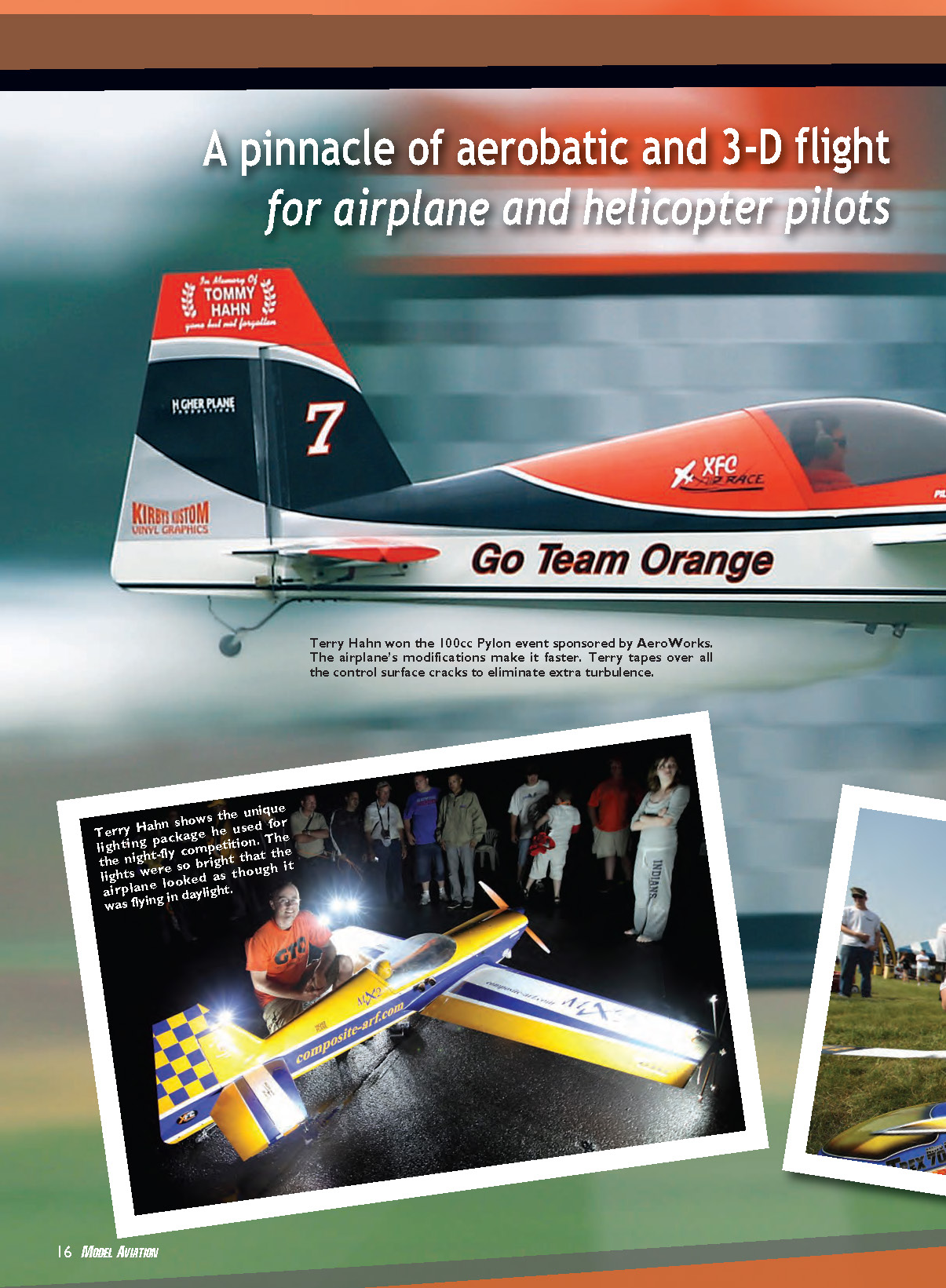
Terry Hahn won the 100cc Pylon event sponsored by AeroWorks. The airplane's modifications make it faster. Terry tapes over all the control surface cracks to eliminate extra turbulence.
Terry Hahn shows the unique lighting package he used for the night-fly competition. The lights were so bright that the airplane looked as though it was flying in daylight.
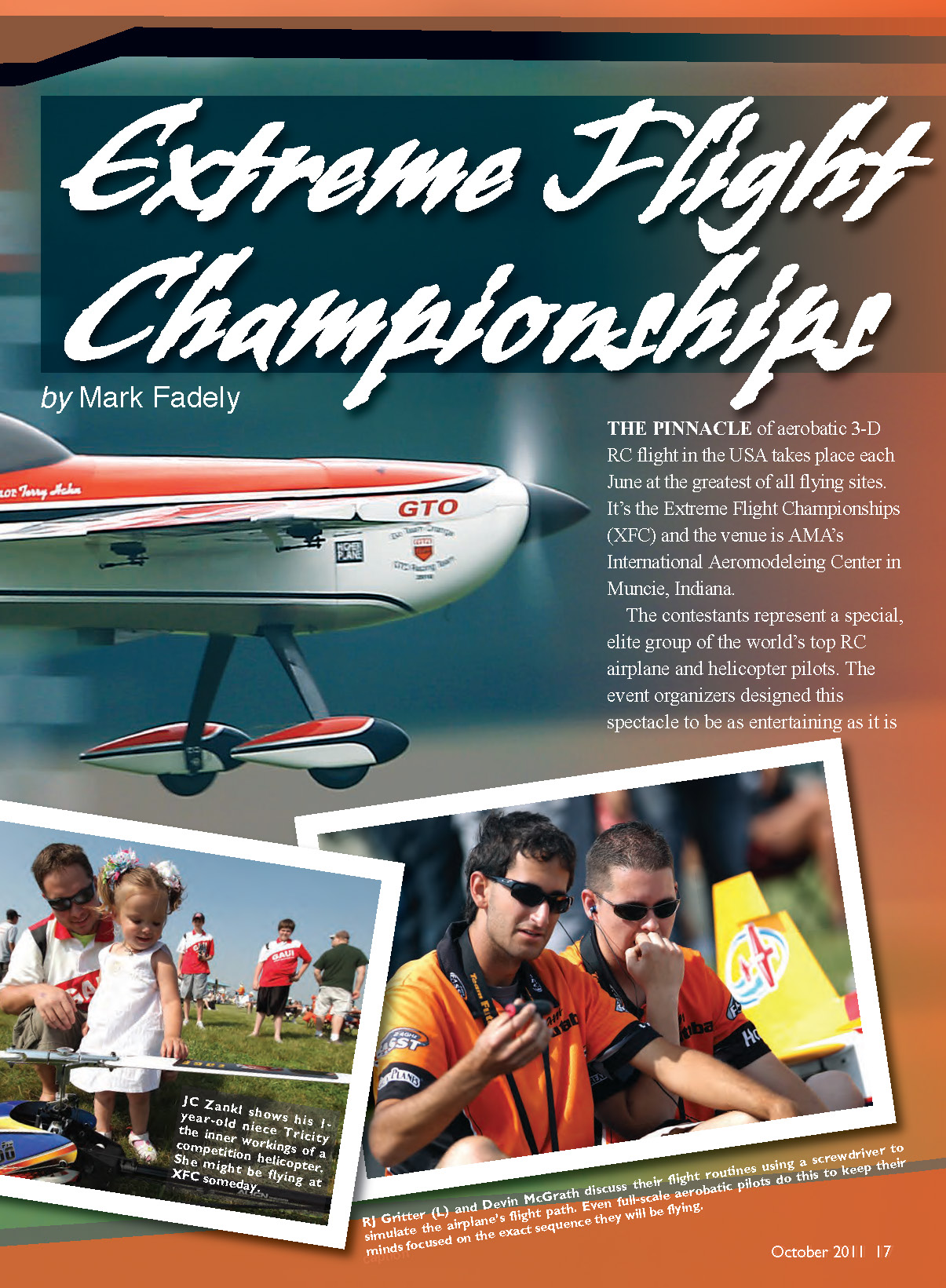
THE PINNACLE of aerobatic 3-D RC flight in the USA takes place each June at the greatest of all flying sites. It's the Extreme Flight Championships (XFC) and the venue is AMA's International Aeromodeling Center in Muncie, Indiana.
The contestants represent a special, elite group of the world's top RC airplane and helicopter pilots. The event organizers designed this spectacle to be as entertaining as it is competitive. Thousands of local residents come out each year to be treated to the aerial displays.
At this year's XFC, art, science, and skill came together in a way that only expert model aviators can accomplish. During the three-day contest, crowds were amazed with daring, low-level flight routines that were precisely choreographed to toe-tapping musical scores. The traditional Indiana thunderstorms made their unwelcome appearance, but all competition flights were flown, including a drizzly Night-Fly championship.
The XFC is the Olympics of RC piloting. Giant Scale airplanes and state-of-the-art helicopters flew heart-pounding, extreme 3-D flights nonstop for three days. Sometimes the inevitable crashes occurred, but the pilots dusted themselves off and continued with their backup aircraft as if nothing had happened.
The contest has evolved throughout the years under the guidance of Frank Noll, his XFC volunteers, and staff. Loyal fans from the Muncie community return year after year to watch and enjoy the competition.
The XFC committee invites competitors to fly. A few spots are intentionally left open and a precontest called the "last-chance qualifier" takes place on Thursday to fill those spots. It is exciting because you can just show up and fly. If you are lucky and win the judges' favor, you might find yourself actually competing in the XFC!
After the 2011 field of pilots was filled, nervous tension inundated the group of anxious pilots. Many of the pilots are not very talkative during the contest because they have to stay focused on the task at hand.
It is common for some to forget part of their flight routines under the intense pressure. If that happens, the flight is usually not scored well and it could mean dropping a place or two in the final results. There is a big incentive to place well because huge cash prizes are awarded to the winners.
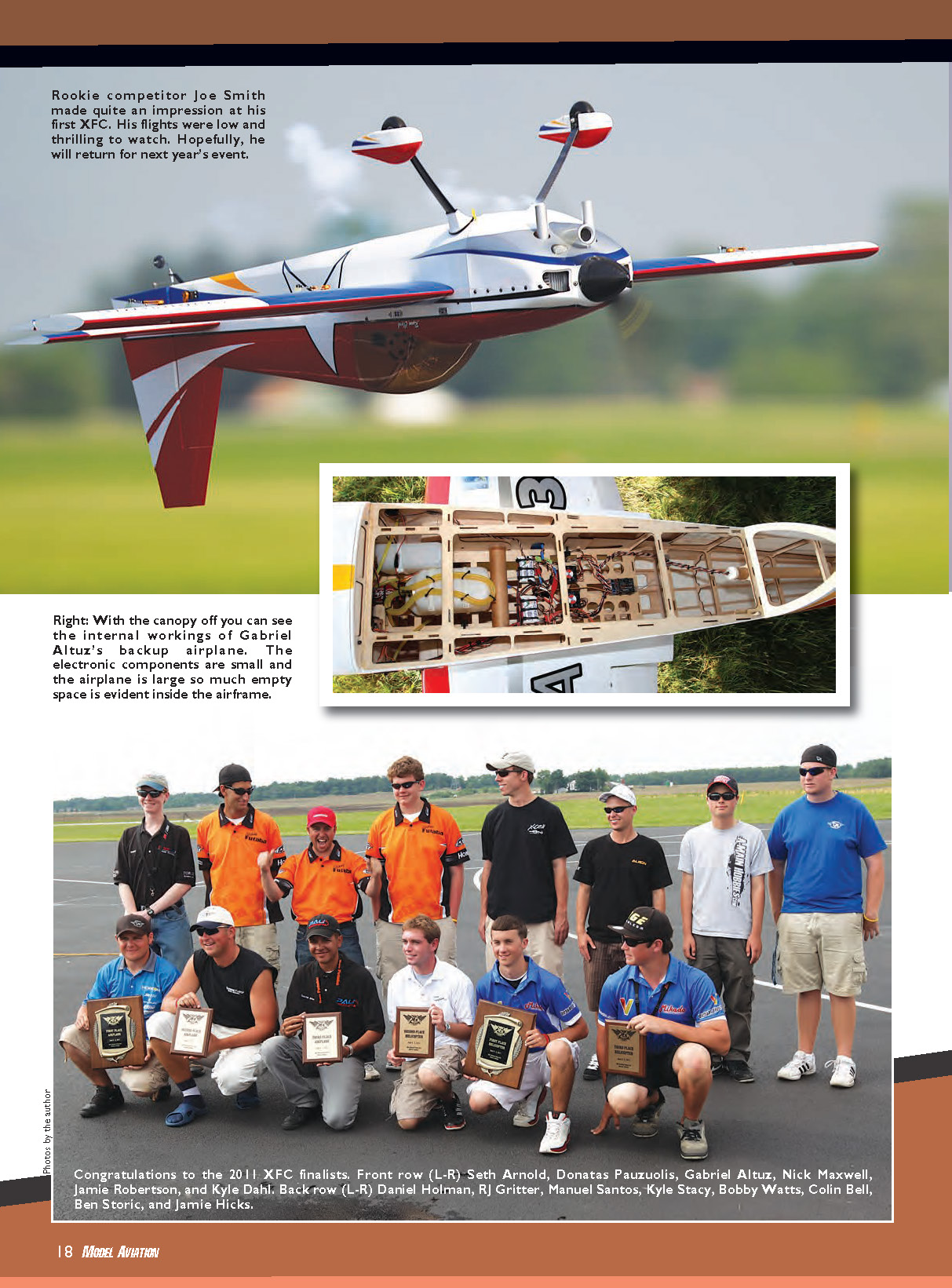
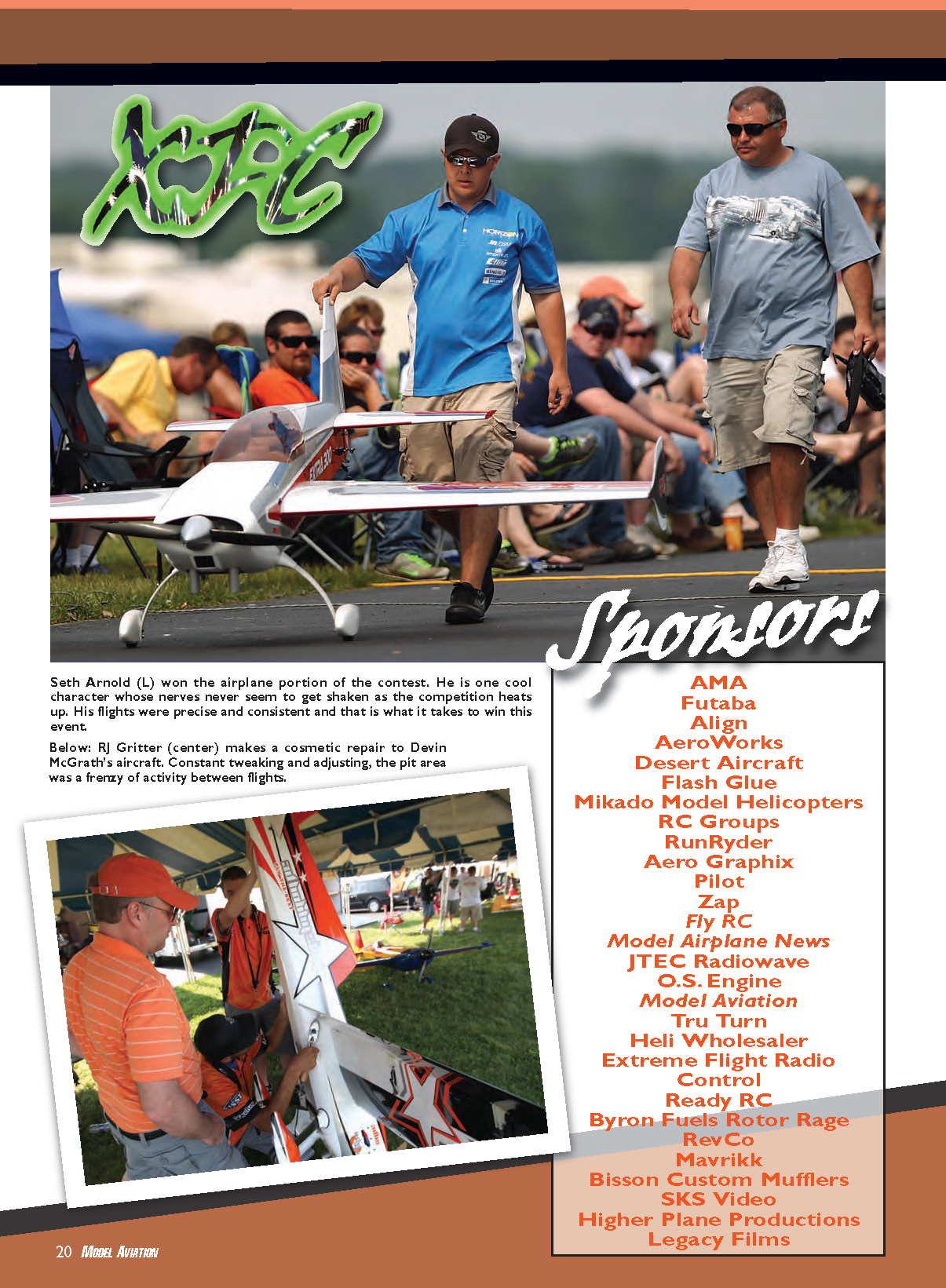
A number of fresh faces attended XFC in 2011. It was no surprise that Seth Arnold took home the gold on the airplane side with his inspiring flights. When you look at the score sheets, Seth dominated by winning the most rounds and ended with a healthy scoring advantage.
On the helicopter side it was a different story. Only a few points separated winner Jamie Robertson from second-place Nick Maxwell.
Both airplane and heli pilots came with their game faces on, ready to do battle. These fliers put the "extreme" in extreme 3-D flight. One thing that is becoming obvious as this competition matures is that the youth are taking over. The top fliers in the world average a mere 18 years old.
Part of the reason for this teen takeover is their quick, steady reflexes, but more importantly it is the time commitment required to compete in the top echelons. Top helicopter pilot Kyle Dahl says he flies seven flights a day for months before the event. After pilots are older and have other commitments—such as families and jobs—there is just not enough time in a day to fly that much.
Some first-time XFC contestants shared some of their thoughts. Donatas Pauzuolis made the long journey from Eastern Europe and flew to a very impressive third-place finish.
Donatas said, "I am sponsored by Extreme Flight RC and the plane I am flying is actually Chris Hinson's personal model. It is a prototype 110-inch Extra 300. My dad is a lifelong modeler who mentored me in RC and helped promote my career. I am 26 years old and speak Russian, German, Lithuanian, and English. This helps me very much with the international modeling community. I want to help promote 3-D contest flying all over the world and I have had a great time competing in the XFC and hope to be back again. I would also like to thank Dave Johnson of Desert Aircraft. He quickly shipped me out a new motor when we needed it. Without his help we would not have been here."
Sixteen-year-old Jesse Kavros is another XFC rookie. He flies helis and lives in California. Jesse said, "I use a simulator for flight-maneuver training and I started out with a T-Rex 450, the old original one. Then I got a T-Rex 600 and my flying really got better. I talk to Kyle Dahl frequently and see him from time to time since we both live in California. He has helped me a lot. Like Kyle, I have flown around seven flights a day, every day, to get ready for the XFC."
The contest runs for three days and it is constant repetition of two basic flying routines. First is Known flight, encompassing three required maneuvers that the pilot must execute at some point during his or her flight.
The other is the Unknown flight and it is an all-out freestyle performance where the pilot composes the entire flight. Every flight has to be choreographed to music and that synchronization counts heavily toward the score. All the competitors fly a Known and Unknown round of flights on both Friday and Saturday. Then the top seven finishers in airplanes and helis advance to the finals on Sunday.
Each pilot then flies two rounds of Known and two rounds of Unknowns, throwing out the low score for each. The contest format allows each pilot to throw out a bad flight so that crashes or equipment problems cannot ruin good scoring. The skill level certainly stepped up a few notches this year in both airplane and heli flights.
The AeroWorks Challenge Pylon Racing returned this year. This event proved to be popular in its debut last year. The 50cc and 100cc airplanes fly around a course of pylons as fast as they can. The pilots, along with the crowd, got very excited during this competition. The airplanes fly on the edge of destruction during the 40 seconds or so they are on the course.
Terry Hahn took home the big prize in Pylon Racing again this year. He won the 100cc class by pushing his airplane to the limit.
People in Muncie anticipate the flights at the famed XFC Night-Fly competition. There is excitement among the pilots and fans during the preshow and up to the Night-Fly.
A live band plays music and drinks are served as the sun sets. A fairly severe storm threatened to cancel the nighttime activities and the band had to close down early when the rains came.
A number of people stayed out at the field in the rain just to see if the show would go on. Sure enough, late in the night, the rain slowed to a light drizzle and Frank Noll gave the green light for the pilots to set up.
Two names are synonymous with RC night flying. Those would be Bobby Watts and Terry Hahn. Bobby does his entertaining with a heli while Terry rips up the sky with a Giant Scale airplane.
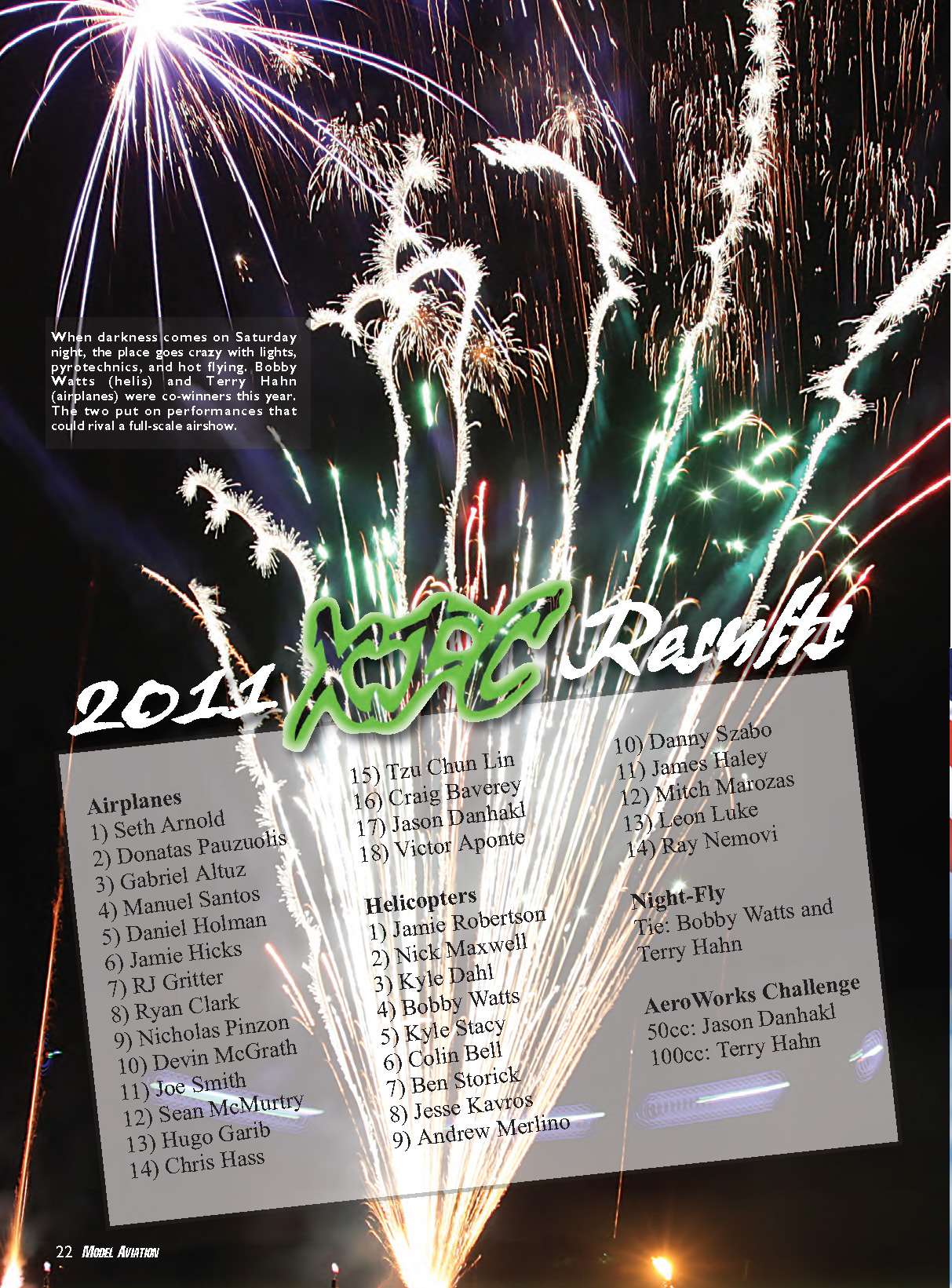
There's a $1,000 prize to the winner and these guys are serious! Terry flew first this year and his large-scale airplane was lit with a special array of LED lights that made the aircraft just as easy to see as in the daytime. His flight was impressive and included an untold amount of pyrotechnic augmentation.
The crowd was still catching its breath after that flight when Bobby Watts took to the air. Bobby had propane torches that shot flames 50 feet into the air. It looked like a meeting with the Wizard of Oz, except scarier.
All kinds of rockets were launched by a pyrotechnics team during the flight. When Bobby finally landed, the crowd greeted him with a standing ovation.
The public also determines the winner by applause. This year both Bobby and Terry's performances were so good that it had to be declared a tie. Congratulations to both of these stars of RC for making it one of the best nights under the stars.
Mark your calendars for early June in 2012 and come to the XFC. You will not be disappointed with the show these great pilots put on.
Congratulations again to all of the competitors for their hard work and time investment in this event. MA
Mark Fadely <REDACTED>
No additional article text on this page — only photo captions and images are present.
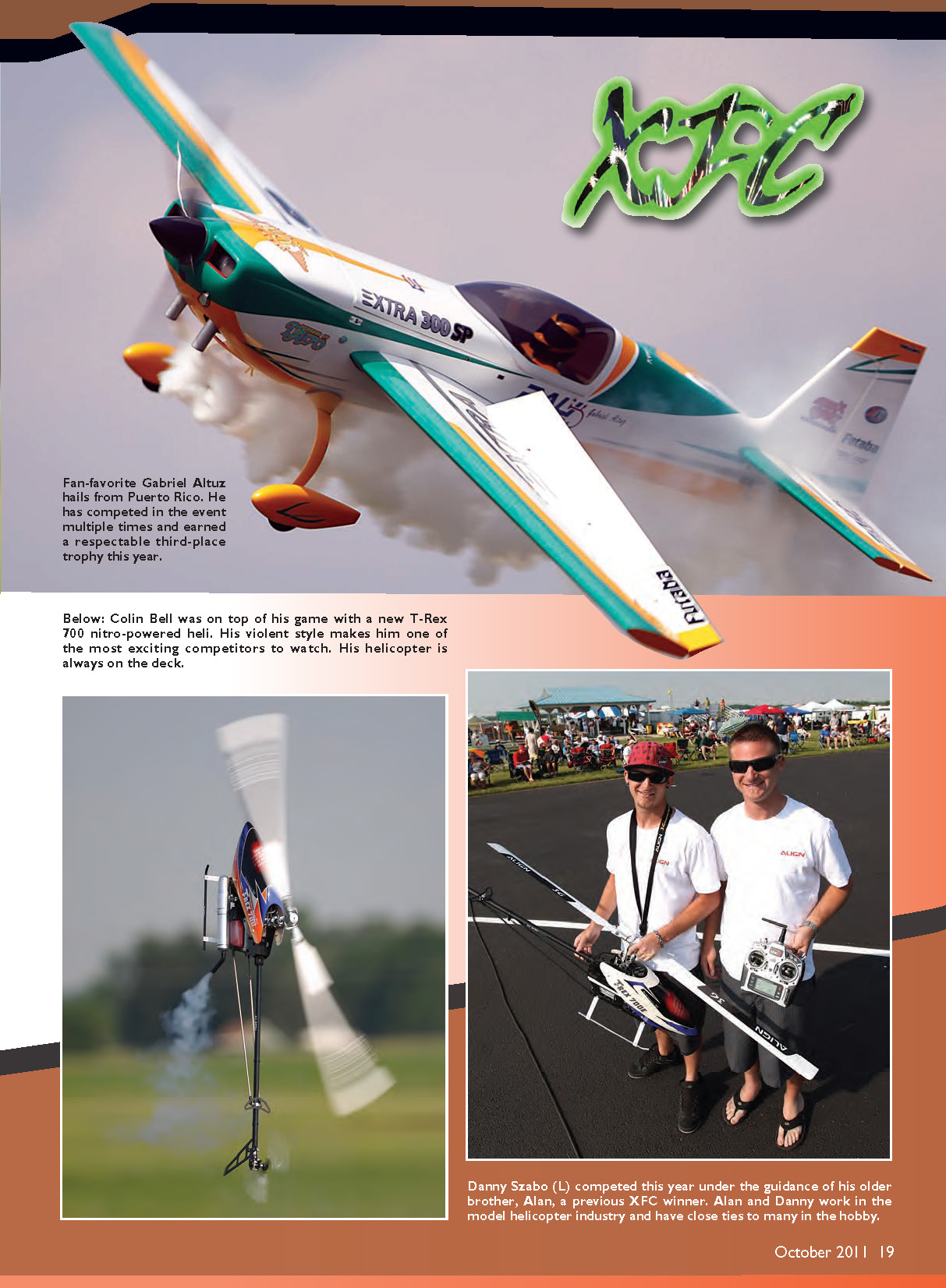
Fan-favorite Gabriel Altuz hails from Puerto Rico. He has competed in the event multiple times and earned a respectable third-place trophy this year.
Below: Colin Bell was on top of his game with a new T-Rex 700 nitro-powered heli. His violent style makes him one of the most exciting competitors to watch. His helicopter is always on the deck.
Danny Szabo (L) competed this year under the guidance of his older brother, Alan, a previous XFC winner. Alan and Danny work in the model helicopter industry and have close ties to many in the hobby.
No additional primary-article text appears on this page.
No primary-article text appears on this page.
2011 XFC Results
Airplanes 1) Seth Arnold 2) Donatas Pauzuolis 3) Gabriel Altuz 4) Manuel Santos 5) Daniel Holman 6) Jamie Hicks 7) RJ Gritter 8) Ryan Clark 9) Nicholas Pinzon 10) Devin McGrath 11) Joe Smith 12) Sean McMurtry 13) Hugo Garib 14) Chris Hass 15) Tzu Chun Lin 16) Craig Baverey 17) Jason Danhakl 18) Victor Aponte
Helicopters 1) Jamie Robertson 2) Nick Maxwell 3) Kyle Dahl 4) Bobby Watts 5) Kyle Stacy 6) Colin Bell 7) Ben Storick 8) Jesse Kavros 9) Andrew Merlino 10) Danny Szabo 11) James Haley 12) Mitch Marozas 13) Leon Luke 14) Ray Nemovi
Night-Fly Tie: Bobby Watts and Terry Hahn
AeroWorks Challenge 50cc: Jason Danhakl 100cc: Terry Hahn
Transcribed from original scans by AI. Minor OCR errors may remain.

