
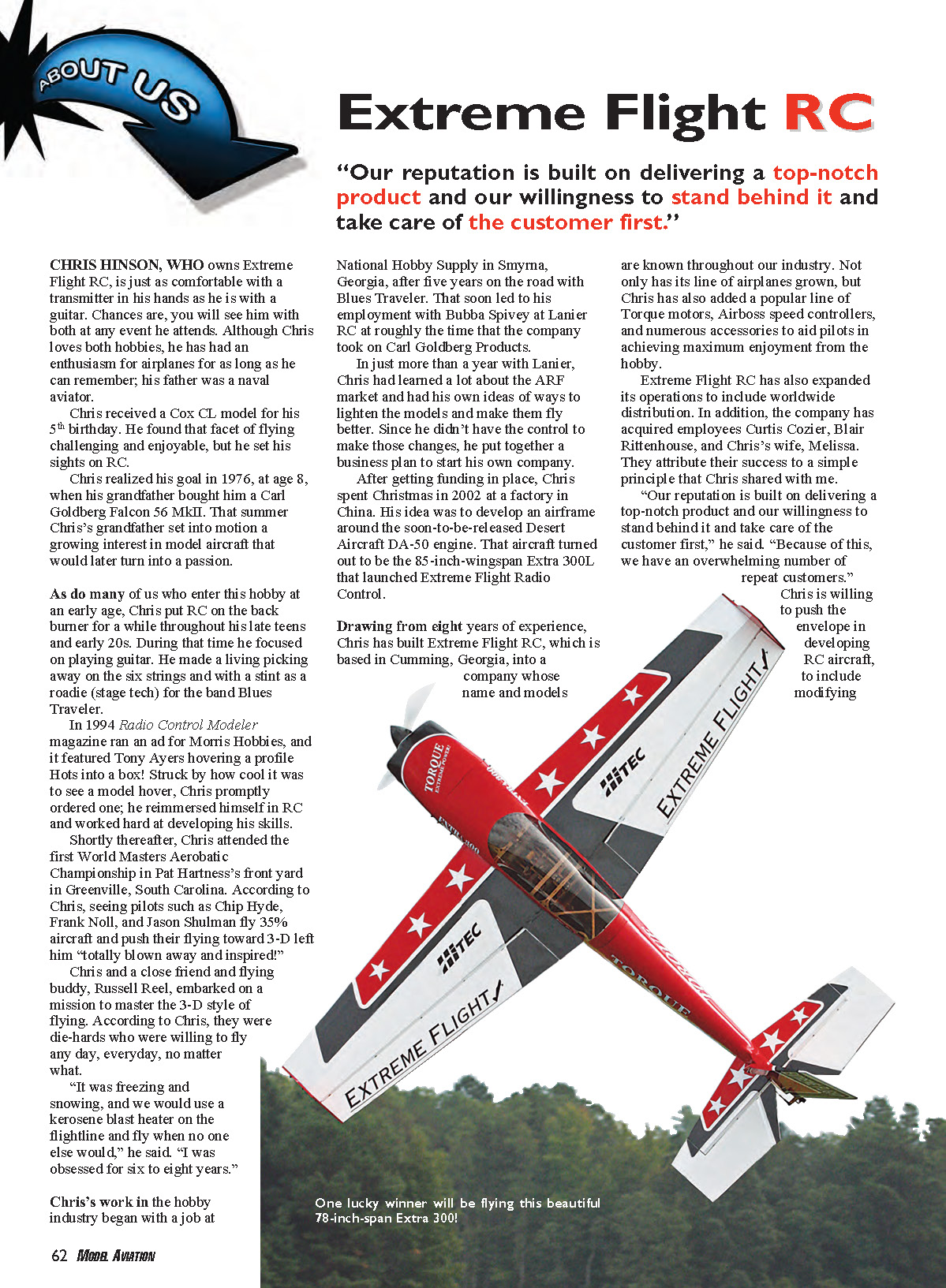
Extreme Flight RC
CHRIS HINSON, who owns Extreme Flight RC, is just as comfortable with a transmitter in his hands as he is with a guitar. Chances are you will see him with both at any event he attends. Although Chris loves both hobbies, he has had an enthusiasm for airplanes for as long as he can remember; his father was a naval aviator.
Early life and introduction to RC
Chris received a Cox CL model for his 5th birthday. He found that facet of flying challenging and enjoyable, but he set his sights on RC. Chris realized his goal in 1976, at age 8, when his grandfather bought him a Carl Goldberg Falcon 56 MkII. That summer Chris’s grandfather set into motion a growing interest in model aircraft that would later turn into a passion.
As do many who enter this hobby at an early age, Chris put RC on the back burner for a while during his late teens and early 20s. During that time he focused on playing guitar, making a living picking away on the six strings and with a stint as a roadie (stage tech) for the band Blues Traveler.
Return to RC and 3-D flying
In 1994, Radio Control Modeler magazine ran an ad for Morris Hobbies featuring Tony Ayers hovering a profile Hots into a box. Struck by how cool it was to see a model hover, Chris promptly ordered one; he reimmersed himself in RC and worked hard at developing his skills.
Shortly thereafter, Chris attended the first World Masters Aerobatic Championship in Pat Hartness’s front yard in Greenville, South Carolina. Seeing pilots such as Chip Hyde, Frank Noll, and Jason Shulman fly 35% aircraft and push their flying toward 3-D left him “totally blown away and inspired!”
Chris and a close friend and flying buddy, Russell Reel, embarked on a mission to master the 3-D style of flying. According to Chris, they were die-hards who were willing to fly any day, every day, no matter what. “It was freezing and snowing, and we would use a kerosene blast heater on the flight line and fly when no one else would,” he said. “I was obsessed for six to eight years.”
Industry career and founding Extreme Flight RC
Chris’s work in the hobby industry began with a job at National Hobby Supply in Smyrna, Georgia, after five years on the road with Blues Traveler. That soon led to employment with Bubba Spivey at Lanier RC around the time the company took on Carl Goldberg Products. In just more than a year with Lanier, Chris learned a lot about the ARF market and developed ideas for ways to lighten models and improve performance. Since he didn’t have the control to make those changes, he put together a business plan to start his own company.
After getting funding in place, Chris spent Christmas in 2002 at a factory in China. His idea was to develop an airframe around the soon-to-be-released Desert Aircraft DA-50 engine. That aircraft turned out to be the 85-inch-wingspan Extra 300L that launched Extreme Flight Radio Control.
Products, team, and operations
Drawing from years of experience, Chris has built Extreme Flight RC, based in Cumming, Georgia, into a company whose name and models are known throughout the industry. The company’s offerings have expanded beyond airframes to include motors, speed controllers, and accessories.
- Product lines:
- Torque motors
- Airboss speed controllers
- A growing line of ARF airplanes and accessories
- Team:
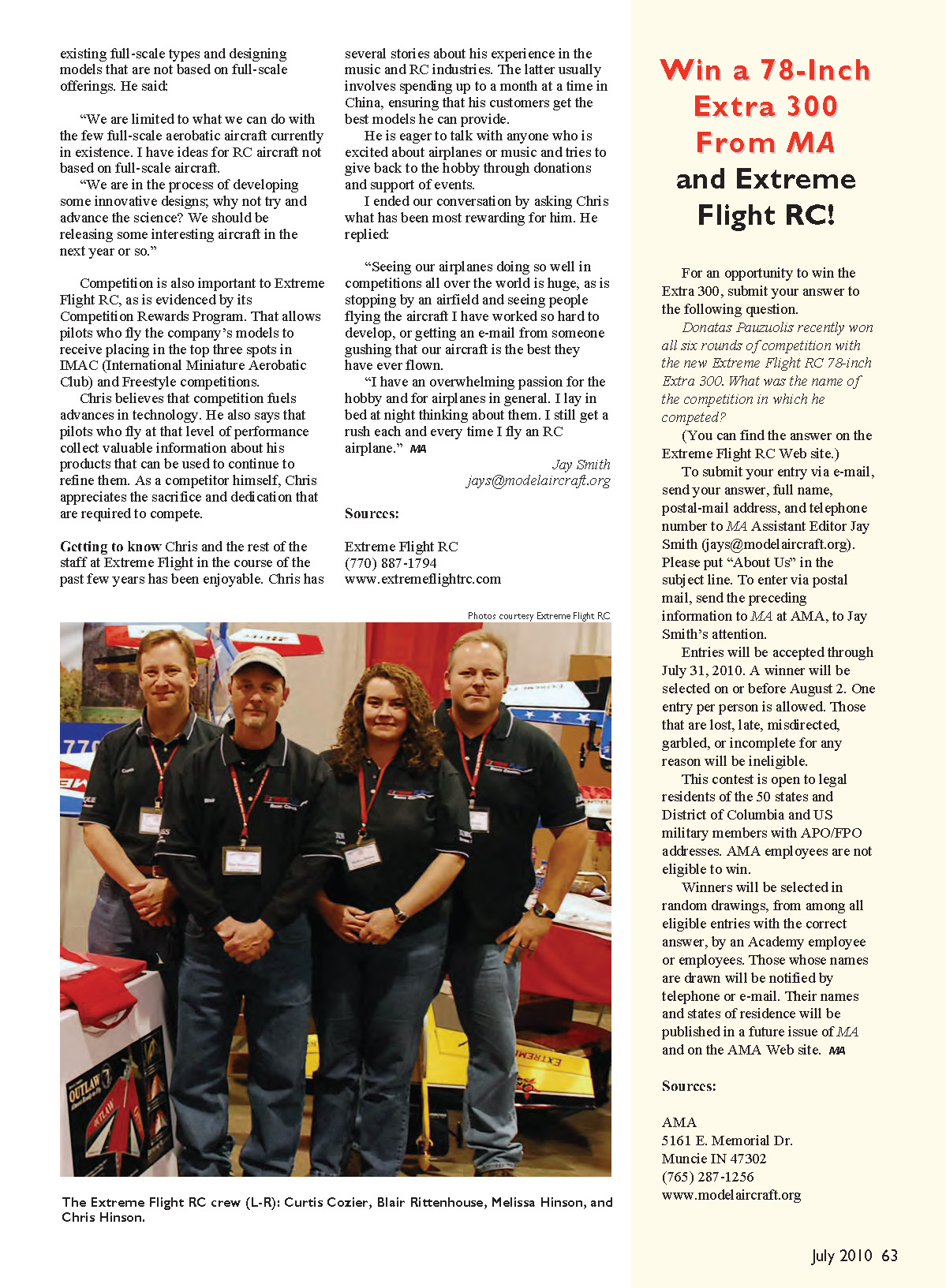
- Curtis Cozier
- Blair Rittenhouse
- Melissa Hinson (Chris’s wife)
Extreme Flight RC has expanded operations to include worldwide distribution. The company attributes its success to a simple principle Chris shared: “Our reputation is built on delivering a top-notch product and our willingness to stand behind it and take care of the customer first. Because of this, we have an overwhelming number of repeat customers.”
Chris is willing to push the envelope in developing RC aircraft, including modifying existing full-scale types and designing models not based on full-scale offerings. He said: “We are limited to what we can do with the few full-scale aerobatic aircraft currently in existence. I have ideas for RC aircraft not based on full-scale aircraft. We are in the process of developing some innovative designs; why not try and advance the science? We should be releasing some interesting aircraft in the next year or so.”
Competition and development
Competition is important to Extreme Flight RC, as evidenced by its Competition Rewards Program. That program allows pilots who fly the company’s models to receive recognition for placing in the top three spots in IMAC (International Miniature Aerobatic Club) and Freestyle competitions.
Chris believes that competition fuels advances in technology. Pilots who fly at that level of performance collect valuable information about products that can be used to continue refining them. As a competitor himself, Chris appreciates the sacrifice and dedication required to compete.
Personal notes
Getting to know Chris and the rest of the staff at Extreme Flight over the past few years has been enjoyable. Chris has several stories about his experiences in the music and RC industries. The latter usually involves spending up to a month at a time in China, ensuring that his customers get the best models he can provide.
He is eager to talk with anyone who is excited about airplanes or music and tries to give back to the hobby through donations and support of events.
When asked what has been most rewarding for him, Chris replied: “Seeing our airplanes doing so well in competitions all over the world is huge, as is stopping by an airfield and seeing people flying the aircraft I have worked so hard to develop, or getting an e-mail from someone gushing that our aircraft is the best they have ever flown. I have an overwhelming passion for the hobby and for airplanes in general. I lay in bed at night thinking about them. I still get a rush each and every time I fly an RC airplane.”
MA
Jay Smith [email protected]
Sources / Contact
Extreme Flight RC (770) 887-1794 www.extremeflightrc.com
Transcribed from original scans by AI. Minor OCR errors may remain.

