

Extreme Slope Soaring
"Ships are safe in the harbor, but that is not why ships are built."
Editor's note
Final segment of the four-part Slope Series.
I remember well the day I learned the key to Extreme Slope Soaring.
We were flying at Point Fermin, an unforgiving mega-lift site on the Palos Verdes peninsula south of Los Angeles, watching the shadows of heavy sailplanes on beach runs a couple hundred feet below. Some of the pilots were speaking of times when they had flown touch-and-gos on breaking waves.
Joe Chovan asked Brian Laird how many receivers he had actually lost to salt water immersion. Brian stared away for a moment, counting on his fingers, and announced, "Four."
Brian was not discouraged by that total; instead, he considered it part of the cost of admission to the adrenaline-filled realm of Extreme Slope Soaring. "Dave, if you lose a plane, you build another one during the week," he told me, and with that remark opened my eyes to the electrifying domain of Slope Soaring at times and places and in conditions that I never before thought were flyable.
The price of admission to this realm is willingness to risk a model, and perhaps the onboard radio gear. Note that Extreme Slope pilots do not risk personal injury, and in fact generally take great care to prep and fly according to the AMA Safety Code.
You may lose an aircraft to Extreme Slope Soaring, but there's no need to increase the risk of injury to yourself or others.
Extreme Locations
When looking out from the top of Pike's Peak after taking the Manitou Springs and Pike's Peak cog railway to the end of the line, I spent an hour thinking, "It sure would be great to fly from here, but if my airplane went down, I might never get it back." Now I wish I had taken my DAV 1-26 to the top on that trip.
Although under ideal conditions we bring home all of the airplanes we take to the slope, sometimes allowing for the possibility that a model might be lost allows flying in locations you might otherwise rule out.
This reasoning contrasts with our normal preservation-of-capital-assets emotions, and to actually throw an airplane off a slope with unrecoverable terrain below requires a new assessment of cost/benefit ratios.
For one thing, slope airplanes, often with simple two-channel control, are among the least-expensive airframes in all of radio-control flying. Many slope kits cost less than $100 and take $75 radio sets.
Hey, it's not like we're losing a $2,000 aircraft 10 seconds into the maiden flight, as is sometimes seen at other events. It's not like we have men onboard, as in full-scale Reno racing. We fly cheap-and-simple slope sailplanes.
What you stand to gain is a chance to fly in really big-sky conditions, to experience what is easily a most-memorable flying day—even in a decades-long sailplane career.
Is it worth risking an airplane? I think so. Should you try it? Only you can answer that.
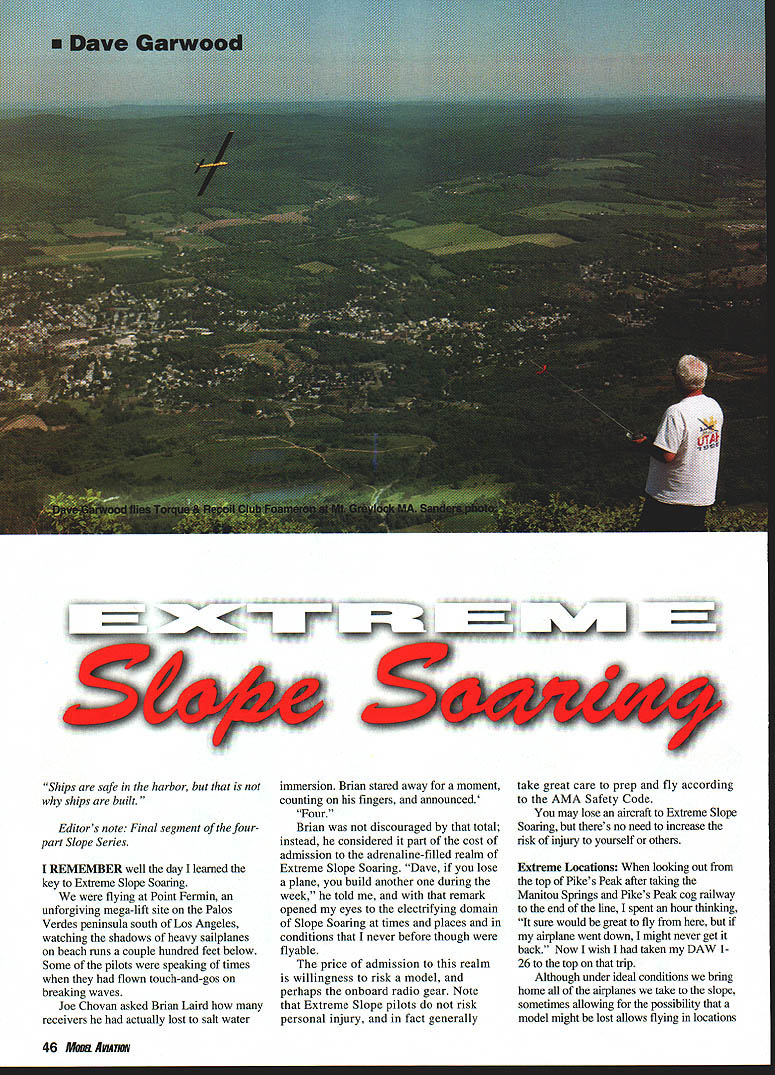
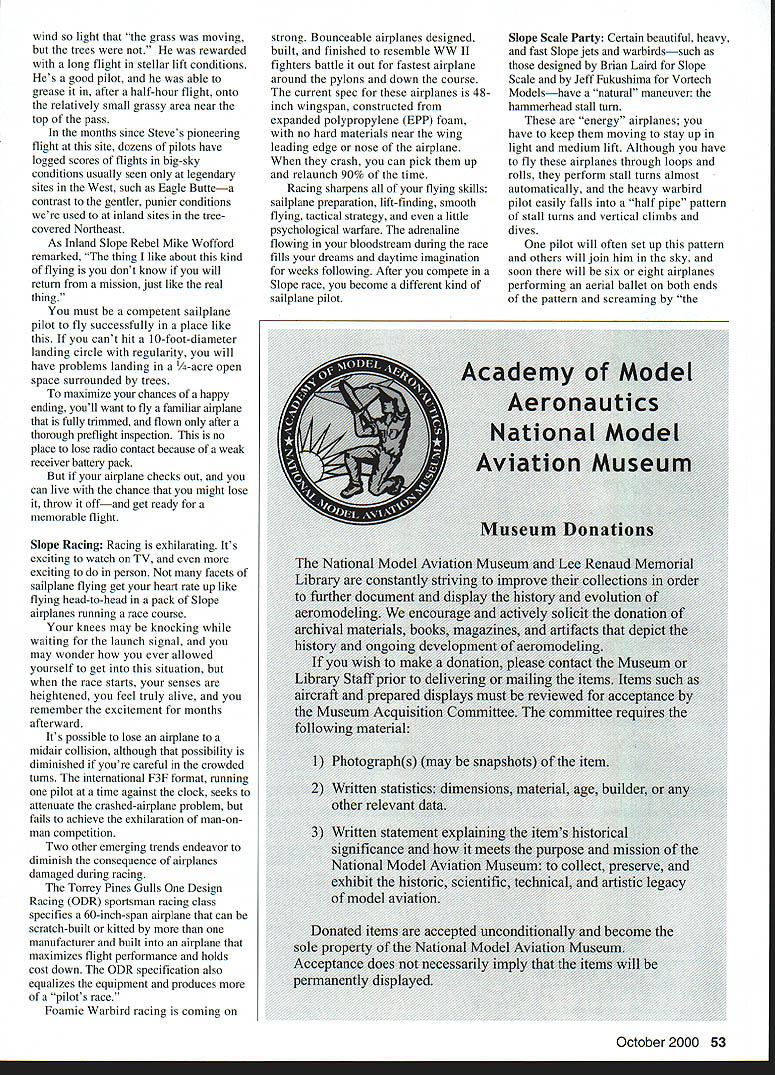
Steve Savoie, sparkplug organizer for the DownEast Soaring Club in Portland, ME, looked west from the top of Petersburg Pass on the NY/MA border and reasoned that the 900-foot-high, bowl-shaped venue would generate some pretty good lift. The main problem at Petersburg is the vast expanse of heavy tree cover below. If your airplane goes down in that forest, it's pretty much gone.
Steve is brave, and three years ago he tossed his kit-bashed Dump Chicken off in wind so light that "the grass was moving, but the trees were not." He was rewarded with a long flight in stellar lift conditions. He's a good pilot, and he was able to grease it in, after a half-hour flight, onto the relatively small grassy area near the top of the pass.
In the months since Steve's pioneering flight at this site, dozens of pilots have logged scores of flights in big-sky conditions usually seen only at legendary sites in the West, such as Eagle Butte—a contrast to the gentler, punier conditions we're used to at inland sites in the tree-covered Northeast.
As inland slope rebel Mike Wofford remarked, "The thing I like about this kind of flying is you don't know if you will return from a mission, just like the real thing."
You must be a competent sailplane pilot to fly successfully in a place like this. If you can't hit a 10-foot-diameter landing circle with regularity, you will have problems landing in a 1/4-acre open space surrounded by trees.
To maximize your chances of a happy ending, you'll want to fly a familiar airplane that is fully trimmed, and flown only after a thorough preflight inspection. This is no place to lose radio contact because of a weak receiver battery pack.
But if your airplane checks out, and you can live with the chance that you might lose it, throw it off—and get ready for a memorable flight.
Slope Racing
Racing is exhilarating. It's exciting to watch on TV, and even more exciting to do in person. Not many facets of sailplane flying get your heart rate up like flying head-to-head in a pack of slope airplanes running a race course.
Your knees may be knocking while waiting for the launch signal, and you may wonder how you ever allowed yourself to get into this situation, but when the race starts, your senses are heightened, you feel truly alive, and you remember the excitement for months afterward.
It's possible to lose an airplane to a midair collision, although that possibility is diminished if you're careful in the crowded turns. The international F3F format, running one pilot at a time against the clock, seeks to attenuate the crashed-airplane problem, but fails to achieve the exhilaration of man-on-man competition.
Two other emerging trends endeavor to diminish the consequence of airplanes damaged during racing.
- The Torrey Pines Gulls One Design Racing (ODR) sportsman racing class specifies a 60-inch-span airplane that can be scratch-built or kitted by more than one manufacturer and built into an airplane that maximizes flight performance and holds cost down. The ODR specification also equalizes the equipment and produces more of a "pilot's race."
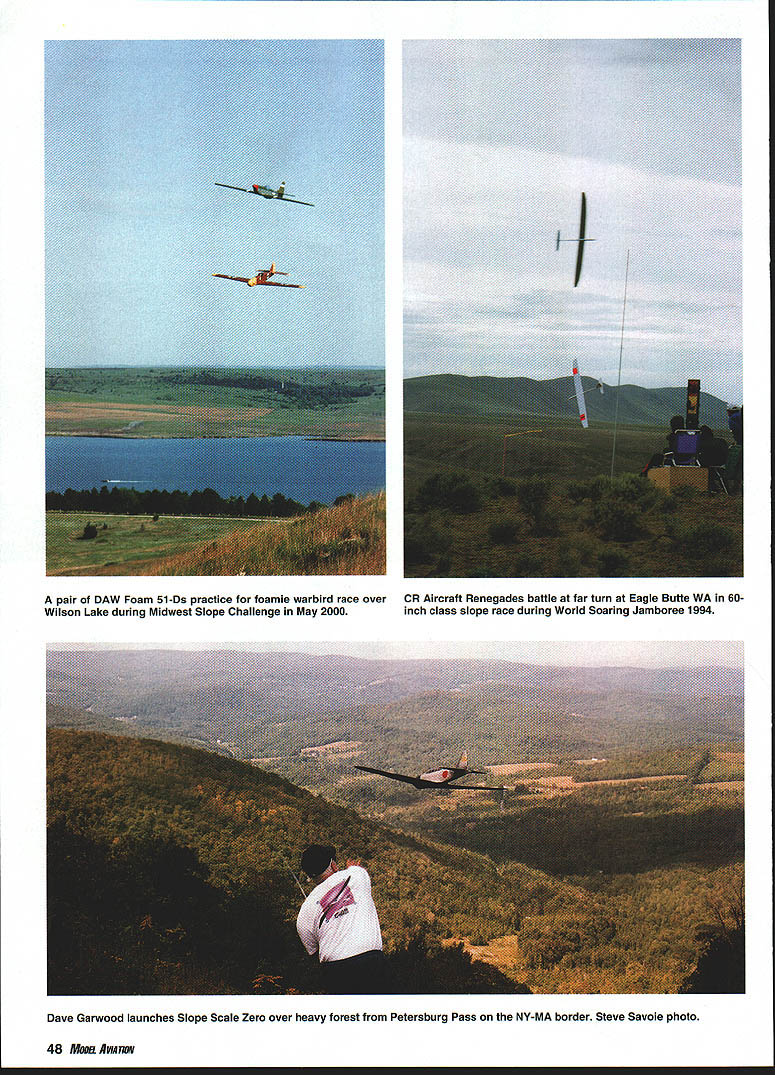
- Foamie Warbird racing is coming on strong. Bounceable airplanes designed, built, and finished to resemble WWII fighters battle it out for fastest airplane around the pylons and down the course. The current spec for these airplanes is 48-inch wingspan, constructed from expanded polypropylene (EPP) foam, with no hard materials near the wing leading edge or nose of the airplane. When they crash, you can pick them up and relearn 90% of the time.
Racing sharpens all of your flying skills: sailplane preparation, lift-finding, smooth flying, tactical strategy, and even a little psychological warfare. The adrenaline flowing in your bloodstream during the race fills your dreams and daytime imagination for weeks following. After you compete in a slope race, you become a different kind of sailplane pilot.
Slope Scale Party
Certain beautiful, heavy, and fast slope jets and warbirds—such as those designed by Brian Laird for Slope Scale and by Jeff Ruchisma for Vortech Models—have a "natural" maneuver: the hammerhead stall turn.
These are "energy" airplanes; you have to keep them moving to stay up in light and medium lift. Although you have to fly these airplanes through loops and rolls, they perform stall turns almost automatically, and the heavy warbird pilot easily falls into a "half pipe" pattern of stall turns and vertical climbs and dives.
One pilot will often set up this pattern and others will join him in the sky, and soon there will be six or eight airplanes performing an aerial ballet on both ends of the pattern and screaming by.
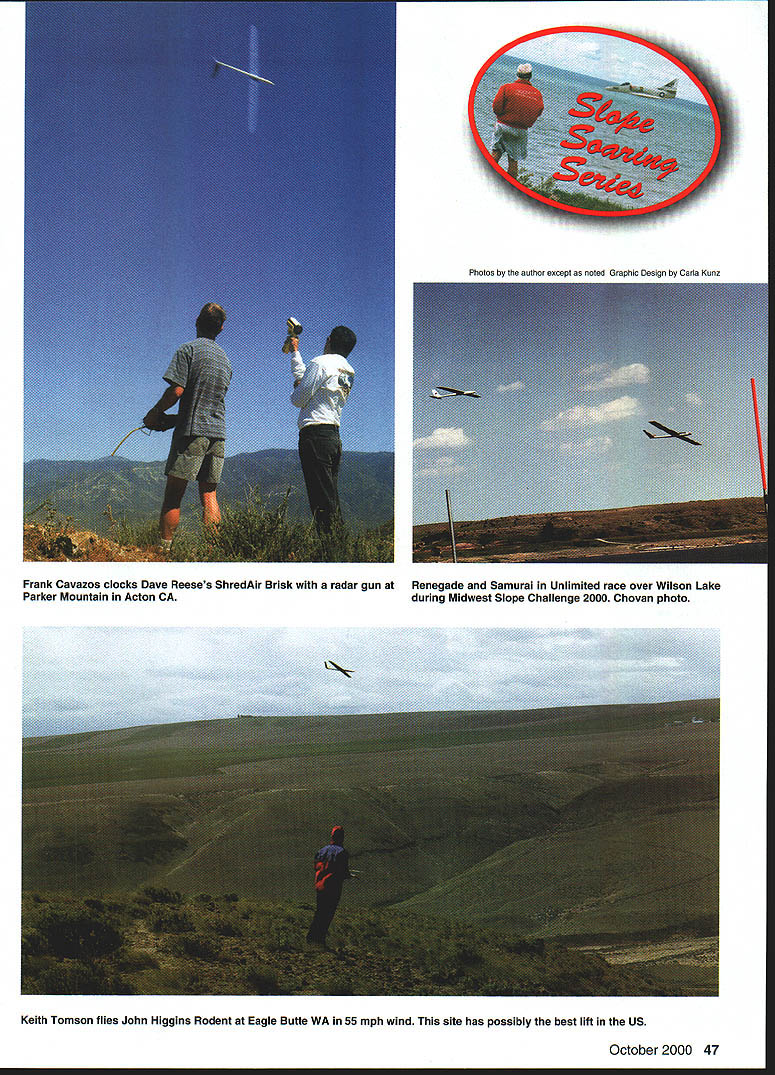
Once in the DS groove, the sailplane accelerates to fearsome speeds and requires maximum concentration to fly. On my last visit to Parker Mountain, Frank Cavazos clocked Dave Reese's ShredAir Brisk at 137 mph coming up the backside—an 18- or 19-mph wind.
Dave could sustain the DS pattern for pretty much as long as he wanted, but he has some mighty fine eyes and thumbs. Lesser pilots who need a rest from the intense concentration can use the stored energy to rocket straight up a few hundred feet, then cross over to the front side and fly in relaxing "normal" slope lift before tackling another DS run.
To DS successfully, you'll need an airplane that holds some energy and has utterly familiar flying characteristics. Many of the really fast DS airplanes resemble F3B models—they're tough, full-house 120-inch-span airplanes—but flying wings such as the Pat Bowman Sonic or Frank Cavazos Boomerang serve admirably as DS trainers, and I've pulled a few DS circuits with the Birdworks Zipper.
Much of Extreme Slope Soaring is difficult to explain fully in text and with still photos. Paul Naton has captured the sound and fury of dynamic soaring on his video Endless Lift II, available from Radio Carbon Art, Box 2311, Corvallis OR 97339-2311; Web site: www.radiocarbonart.com.
I have previewed DS and Slope Scale Party footage that will become part of an Extreme Slope Soaring video to be released late this year. For information on the availability of this upcoming tape, contact Dave Reese at <REDACTED>.
Paul's tape captures the awesome sound of high-speed airplanes doing DS and shows one airplane exploding (from air loads only) at Parker Mountain. Dave's tape shows a Slope Scale Party and DS at his smaller-than-Parker-Mountain site. Both show crashes, to remind us of ways a flight can go wrong.
Maybe you're a little nervous about these slope soaring endeavors; perhaps you're hesitant to wreck or lose an airplane. Think back to the primary training days of your time in RC flying. Did you wreck or lose an airplane? How about the feeling of pride and elation when you finally learned to fly the airplane—complete with shiny-side-up landings? Many of us were prepared to lose an airplane, and we did; yet the outcome was worth the risk.
Well, the exhilaration is all there for you, in a repeat performance in Extreme Slope Soaring.
Dave Garwood <REDACTED>
Transcribed from original scans by AI. Minor OCR errors may remain.

