
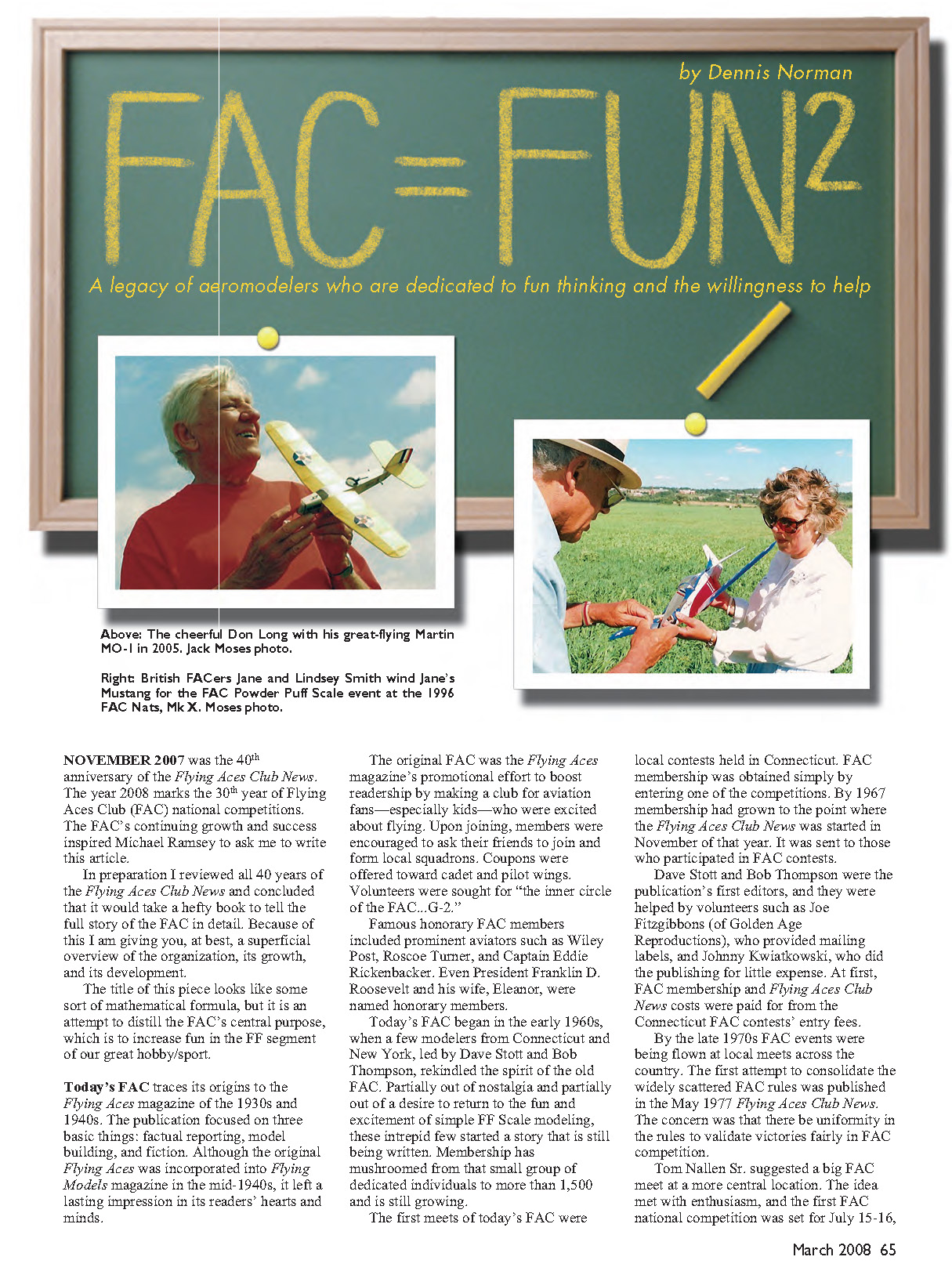
FAC = FUN2
by Dennis Norman
Overview
A legacy of aeromodelers who are dedicated to fun thinking and the willingness to help.
November 2007 was the 40th anniversary of the Flying Aces Club News. The year 2008 marks the 30th year of Flying Aces Club (FAC) national competitions. The FAC’s continuing growth and success inspired Michael Ramsey to ask me to write this article.
I reviewed all 40 years of the Flying Aces Club News and concluded that it would take a hefty book to tell the full story of the FAC in detail. Because of that, this article provides a concise overview of the organization, its growth, and its development.
The title looks like a mathematical formula, but it attempts to distill the FAC’s central purpose: to increase fun in the free-flight (FF) segment of our great hobby/sport.
Origins
Today’s FAC traces its origins to the Flying Aces magazine of the 1930s and 1940s. The publication focused on three basic things: factual reporting, model building, and fiction. Although the original Flying Aces was incorporated into Flying Models magazine in the mid-1940s, it left a lasting impression on its readers.
The original FAC was the Flying Aces magazine’s promotional effort to boost readership by creating a club for aviation fans—especially kids—who were excited about flying. Upon joining, members were encouraged to ask their friends to join and form local squadrons. Coupons were offered toward cadet and pilot wings. Volunteers were sought for “the inner circle of the FAC... G-2.”
Famous honorary FAC members included prominent aviators such as Wiley Post, Roscoe Turner, and Captain Eddie Rickenbacker. Even President Franklin D. Roosevelt and his wife, Eleanor, were named honorary members.
Rebirth and Early Growth
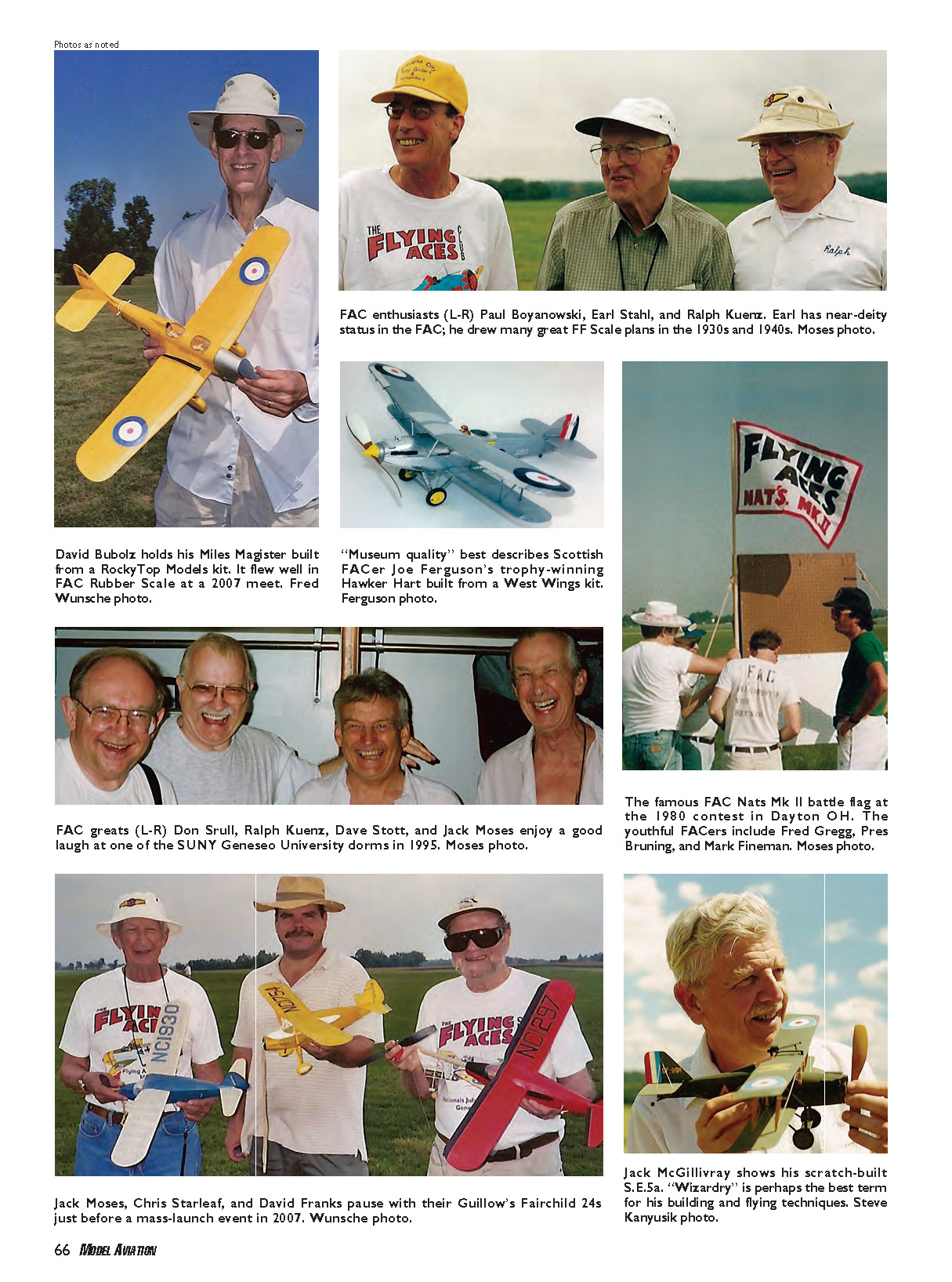
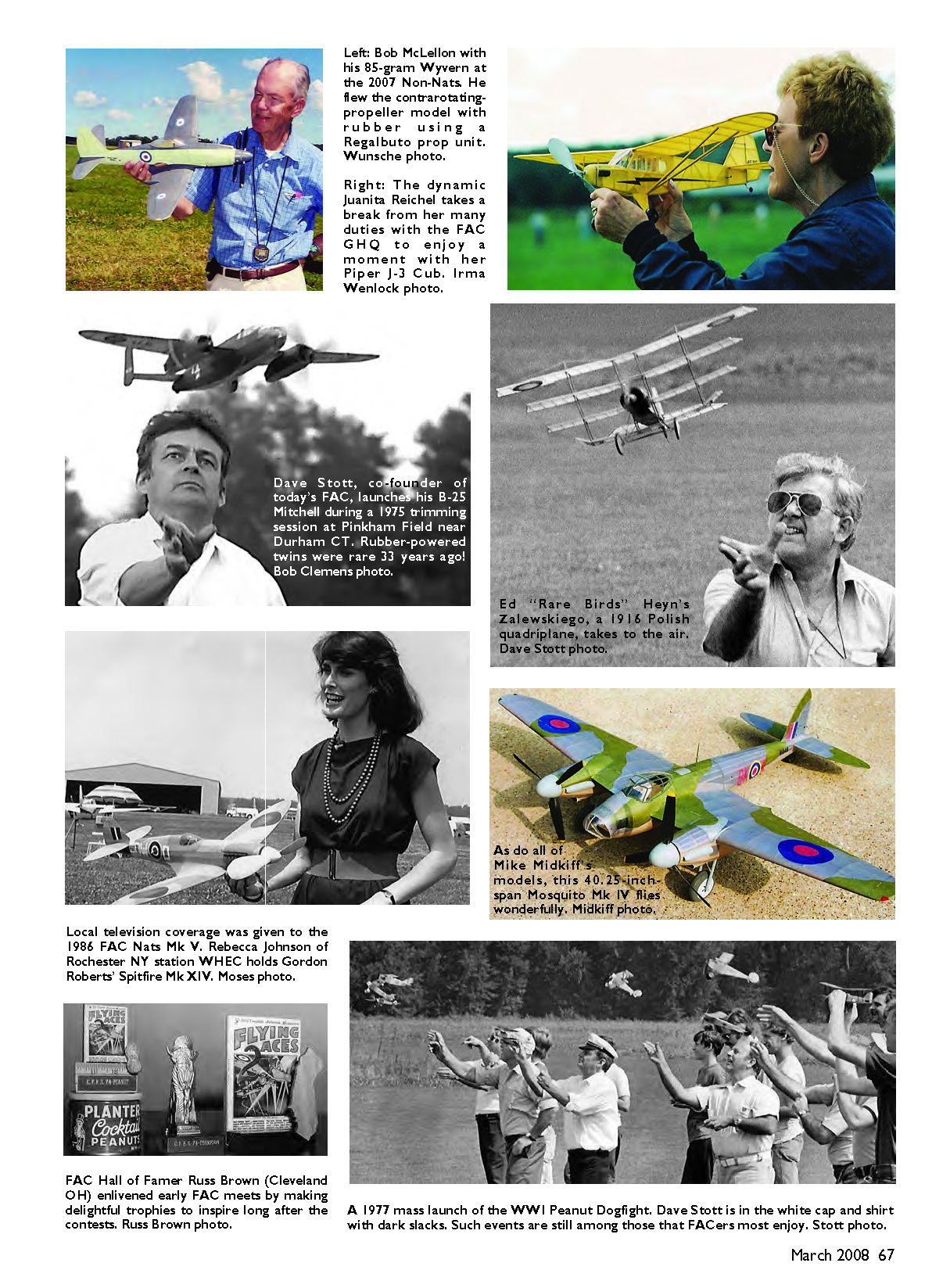
Today’s FAC began in the early 1960s, when a few modelers from Connecticut and New York, led by Dave Stott and Bob Thompson, rekindled the spirit of the old FAC. Partially out of nostalgia and partially from a desire to return to the fun and excitement of simple FF scale modeling, these intrepid few started a story that is still being written. Membership has grown from that small group to more than 1,500 and is still growing.
The first meets of today’s FAC were local contests held in Connecticut. FAC membership was obtained simply by entering one of the competitions. By 1967 membership had grown to the point where the Flying Aces Club News was started in November of that year. It was sent to those who participated in FAC contests. Dave Stott and Bob Thompson were the publication’s first editors, helped by volunteers such as Joe Fitzgibbons (of Golden Age Reproductions), who provided mailing labels, and Johnny Kwiatkowski, who did the publishing at little expense. At first, FAC membership and Flying Aces Club News costs were paid from Connecticut FAC contests’ entry fees.
By the late 1970s FAC events were being flown at local meets across the country. The first attempt to consolidate the widely scattered FAC rules was published in the May 1977 Flying Aces Club News. The concern was that there be uniformity in the rules to validate victories fairly in FAC competition.
First National Competition
Tom Nallen Sr. suggested a big FAC meet at a more central location. The idea met with enthusiasm, and the first FAC national competition was set for July 15–16, 1978, at the Johnsville Naval Air Station in Pennsylvania. Lin Reichel volunteered to be Contest Director (CD).
- A total of 10 events were scheduled.
- 81 contestants made 743 official flights.
- Don Srull was declared the first Grand Champion.
The contest’s great success made it clear that similar events would follow. However, by 1980 the growing FAC’s demands caused co-founders Dave Stott and Bob Thompson to announce that they were giving up running the organization and publishing the Flying Aces Club News.
New Leadership: The Reichels and Growth of the Nats
As news spread, FAC enthusiasm had begun to sweep Cleveland, Detroit, and other areas. When Lin Reichel of the Erie Model Aircraft Association in Pennsylvania heard the news, he asked Dave and Bob if he might take over the organization to keep it alive. They consented.
Lin and his dynamic wife, Juanita, were well suited to the job. They had successfully run the Erie-area Little League and were experienced with the rigors and demands of a large organization. The Reichels had capable friends in FAC members such as Vic Didelot (founder of the Erie Model Aircraft Association in 1963) and Ross Mayo, who brought energy and expertise.
Under Lin’s leadership, the FAC Nats were scheduled at two-year intervals at:
- Wright-Patterson Air Force Base, Ohio (1980)
- Johnsville Naval Air Station (1982)
- Utica, Michigan (1984)
- Geneseo, New York (1986)
Geneseo’s central location, huge flying site at the National Warplane Museum, State University of New York Geneseo facilities, and welcoming community spirit led the FAC to make it the Nats’ permanent home on May 16, 1987.
Modern FAC Competitions and Activity
The FAC Nats has continued to grow. In 2006 there were:
- 150 contestants
- 1,007 official flights
- 190 “maxes” (maximum flight times reached)
- 335 mass-launch flights
In addition to individual event winners, 12 awards were given for special achievements and a distinguished group of modelers was inducted into the FAC Hall of Fame.
There are currently two national FAC contests held each year:
- The biennial FAC Nats (mid-July, Geneseo)
- A smaller FAC Non-Nats held in the off years at Geneseo
Additionally, the FAC Championships is held each early September at the AMA flying site in Muncie, Indiana. FAC Squadrons, of which there are more than 70, hold numerous local meets.
Newsletter and Community Culture
The reborn FAC’s newsletter mimics the Flying Aces magazine’s style, but coverage has been expanded to include member correspondence, contest information, advertisements, reports of members’ achievements, technical articles, editorials, FAC rule updates, and even poetry, prayers, and songs as expressions of FACers’ joy and creativity.
People such as Vance Gilbert (a professional folk singer) and Bill Warner have regaled FAC gatherings with musical talent. The unforgettable Richard Miller has danced jigs while playing a small harmonica in the closing minutes of FAC competitions.
Ross Mayo emcees the FAC Nats banquets and keeps them light despite endless award presentations. He also helps direct much of the Nats activities, including hilarious model inspections for mass-launch events, and writes humorous pieces for the Flying Aces Club News.
Anecdote: Midway Motor Lodge Revisited
One of Ross’s classics is “Midway Motor Lodge Revisited,” which recounts a visit to the motel that housed many contestants during FAC Nats. Ross once returned to attend a wedding and stayed at the same motel. When he informed the clerk he had been a guest with the FAC, the clerk called for the manager and became pale and nervous.
The manager tried to reassure Ross, then led him to his room. Stopping at room 127, the manager became serious and pointed to a plaque near the window. The inscription read:
"July 14, 1984 On this date, twenty adult males stared through this window to watch another grown man finish building a model airplane ...as his lovely new bride stepped out from the shower, dried and dressed for dinner ... totally unnoticed!!!"
It is funny and true. I was the one still working on my Lancaster at the start of the 1984 FAC Nats, and I had made the table near the window my temporary workbench. Approximately 20 FACers had gathered to watch when my new bride, Linda, stepped out of the shower in full view of the window and was completely overlooked. One can be too dedicated to one’s hobby.
Traditions, Ranks, and Camaraderie
Dave Stott cited several factors contributing to the FAC’s success:
- Close association of the new FAC with survivors of the original FAC and magazine.
- Widespread member participation in organizing and running FAC contests.
- Informal culture with nicknames and a broad sense of humor.
A unique FAC tradition was the awarding of "Kanones" for winning official FAC events:
- 1 Kanone = Lieutenant
- 5 Kanones = Captain
- Progression continues up to Air Marshal at 50 Kanones
A German full-scale pilot who reached 16 Kanones was awarded the "Blue Max Medal," and the FAC follows that practice.
All Air Marshals are Tigers of the FAC. Gordon Roberts, with 534 Kanones, is the organization's Ace of Aces and was the first to reach Air Marshal. I was the second to reach Air Marshal status. When I topped 100 Kanones I gave up serious competition to concentrate on new-member recruitment, teaching, and writing. Today there are 55 Air Marshals.
FAC members are famous for their willingness to help others—especially the young and inexperienced—learn to build and fly. It has been said that a true FAC member will gladly give a needy competitor his or her last bit of high-quality rubber, even if it helps that competitor win. I have witnessed this unselfish gallantry many times.
Membership and Contact
If you are not a member, please contact FAC GHQ.
- Membership (includes Flying Aces Club News):
- US: $18 per year
- Canada: $25 per year
- Overseas: $30 per year
- All amounts in US dollars
- Flying Aces Club News is published approximately every other month.
FAC GHQ 3301 Cindy Ln. Erie, PA 16506
Dennis Norman [email protected]
Sources:
- FAC GHQ, Erie PA
Transcribed from original scans by AI. Minor OCR errors may remain.

