
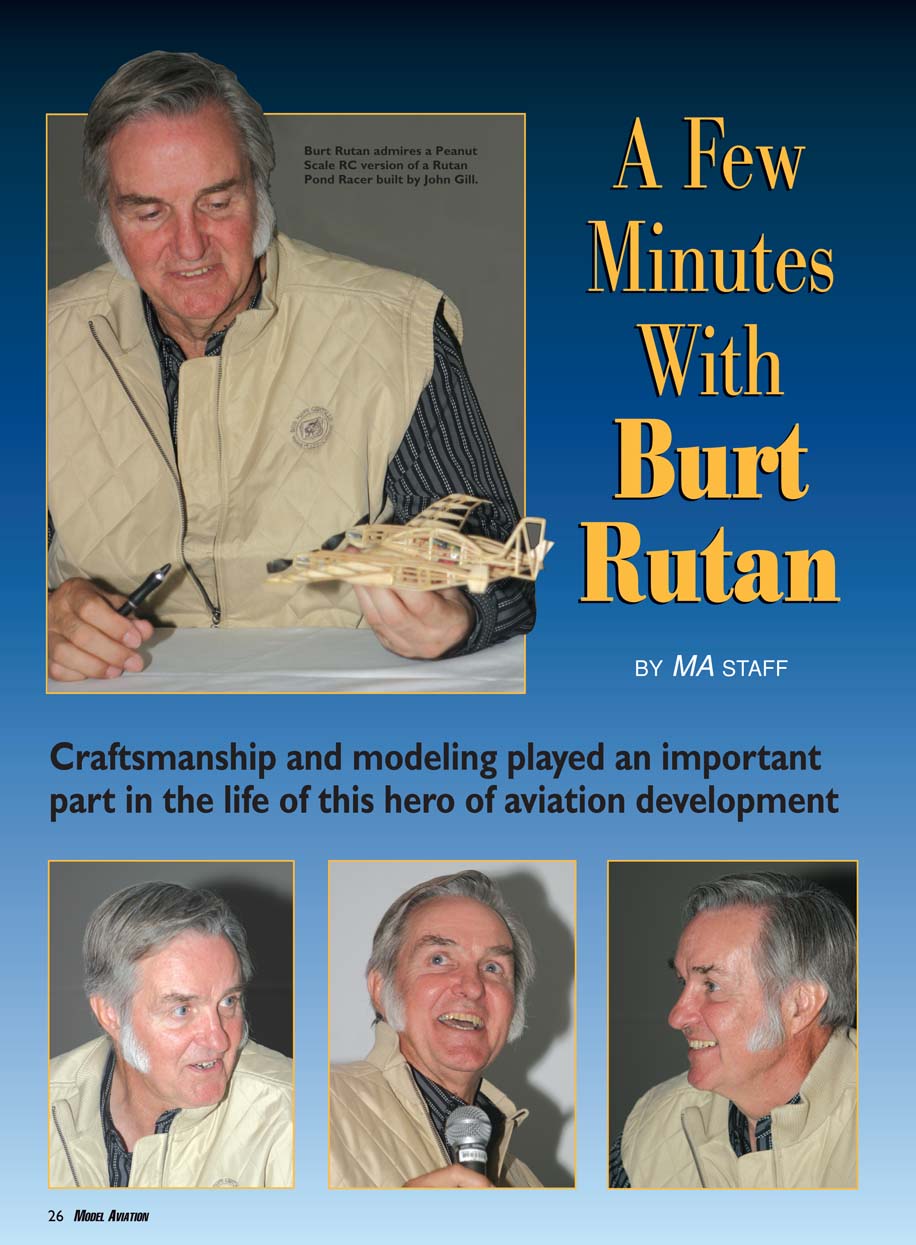
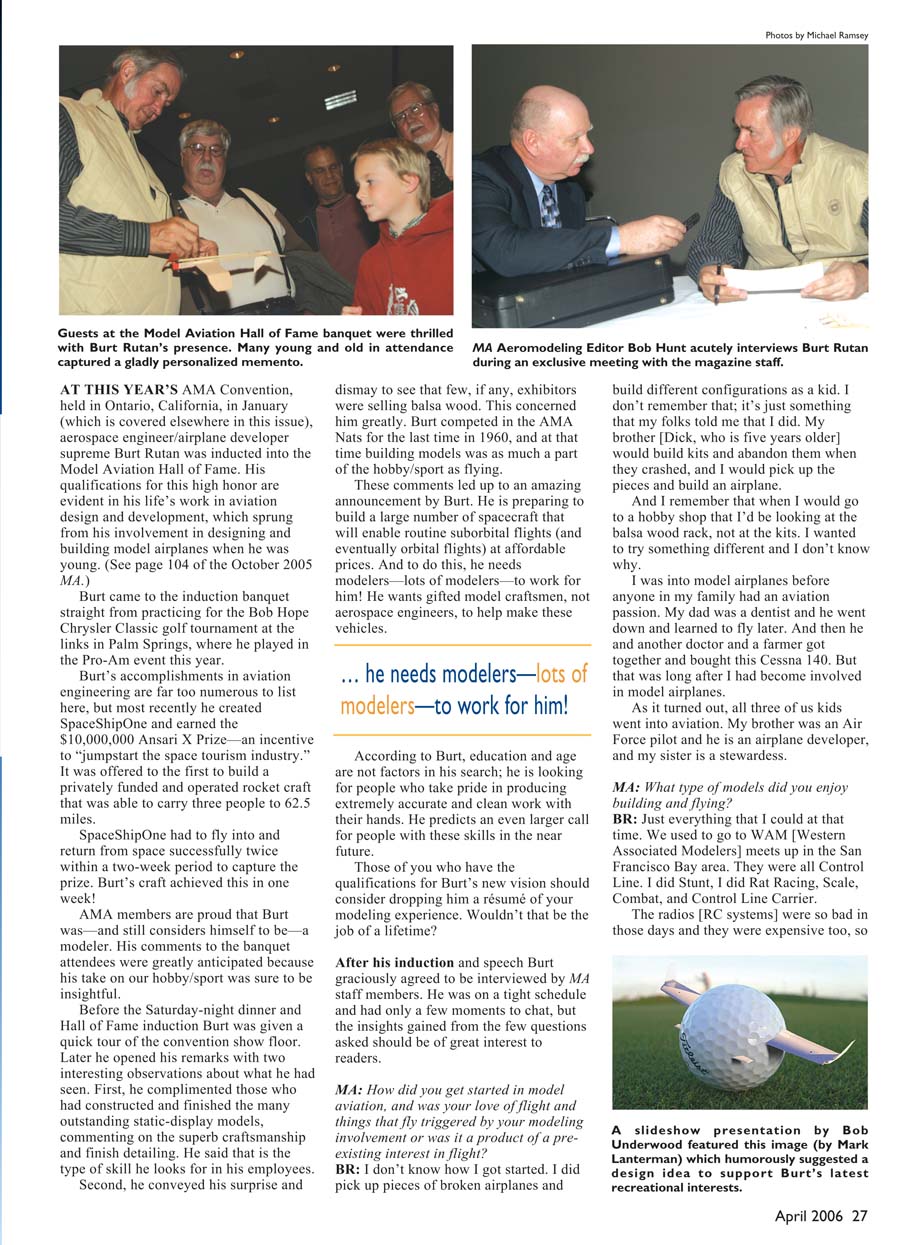
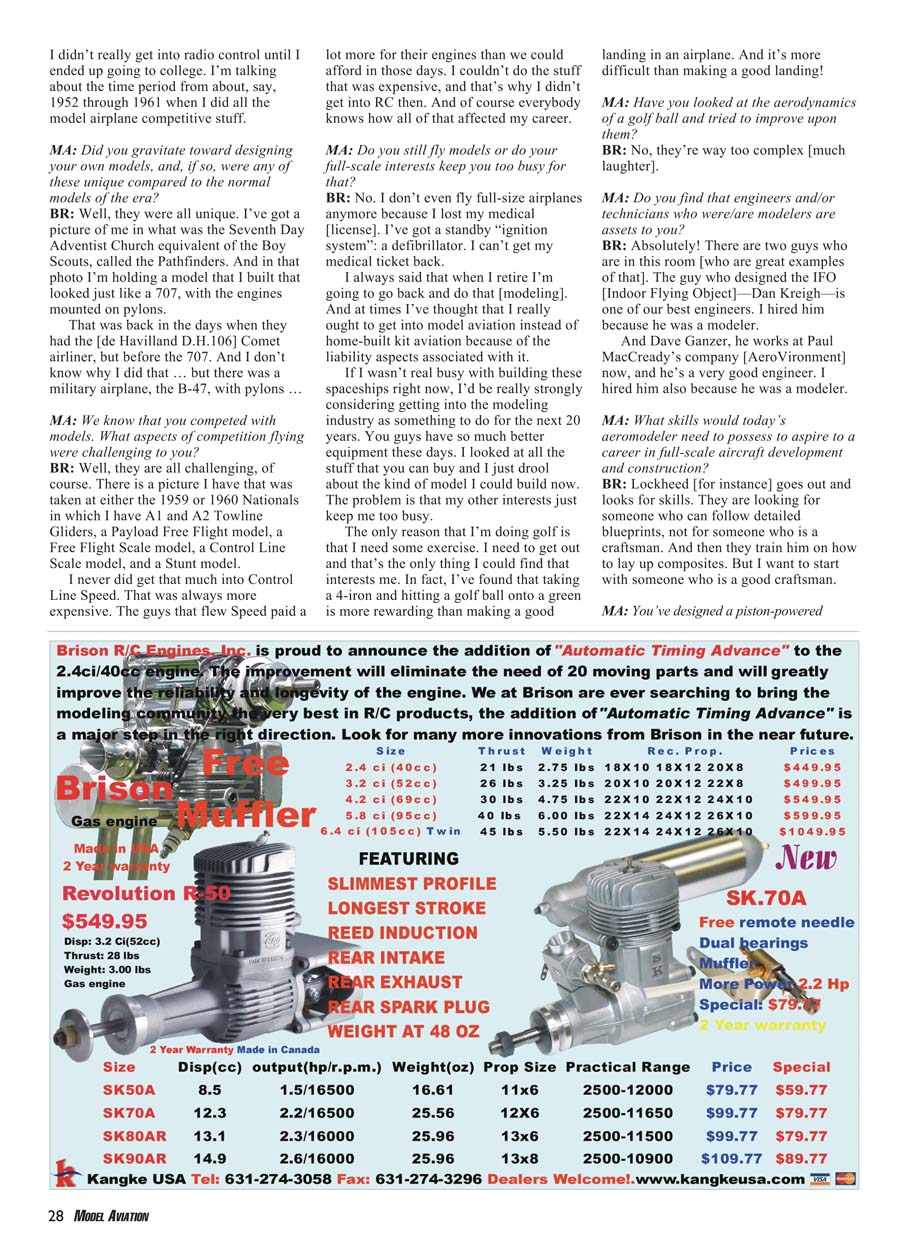
A Few Minutes With Burt Rutan
By MA Staff
Craftsmanship and modeling played an important part in the life of this hero of aviation development.
MA: I don’t remember that; it’s just something that my folks told me that I did. My brother [Dick, who is five years older] would build kits and abandon them when they crashed, and I would pick up the pieces and build an airplane.
BR: And I remember that when I would go to a hobby shop I’d be looking at the balsa wood rack, not at the kits. I wanted to try something different and I don’t know why.
BR: I was into model airplanes before anyone in my family had an aviation passion. My dad was a dentist and he went down and learned to fly later. Then he and another doctor and a farmer got together and bought a Cessna 140. But that was long after I had become involved in model airplanes.
BR: As it turned out, all three of us kids went into aviation. My brother was an Air Force pilot and he is an airplane developer, and my sister is a stewardess.
MA: What type of models did you enjoy building and flying?
BR: Just everything that I could at that time. We used to go to WAM (Western Associated Modelers) meets up in the San Francisco Bay area. They were all Control Line. I did Stunt, Rat Racing, Scale, Combat, and Control Line Carrier.
BR: The radios (RC systems) were so bad in those days and they were expensive too, so I didn't really get into radio control until I ended up going to college. I'm talking about the time period from about, say, 1952 through 1961 when I did all the model airplane competitive stuff.
MA: Did you gravitate toward designing your own models, and, if so, were any of these unique compared to the normal models of the era?
BR: Well, they were all unique. I've got a picture of me in what was the Seventh-day Adventist Church equivalent of the Boy Scouts, called the Pathfinders. In that photo I'm holding a model that I built that looked just like a 707, with the engines mounted on pylons.
BR: That was back in the days when they had the de Havilland D.H.106 Comet airliner, but before the 707. I don't know why I did that ... but there was a military airplane, the B-47, with pylons ...
MA: We know that you competed with models. What aspects of competition flying were challenging to you?
BR: Well, they are all challenging, of course. There is a picture I have that was taken at either the 1959 or 1960 Nationals in which I have A-1 and A-2 Townline Gliders, a Payload Free Flight model, a Free Flight Scale model, a Control Line Scale model, and a Stunt model.
BR: I never did get that much into Control Line Speed. That was always more expensive. The guys that flew Speed paid a lot more for their engines than we could afford in those days. I couldn't do the stuff that was expensive, and that's why I didn't get into RC then. And of course everybody knows how all of that affected my career.
MA: Do you still fly models or do your full-scale interests keep you too busy for that?
BR: No. I don't even fly full-size airplanes anymore because I lost my medical [license]. I've got a standby "ignition system": a defibrillator. I can't get my medical ticket back.
BR: I always said that when I retire I'm going to go back and do that [modeling]. At times I've thought that I really ought to get into model aviation instead of home-built kit aviation because of the liability aspects associated with it.
BR: If I wasn't real busy with building these spaceships right now, I'd be strongly considering getting into the modeling industry as something to do for the next 20 years. You guys have so much better equipment these days. I looked at all the stuff that you can buy and I just drool about the kind of model I could build now. The problem is that my other interests just keep me too busy.
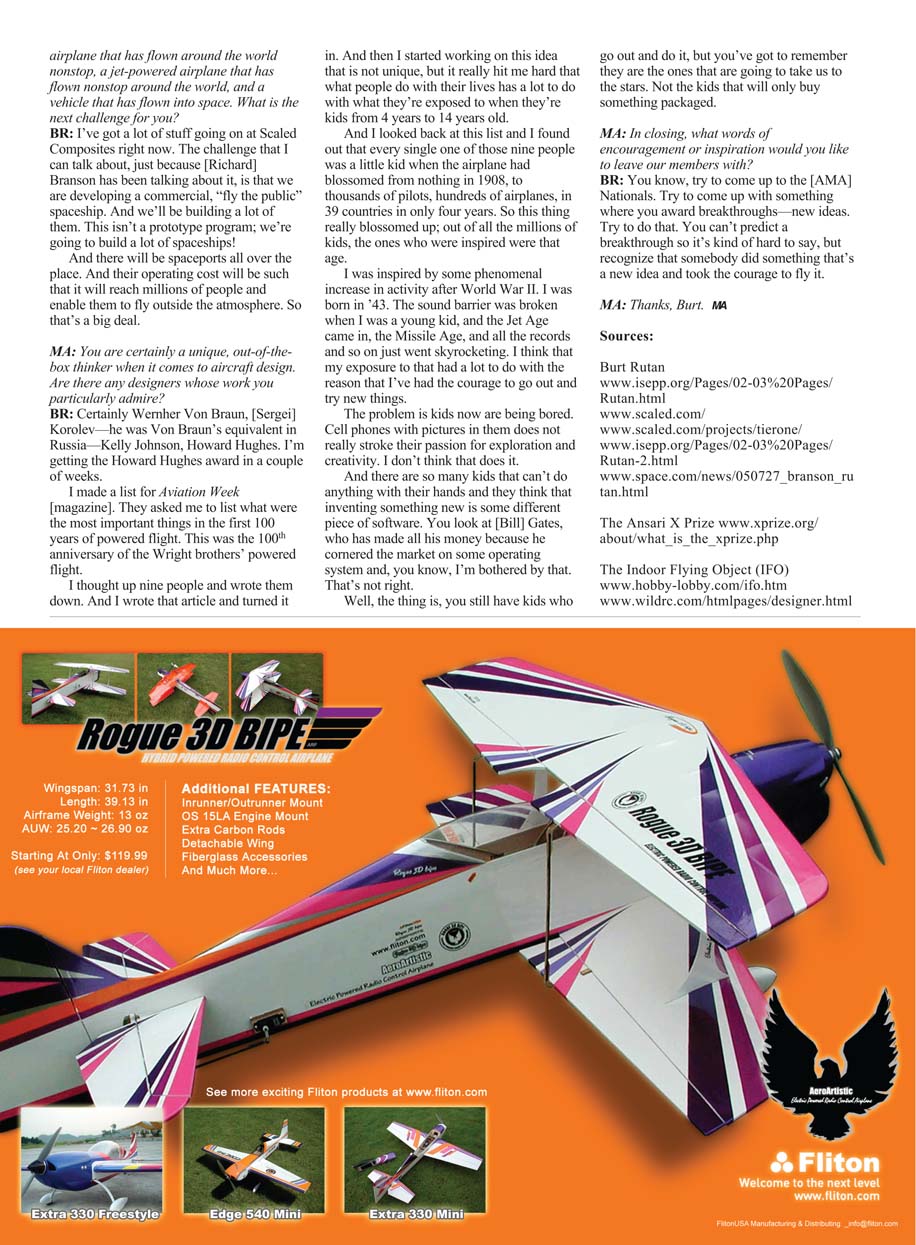
BR: The only reason that I'm doing golf is that I need some exercise. I need to get out and that's the only thing I could find that interests me. In fact, I've found that taking a 4-iron and hitting a golf ball onto a green is more rewarding than making a good landing in an airplane. And it's more difficult than making a good landing!
MA: Have you looked at the aerodynamics of a golf ball and tried to improve upon them?
BR: No, they're way too complex. [laughter]
MA: Do you find that engineers and/or technicians who were/are modelers are assets to you?
BR: Absolutely! There are two guys who are in this room who are great examples of that. The guy who designed the IFO [Indoor Flying Object]—Dan Kreigh—is one of our best engineers. I hired him because he was a modeler.
BR: And Dave Ganzer, he works at Paul MacCready's company [AeroVironment] now, and he's a very good engineer. I hired him also because he was a modeler.
MA: What skills would today's aeromodeler need to possess to aspire to a career in full-scale aircraft development and construction?
BR: Lockheed, for instance, goes out and looks for skills. They are looking for someone who can follow detailed blueprints, not for someone who is just a craftsman. Then they train him on how to lay up composites. But I want to start with someone who is a good craftsman.
MA: You've designed a piston-powered airplane that has flown around the world nonstop, a jet-powered airplane that has flown nonstop around the world, and a vehicle that has flown into space. What is the next challenge for you?
BR: I've got a lot of stuff going on at Scaled Composites right now. The challenge that I can talk about, just because [Richard] Branson has been talking about it, is that we are developing a commercial, "fly-the-public" spaceship. And we'll be building a lot of them. This isn't a prototype program; we're going to build a lot of spaceships!
BR: There will be spaceports all over the place. Their operating cost will be such that it will reach millions of people and enable them to fly outside the atmosphere. So that's a big deal.
MA: You are certainly a unique, out-of-the-box thinker when it comes to aircraft design. Are there any designers whose work you particularly admire?
BR: Certainly Wernher von Braun, Sergei Korolev—he was von Braun's equivalent in Russia—Kelly Johnson, Howard Hughes. I'm getting the Howard Hughes award in a couple of weeks.
BR: I made a list for Aviation Week. They asked me to list what were the most important things in the first 100 years of powered flight. This was the 100th anniversary of the Wright brothers' powered flight.
BR: I thought up nine people and wrote them down. Then I started working on this idea that is not unique, but it really hit me hard that what people do with their lives has a lot to do with what they're exposed to when they're kids from 4 years to 14 years old.
BR: I looked back at this list and found that every single one of those nine people was a little kid when the airplane had blossomed from nothing in 1908 to thousands of pilots, hundreds of airplanes, in 39 countries in only four years. So this thing really blossomed; out of all the millions of kids, the ones who were inspired were that age.
BR: I was inspired by some phenomenal increase in activity after World War II. I was born in 1943. The sound barrier was broken when I was a young kid, and the Jet Age came in, the Missile Age, and all the records and so on just went skyrocketing. I think that my exposure to that had a lot to do with the reason that I've had the courage to go out and try new things.
BR: The problem is kids now are bored. Cell phones with pictures in them do not really stoke their passion for exploration and creativity. I don't think that does it.
BR: There are so many kids that can't do anything with their hands and they think that inventing something new is some different piece of software. You look at Bill Gates, who has made all his money because he cornered the market on some operating system and, you know, I'm bothered by that. That's not right.
BR: The thing is, you still have kids who go out and do it, but you've got to remember they are the ones who are going to take us to the stars, not the kids who will only buy something packaged.
MA: In closing, what words of encouragement or inspiration would you like to leave our members with?
BR: Try to come up to the [AMA] Nationals. Try to come up with something where you award breakthroughs—new ideas. Try to do that. You can't predict a breakthrough so it's kind of hard to say, but recognize that somebody did something that's a new idea and took the courage to fly it.
MA: Thanks, Burt. MA
Sources
- Burt Rutan
- www.isepp.org/Pages/02-03%20Pages/Rutan.html
- www.scaled.com
- www.scaled.com/projects/tierone/
- www.isepp.org/Pages/02-03%20Pages/Rutan-2.html
- www.space.com/news/050727_branson_rutan.html
- The Ansari X Prize: www.xprize.org/about/what_is_the_xprize.php
- The Indoor Flying Object (IFO):
- www.hobby-lobby.com/ifo.htm
- www.wildrc.com/htmlpages/designer.html
Transcribed from original scans by AI. Minor OCR errors may remain.

