
FREE FLIGHT DURATION
Louis Joyner, 4221 Old Leeds Rd., Birmingham AL 35213
When I was a junior in the 1950s and early 1960s, there were separate Junior, Senior, and Open age categories for almost every event at the Nationals.
One of the shocks and disappointments to me when I attended the 1996 Nats after a long layoff was the lack of Junior events and Junior contestants.
Was Free Flight dying, as many had predicted?
However, during the last five years I have noticed a steady upward trend, with a few more Juniors competing at each Nats. Although the quantity of fliers doesn't rival the numbers at Navy Nationals of the 1950s, the quality of flying gets better each year. F1B Wakefield helps illustrate the change.
Two years ago, the United States had no F1B Wakefield fliers to send to the Junior World Championships. This year the US is sending three Junior Wakefield fliers, three F1A towline glider fliers, and one F1J Power flier.
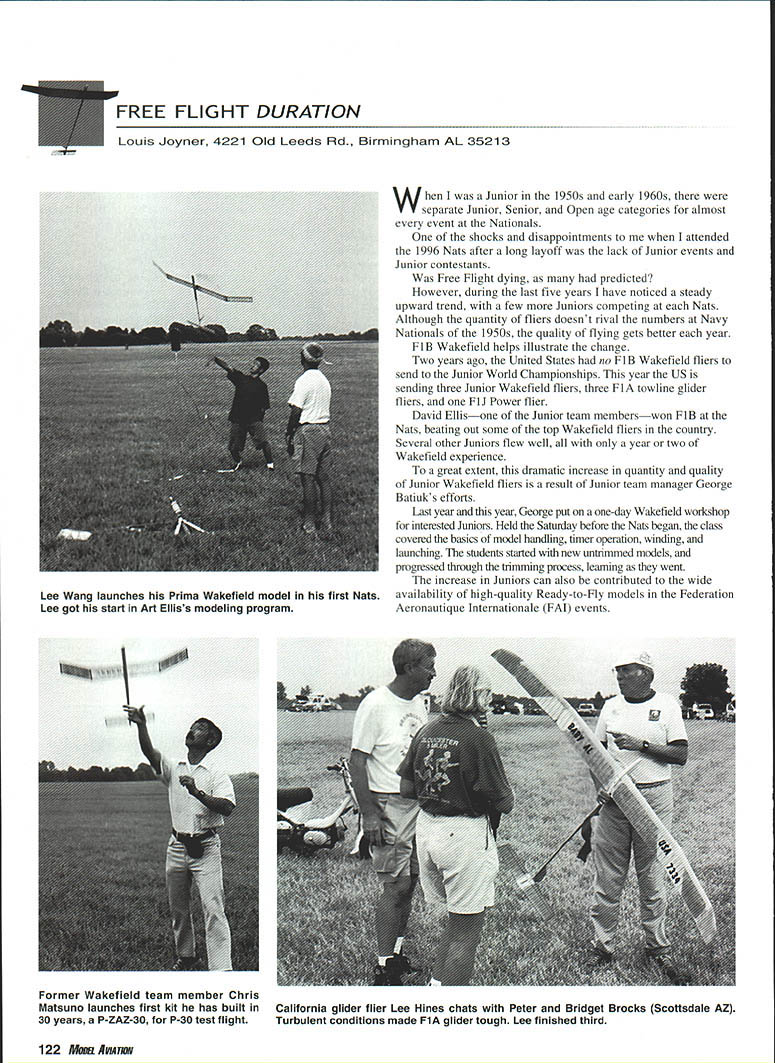
David Ellis—one of the Junior team members—won F1B at the Nats, beating out some of the top Wakefield fliers in the country. Several other Juniors flew well, all with only a year or two of Wakefield experience.
To a great extent, this dramatic increase in quantity and quality of Junior Wakefield fliers is a result of Junior team manager George Batiuk's efforts.
Last year and this year, George put on a one-day Wakefield workshop for interested Juniors. Held the Saturday before the Nats began, the class covered the basics of model handling, timer operation, winding, and launching. The students started with new untrimmed models and progressed through the trimming process, learning as they went.
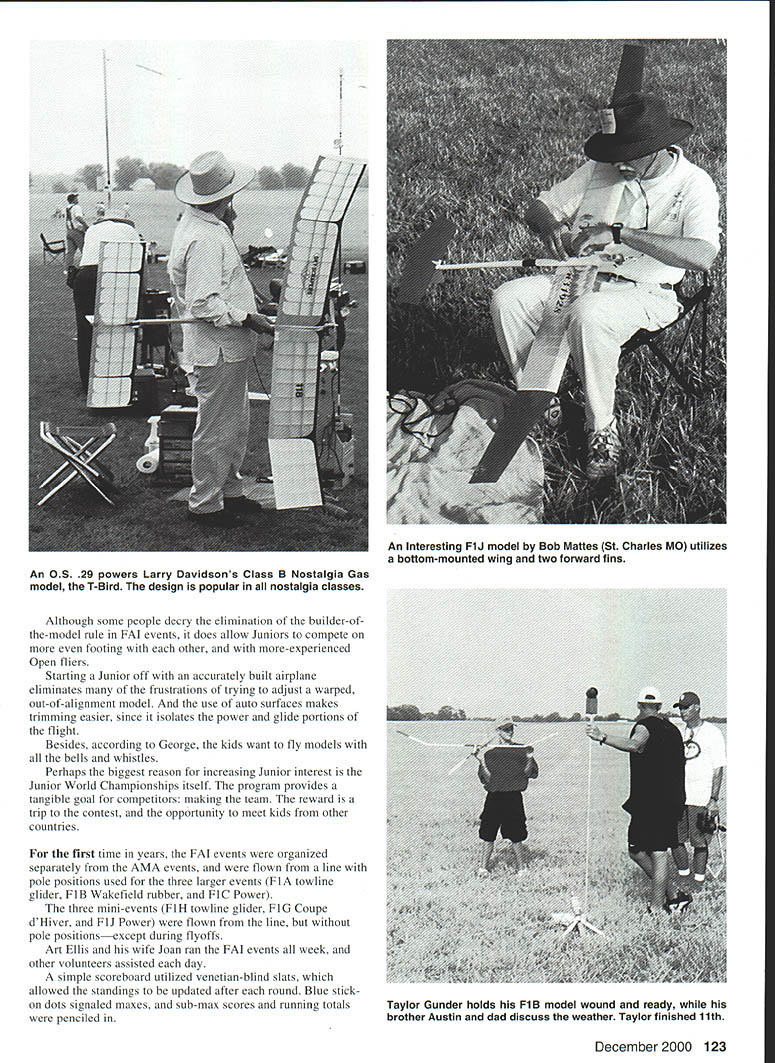
The increase in Juniors can also be attributed to the wide availability of high-quality ready-to-fly models in the Fédération Aéronautique Internationale (FAI) events. Although some people decry the elimination of the builder-of-the-model rule in FAI events, it does allow Juniors to compete on more even footing with each other and with more-experienced Open fliers.
Starting a Junior off with an accurately built airplane eliminates many of the frustrations of trying to adjust a warped, out-of-alignment model. And the use of auto surfaces makes trimming easier, since it isolates the power and glide portions of the flight.
Besides, according to George, the kids want to fly models with all the bells and whistles.
Perhaps the biggest reason for increasing Junior interest is the Junior World Championships itself. The program provides a tangible goal for competitors: making the team. The reward is a trip to the contest and the opportunity to meet kids from other countries.
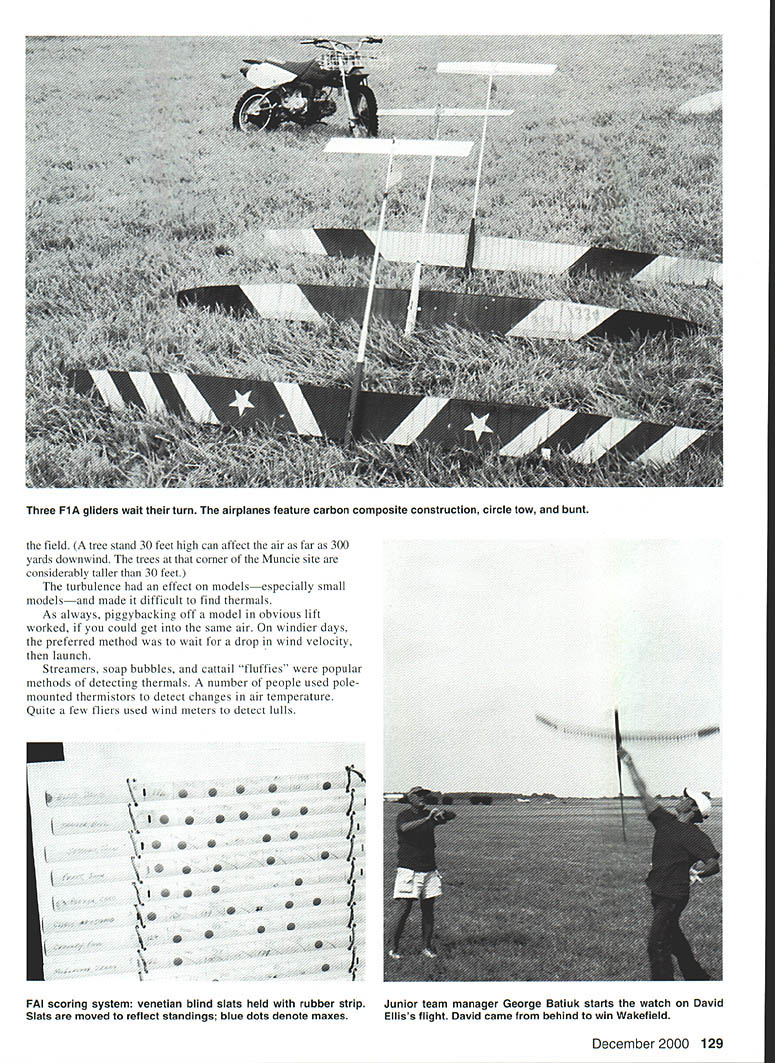
For the first time in years, the FAI events were organized separately from the AMA events and were flown from a line with pole positions used for the three larger events:
- F1A towline glider
- F1B Wakefield rubber
- F1C Power
The three mini-events (F1H towline glider, F1G Coupe d'Hiver, and F1J Power) were flown from the line but without pole positions—except during flyoffs.
Art Ellis and his wife Joan ran the FAI events all week, and other volunteers assisted each day.
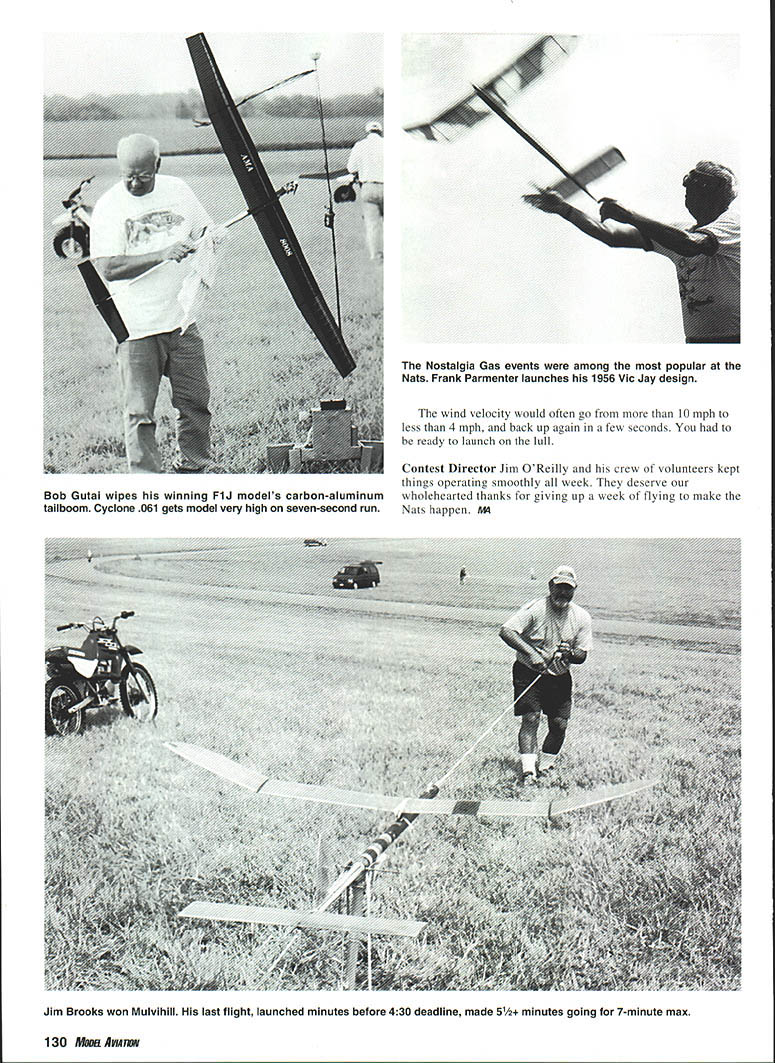
A simple scoreboard utilized venetian-blind slats, which allowed the standings to be updated after each round. Blue stick-on dots signaled maxes, and sub-max scores and running totals were penciled in.
Flight cards were kept in plastic bags at each pole position, and scores were called in with two-way radios. This eliminated having to carry the cards back to contest control after each flight, which would often involve a half-mile (or more) round-trip.
Flying from a line also encouraged camaraderie and the exchange of ideas. It is a good idea, and it should be continued.
The F1J event was started as a simpler, lower-performance alternative to F1C Power. Using a maximum 1 cc engine instead of the F1C's 2.5 cc displacement, F1J wasn't much different from the familiar 1/2A Gas class at first.
However, better engines, such as the Russian Cyclone .061, and the adoption of F1C construction methods and automated surfaces have made F1J models potent performers. With a seven-second engine run compared to the F1C model's five-second run, the F1J model gets higher.
The F1J event is flown in rounds, with five two-minute maxes required to make it to the flyoff. Eight competitors made the requirement—more than in all other FAI events combined. Evening flyoffs narrowed the field to four, who settled things in a 7 a.m. flyoff.
Bob Gutai won with a flight of almost seven minutes—nearly two minutes ahead of second-place finisher Joseph Servaites.
When will the F1J engine run be cut to five seconds?
Gil Morris and Bob Mattes flew unusual models in this event. On Gil's design, the wing was mounted directly atop the fuselage at −6°, with a corresponding amount of downthrust. This resulted in the same force arrangement as in a high-thrust model, but without the pylon-mounted engine.
Bob's model also dispensed with a pylon; instead, it had an under-mounted wing and small forward fins—one above and the other below the nose.
Power patterns on both models looked very promising.
FF Duration
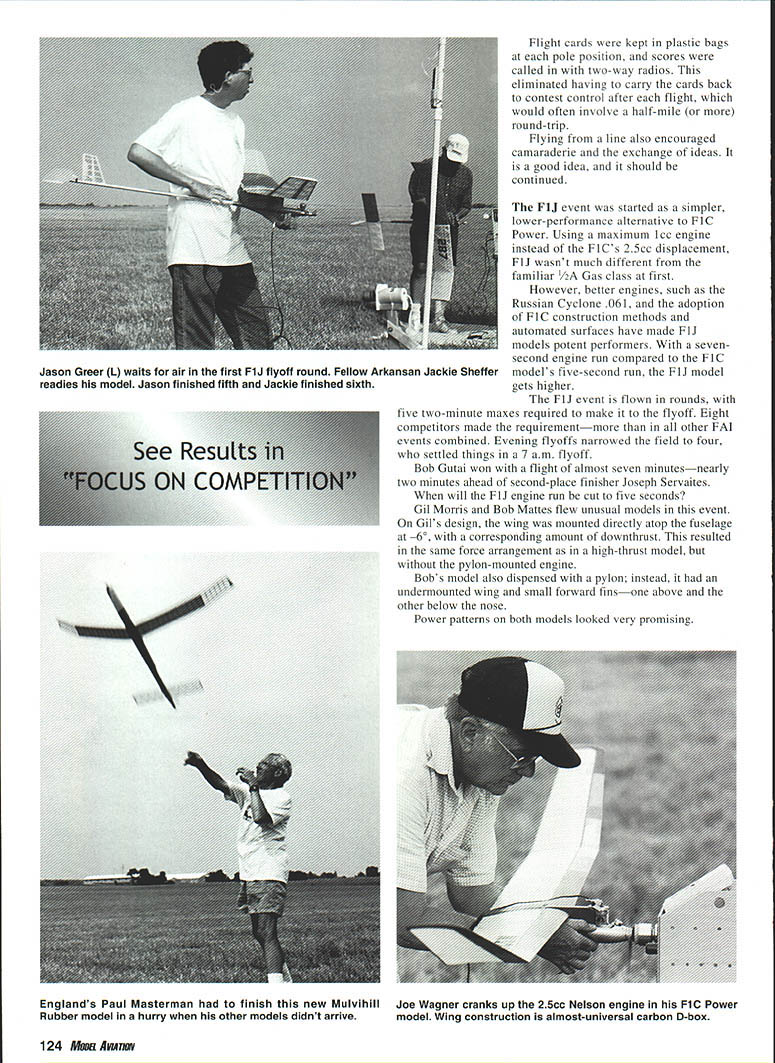
In F1A, the turbulence made air-picking difficult for the towline fliers. Models ranged from the latest carbon-fiber circle-tow models with electronic timers to balsa-and-tissue straight-tow models. I even saw someone flying a copy of Gerry Ritz's 1959 World Championships design! The 31 fliers only scored 40 maxes out of a possible 217 flights. (Discouraged by the conditions, some people didn't put in all their flights.) Only veteran all-arounder Bob Sifleet maxed all seven three-minute rounds.
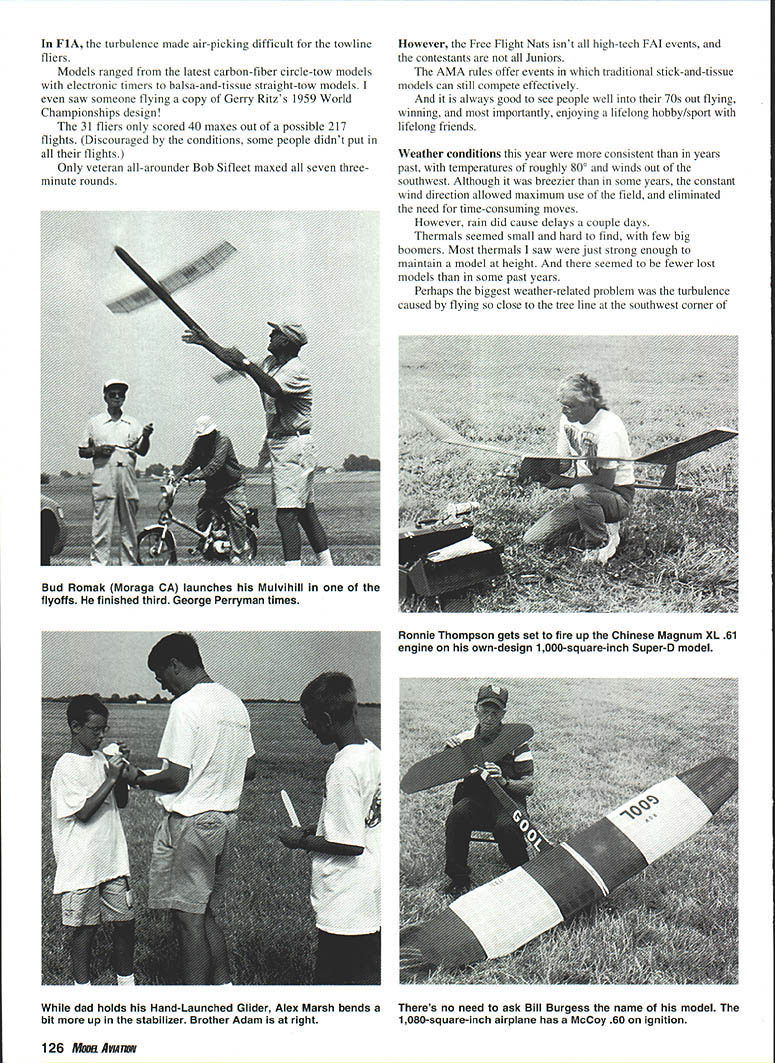
However, the Free Flight Nats isn't all high-tech FAI events, and the contestants are not all Juniors. The AMA rules offer events in which traditional stick-and-tissue models can still compete effectively.
And it is always good to see people well into their 70s out flying, winning, and most importantly, enjoying a lifelong hobby/sport with lifelong friends.
Weather conditions this year were more consistent than in years past, with temperatures of roughly 80° and winds out of the southwest. Although it was breezier than in some years, the constant wind direction allowed maximum use of the field and eliminated the need for time-consuming moves.
However, rain did cause delays a couple of days.
Thermals seemed small and hard to find, with few big boomers. Most thermals I saw were just strong enough to maintain a model at height. And there seemed to be fewer lost models than in some past years.
Perhaps the biggest weather-related problem was the turbulence caused by flying so close to the tree line at the southwest corner of the field. (A tree stand 30 feet high can affect the air as far as 300 yards downwind. The trees at that corner of the Muncie site are considerably taller than 30 feet.)
The turbulence had an effect on models—especially small models—and made it difficult to find thermals. As always, piggybacking off a model in obvious lift worked, if you could get into the same air. On windier days, the preferred method was to wait for a drop in wind velocity, then launch.
Streamers, soap bubbles, and cattail "fluffies" were popular methods of detecting thermals. A number of people used pole-mounted thermistors to detect changes in air temperature. Quite a few fliers used wind meters to detect lulls.
The wind velocity would often go from more than 10 mph to less than 4 mph, and back up again in a few seconds. You had to be ready to launch on the lull.
Contest Director Jim O'Reilly and his crew of volunteers kept things operating smoothly all week. They deserve our wholehearted thanks for giving up a week of flying to make the Nats happen.
MM
Transcribed from original scans by AI. Minor OCR errors may remain.

