
FREE FLIGHT DURATION
Louis Joyner, 183 Civitas St., Mt. Pleasant SC 29464
FREE FLIGHT (FF) is a victim of its own success. More than a century of development has pushed performance to the point where outdoor models can only be flown in remote areas far away from centers of population.
This means that most people, and especially most kids, have never seen an FF model fly.
Indoor is certainly one answer; witness the success of the Science Olympiad. But there is still a need for small, lower-performance models that can be flown on small fields. The rapid growth of Electric Radio Control park flyers proves that there is a demand for small-field models.
For those of us interested in preserving and encouraging FF, the challenge will be to find ways to fly in small fields where people can see the fun and challenge of it.
A variety of FF models can be flown safely in a neighborhood park or at a soccer field. Small sport or scale rubber models, hand-launch gliders, CO2, and electrics can work. Just keep the power low, and be content with short flights.
Flying in calm air is a must, but with close-by fields it is easy to get in a few flights just before dark or at the crack of dawn.
One of my favorite models for this sort of flying was the JASCO Hawk—a small rubber model kitted in the 1950s.
The Hawk featured a built-up box fuselage, a plastic propeller, a two-wheeled landing gear, and an unusual tapered V-dihedral wing that used trailing-edge stock for the leading and trailing edges; there was no spar.
I must have built a half dozen of these models in roughly a 10-year period. We even had a one-design contest for the Hawk.
With hand winds, the Hawk provided a lot of fun flying in schoolyards or even in empty parking lots at night. But crank in too many turns, and the Hawk would fly off with the other birds to nest permanently in a tree.
The need for small, easy-to-fly FF models is with us still. To that has been added the need for immediacy. Many of us don't want to spend hours building; we'd rather be out flying.
Besides, a ready-made model allows someone who has not yet learned modeling skills to enjoy the fun with an accurately constructed model that will fly—not fail.
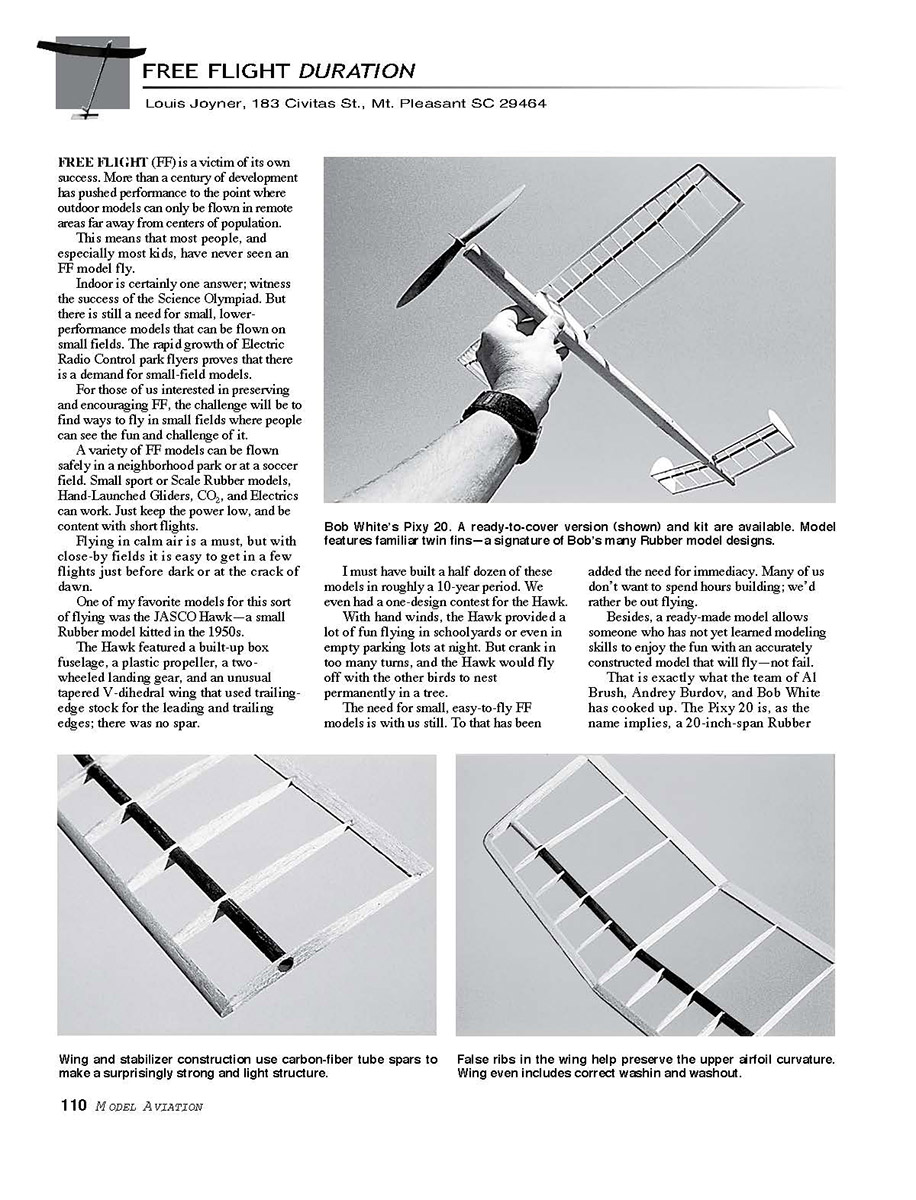
That is exactly what the team of Al Brush, Andrey Burdov, and Bob White has cooked up. The Pixy 20 is, as the name implies, a 20-inch-span rubber model patterned after Bob's Twin Fin series of models.
FF Duration
Throughout the years Bob has flown Coupe, P-30, and Mulvihill derivatives of the basic design, with its twin rudders and dihedraled stabilizer. In 1987 Bob won modeling's premier contest—the Wakefield Cup—flying his Number 22 Twin Fin.
Andrey Burdov is a Russian aeronautical engineer who has represented his country at a number of World and European Championships.
For a number of years Andrey has been producing high-quality Wakefield and Coupe models and component parts for sale throughout the world. His Sweet G Coupe has proved a winner for a number of American fliers.
Al Brush has been an active Wakefield competitor, winning the America's Cup in 1998. He, along with his wife Tina, operate Star Link, which imports the Burdov line of models, and Flite Tech, which produces Al's many innovative pieces of support equipment for rubber flying.
The Pixy 20, as well as the other models in the Bob White Collection, will be marketed through Flite Tech.
The best word to describe the Pixy 20 is "cute." It really does look like a miniature of Bob White's Coupe and P-30. The model comes two ways: Almost Ready to Fly (ARF) for $35 or in kit form for $39. (Postage is extra.)
The ARF version shown comes with almost everything done. All you have to do is cover the wing and stabilizer, glue on the twin fins and the pylon, and go flying.
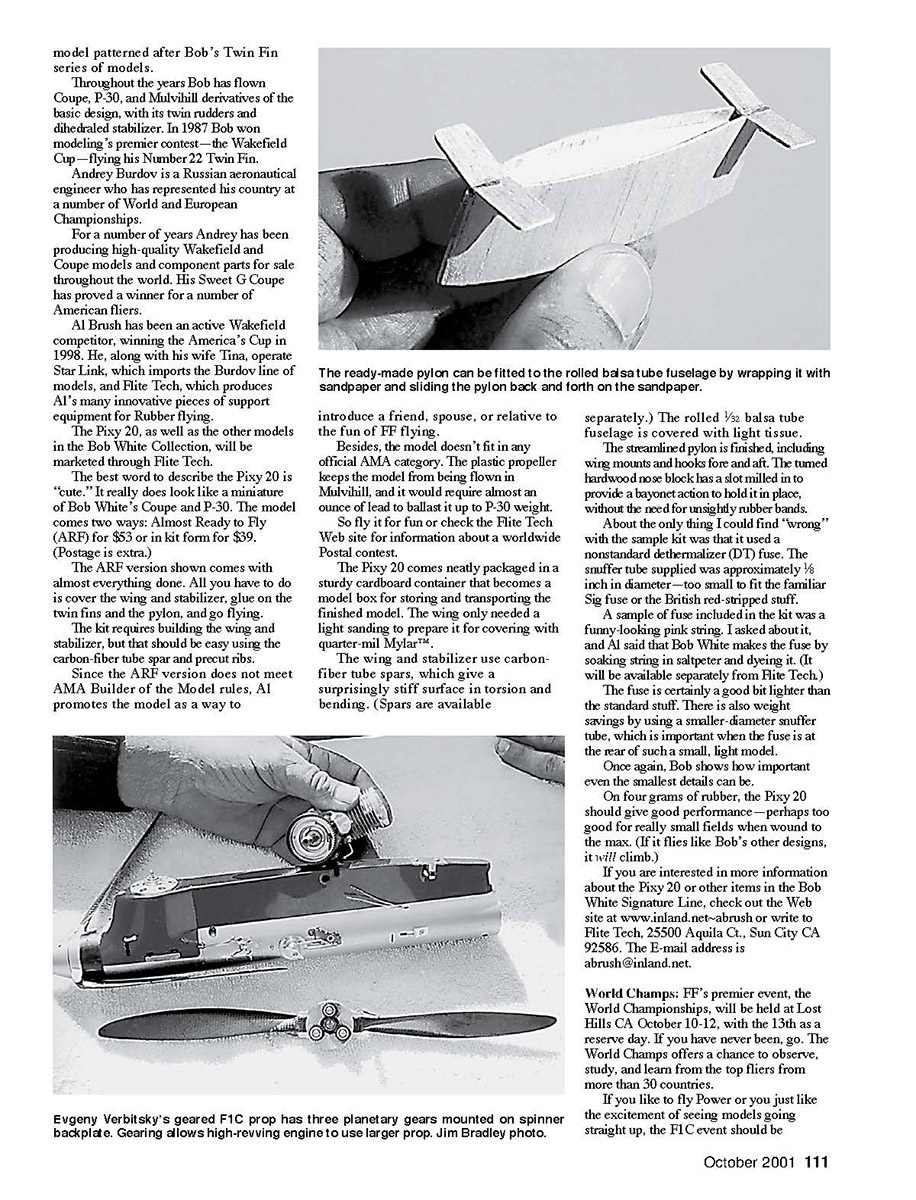
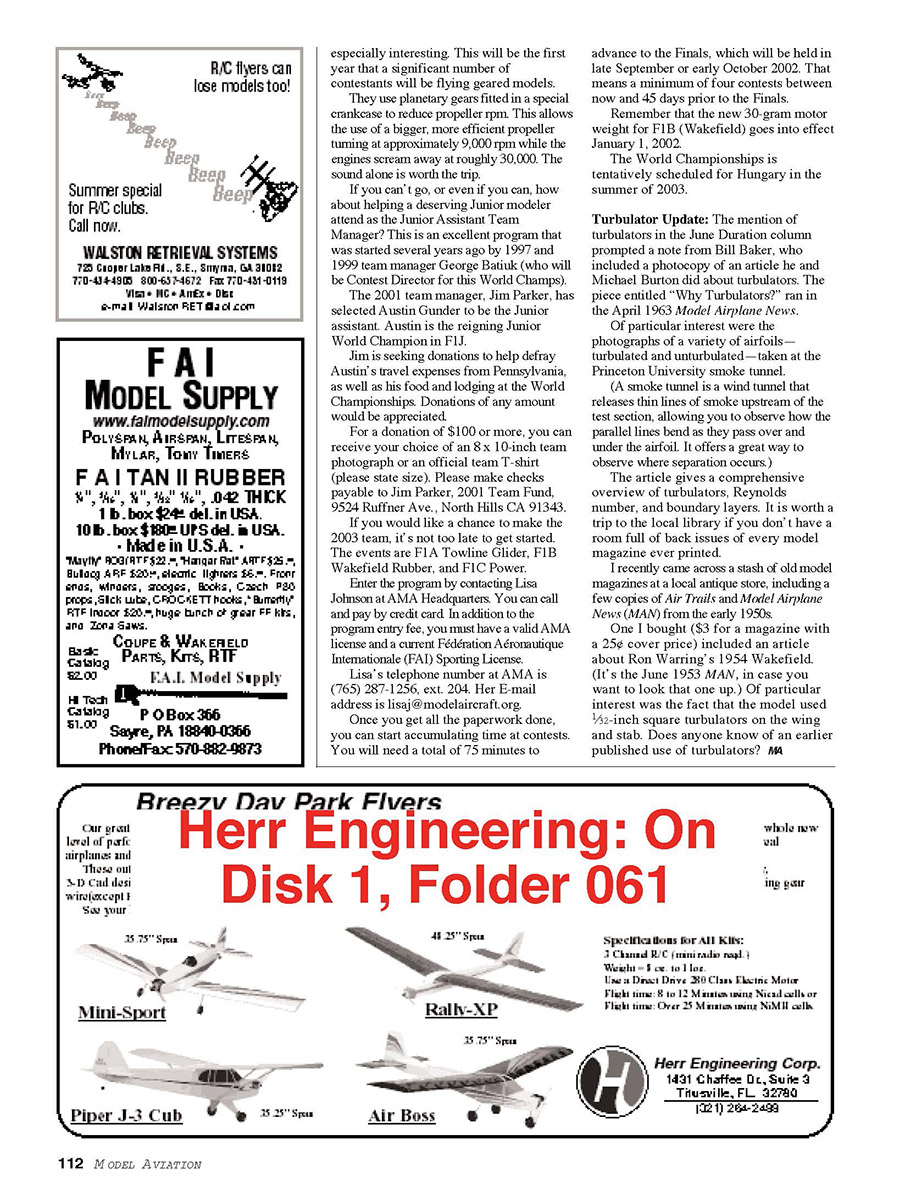
The kit requires building the wing and stabilizer, but that should be easy using the carbon-fiber tube spar and precut ribs.
Since the ARF version does not meet AMA Builder of the Model rules, Al promotes the model as a way to introduce a friend, spouse, or relative to the fun of FF flying.
Besides, the model doesn't fit in any official AMA category. The plastic propeller keeps the model from being Mulvihill, and it would require almost an ounce of lead to ballast it up to P-30 weight.
So fly it for fun or check the Flite Tech Web site for information about a worldwide Postal contest.
The Pixy 20 comes neatly packaged in a sturdy cardboard container that becomes a model box for storing and transporting the finished model. The wing only needed a light sanding to prepare it for covering with quarter-mil Mylar.
The wing and stabilizer use carbon-fiber tube spars, which give a surprisingly stiff surface in torsion and bending. (Spars are available separately.) The rolled 3/32-inch balsa tube fuselage is covered with light tissue.
The streamlined pylon is finished, including wing mounts and hooks fore and aft. The turned hardwood nose block has a slot milled in to provide a bayonet action to hold it in place, without the need for unsightly rubber bands.
About the only thing I could find "wrong" with the sample kit was that it used a nonstandard dethermalizer (DT) fuse. The snuffer tube supplied was approximately 1/8 inch in diameter—too small to fit the familiar Sig fuse or the British red-striped stuff.
A sample of fuse included in the kit was a funny-looking pink string. I asked about it, and Al said that Bob White makes the fuse by soaking string in saltpeter and dyeing it. (It will be available separately from Flite Tech.)
The fuse is certainly a good bit lighter than standard stuff. There is also weight savings by using a smaller-diameter snuffer tube, which is important when the fuse is at the rear of such a small, light model.
Once again, Bob shows how important even the smallest details can be.
On four grams of rubber, the Pixy 20 should give good performance—perhaps too good for really small fields when wound to the max. (If it flies like Bob's other designs, it will climb.)
If you are interested in more information about the Pixy 20 or other items in the Bob White Signature Line, check out the Web site at www.inland.net/~abrush or write to Flite Tech, 25500 Aquila Ct., Sun City CA 92586. The E-mail address is [email protected].
World Champs
FF's premier event, the World Championships, will be held at Lost Hills CA October 10-12, with the 13th as a reserve day. If you have never been, go. The World Champs offers a chance to observe, study, and learn from the top fliers from more than 30 countries.
If you like to fly Power or you just like the excitement of seeing models going straight up, the F1C event should be especially interesting. This will be the first year that a significant number of contestants will be flying geared models.
They use planetary gears fitted in a special crankcase to reduce propeller rpm. This allows the use of a bigger, more efficient propeller turning at approximately 9,000 rpm while the engines scream away at roughly 30,000. The sound alone is worth the trip.
If you can't go, or even if you can, how about helping a deserving junior modeler attend as the Junior Assistant Team Manager? This is an excellent program that was started several years ago by 1997 and 1999 team manager George Batik (who will be Contest Director for this World Champs).
The 2001 team manager, Jim Parker, has selected Austin Gunder to be the Junior assistant. Austin is the reigning Junior World Champion in F1J.
Jim is seeking donations to help defray Austin's travel expenses from Pennsylvania, as well as his food and lodging at the World Championships. Donations of any amount would be appreciated.
For a donation of $100 or more, you can receive your choice of an 8 x 10-inch team photograph or an official team T-shirt (please state size). Please make checks payable to Jim Parker, 2001 Team Fund, 9524 Ruffer Ave., North Hills CA 91343.
If you would like a chance to make the 2003 team, it's not too late to get started. The events are F1A Towline Glider, F1B Wakefield Rubber, and F1C Power.
Enter the program by contacting Lisa Johnson at AMA Headquarters. You can call and pay by credit card. In addition to the program entry fee, you must have a valid AMA license and a current Fédération Aéronautique Internationale (FAI) Sporting License.
Lisa's telephone number at AMA is (765) 287-1256, ext. 204. Her E-mail address is [email protected].
Once you get all the paperwork done, you can start accumulating time at contests. You will need a total of 75 minutes to advance to the Finals, which will be held in late September or early October 2002. That means a minimum of four contests between now and 45 days prior to the Finals.
Remember that the new 30-gram motor weight for F1B (Wakefield) goes into effect January 1, 2002.
The World Championships is tentatively scheduled for Hungary in the summer of 2003.
Turbulator Update
The mention of turbulators in the June Duration column prompted a note from Bill Baker, who included a photocopy of an article he and Michael Burton did about turbulators. The piece entitled "Why Turbulators?" ran in the April 1963 Model Airplane News.
Of particular interest were the photographs of a variety of airfoils—turbulated and unturbulated—taken at the Princeton University smoke tunnel.
(A smoke tunnel is a wind tunnel that releases thin lines of smoke upstream of the test section, allowing you to observe how the parallel lines bend as they pass over and under the airfoil. It offers a great way to observe where separation occurs.)
The article gives a comprehensive overview of turbulators, Reynolds number, and boundary layers. It is worth a trip to the local library if you don't have a room full of back issues of every model magazine ever printed.
I recently came across a stash of old model magazines at a local antique store, including a few copies of Air Trails and Model Airplane News (MAN) from the early 1950s.
One I bought ($3 for a magazine with a 25¢ cover price) included an article about Ron Warring's 1954 Wakefield. (It's the June 1953 MAN, in case you want to look that one up.) Of particular interest was the fact that the model used 1/32-inch square turbulators on the wing and stab. Does anyone know of an earlier published use of turbulators? MA
Transcribed from original scans by AI. Minor OCR errors may remain.

