
FF Duration
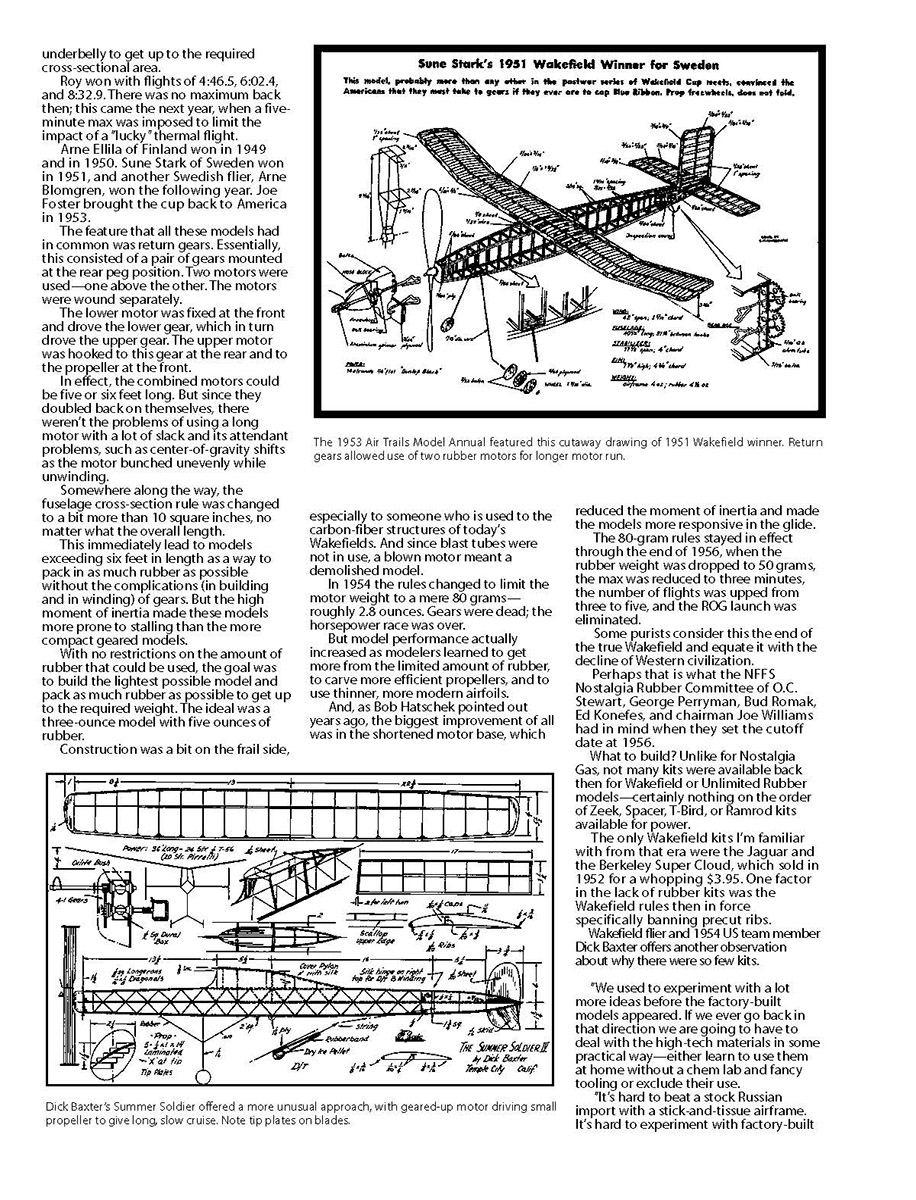
New Nostalgia events will be for late 1940s–early 1950s Rubber-model designs. Model magazines covered events, models.
WHY SHOULD the Power fliers have all the fun? That must have been the thought behind the new Nostalgia Rubber events. As are the popular Nostalgia Gas (NosGas) events, Nostalgia Rubber is sponsored by the National Free Flight Society (NFFS).
And, as in NosGas, Nostalgia Rubber is for models designed and published between January 1, 1943 and December 31, 1956.
Specifically excluded are SAM (Society of Antique Modelers)-legal designs such as the Gollywock and the Korda Wakefield, even though these prewar designs were kitted, built, and flown well into the early 1950s.
There are actually two Nostalgia Rubber events: Nostalgia Wakefield and Nostalgia Rubber, which includes everything else. (If memory serves, there were several AMA stick and cabin events during the late 1940s. Sometime in the early 1950s, they were combined into an Unlimited Rubber event. This has essentially remained unchanged to this day, with only a name change a few years back to Mulvihill.)
But during that same 1943-to-1956 time period, the international Wakefield event underwent a few rules changes. (It is still changing; starting January 1, 2002, the maximum rubber weight will be reduced from 35 grams to 30 grams, with a corresponding five-gram airframe-weight increase to 200 grams.)
Although the Wakefield Cup event was not held during the war years, model specifications continued the eight-ounce model weight, including motor, and 210-square-inch wing-area limits from before the war.
Rubber weight was unrestricted, but a fuselage cross-section rule, based on length, meant that the longer the model, the fatter it had to be.
Consequently, models were fairly compact; a span of approximately 44 inches and a length of roughly three feet was typical. Designs ranged from simple to streamlined. Propellers were freewheeled, folded, or feathered.
And the models had to ROG (rise-off-ground). That made things very interesting, and it is one of the rules wisely carried over for the new Nostalgia Wakefield event.
Roy Chesterton of England won the first postwar Wakefield championship, held on Long Island, New York in 1948, flying the Ted Evans Jaguar design. This model featured a diamond fuselage, an elegantly tapered V-dihedral wing, and a large underbelly to get up to the required cross-sectional area.
They won with flights of 4:46.5, 6:02.4, and 8:32.9. There was no maximum back then; this came the next year, when a five-minute max was imposed to limit the impact of a "lucky" thermal flight.
Arne Ellila of Finland won in 1949 and in 1950. Sune Stark of Sweden won in 1951, and another Swedish flier, Arne Blomgren, won the following year. Joe Foster brought the cup back to America in 1953.
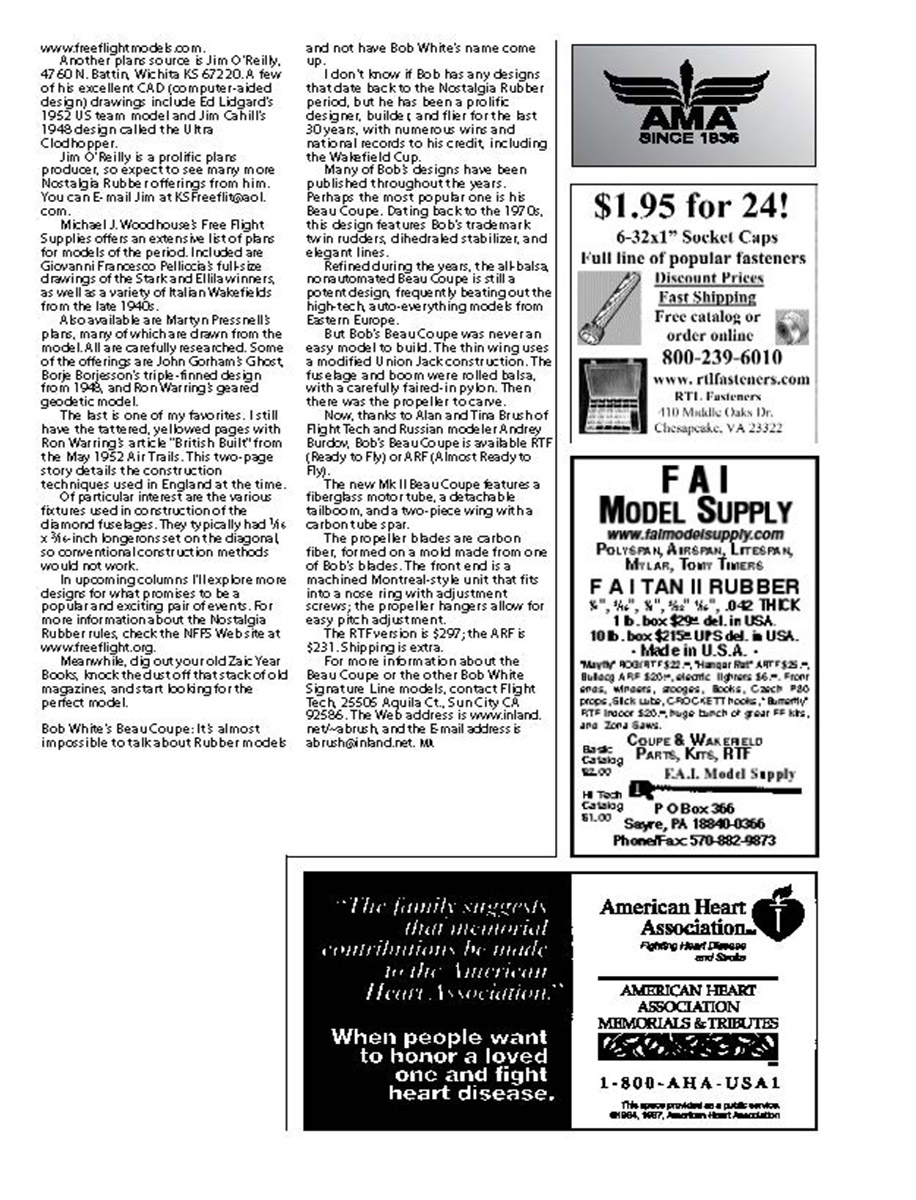
The feature that all these models had in common was return gears. Essentially, this consisted of a pair of gears mounted at the rear peg position. Two motors were used—one above the other. The motors were wound separately.
The lower motor was fixed at the front and drove the lower gear, which in turn drove the upper gear. The upper motor was hooked to this gear at the rear and to the propeller at the front.
In effect, the combined motors could be five or six feet long. But since they doubled back on themselves, there weren't the problems of using a long motor with a lot of slack and its attendant problems, such as center-of-gravity shifts as the motor bunched unevenly while upwinding.
Somewhere along the way, the fuselage cross-section rule was changed to a bit more than 10 square inches, no matter what the overall length.
This immediately lead to models exceeding six feet in length as a way to pack in as much rubber as possible without the complications (in building and in winding) of gears. But the high moment of inertia made these models more prone to stalling than the more compact geared models.
With no restrictions on the amount of rubber that could be used, the goal was to build the lightest possible model and pack as much rubber as possible to get up to the required weight. The ideal was a three-ounce model with five ounces of rubber.
Construction was a bit on the frail side, especially to someone who is used to the carbon-fiber structures of today's Wakefields. And since blast tubes were not in use, a blown motor meant a demolished model.
In 1954 the rules changed to limit the motor weight to a mere 80 grams—roughly 2.8 ounces. Gears were dead; the horsepower race was over.
But model performance actually increased as modelers learned to get more from the limited amount of rubber, to carve more efficient propellers, and to use thinner, more modern airfoils.
And, as Bob Hatschek pointed out years ago, the biggest improvement of all was in the shortened motor base, which reduced the moment of inertia and made the models more responsive in the glide.
The 80-gram rules stayed in effect through the end of 1956, when the rubber weight was dropped to 50 grams, the max was reduced to three minutes, the number of flights was upped from three to five, and the ROG launch was eliminated.
Some purists consider this the end of the true Wakefield and equate it with the decline of Western civilization.
Perhaps that is what the NFFS Nostalgia Rubber Committee of O.C. Stewart, George Perryman, Bud Romak, Ed Konefes, and chairman Joe Williams had in mind when they set the cutoff date at 1956.
What to build? Unlike for Nostalgia Gas, not many kits were available back then for Wakefield or Unlimited Rubber models—certainly nothing on the order of Zeek, Spacer, T-Bird, or Ramrod kits available for power.
The only Wakefield kits I'm familiar with from that era were the Jaguar and the Berkeley Super Cloud, which sold in 1952 for a whopping $3.95. One factor in the lack of rubber kits was the Wakefield rules then in force specifically banning pre-cut ribs.
Wakefield flier and 1954 US team member Dick Baxter offers another observation about why there were so few kits.
"We used to experiment with a lot more ideas before the factory-built models appeared. If we ever go back in that direction we are going to have to deal with the high-tech materials in some practical way—either learn to use them at home without a chem lab and fancy tooling or exclude their use.
"It's hard to beat a stock Russian import with a stick-and-tissue airframe. It's hard to experiment with factory-built airframes. I always found trying weird things the most interesting part of modeling.
Dick's unusual Summer Soldier design with a single motor driving front-mounted 4:1 gears illustrates that there could be a variety of approaches. He says:
"The theory behind it was basically that the Indoor guys are right in thinking that flying under power all the way back to the floor was the way to go. Trimming was easier, you could trade folder weight for more rubber, and you don't waste energy on high-speed flight during the power burst.
"I eventually compromised on a configuration that rolled one or two body lengths to lift off, climbed out at about 30 degrees, but flew only slightly faster than cruise speed even on the power burst. This combination handled the wind pretty well."
In addition to the geared models and the stretched ones, a number of other interesting approaches were tried, including pusher, push-pull, and canards. Former national champ Frank Cummings used a twin-fuselage model that resembled a P-38 minus the pilot's pod.
One photograph shows Frank standing in front of the model, which is set in ROG position, holding the tips of both propellers.
Based on this photograph, the only way I can figure that Frank could launch the model would be to release both blades and jump up so the model could roll out below him.
However he did it, it must have been great to watch.
Unfortunately, experimentation with the new Nostalgia Rubber will be limited. The flying surfaces, airfoils, and propellers must be as shown on the original plans.
The only allowed modifications are those necessary to fit a dethermalizer or to allow the use of a blast tube for winding.
One possible area for experimentation is weight. Even for the Wakefield event, there are no restrictions on rubber weight or model weight.
Instead of building a three-ounce model and packing it with five ounces of rubber, you could cut the rubber weight to three ounces, resulting in an all-up weight of six ounces instead of eight.
The glide should be better and the climb might not suffer that much. Or you could beef up the airframe for longer life, and go for a four-ounce model carrying four ounces of rubber.
Remember too that today's Tan II rubber is significantly better than the T-56, Dunlap, or Pirelli of the 1950s; the best numbers I could find from that era showed a specific energy of 2,700 foot-pounds per pound; typical numbers for today's rubber are in the 4,200 to 4,400 range.
Three ounces of modern rubber could store as much energy as five ounces of the old stuff.
Which way to go? Gears seem like a great deal of trouble. The superlong models would be difficult to transport and hard to retrieve from an Indiana cornfield.
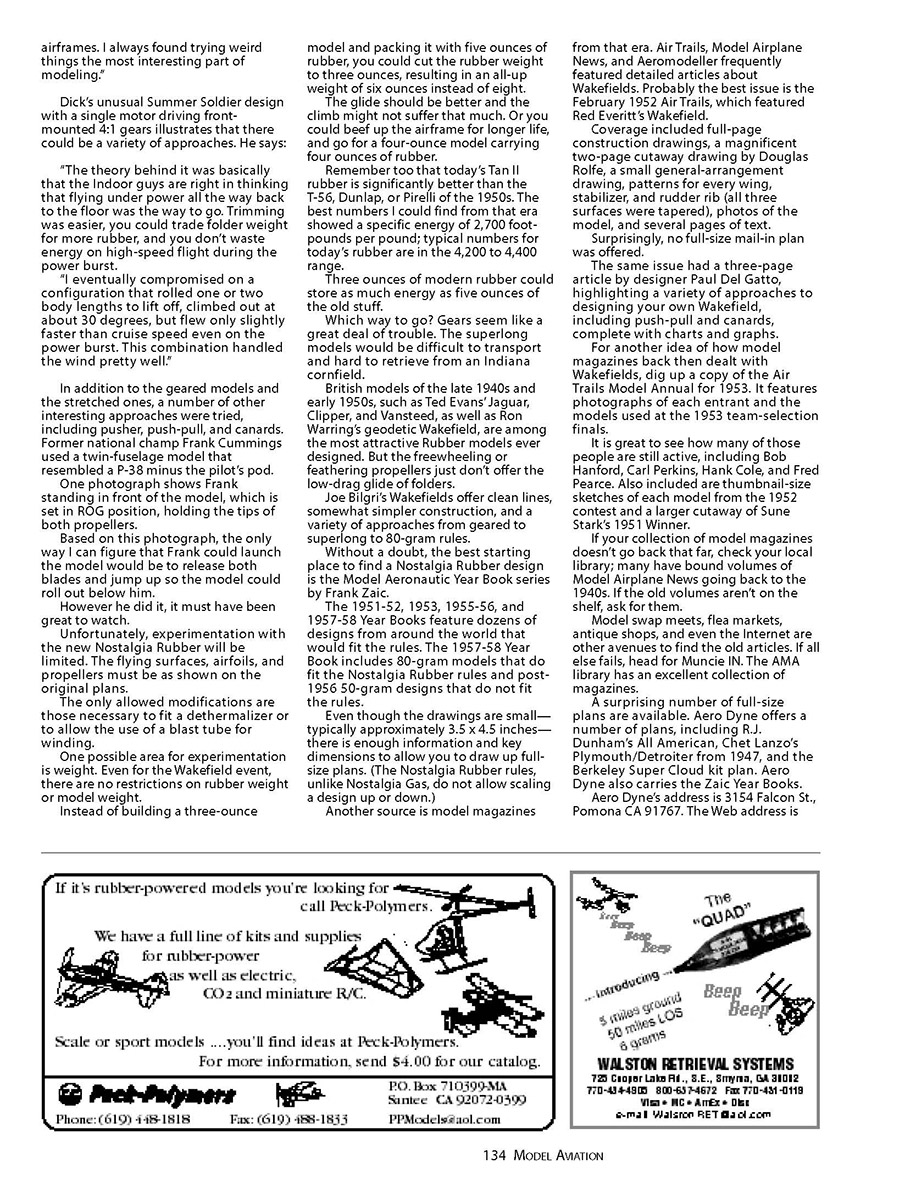
British models of the late 1940s and early 1950s, such as Ted Evans' Jaguar, Clipper, and Vanseted, as well as Ron Warring's geodetic Wakefield, are among the most attractive Rubber models ever designed. But the freewheeling or feathering propellers just don't offer the low-drag glide of folders.
Joe Bilgri's Wakefields offer clean lines, somewhat simpler construction, and a variety of approaches from geared to superlong to 80-gram rules.
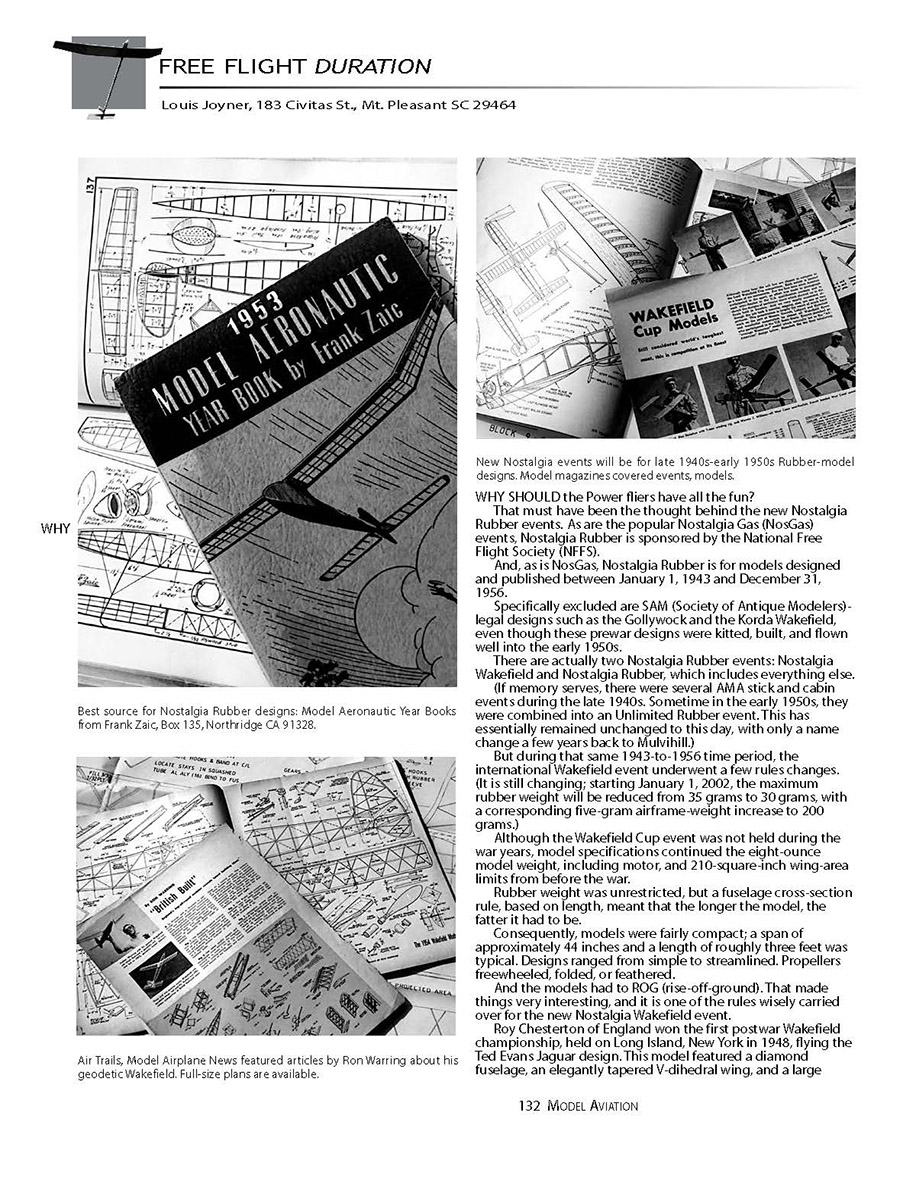
Without a doubt, the best starting place to find a Nostalgia Rubber design is the Model Aeronautic Year Book series by Frank Zaic.
The 1951-52, 1953, 1955-56, and 1957-58 Year Books feature dozens of designs from around the world that would fit the rules. The 1957-58 Year Book includes 80-gram models that do not fit the Nostalgia Rubber rules and post-1956 50-gram designs that do not fit the rules.
Even though the drawings are small—typically approximately 3.5 x 4.5 inches—there is enough information and key dimensions to allow you to draw up full-size plans. (The Nostalgia Rubber rules, unlike Nostalgia Gas, do not allow scaling a design up or down.)
Another source is model magazines from that era. Air Trails, Model Airplane News, and Aeromodeller frequently featured detailed articles about Wakefields. Probably the best issue is the February 1952 Air Trails, which featured Red Everitt's Wakefield.
Coverage included full-page construction drawings, a magnificent two-page cutaway drawing by Douglas Rolfe, a small general-arrangement drawing, plans for every wing, stabilizer, and rudder rib (all three surfaces were tapered), photos of the model, and several pages of text.
Surprisingly, no full-size mail-in plan was offered.
The same issue had a three-page article by designer Del Gatto, highlighting a variety of approaches to designing your own Wakefield, including push-pull and canards, complete with charts and graphs.
For another idea of how model magazines back then dealt with Wakefields, dig up a copy of the Air Trails Model Annual for 1953. It features photographs of each entrant and the models used at the 1953 team-selection finals.
It is great to see how many of those people are still active, including Bob Hanford, Carl Perkins, Hank Cole, and Fred Pearce. Also included are thumbnail-size sketches of each model from the 1952 contest and a larger cutaway of Sune Stark's 1951 Winner.
If your collection of model magazines doesn't go back that far, check your local library; many have bound volumes of Model Airplane News going back to the 1940s. If the old volumes aren't on the shelf, ask for them.
Model swap meets, flea markets, antique shops, and even the Internet are other avenues to find the old articles. If all else fails, head for Muncie IN. The AMA library has an excellent collection of magazines.
A surprising number of full-size plans are available. Aero Dyne offers a number of plans, including R.J. Dunham's All American, Chet Lanzo's Plughole/Detractor from 1947, and the Berkeley Super Cloud kit plan. Aero Dyne also carries the Zaic Year Books.
Aero Dyne's address is 3154 Falcon St., Pomona CA 91767. The Web address is www.freeflightmodels.com.
Another plans source is Jim O'Reilly, 4760 N. Batir, Wichita KS 67220. A few of his excellent CAD (computer-aided design) drawings include Ed Lidgard's 1952 US team model and Jim Cahill's 1948 design called the Ultra Clodhopper.
Jim O'Reilly is a prolific plans producer, so expect to see many more Nostalgia Rubber offerings from him. You can E-mail Jim at [email protected].
Michael J. Woodhouse's Free Flight Supplies offers an extensive list of plans for models of the period. Included are Giovanni Francesco Pelliccia's full-size drawings of the Stark and Ellilia winners, as well as a variety of Italian Wakefields from the late 1940s.
Also available are Martyn Presnell's plans, many of which are drawn from the model. All are carefully researched. Some of the offerings are John Gorham's Ghost, Bjorn Bogerson's triple-finned design from 1949, and Ron Warring's geared geodetic model.
The last is one of my favorites. I still have the tattered, yellowed pages with Ron Warring's article "British Built" from the May 1952 Air Trails. This two-page story details the construction techniques used in England at the time.
Of particular interest are the various fixtures used in construction of the diamond fuse/bellies. They typically had 1/8 x 3/8-inch longerons set on the diagonal so conventional construction methods would not work.
In upcoming columns I'll explore more designs for what promises to be a popular and exciting pair of events. For more information about the Nostalgia Rubber rules, check the NFFS Website at www.freeflight.org.
Meanwhile, dig out your old Zaic Year Books, knock the dust off that stack of old magazines, and start looking for the perfect model.
Bob White's Beau Coupe: It's almost impossible to talk about Rubber models and not have Bob White's name come up.
I don't know if Bob has any designs that date back to the Nostalgia Rubber period, but he has been a prolific designer, builder and flier for the last 30 years, with numerous wins and national records to his credit, including the Wakefield Cup.
Many of Bob's designs have been published throughout the years. Perhaps the most popular one is his Beau Coupe. Dating back to the 1970s, this design features Bob's trademark twin rudders, dihedraled stabilizer, and elegant lines.
Refined during the years, the all-balsa, non-automated Beau Coupe is still a potent design, frequently beating out the high-tech, auto-everything models from Eastern Europe.
But Bob's Beau Coupe was never an easy model to build. The thin wing uses a modified Union Jack construction. The fuselage and boom were rolled balsa, with a carefully faired-in ply join. Then there was the propeller to carve.
Now, thanks to Alan and Tins Burford Flight Tech and Russian modeller Andrey Burkov, Bob's Beau Coupe is available RTF (ready to fly) or ARF (almost ready to fly).
The new Mk II Beau Coupe features a fiberglass motor tube, a detachable tailboom, and a two-piece wing with a carbon tube spar.
The propeller blades are carbon fiber, formed on a mold made from one of Bob's blades. The front end is a machined Montreal-style unit that fits into a nose ring with adjustable screws; the propeller hangers allow for easy pitch adjustment.
The RTF version is $297; the ARF is $231. Shipping is extra.
For more information about the Beau Coupe or the other Bob White Signature Line models, contact Flight Tech, 25256 Acquila Ct., Sun City, CA 92586. The Web address is www.inland.net/~abrush and the E-mail address is [email protected]. MB
Transcribed from original scans by AI. Minor OCR errors may remain.

